Ventoduo 100 micrograms/50 micrograms/puff suspension for inhalation in pressurised container
Spain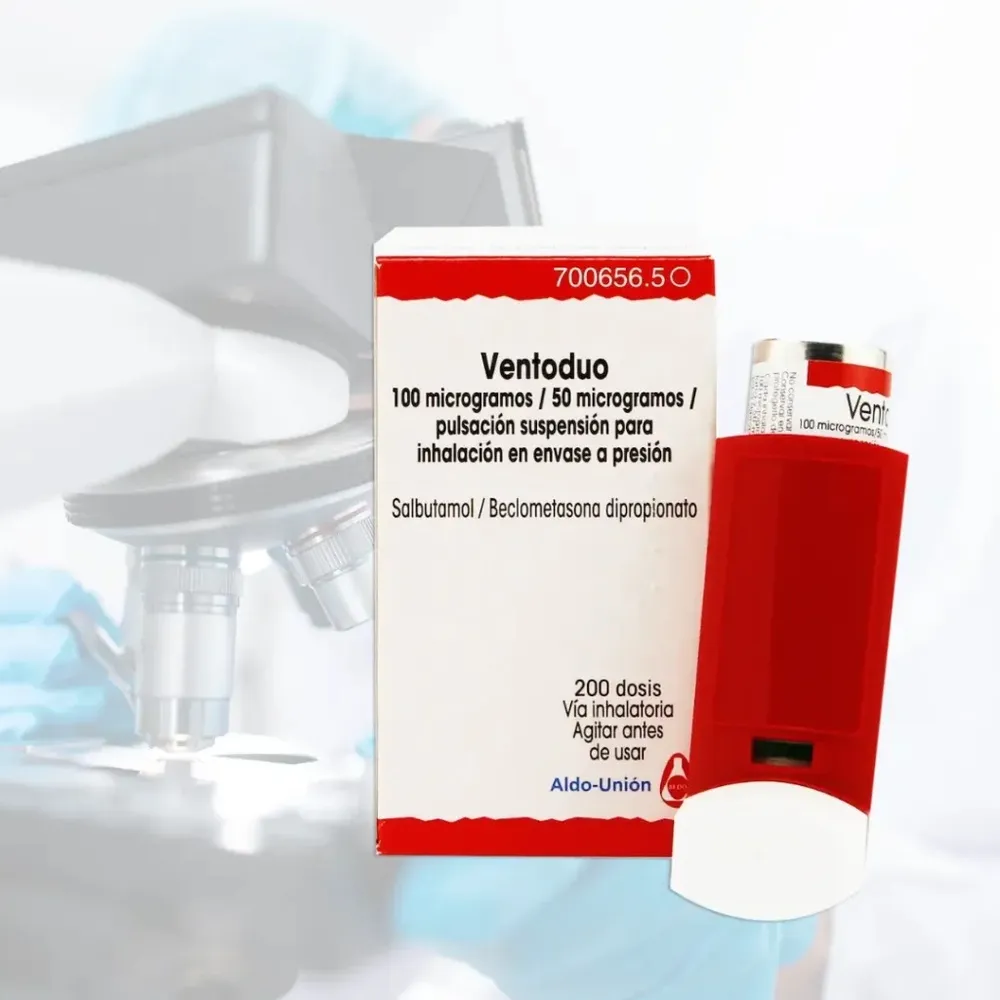
Table of Contents
Package leaflet: Information for the user
Introduction
Package leaflet: information for the user
Ventoduo 100 micrograms/50 micrograms per actuation suspension for inhalation in pressurised container
Salbutamol / Beclometasone dipropionate
Read the entire leaflet carefully before you start using this medicine, because it contains important information for you.
- Keep this leaflet, as you may need to read it again. If you have any questions, ask your doctor or pharmacist.
- This medicine has been prescribed for you only, and you should not give it to other people, even if they have the same symptoms as you, because it could harm them.
- If you experience any adverse effects, consult your doctor or pharmacist, even if they are adverse effects not listed in this leaflet. See section 4.
Contents of the leaflet
- What Ventoduo is and what it is used for
- What you need to know before using Ventoduo
- How to use Ventoduo
- Possible adverse effects
- How to store Ventoduo
- Contents of the pack and other information
1. What Ventoduo is and what it is used for
Ventoduo contains two active substances, salbutamol and beclometasone dipropionate.
Salbutamol is a short-acting bronchodilator. Bronchodilators relax the muscles in the walls of the airways of the lungs, thereby helping to open the air passages so that breathing becomes easier.
Beclometasone dipropionate is a corticosteroid that works by reducing inflammation and irritation in the lungs.
Ventoduo is indicated for the treatment of asthma in patients who require a corticosteroid and a short-acting, fast-acting bronchodilator.
2. What you need to know before using Ventoduo
Do not use Ventoduo:
- if you are allergic to salbutamol, beclometasone dipropionate, or any of the other ingredients of this medicine (listed in section 6).
Warnings and precautions:
Talk to your doctor or pharmacist before starting to use Ventoduo:
-
If you have had mouth ulcers
-
If your asthma worsens or you have increasing difficulty breathing. You may notice more "wheezing" or a choking sensation, or need to use your medication much more frequently than usual. If any of these occur, you should see your doctor as soon as possible.
-
If you have active or latent tuberculosis.
-
If you have serious heart or blood vessel disorders (severe cardiopathy, history of heart disease, irregular heartbeat, angina, or severe untreated hypertension). If you experience chest pain or worsening symptoms of heart disease, consult your doctor immediately.
-
If you have thyrotoxicosis (overactive thyroid gland), hypokalaemia (low blood potassium levels), known aneurysm (arterial dilation), or diabetes mellitus (your doctor may perform additional glucose checks before starting treatment).
-
If you have phaeochromocytoma (a tumour of the adrenal medulla).
-
If you have acute asthma. This medicine may reduce potassium levels, which could be exacerbated by hypoxia (low oxygen levels).
-
The reduction in potassium levels caused by this medicine may also be increased by other drugs used to treat asthma.
-
If you have previously been treated with oral corticosteroids. Your doctor may recommend regular monitoring of adrenal gland function and will advise you on how to gradually reduce the dose of your previous treatment. You may require additional symptomatic treatment.
-
Your doctor will instruct you on how to use the inhaler. You must use this medicine even if you have no symptoms.
-
Always use the dose prescribed by your doctor. Do not increase it, as this could cause adverse effects.
-
Treatment with Ventoduo must not be stopped abruptly, but should be tapered gradually. Your doctor will advise you on how to do this.
Contact your doctor if you experience blurred vision or other visual disturbances.
Children
Regular monitoring of height is recommended in children receiving long-term treatment with inhaled corticosteroids.
Use in athletes
This medicine contains salbutamol, which may result in a positive doping test.
Other medicines and Ventoduo
Inform your doctor if you are taking, have recently taken, or might need to take any other medicines.
Some medicines may increase the effects of Ventoduo, so your doctor will monitor you closely if you are taking these (including certain HIV medications: ritonavir, cobicistat).
Tell your doctor if you are taking the following medicines:
- Heart and vascular medicines that may narrow the airways (non-selective β-blockers such as atenolol, propranolol).
- Other bronchodilator drugs.
- Certain antidepressants, known as monoamine oxidase inhibitors (e.g., moclobemide) and tricyclic antidepressants (e.g., amitriptyline).
- Anaesthetics (agents inducing partial or total loss of sensation), such as halothane.
- Medicines for irregular heartbeat, such as digoxin.
- Xanthine derivatives (used to aid breathing), such as theophylline.
- Diuretics (medicines to increase urine production), such as furosemide.
- Disulfiram or metronidazole.
- Other corticosteroids.
- Medicines for HIV (e.g., ritonavir, cobicistat).
Pregnancy and breastfeeding
If you are pregnant or breastfeeding, think you may be pregnant, or plan to become pregnant, consult your doctor or pharmacist before using this medicine.
Ventoduo will only be administered during pregnancy or breastfeeding if, in the doctor's opinion, the expected benefit to the mother outweighs any possible risk to the fetus.
Driving and using machines
Although effects on the ability to drive and operate machinery are not expected, you should be aware of the possibility of dizziness and tremors.
Ventoduo contains ethanol
This medicine contains approximately 5 mg of alcohol (ethanol) per actuation. The amount per actuation of this medicine is equivalent to less than 1 ml of beer or 1 ml of wine. The small amount of alcohol in this medicine does not produce any noticeable effect.
3. How to use Ventoduo
Follow exactly the administration instructions for this medicine given by your doctor or pharmacist. If in doubt, consult your doctor or pharmacist again.
Ventoduo is administered by inhalation and should be used on an as-needed basis, not regularly.
If your asthma is active (for example, you have symptoms or frequent attacks such as difficulty breathing that interferes with speaking, eating, or sleeping, coughing, wheezing, chest tightness, or limited physical capacity), you must inform your doctor immediately. Your doctor may start or increase your treatment, such as with an inhaled corticosteroid, to control your asthma.
Inform your doctor as soon as possible if your medicine does not seem to be working as well as usual (for example, if you need higher doses to relieve breathing problems or if your inhaler does not provide relief for at least 3 hours), since your asthma may be worsening and you may require a different medication.
If you use Ventoduo more than twice a week to treat your asthma symptoms, excluding preventive use before exercise, this indicates poorly controlled asthma and may increase the risk of severe asthma attacks (asthma worsening) that can lead to serious complications and may be life-threatening or even fatal. You should contact your doctor as soon as possible to review your asthma treatment.
If you are taking daily medication for lung inflammation, e.g., an "inhaled corticosteroid", it is important that you continue using it regularly, even if you feel better.
Recommended and maximum doses are:
Use in adults and adolescents (from 12 years of age)
Recommended dose: 2 inhalations (200 micrograms of salbutamol and 100 micrograms of beclometasone dipropionate), 1 or 2 times daily.
Maximum dose: 2 inhalations (200 micrograms of salbutamol and 100 micrograms of beclometasone dipropionate), 3 or 4 times daily.
Use in children aged 5 to 11 years
Recommended dose: 1 inhalation (100 micrograms of salbutamol and 50 micrograms of beclometasone dipropionate), 1 or 2 times daily.
Maximum dose: 2 inhalations (200 micrograms of salbutamol and 100 micrograms of beclometasone dipropionate), 2 times daily.
Do not increase the dose or frequency of administration on your own, as adverse effects may occur when excessively high doses are administered.
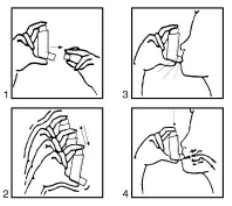
Instructions for use:
-
Remove the cap (fig. 1). If this is a new inhaler or has not been used for several days, shake the inhaler (fig. 2) and release one puff to ensure proper functioning of the inhaler. If the inhaler is used regularly, proceed to the following instructions:
-
Shake the inhaler (fig. 2).
-
Empty your lungs of air as much as possible.
-
Place the inhaler in your mouth in the position shown in the drawing (fig. 3).
-
Breathe in as deeply as possible.
You must press down on the inhaler as shown by the arrows in the drawing (fig. 4) while inhaling.
-
Remove the inhaler from your mouth and try to hold your breath for a few seconds.
-
You must clean the mouthpiece of the inhaler regularly. To do this, remove the mouthpiece from the inhaler and clean it with a cloth or paper towel.
-
Store with the cap on to protect it from dust and dirt.
-
It is advisable to rinse your mouth with water after each use.
A spacer device may optionally be used to improve dose delivery and facilitate the medicine reaching the lungs.
The inhaler has a dose indicator visible through a small hole or window in the mouthpiece, which shows how many doses remain. On a new inhaler, the number "200" can be seen through the window. This number corresponds to the number of doses remaining in the inhaler. As the inhaler is used, the dose indicator rotates downward every 5–7 actuations until it reaches 0.
When approximately 40 doses remain, the indicator changes from green to red (see figure 5) to remind the patient to consult their doctor about continuing treatment or obtaining a new prescription. Discard the inhaler once the indicator reaches "0".

(figure 5)
If you use more Ventoduo than you should
It is important that you take your dose exactly as prescribed by your doctor. Do not increase or decrease your dose without medical supervision.
If you use more Ventoduo than recommended, neuromuscular disturbances may occur, ranging from muscle weakness to paralysis and respiratory failure. Changes in your electrocardiogram (ECG) may also occur, as well as an increased risk of toxicity from other medications you may be taking (e.g., digoxin).
In case of overdose, contact your doctor or pharmacist immediately or call the Toxicology Information Service at telephone 91 562 04 20, indicating the medicine and the amount used.
If you forget to take Ventoduo
Do not take a double dose to make up for missed doses. Take the next dose as scheduled.
4. Possible adverse effects
Like all medicines, Ventoduo may produce adverse effects, although not everyone experiences them. The adverse effects associated with Ventoduo, listed below, are classified by frequency.
Very common (may affect more than 1 in 10 people)
- Oral and/or throat candidiasis (thrush)
Common (may affect up to 1 in 10 people)
- Tremor, usually in the hands, related to the dose
- Headache
- Dizziness
- Hoarseness and/or throat irritation
- Tachycardia (fast heart rate)
Uncommon (may affect up to 1 in 100 people)
- Palpitations (fast or irregular heartbeat)
- Transient muscle cramps
- Skin rash, urticaria, pruritus, and/or erythema, hypotension
Rare (may affect up to 1 in 1,000 people)
- Hypokalemia (low potassium levels in blood)
β2 agonist therapy may lead to potentially serious hypokalemia, and this effect may be increased by concomitant administration of salbutamol and a corticosteroid.
- Eosinophilic pneumonia (lung disorder)
Very rare (may affect up to 1 in 10,000 people)
- Allergic reactions, manifesting as swelling of the eyelids, face, lips, and/or throat (angioedema)
- Respiratory disturbances such as dyspnea (feeling of breathlessness or difficulty breathing) and/or bronchospasm (narrowing of the bronchial walls with reduced airflow)
- Anaphylactic or anaphylactoid reactions (severe allergic reactions that may impair breathing or alter consciousness)
- Ventoduo may increase the normal production of steroid hormones, particularly if high doses have been taken for long periods. Effects include:
- Growth retardation in children and adolescents
- Decreased bone mineral density (weakening of bones)
- Cataracts and glaucoma (increased eye pressure)
- Cushing's syndrome (rounded face)
- Anxiety, sleep disorders, and mood changes, including hyperactivity and irritability (mainly in children)
- Cardiac arrhythmias including atrial fibrillation, supraventricular tachycardia, and extrasystoles (heart rhythm disorders)
Frequency not known
- Depression or aggression. These effects are more likely to occur in children.
- Myocardial ischemia (inadequate blood supply to the heart)
- Blurred vision
In patients who experience hoarseness or throat irritation, rinsing the mouth with water immediately after inhalation may be helpful.
As with other inhaled therapies, the possibility of paradoxical bronchospasm should be considered. Treatment with Ventoduo should be discontinued immediately, the patient evaluated, and if necessary, alternative therapy initiated. This should be treated immediately with a fast-acting bronchodilator administered by inhalation.
Reporting of adverse effects
If you experience any adverse effect, consult your doctor or pharmacist, even if it is a possible adverse effect not listed in this leaflet. You may also report them directly via the Spanish Pharmacovigilance System for Human Medicinal Products. Website: www.notificaRAM.es. By reporting adverse effects, you can help provide more information on the safety of this medicine.
5. Storage of Ventoduo
Keep this medicine out of the sight and reach of children.
Do not store above 30 °C. Store in the original packaging to protect from light. Do not freeze.
The container is under pressure. It must not be pierced, broken, or burned, even if it appears to be empty.
If the inhaler is cold, remove the cartridge and warm it in the hand for a few minutes before use. Do not use any other method to heat it.
Do not use this medicine after the expiry date stated on the packaging after Exp: The expiry date is the last day of the month indicated.
Medicines must not be disposed of via wastewater or household waste. Dispose of unused containers and medicines at a pharmacy’s SIGRE collection point. If in doubt, ask your pharmacist how to dispose of containers and medicines you no longer need. This will help protect the environment.
6. Contents of the pack and other information
Composition of Ventoduo
The active substances are: salbutamol (as sulphate) and beclometasone dipropionate.
The other components are: oleic acid, ethanol and norflurane (HFA-134a).
Each puff contains 100 micrograms of salbutamol (as sulphate) and 50 micrograms of beclometasone dipropionate.
This medicinal product contains fluorinated greenhouse gases.
Each inhaler contains 12.44 g of norflurane (HFA-134a), equivalent to 0.0178 tonnes of CO2 (global warming potential GWP = 1,430).
Nature and contents of the container
Ventoduo is supplied in a 10 ml pressurised container (200 puffs) which delivers the medicine as a suspension for inhalation.
Marketing Authorisation Holder and Manufacturer
Laboratorio Aldo-Unión, S.L.
Baronesa de Maldá, 73
08950 Esplugues de Llobregat (Barcelona)
Spain
Date of the most recent revision of this leaflet: February 2026
Other sources of information
Detailed and up-to-date information on this medicinal product is available on the website of the Spanish Agency of Medicines and Health Products (AEMPS):
http://www.aemps.gob.es/