Venosmil 20 mg/g gel
Spain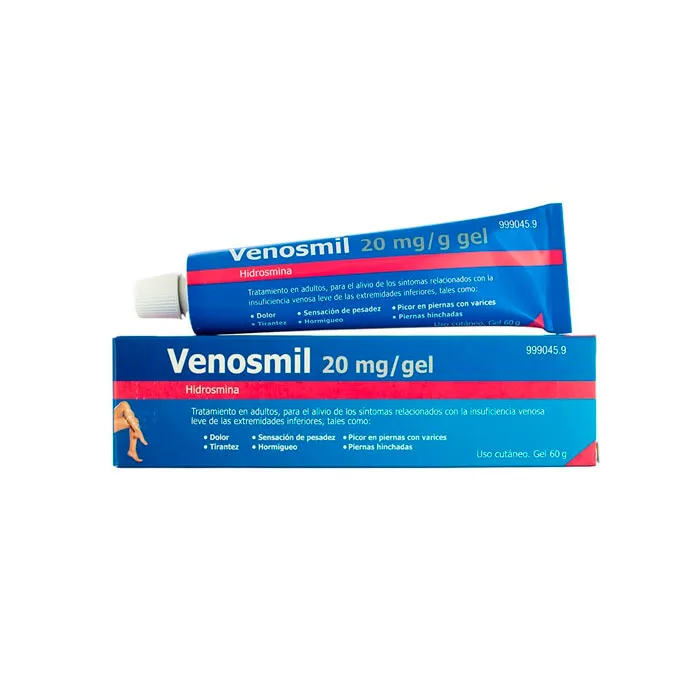
Table of Contents
Patient Information Leaflet
Introduction
Patient Information Leaflet
VENOSMIL 20 mg/g gel
Hydroxyethylrutosides
Read the entire leaflet carefully before you start using this medicine, because it contains important information for you.
Follow exactly the instructions for using this medicine as described in this leaflet or as directed by your doctor or pharmacist.
- Keep this leaflet, as you may need to read it again.
- If you need advice or more information, consult your pharmacist.
- If you experience any adverse effects, consult your doctor or pharmacist, even if they are effects not listed in this leaflet. See section 4.
- You should consult a doctor if your condition worsens or does not improve after 5 to 6 days.
Contents of the leaflet:
- What Venosmil gel is and what it is used for
- What you need to know before using Venosmil gel
- How to use Venosmil gel
- Possible side effects
- How to store Venosmil gel
- Contents of the pack and other information
1. What Venosmil gel is and what it is used for
Venosmil is a venotonic medicine: it increases venous tone and capillary resistance (small blood vessels).
Venosmil is indicated in adults for the relief of symptoms related to mild venous insufficiency of the lower limbs, such as pain, heaviness, tightness, tingling, and itching in legs with varicose veins or swollen legs.
You should consult a doctor if your condition worsens or does not improve after 5 or 6 days.
2. What you need to know before starting to use Venosmil gel
Do not use Venosmil gel
- if you are allergic to hidrosmin or to any of the other ingredients of this medicine (listed in section 6).
- in skin conditions such as dermatitis, eczema, or urticaria.
- on mucous membranes or on irritated or wounded skin areas.
Warnings and precautions
Consult your doctor or pharmacist before starting to use Venosmil gel.
- use only on intact skin.
- avoid contact with eyes, mucous membranes, ears, and mouth.
- do not apply simultaneously on the same area as other topical medications.
- do not use for prolonged periods without medical supervision.
Children and adolescents
- should not be used in children and adolescents unless specifically directed by a doctor.
Using Venosmil gel with other medicines
Inform your doctor or pharmacist if you are using, have recently used, or might need to use any other medicines, including those obtained without a prescription.
No interactions with food or other medicines are known. However, you should never use another medicine on your own initiative without first consulting your doctor.
Do not apply simultaneously on the same area as other topical medications.
Pregnancy and breastfeeding
If you are pregnant or breastfeeding, think you may be pregnant, or are planning to become pregnant, consult your doctor or pharmacist before using this medicine.
There are no clinical data available on Venosmil regarding the use of hidrosmin in pregnant women. As a precautionary measure, the use of Venosmil during pregnancy is not recommended unless, in the opinion of the doctor, the potential benefits outweigh the possible risks.
There are no clinical data available on the use of hidrosmin in breastfeeding women. It is unknown whether hidrosmin is excreted in breast milk; therefore, its use during lactation is not recommended.
Driving and using machines
The effect of Venosmil on the ability to drive and use machines is negligible or none.
Venosmil gel contains methyl parahydroxybenzoate (E-218) and propyl parahydroxybenzoate (E-216).
This medicine may cause allergic reactions (possibly delayed) because it contains methyl parahydroxybenzoate (E-218) and propyl parahydroxybenzoate (E-216) (see section 4. “Possible side effects”).
3. How to use Venosmil gel
Follow exactly the administration instructions for this medicine provided in this leaflet or those indicated by your doctor or pharmacist. If in doubt, consult your doctor or pharmacist.
If symptoms do not improve within 5–6 days, you must stop treatment and see your doctor.
Adults
The recommended dose is: 3–4 centimeters of gel 2 or 3 times a day, if necessary.
Instructions for correct administration of the preparation
For external use only on intact skin.
-
Unscrew the cap from the tube and use the back of the cap to pierce the metal seal sufficiently.
-
Apply approximately 3–4 cm of gel to the affected area, as needed, 2 or 3 times a day, gently massaging to promote absorption of the product.
Hands should be washed after each application to avoid inadvertent contact with eyes and mucous membranes.
If symptoms worsen, do not improve, or irritation develops in the treated area, you should consult your doctor.
Children and adolescents
Venosmil gel should not be used in children and adolescents unless specifically directed by your doctor.
If you use more Venosmil gel than you should
No cases of poisoning have been reported with this medicine, even in cases of accidental overdose.
In case of overdose or accidental ingestion, consult your doctor or pharmacist immediately, go to a medical center, or call the Toxicology Information Service at telephone number 91 562 04 20, indicating the medicine and the amount ingested.
If you forget to use Venosmil gel
Do not apply a double dose to make up for missed doses. Apply it as soon as you remember and then continue with your usual dosing schedule.
If you have any further questions about the use of this medicine, ask your doctor or pharmacist.
4. Possible adverse effects
Like all medicines, this medicine may cause adverse effects, although not everyone will experience them.
During the period of use of Venosmil gel, some adverse effects have been reported, the frequency of which has not been accurately determined:
-
Hypersensitivity (allergic) reactions to hidrosmin or to any of the excipients (see section 2 “What you need to know before starting to use Venosmil gel”).
-
Skin rash and itching at the site of application.
These reactions disappear when treatment is discontinued.
Reporting of adverse effects:
If you experience any type of adverse effect, consult your doctor or pharmacist, even if it is a possible adverse effect not listed in this leaflet. You may also report them directly via the Spanish Pharmacovigilance System for Human Medicinal Products: https://www.notificaRAM.es/. By reporting adverse effects, you can help provide more information on the safety of this medicine.
5. Storage of Venosmil gel
Keep out of sight and reach of children.
Store below 30°C.
Do not use this medicine after the expiry date stated on the packaging after EXP. The expiry date is the last day of the month indicated.
Medicines should not be disposed of via wastewater drains or household waste. Dispose of unused containers and medicines at the SIGRE collection point at your pharmacy. If you have any doubts, ask your pharmacist how to properly dispose of containers and unused medicines. This way, you will help protect the environment.
6. Contents of the pack and other information
Composition of Venosmil gel
- The active substance is hydrosmine. Each gram of gel contains 20 mg of hydrosmine.
- The other components (excipients) are carbomer, triethanolamine, methylparahydroxybenzoate (E218), propylparahydroxybenzoate (E216), and distilled water.
Appearance of the product and contents of the pack
Venosmil gel is presented in a 60 g aluminium tube containing a yellowish transparent gel.
Marketing Authorization Holder
Faes Farma, S.A.
Autonomia Etorbidea, 10
48940 Leioa (Bizkaia)
Spain
Manufacturer and batch release responsible
Faes Farma Portugal, S.A.
Rua Elias Garcia, 28
2700-327 Amadora, Lisbon
Portugal
Date of the most recent review of this leaflet: July 2016
Detailed and up-to-date information on this medicinal product is available on the website of the Spanish Agency for Medicines and Health Products (AEMPS) http://www.aemps.gob.es/