Venofeer 20 mg/ml injection solution or concentrate for infusion solution
Spain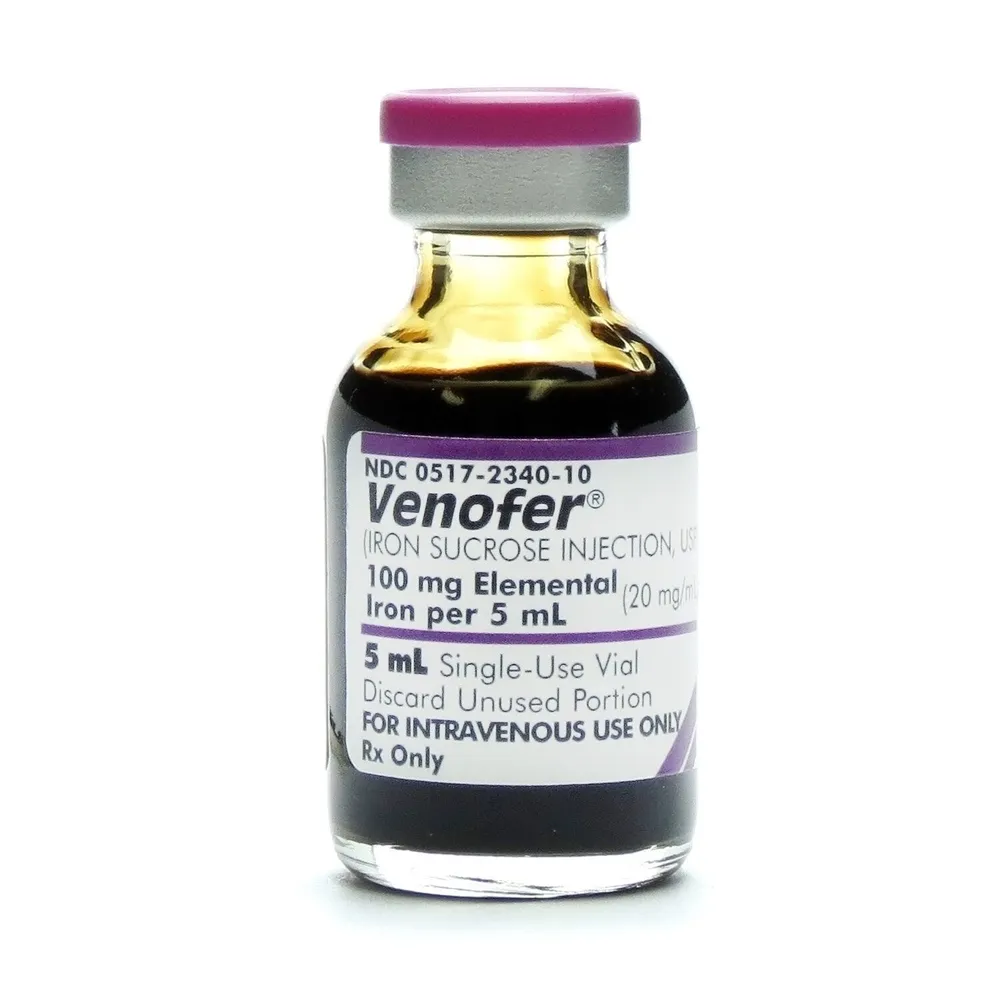
Table of Contents
- Package leaflet: Information for the user
- Introduction
- **Venofer 20 mg/mL**
- 1. What Venofer is and what it is used for
- 2. What you need to know before Venofer is administered to you
- 3. How Venofer is administered
- 4. Possible adverse effects
- 5. Storage of Venofer
- 6. Pack contents and other information
Package leaflet: Information for the user
Introduction
Package leaflet: information for the user
Venofer 20 mg/mL
Injectable solution or concentrate for infusion solution
Iron sucrose
Read the entire package leaflet carefully before this medicine is administered to you, as it contains important information for you.
- Keep this leaflet, as you may need to read it again.
- If you have any questions, consult your doctor.
- If you experience any adverse effects, consult your doctor, even if they are adverse effects not listed in this leaflet. See section 4.
Contents of the package leaflet
- What Venofer is and what it is used for
- What you need to know before Venofer is administered to you
- How Venofer is administered
- Possible adverse effects
- Storage of Venofer
- Contents of the pack and other information
1. What Venofer is and what it is used for
Venofer is a medicine that contains iron (in the form of iron sucrose).
Medicines containing iron are used when there is not enough iron in the body. This condition is called "iron deficiency".
Venofer is used when:
- You cannot take oral iron – for example, if iron tablets do not agree with you.
- You have already taken oral iron and it has not been effective.
2. What you need to know before Venofer is administered to you
Do not receive Venofer:
- If you are allergic (hypersensitive) to the product or to any of the other components of this medicine (listed in section 6).
- If you have experienced severe allergic reactions (hypersensitivity) to other injectable iron preparations.
- If you have anaemia not caused by iron deficiency.
- If you have too much iron in your body or a condition affecting iron metabolism.
You must not be given Venofer if any of the above apply to you. If you have any doubts, consult your doctor before receiving Venofer.
Warnings and precautions
Talk to your doctor or nurse before starting Venofer:
- If you have a history of drug allergies.
- If you have systemic lupus erythematosus.
- If you have rheumatoid arthritis.
- If you have severe asthma, eczema, or other allergies.
- If you have an infection.
- If you have liver problems.
If you are unsure whether any of the above apply to you, consult your doctor or pharmacist before receiving Venofer.
Use of Venofer with other medicines
Inform your doctor or pharmacist if you are taking, have recently taken, or might need to take any other medicines, including those obtained without a prescription and herbal medicines.
This is because Venofer may affect how other medicines work. Likewise, other medicines may affect how Venofer works.
Specifically, inform your doctor or pharmacist if you are taking:
- Iron-containing medicines taken by mouth (oral iron). These may not work properly if taken at the same time as Venofer.
Pregnancy and breastfeeding
Venofer has not been evaluated in women during the first three months of pregnancy. If you are pregnant or breastfeeding, think you may be pregnant, or are planning to become pregnant, consult your doctor before using this medicine.
If you become pregnant during treatment, seek medical advice so your doctor can decide whether or not Venofer should continue to be administered.
If you are breastfeeding, ask your doctor for advice before receiving Venofer.
If you are pregnant or breastfeeding, consult your doctor or pharmacist for advice before using any medicine.
Driving and using machines
You are personally responsible for deciding whether you are fit to drive or perform tasks requiring heightened alertness. After receiving Venofer, you may feel dizzy, confused, or drowsy. If this happens, do not drive or operate machinery or tools. Consult your doctor if you have any doubts.
Venofer contains sodium
Venofer contains up to 7 mg of sodium (the main component of table/cooking salt) per mL. This corresponds to 0.4% of the maximum daily sodium intake recommended for an adult.
3. How Venofer is administered
Your doctor will decide how much Venofer you should be given, how often you need it, and for how long. Your doctor will perform a blood test to determine the dose you require.
Your doctor or nurse will administer Venofer to you in one of the following ways:
- By slow injection into a vein – 1 to 3 times per week.
- By infusion (drip) into a vein – 1 to 3 times per week.
- During dialysis, it will be administered through the venous line of the dialyzer.
Venofer will be administered in a facility where immediate and appropriate treatment of immunological or allergic reactions can be provided.
After each administration, you will remain under observation for at least 30 minutes under the supervision of a doctor or nurse.
Venofer is a brown liquid, so the injection or infusion will appear brown.
Use in children
Venofer is not recommended for use in children.
4. Possible adverse effects
Like all medicines, this medicine may cause adverse effects, although not everyone experiences them.
Allergic reactions (uncommon). If you have an allergic reaction, inform your doctor or nurse immediately. Symptoms may include:
- Hypotension (feeling dizzy, lightheaded, or fainting).
- Swelling of the face.
- Difficulty breathing.
- Chest pain, which may be a sign of a potentially serious allergic reaction called Kounis syndrome.
In some patients, these allergic reactions (rare) may become severe or potentially life-threatening (known as anaphylactoid/anaphylactic reactions).
Inform your doctor or nurse immediately if you think you are experiencing an allergic reaction.
Other adverse effects include:
Frequent (may affect up to 1 in 10 people)
- Taste disturbances, such as a metallic taste. This effect is usually short-lived.
- Hypotension or hypertension.
- Feeling unwell (nausea).
- Reactions around the injection/perfusion site, such as pain, irritation, itching, bruising, or skin discoloration following extravasation of the injection.
Uncommon (may affect up to 1 in 100 people)
- Headache or dizziness.
- Stomach pain or diarrhea.
- Feeling sick (vomiting).
- Wheezing, difficulty breathing.
- Itching, hives.
- Muscle spasms, cramps, or pain.
- Tingling or paresthesia.
- Reduced sensation to touch.
- Inflammation of veins.
- Hot flushes, burning sensation.
- Constipation.
- Joint pain.
- Pain in the limbs.
- Back pain.
- Chills.
- Weakness, fatigue.
- Swelling of hands and feet.
- Pain.
- Increased levels of liver enzymes (GGT, ALT, AST, GGT) in the blood.
- Increased serum ferritin levels.
Rare (may affect up to 1 in 1,000 people)
- Fainting.
- Drowsiness.
- Rapid or pounding heartbeat (palpitations).
- Changes in urine color.
- Chest pain.
- Increased sweating.
- Fever.
- Increased blood lactate dehydrogenase levels.
Other adverse effects with unknown frequency include: reduced level of alertness, confusion; loss of consciousness; anxiety; tremors; swelling of the face, mouth, tongue, or throat that may cause breathing difficulties; low pulse rate; high pulse rate; circulatory collapse; vein inflammation leading to blood clot formation; acute narrowing of the airways; itching, hives, rash, or erythema; cold sweating; general feeling of malaise; pale skin; sudden potentially life-threatening allergic reactions.
Flu-like illness may occur several hours or several days after injection and is typically characterized by symptoms such as high temperature and muscle and joint pain.
Reporting of adverse effects
If you experience any adverse effect, consult your doctor or nurse, even if it is a possible adverse effect not listed in this leaflet. You may also report them directly via the national reporting system included in the Spanish Pharmacovigilance System for Human Medicines: www.notificaRAM.es. By reporting adverse effects, you can help provide more information on the safety of this medicine.
5. Storage of Venofer
Keep this medicine out of the sight and reach of children.
Do not use this medicine after the expiry date stated on the label after EXP. The expiry date is the last day of the month indicated.
Do not store above 25°C. Do not freeze. Store the ampoules or vials in the outer packaging.
Once opened, Venofer ampoules or Venofer vials must be used immediately. After dilution with sodium chloride solution, the diluted solution must be used immediately.
Venofer is usually stored by the doctor or hospital.
Medicines should not be disposed of via wastewater or household waste. Ask your pharmacist how to dispose of medicines and packaging that you no longer need. This will help protect the environment.
6. Pack contents and other information
Composition of Venofer
- The active substance is iron (as iron sucrose). Each millilitre contains 20 mg of iron.
- The other components are water for injections and sodium hydroxide.
Appearance of the product and pack contents
Venofer is a dark brown, non-transparent aqueous solution.
Venofer is available in the following pack sizes:
• 5 glass ampoules of 5 mL. Each 5 mL ampoule contains 100 mg of iron.
• 5 glass vials of 5 mL. Each 5 mL vial contains 100 mg of iron.
Only certain pack sizes may be marketed.
Marketing Authorisation Holder and Manufacturer
Vifor France
100-101 Terrasse Boieldieu
Tour Franklin La Défense 8
92042 Paris La Défense Cedex, France
Tel. +33 (0)1 41 06 58 90
Fax +33 (0)1 41 06 58 99
Local representative:
Vifor Pharma España, S.L.
Av. Diagonal 611, Planta 10
08028 Barcelona
Spain
Date of most recent review of this summary: 12/2021
Further information about this medicine can be requested from the local representative of the Marketing Authorisation Holder.
Detailed information on this medicine is available on the website of the Spanish Agency for Medicines and Health Products (Agencia Española de Medicamentos y Productos Sanitarios - AEMPS) at http://www.aemps.gob.es/
This information is intended for healthcare professionals only:
This information is intended for healthcare professionals only:
Administration
Closely monitor patients for signs and symptoms of hypersensitivity reactions during and after each administration of Venofer.
Venofer must only be administered when trained personnel capable of diagnosing and treating anaphylactic reactions are immediately available, and in a setting where full resuscitation facilities are accessible. Patients should be observed for at least 30 minutes after each administration of Venofer for the occurrence of adverse reactions.
Method of administration:
Venofer must be administered exclusively by intravenous route. Administration may be performed via infusion, slow injection, or directly into the venous line of the dialyzer.
Extravasation must be avoided, as leakage of Venofer outside the intravenous route may cause pain, swelling, and brownish discolouration of the skin at the injection site.
Intravenous infusion by drip:
Venofer must be diluted only in a sterile 0.9 % m/V sodium chloride (NaCl) solution. Dilution must be performed immediately prior to infusion, and the solution should be administered as follows:
Venofer Dose (mg of iron) | Venofer Dose (mL of Venofer) | Maximum volume of the sterile 0.9% m/V NaCl solution dilution | Minimum infusion time |
50 mg | 2.5 mL | 50 mL | 8 minutes |
100 mg | 5 mL | 100 mL | 15 minutes |
200 mg | 10 mL | 200 mL | 30 minutes |
Due to stability reasons, dilutions of Venofer to lower concentrations are not permitted.
Intravenous injection:
Administration of Venofer by slow intravenous injection may be performed at a rate of 1 mL of undiluted solution per minute, without exceeding 10 mL of Venofer (200 mg of iron) per injection.
Injection into the dialyzer venous line:
Venofer may be administered during a hemodialysis session directly into the venous line of the dialyzer, following the same procedures described for intravenous injection.
Incompatibilities
Venofer must not be mixed with other medicinal products, except with sterile 0.9% m/V sodium chloride solution. There is a potential risk of precipitation and/or interaction if mixed with other solutions or medicinal products. Compatibility with containers other than glass, polyethylene, and PVC is unknown.
Shelf life and storage
Do not use this medicinal product after the expiry date stated on the packaging after EXP. Do not store above 25°C. Do not freeze. Keep in the original container.
Shelf life after first opening of the container
From a microbiological standpoint, the product should be used immediately.
Shelf life after dilution with sterile 0.9% m/V sodium chloride (NaCl) solution
From a microbiological standpoint, the medicinal product should be used immediately after dilution.
Instructions for use and handling
Ampoules or vials should be inspected visually for sediment or possible damage before use. Use only solutions that appear homogeneous and free from sediment. The diluted solution should have a brown, transparent appearance.
Disposal of unused medicinal product and of all materials that have been in contact with it should be carried out in accordance with local regulations.