Veklury 100 mg powder for concentrate for solution for infusion
Spain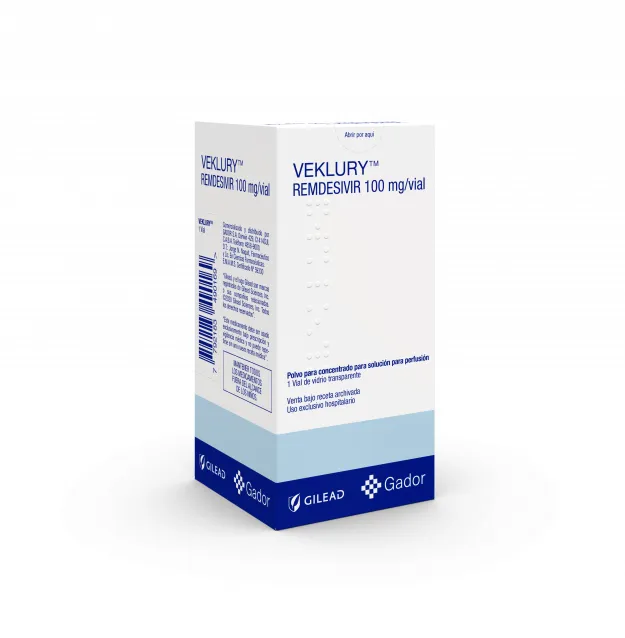
Table of Contents
Package leaflet: Information for the user
Introduction
Package leaflet: information for the patient
Veklury 100 mg powder for concentrate for solution for infusion
remdesivir
This medicinal product is subject to additional monitoring, which will allow for faster detection of new safety information. You can help by reporting any adverse reactions you may experience. Information on how to report adverse reactions is included at the end of section 4.
Read this entire leaflet carefully before this medicine is administered to you, because it contains important information for you.
- Keep this leaflet, as you may need to read it again.
- If you have any questions, ask your doctor or nurse.
- If you experience any adverse reactions, consult your doctor or nurse, even if they are adverse reactions not listed in this leaflet. See section 4.
If Veklury has been prescribed for your child, please note that all information in this leaflet refers to your child (in this case, when you read “you”, please substitute “your child”).
Contents of this leaflet
- What Veklury is and what it is used for
- What you need to know before Veklury is administered to you
- How Veklury is administered
- Possible adverse reactions
- How to store Veklury
- Contents of the pack and other information
1. What Veklury is and what it is used for
The active substance in Veklury is remdesivir. It is an antiviral medicine used to treat COVID-19.
COVID-19 is caused by a virus called coronavirus. Veklury stops the virus from multiplying in the cells, thereby preventing the spread of the virus in the body. This may help your body overcome the viral infection and may help you recover faster.
Veklury will be administered to treat COVID-19 in:
- adults and children at least 4 weeks of age and weighing at least 3 kg who have pneumonia and require additional oxygen to help them breathe, but who are not receiving mechanical ventilation (in which mechanical means are used at the start of treatment to assist or replace spontaneous breathing).
- adults and children (weighing at least 40 kg) who do not require additional oxygen to help them breathe and who are at higher risk of progressing to severe COVID-19.
2. What you need to know before Veklury is administered to you
Veklury will generally not be given to you:
- if you are allergic to remdesivir or to any of the other components of this medicine (listed in section 6).
Consult your doctor or nurse as soon as possible if this applies to you.
Warnings and precautions
Talk to your doctor or nurse before starting treatment with Veklury:
- if you have kidney problems. Your doctor may monitor you for kidney problems to ensure your safety.
- if you are immunocompromised. Your doctor may monitor you more closely if your immune system is not working properly to ensure the treatment is effective.
Reactions after infusion
Veklury may cause allergic reactions during and after infusion, including anaphylactic reactions (sudden, potentially life-threatening allergic reactions). Allergic reactions have been observed rarely. For anaphylactic reactions, the frequency cannot be estimated from the available data. Symptoms may include:
- Changes in blood pressure or heart rate
- Low blood oxygen levels
- High temperature
- Shortness of breath, wheezing
- Swelling of the face, lips, tongue, or throat (angioedema)
- Rash
- Nausea
- Vomiting
- Sweating
- Chills
Tell your doctor or nurse immediately if you notice any of these effects.
Blood tests before and during treatment
If you have been prescribed Veklury, you may have blood tests before starting treatment. Patients receiving Veklury may also have blood tests during treatment, as determined by their healthcare providers. These tests are intended to detect kidney problems.
Children and adolescents
Veklury must not be given to children under 4 weeks of age or to children weighing less than 3 kg. There is insufficient information on the use of Veklury in these children.
Other medicines and Veklury
Tell your doctor or nurse if you are taking or have recently taken any other medicines.
Do not take chloroquine or hydroxychloroquine at the same time as Veklury.
Tell your doctor if you are taking any of the following medicines
Pregnancy and breastfeeding
Tell your doctor or nurse if you are pregnant or think you might be pregnant. There is not enough information to confirm that Veklury is safe for use during the first trimester of pregnancy. Veklury should only be administered if the potential benefits of treatment outweigh the potential risks to the mother and fetus. Discuss with your doctor the need to use effective contraceptive methods during treatment with Veklury.
Tell your doctor or nurse if you are breastfeeding. Veklury passes into breast milk in very small amounts. Because experience with its use during breastfeeding is limited, you should discuss thoroughly with your doctor whether you should continue or interrupt breastfeeding during treatment with Veklury.
Driving and using machines
Veklury is not expected to have any effect on the ability to drive.
Veklury contains a cyclodextrin
This medicine contains 3 g of sodium betadex sulfobutyl ether in each 100 mg dose of Veklury (6 g in the initial dose). This component is a cyclodextrin emulsifier that helps the medicine disperse in the body.
Veklury contains sodium
This medicine contains 212 mg of sodium (main component of table/cooking salt) in each 100 mg dose. This corresponds to 10.6% of the maximum daily recommended sodium intake for an adult.
3. How Veklury is administered
A nurse or doctor will administer Veklury to you through a drip into a vein (intravenous infusion) for 0.5 to 2 hours, once daily. You will be appropriately monitored during treatment.
Recommended dose in adults and children
Adults | Children (weighing at least 40 kg) | Children at least 4 weeks of age (weighing at least 3 kg, but less than 40 kg) | |
Day 1 (single initial dose) | 200 mg | 200 mg | 5 mg per kg of body weight |
From day 2 onwards (once daily) | 100 mg | 100 mg | 2.5 mg per kg of body weight |
Duration of treatment
Adults | Children (weighing at least 40 kg) | Children at least 4 weeks of age (weighing at least 3 kg but less than 40 kg) | |
Patients with pneumonia requiring supplemental oxygen | Once daily for at least 5 days. Treatment may be extended up to a total of 10 days | Once daily for at least 5 days. Treatment may be extended up to a total of 10 days. | Once daily up to a total of 10 days. |
Patients not requiring supplemental oxygen who are at increased risk of progressing to severe COVID-19 | Once daily for 3 days; treatment should be initiated within 7 days of COVID-19 symptom onset. | Once daily for 3 days; treatment should be initiated within 7 days of COVID-19 symptom onset. | Not applicable |
See the Instructions for Healthcare Professionals for details on how the Veklury infusion is administered.
If you are given more or less Veklury than you should
Since Veklury is administered only by a healthcare professional, it is unlikely that you will be given too much or too little. If you have been given an extra dose or missed a dose, inform your nurse or doctor immediately.
If you have any further questions about the use of this medicine, ask your doctor, pharmacist, or nurse.
4. Possible adverse effects
Like all medicines, this medicine can cause adverse effects, although not everyone will experience them.
Some adverse effects may be or become serious:
Rare
(may affect up to 1 in 1,000 patients)
- Allergic reactions during or after infusion. Symptoms may include:
- Changes in blood pressure or heart rate
- Low oxygen levels in the blood
- High temperature
- Shortness of breath, wheezing
- Swelling of the face, lips, tongue, or throat (angioedema)
- Rash
- Nausea
- Vomiting
- Sweating
- Chills
Frequency not known
(frequency cannot be estimated from the available data)
- Anaphylactic reactions, anaphylactic shock (sudden, potentially life-threatening allergic reactions)
Symptoms are the same as those of allergic reactions; however, the reaction is more severe and requires immediate medical attention.
- Sinus bradycardia (the heart beats more slowly than normal)
Immediately inform your doctor or nurse if you notice any of these effects.
Other adverse effects:
Very common adverse effects
(may affect more than 1 in 10 patients)
- Blood tests may show an increase in liver enzymes called transaminases
- Blood tests may show that blood takes longer to clot.
Common adverse effects
(may affect up to 1 in 10 patients)
- Headache
- Nausea
- Rash
Reporting of adverse effects
If you experience any type of adverse effect, consult your doctor or nurse, even if it is a possible adverse effect not listed in this leaflet. You may also report them directly through the national reporting system included in Appendix V. By reporting adverse effects, you can help provide more information on the safety of this medicine.
5. Storage of Veklury
Keep this medicine out of the sight and reach of children.
Do not use this medicine after the expiry date stated on the label and packaging after EXP. The expiry date refers to the last day of the month indicated.
- Before use, this medicine requires no special storage precautions.
- After reconstitution, Veklury must be diluted immediately.
- After dilution, Veklury must be used immediately. If necessary, bags of diluted solution may be stored for up to 24 hours at a temperature below 25 °C or up to 48 hours in a refrigerator. Do not allow more than 48 hours to elapse between dilution and administration.
Medicines must not be disposed of via wastewater or household waste. Ask your pharmacist how to dispose of medicines and containers you no longer need. This helps protect the environment.
6. Contents of the pack and other information
Composition of Veklury
- The active substance is remdesivir. Each vial contains 100 mg.
- The other components are: sulfobutylether beta-cyclodextrin sodium, hydrochloric acid, and sodium hydroxide.
Appearance of the product and contents of the pack
Veklury 100 mg powder for concentrate for solution for infusion is a white, off-white or yellowish powder which must be reconstituted and then diluted in a sodium chloride solution prior to intravenous infusion administration. It is supplied in a single-use clear glass vial.
Veklury is available in cartons containing 1 vial.
Marketing Authorization Holder and Manufacturer
Gilead Sciences Ireland UC
Carrigtohill
County Cork, T45 DP77
Ireland
For further information on this medicinal product, please contact the local representative of the Marketing Authorization Holder:
Belgium/Belgium/Belgium Gilead Sciences Belgium SRL-BV Tel/Tel: + 32 (0) 24 01 35 50 | Lithuania Gilead Sciences Ireland UC Tel: + 353 (0) 1 686 1888 |
Gilead Sciences Ireland UC Tel: + 353 (0) 1 686 1888 | Luxembourg/Luxembourg Gilead Sciences Belgium SRL-BV Tel/Tel: + 32 (0) 24 01 35 50 |
Czech Republic Gilead Sciences s.r.o. Tel: + 420 910 871 986 | Hungary Gilead Sciences Ireland UC Tel.: + 353 (0) 1 686 1888 |
Denmark Gilead Sciences Sweden AB Tlf: + 46 (0) 8 5057 1849 | Malta Gilead Sciences Ireland UC Tel: + 353 (0) 1 686 1888 |
Germany Gilead Sciences GmbH Tel: + 49 (0) 89 899890-0 | Netherlands Gilead Sciences Netherlands B.V. Tel: + 31 (0) 20 718 36 98 |
Estonia Gilead Sciences Ireland UC Tel: + 353 (0) 1 686 1888 | Norway Gilead Sciences Sweden AB Tlf: + 46 (0) 8 5057 1849 |
Greece Gilead Sciences Hellas ME.PE. Tel: + 30 210 8930 100 | Austria Gilead Sciences GesmbH Tel: + 43 1 260 830 |
Spain Gilead Sciences, S.L. Tel: + 34 91 378 98 30 | Poland Gilead Sciences Poland Sp. z o.o. Tel.: + 48 22 262 8702 |
France Gilead Sciences Tél : + 33 (0) 1 46 09 41 00 | Portugal Gilead Sciences, Lda. Tel: + 351 21 7928790 |
Croatia Gilead Sciences Ireland UC Tel: + 353 (0) 1 686 1888 | Romania Gilead Sciences (GSR) S.R.L. Tel: + 40 31 631 18 00 |
Ireland Gilead Sciences Ireland UC Tel: + 353 (0) 214 825 999 | Slovenia Gilead Sciences Ireland UC Tel: + 353 (0) 1 686 1888 |
Iceland Gilead Sciences Sweden AB Sími: + 46 (0) 8 5057 1849 | Slovakia Gilead Sciences Slovakia s.r.o. Tel: + 421 232 121 210 |
Italy Gilead Sciences S.r.l. Tel: + 39 02 439201 | Finland/Finland Gilead Sciences Sweden AB Puh/Tel: + 46 (0) 8 5057 1849 |
Cyprus Gilead Sciences Hellas ME.PE. Tel: + 30 210 8930 100 | Sweden Gilead Sciences Sweden AB Tel: + 46 (0) 8 5057 1849 |
Latvia Gilead Sciences Ireland UC Tel: + 353 (0) 1 686 1888 | United Kingdom (Northern Ireland) Gilead Sciences Ireland UC Tel: + 44 (0) 8000 113 700 |
Date of the most recent review of this leaflet: .
Other sources of information
Scan the code below using a mobile device to access this information in multiple languages.
QR code to be included: www.veklury.eu
Detailed information on this medicine is available on the European Medicines Agency website: http://www.ema.europa.eu.
This leaflet can be found on the European Medicines Agency website in all languages of the European Union/European Economic Area.
The following information is intended for healthcare professionals only.
For further information, please refer to the Summary of Product Characteristics.
Instructions for healthcare professionals
Veklury 100 mg powder for concentrate for solution for infusion
remdesivir
Each single-use vial contains 100 mg of remdesivir as a white, off-white or yellowish powder for reconstitution and dilution.
Treatment summary
Veklury is used for the treatment of COVID-19 in:
- adult and pediatric patients (at least 4 weeks of age and weighing at least 3 kg) with pneumonia requiring supplemental oxygen (high-flow or low-flow oxygen or other non-invasive ventilation at initiation of treatment).
- adult and pediatric patients (weighing at least 40 kg) who do not require supplemental oxygen and who are at higher risk of progressing to severe COVID-19.
Veklury should be administered by intravenous infusion in a total volume of 25 ml, 50 ml, 100 ml or 250 ml of 0.9% sodium chloride, over 30 to 120 minutes.
Table 1: | Recommended dosage in adult and pediatric patients | ||
Adults | Pediatric patients (weighing at least 40 kg) | Pediatric patients at least 4 weeks of age (weighing at least 3 kg, but less than 40 kg) | |
Day 1 (single loading dose) | 200 mg | 200 mg | 5 mg/kg |
From day 2 onwards (once daily) | 100 mg | 100 mg | 2.5 mg/kg |
Table 2: | Duration of treatment | ||
Adults | Pediatric patients (weighing at least 40 kg) | Pediatric patients at least 4 weeks of age (weighing at least 3 kg, but less than 40 kg) | |
Patients with pneumonia requiring supplemental oxygen | Daily for at least 5 days and no more than 10 days. | Daily for at least 5 days and no more than 10 days. | Daily for a total of 10 days. |
Patients who do not require supplemental oxygen and who are at higher risk of progressing to severe COVID-19 | Daily for 3 days; treatment should be initiated as soon as possible after diagnosis of COVID-19 and within 7 days of symptom onset. | Daily for 3 days; treatment should be initiated as soon as possible after diagnosis of COVID-19 and within 7 days of symptom onset. | Not applicable. |
The powder must be reconstituted with sterile water for injectable preparations and then diluted in a sodium chloride solution 9 mg/mL (0.9%) under aseptic conditions. Administer the diluted solution immediately.
As clinically appropriate, renal function should be assessed in patients prior to initiating remdesivir treatment and during treatment.
Monitor patients for adverse reactions during and after infusion. See below for details on reporting adverse reactions.
Reconstitute the powder
For each single-use vial, the powder must be reconstituted and then diluted under aseptic conditions.
-
Add 19 mL of sterile water for injectable preparations to the vial, using a syringe and needle of appropriate size for each vial, inserting the needle into the center of the vial stopper.
-
This produces a solution of 5 mg/mL of remdesivir.
-
Discard the vial if the vacuum does not draw the sterile water into the vial.
-
Use only sterile water for injectable preparations to reconstitute remdesivir powder.
-
Immediately shake the vial for 30 seconds.
-
Allow the contents of the vial to settle for 2 to 3 minutes. A clear solution should form.
-
If the contents of the vial have not completely dissolved, shake the vial again for 30 seconds and allow the contents to settle for 2 to 3 minutes. Repeat this procedure as necessary until the vial contents are completely dissolved.
-
Inspect the vial to ensure the container closure is free from defects.
-
The solution should only be used if it is clear and free from particles.
-
Dilute immediately after reconstitution.
Dilute the concentrate with sodium chloride solution
Reconstituted Veklury must be diluted in 9 mg/mL (0.9%) sodium chloride injectable solution under aseptic conditions.
Dilution instructions for adult and pediatric patients weighing at least 40 kg
Using Table 3, determine the volume of 9 mg/mL (0.9%) sodium chloride solution to withdraw from the infusion bag.
Table 3: | Dilution instructions | ||
Dose | Size of infusion bag to use | Volume of sodium chloride solution to remove and discard from the infusion bag | Volume of reconstituted Veklury |
200 mg (2 vials) | 250 ml | 40 ml | 2 × 20 ml |
100 ml | 40 ml | 2 × 20 ml | |
100 mg (1 vial) | 250 ml | 20 ml | 20 ml |
100 ml | 20 ml | 20 ml |
Note: The 100 ml infusion should only be used in patients with severe fluid restrictions.
- Withdraw and discard the required volume of sodium chloride solution from the infusion bag using a syringe and a needle of suitable size. See Table 3.
- Withdraw the required volume of reconstituted Veklury from the vial using a syringe of suitable size. See Table 3.
- Transfer the reconstituted Veklury into the infusion bag.
- Gently invert the bag 20 times to mix the solution in the bag. Do not shake.
- Administer the diluted solution immediately or as soon as possible after preparation. The diluted solution is stable for 24 hours at room temperature (between 20 °C and 25 °C) or for 48 hours under refrigeration (between 2 °C and 8 °C).
Dilution instructions for pediatric patients at least 4 weeks of age and weighing at least 3 kg but less than 40 kg
- Further dilute the remdesivir concentrate 100 mg/20 ml (5 mg/ml) with 0.9 % sodium chloride to achieve a fixed concentration of 1.25 mg/ml.
- The total required infusion volume of remdesivir 1.25 mg/ml solution for infusion is calculated according to pediatric dosing guidelines based on a 5 mg/kg loading dose and 2.5 mg/kg for each maintenance dose.
- Small sodium chloride 0.9 % infusion bags (e.g., 25, 50, or 100 ml) or a syringe of appropriate size should be used to administer the dose to pediatric patients. The recommended dose is administered by intravenous infusion in a total volume dependent on the dose to achieve the target remdesivir concentration of 1.25 mg/ml.
- A syringe may be used for administration of volumes < 50 ml.
Administration of the infusion
- May be used in cases of severe hypersensitivity reactions, such as anaphylaxis.
- Administer the diluted solution over 30 to 120 minutes at the rate specified in Table 4 or Table 5.
- After completion of the infusion, flush with at least 30 ml of 9 mg/ml (0.9 %) sodium chloride solution.
- The diluted solution must not be administered simultaneously with any other medication through the same intravenous line. Compatibility of Veklury with intravenous solutions and medications other than sodium chloride is unknown.
Table 4: | Infusion rate in adult and pediatric patients weighing 40 kg or more | |
Infusion bag volume | Infusion time | Infusion rate |
250 ml | 30 min | 8.33 ml/min |
60 min | 4.17 ml/min | |
120 min | 2.08 ml/min | |
100 ml | 30 min | 3.33 ml/min |
60 min | 1.67 ml/min | |
120 min | 0.83 ml/min |
Table 5: | Infusion rate in pediatric patients at least 4 weeks of age and weighing at least 3 kg but less than 40 kg | |
Infusion bag volume | Infusion time | Infusion ratea |
100 ml | 30 min | 3.33 ml/min |
60 min | 1.67 ml/min | |
120 min | 0.83 ml/min | |
50 ml | 30 min | 1.67 ml/min |
60 min | 0.83 ml/min | |
120 min | 0.42 ml/min | |
25 ml | 30 min | 0.83 ml/min |
60 min | 0.42 ml/min | |
120 min | 0.21 ml/min |
a The infusion rate can be adjusted according to the total volume to be infused.
Monitoring and reporting of adverse reactions
- Monitor the patient for adverse reactions during and after infusion according to local medical practices.
- Healthcare professionals are encouraged to report suspected adverse reactions via the national reporting system included in Appendix V.
Safely store Veklury
- Before use, this medicinal product requires no special storage precautions. Do not use after the expiry date stated on the vials/boxes following the letters CAD.
- Veklury powder ranges in color from white to off-white or yellowish. Color variation does not affect product stability.
- After reconstitution, Veklury must be diluted immediately.
- After dilution, Veklury must be administered immediately. If necessary, diluted solution in infusion bags may be stored for up to 24 hours at room temperature (between 20 °C and 25 °C) or up to 48 hours refrigerated (between 2 °C and 8 °C). Do not exceed 48 hours between dilution and administration.
Do not reuse or store unused Veklury powder, reconstituted solution, or diluted solution.
Information in other languages
- Scan the code below with a mobile device to access information in different languages.
QR code to be included: www.veklury.eu
Date of latest revision of this leaflet: .