Vedrop 50 mg/ml oral solution
Spain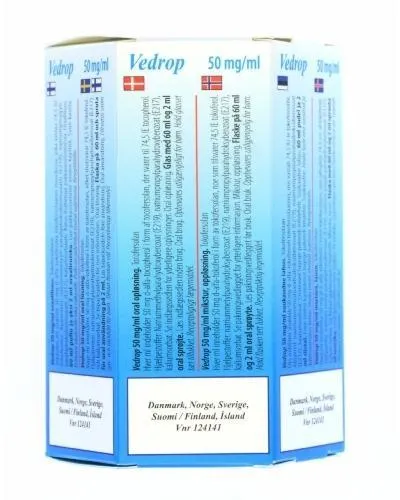
Table of Contents
Package Leaflet: Information for the User
Introduction
Package Leaflet: Information for the User
Vedrop 50 mg/ml oral solution
Tocofersolan
This medicinal product is subject to additional monitoring, which will allow quicker identification of new safety information. You can help by reporting any side effects you may experience. Information on how to report side effects is included at the end of section 4.
Read all of this leaflet carefully before you start taking this medicine, as it contains important information for you.
- Keep this leaflet, as you may need to read it again.
- If you have any questions, ask your doctor or pharmacist.
- This medicine has been prescribed for you only, and you should not give it to other people, even if they have the same symptoms as you, because it may harm them.
- If you experience any side effects, consult your doctor or pharmacist, even if they are side effects not listed in this leaflet. See section 4.
Leaflet Contents:
- What Vedrop is and what it is used for
- What you need to know before taking Vedrop
- How to take Vedrop
- Possible side effects
- How to store Vedrop
- Contents of the pack and other information
1. What Vedrop is and what it is used for
Vedrop contains vitamin E (in the form of tocofersolan). This medicine is used to treat vitamin E deficiency caused by digestive malabsorption (where nutrients from food are not easily absorbed during digestion) in patients from birth (full-term newborns) up to 18 years of age with chronic cholestasis (an inherited or congenital disease in which bile cannot pass from the liver to the intestine).
2. What you need to know before starting Vedrop
Do not take Vedrop
- If you are allergic to vitamin E (d-alpha tocopherol) or to any of the other ingredients of this medicine (listed in section 6).
- Vedrop must not be administered to premature infants.
Warnings and precautions
Talk to your doctor before starting Vedrop if you have:
- Kidney problems or dehydration. Vedrop should be used with caution, and kidney function should be closely monitored, as polyethylene glycol, which is part of the active substance tocophersolan, may damage the kidneys.
- Liver problems. Vedrop should be used with caution, and liver function should be strictly monitored.
Other medicines and Vedrop
Tell your doctor or pharmacist if you are taking, have recently taken, or might need to take any other medicines.
Tell your doctor or pharmacist if you are taking:
- Certain medicines that reduce blood viscosity (oral anticoagulants such as warfarin). Your doctor will ask you to have regular blood tests and may adjust your dose to avoid an increased risk of bleeding.
- Fat-soluble vitamins (such as vitamins A, D, E, or K) or highly fat-soluble medicines (such as corticosteroids, cyclosporine, tacrolimus, antihistamines). Vedrop may increase their absorption during digestion, so your doctor will monitor the treatment effect and adjust the dose when necessary.
Pregnancy and breastfeeding
There are no clinical data available on the use of this medicine during pregnancy. Inform your doctor if you are pregnant so that they can decide whether it is appropriate to use the medicine.
There are no data on whether this medicine is excreted in breast milk. Inform your doctor if you intend to breastfeed your child so that they can decide whether it is appropriate to use the medicine. Your doctor will help you make the best decision for you and your child.
If you are pregnant or breastfeeding, think you may be pregnant, or plan to become pregnant, consult your doctor or pharmacist before using this medicine.
Driving and using machines
It is unlikely that Vedrop will affect your ability to drive or operate machinery.
Vedrop contains sodium methyl-hydroxybenzoate (E219) and sodium ethyl-hydroxybenzoate (E215), which may cause allergic reactions (possibly delayed).
Vedrop contains 0.18 mmol (4.1 mg) of sodium per ml. Consult your doctor if you are on a low-sodium diet.
3. How to take Vedrop
Follow exactly the instructions given by your doctor for taking this medicine. If in doubt, consult your doctor or pharmacist again.
The usual dose is 0.34 ml/kg/day.
Your doctor will prescribe the dose in ml.
Your doctor will adjust your dose of this medicine according to your blood levels of vitamin E.
Method of administration
Swallow the solution with or without water. Use only the oral syringe provided in the package.
You may take Vedrop before or during meals, with or without water.
To measure the dose:
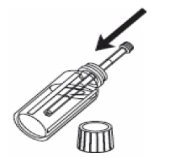
1- Open the bottle. 2- Insert the oral syringe into the bottle. |
|
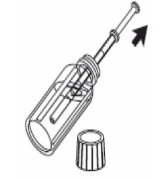
3- Fill the oral syringe with the liquid by pulling the plunger until it reaches the mark corresponding to the amount in milliliters (ml) prescribed by your doctor. |
|
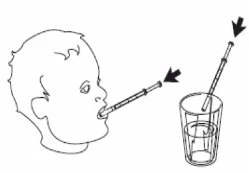
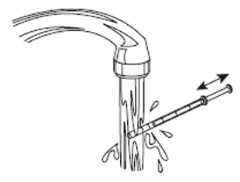
4- Remove the oral syringe from the bottle. 5- Empty the contents of the syringe by pressing the plunger fully down either:
or
|
|
6- Close the bottle. 7- Wash the syringe with water. |
|
If you take more Vedrop than you should
If you take high doses of vitamin E, you may experience transient diarrhoea and stomach pain. Consult your doctor or pharmacist if symptoms persist for more than two days.
If you forget to take Vedrop
Do not take the missed dose; resume your regular scheduled dosing regimen. Do not take a double dose to make up for the missed doses.
If you stop using Vedrop
Do not interrupt treatment without consulting your doctor, as vitamin E deficiency may recur and affect your health. Contact your doctor or pharmacist before stopping treatment.
If you have any further questions about the use of this medicine, ask your doctor or pharmacist.
4. Possible adverse effects
Like all medicines, this medicine can cause adverse effects, although not everyone experiences them.
The following adverse effects have been reported:
Frequent adverse effects (may affect up to 1 in 10 people)
- Diarrhea
Uncommon adverse effects (may affect up to 1 in 100 people)
- Asthenia (feeling of weakness)
- Headache
- Hair loss
- Itching
- Skin rash
- Abnormal blood sodium levels
- Abnormal blood potassium levels
- Increased transaminases (liver enzymes)
Frequency not known (cannot be estimated from available data)
- Stomach pain
Reporting of adverse effects
If you experience any type of adverse effect, consult your doctor or pharmacist, even if it is a possible adverse effect not listed in this leaflet. You may also report them directly through the national reporting system indicated in Annex V. By reporting adverse effects, you can help provide more information on the safety of this medicine.
5. Storage of Vedrop
- Keep this medicine out of the sight and reach of children.
- Do not use this medicine after the expiry date stated on the packaging and on the bottle after EXP. The expiry date refers to the last day of the month indicated.
- This medicine does not require any special storage conditions.
- Discard the medicine one month after opening, even if some solution remains.
Medicines must not be disposed of via wastewater or household waste. Ask your pharmacist how to dispose of medicines and packaging you no longer need. This will help protect the environment.
6. Contents of the pack and other information
Composition of Vedrop
- The active substance is tocofersolan. Each ml of solution contains 50 mg of d-alpha-tocopherol in the form of tocofersolan, equivalent to 74.5 IU of tocopherol.
- The other components are: potassium sorbate, sodium methyl-parahydroxybenzoate (E219) and sodium ethyl-parahydroxybenzoate (E215) (see the end of section 2 for further information on these two excipients), glycerol, disodium phosphate dodecahydrate, concentrated hydrochloric acid, ultrapure water.
Appearance of the product and contents of the container
Vedrop is a slightly viscous, pale yellow oral solution contained in a brown glass bottle sealed with a safety cap. The bottles contain 10 ml, 20 ml or 60 ml of oral solution. Each pack contains one bottle and an oral syringe (a 1 ml syringe with a 10 ml or 20 ml bottle, a 2 ml syringe with a 60 ml bottle).
Marketing Authorization Holder
Recordati Rare Diseases
Tour Hekla
52 avenue du Général de Gaulle
F-92800 Puteaux
France
Manufacturer
Recordati Rare Diseases
Tour Hekla
52 avenue du Général de Gaulle
92800 Puteaux
France
or
Recordati Rare Diseases
Eco River Parc
30, rue des Peupliers
F-92000 Nanterre
France
Further information on this medicinal product can be obtained by contacting the local representative of the Marketing Authorization Holder.
Belgium/Belgium/Belgium Recordati Tel/Tel: +32 2 46101 36 | Lithuania Recordati AB. Tel: + 46 8 545 80 230 Sweden |
| Luxembourg/Luxembourg Recordati Tel/Tel: +32 2 46101 36 Belgium/Belgium |
Czech Republic Recordati Rare Diseases Tel: +33 (0)1 47 73 64 58 France | Hungary Recordati Rare Diseases Tel: +33 (0)1 47 73 64 58 France |
Denmark Recordati AB. Tlf : +46 8 545 80 230 Sweden | Malta Recordati Rare Diseases Tel: +33 1 47 73 64 58 France |
Germany Recordati Rare Diseases Germany GmbH Tel: +49 731 140 554 0 | Netherlands Recordati Tel: +32 2 46101 36 Belgium |
Estonia Recordati AB. Tel: + 46 8 545 80 230 Sweden | Norway Recordati AB. Tlf : +46 8 545 80 230 Sweden |
Greece Recordati Rare Diseases Tel: +33 1 47 73 64 58 France | Austria Recordati Rare Diseases Germany GmbH Tel: +49 731 140 554 0 Germany |
Spain Recordati Rare Diseases Spain S.L.U. Tel: + 34 91 659 28 90 | Poland Recordati Rare Diseases Tel: +33 (0)1 47 73 64 58 France |
France Recordati Rare Diseases Tel: +33 (0)1 47 73 64 58 | Portugal Recordati Rare Diseases SARL Tel: +351 21 432 95 00 |
Croatia Recordati Rare Diseases Tel: +33 (0)1 47 73 64 58 France | Romania Recordati Rare Diseases Tel: +33 (0)1 47 73 64 58 France |
Ireland Recordati Rare Diseases Tel: +33 (0)1 47 73 64 58 France | Slovenia Recordati Rare Diseases Tel: +33 (0)1 47 73 64 58 France |
Iceland Recordati AB. Tel: +46 8 545 80 230 Sweden | Slovakia Recordati Rare Diseases Tel: +33 (0)1 47 73 64 58 France |
Italy Recordati Rare Diseases Italy Srl Tel: +39 02 487 87 173 | Finland Recordati AB. Tel/Tel : +46 8 545 80 230 Sweden |
Cyprus Recordati Rare Diseases Tel : +33 1 47 73 64 58 France | Sweden Recordati AB. Tel : +46 8 545 80 230 |
Latvia Recordati AB. Tel: + 46 8 545 80 230 Sweden |
Date of the most recent review of this leaflet:
This medicinal product has been authorized under "exceptional circumstances". This type of approval means that, due to the rarity of the disease, it has not been possible to obtain complete information about this medicinal product.
The European Medicines Agency will review any new information on this medicinal product that becomes available on an annual basis, and this leaflet will be updated as necessary.
Detailed information on this medicinal product is available on the website of the European Medicines Agency: http://www.ema.europa.eu/.