Vaxelis injectable suspension in pre-filled syringe
Spain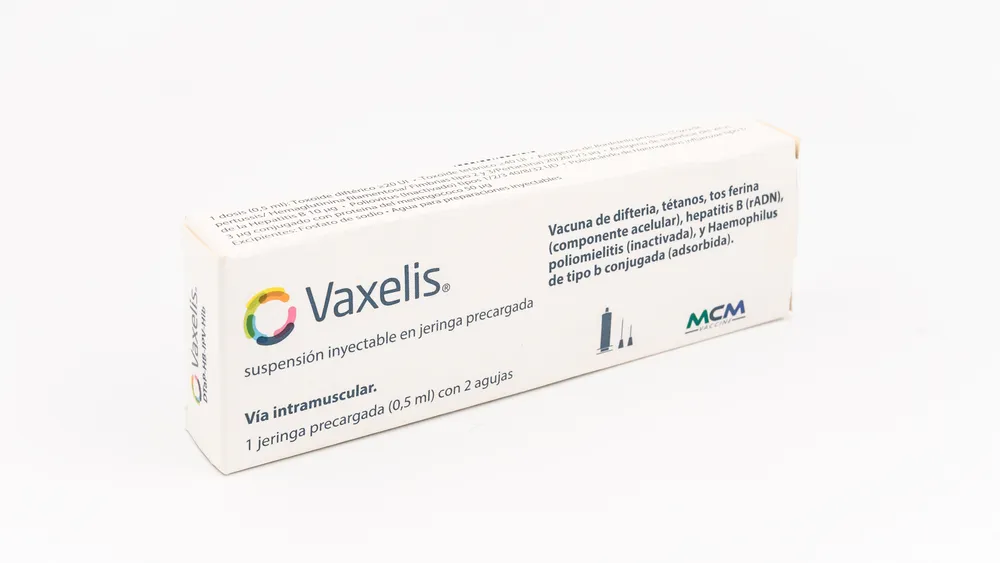
Table of Contents
Package leaflet: Information for the user
Introduction
Package leaflet: information for the user
Vaxelis injectable suspension in a pre-filled syringe
Diphtheria, tetanus, pertussis (acellular component), hepatitis B (rDNA), poliomyelitis (inactivated) and Haemophilus influenzae type b conjugate vaccine (adsorbed)
Read the entire leaflet carefully before your child is vaccinated with this medicine because it contains important information for you.
- Keep this leaflet, as you may need to read it again.
- If you have any questions, consult your doctor, pharmacist or nurse.
- This medicine has been prescribed only for your child and must not be given to others.
- If your child experiences any adverse effects, consult your doctor, pharmacist or nurse, even if they are effects not listed in this leaflet. See section 4.
Leaflet contents
- What Vaxelis is and what it is used for
- What you need to know before your child is given Vaxelis
- How to use Vaxelis
- Possible side effects
- How to store Vaxelis
- Contents of the pack and other information
1. What Vaxelis is and what it is used for
Vaxelis is a vaccine that helps protect your child against diphtheria, tetanus, pertussis (whooping cough), hepatitis B, poliomyelitis (polio), and serious diseases caused by Haemophilus influenzae type b. Vaxelis is given to infants from six weeks of age.
The vaccine works by stimulating the body to produce its own protection (antibodies) against the bacteria and viruses that cause the following diseases:
- Diphtheria: a bacterial infection that usually first affects the throat, causing pain and swelling that can lead to suffocation. The bacteria also produce a toxin (poison) that can damage the heart, kidneys, and nerves.
- Tetanus: caused by the entry of the tetanus bacterium into a deep wound. The bacterium produces a toxin (poison) that causes muscle spasms, leading to breathing difficulties and potential suffocation.
- Pertussis (commonly known as whooping cough): a highly contagious disease affecting the respiratory tract. It causes severe coughing fits that may lead to breathing problems. Coughing fits often end with a characteristic high-pitched "whoop" sound during inhalation. The cough may last one to two months or longer. Pertussis can also cause ear infections, chest infections (bronchitis) that may persist for a long time, lung infections (pneumonia), seizures, brain damage, and even death.
- Hepatitis B: caused by the hepatitis B virus. This causes the liver to swell (inflammation). In some people, the virus may remain in the body for a long time and may eventually lead to serious liver problems, including liver cancer.
- Poliomyelitis (commonly known as polio): caused by viruses that affect the nerves. It can lead to paralysis or muscle weakness, most commonly in the legs. Paralysis of the muscles controlling breathing and swallowing can be fatal.
- Infections caused by Haemophilus influenzae type b (often referred to simply as Hib infections): serious bacterial infections causing meningitis (inflammation of the membranes surrounding the brain), which can result in brain damage, deafness, epilepsy, or partial blindness. The infection may also cause inflammation and swelling of the throat, leading to difficulty swallowing and breathing, and may affect other parts of the body such as the blood, lungs, skin, bones, and joints.
Important information about protection provided
- Vaxelis will only help prevent these diseases if they are caused by the specific bacteria and viruses the vaccine is designed to target. Vaxelis does not protect your child against diseases caused by other bacteria and viruses that may cause similar symptoms.
- The vaccine does not contain any live bacteria or virus and cannot cause any of the infectious diseases it protects against.
- As with any vaccine, Vaxelis may not protect 100% of vaccinated children.
2. What you need to know before your child is given Vaxelis
To ensure that Vaxelis is suitable for your child, it is important that you inform your doctor or nurse if your child has any of the characteristics listed below. If there is anything you do not understand, please consult your doctor, pharmacist, or nurse.
Do not use Vaxelis if your child:
-
has experienced difficulty breathing or swelling of the face (anaphylactic reaction) after receiving a previous dose of Vaxelis.
-
is allergic (hypersensitive)
- to the Vaxelis vaccine or to any other vaccine containing diphtheria, tetanus, pertussis, poliomyelitis, hepatitis B, or Hib,
- to any of the other components listed in section 6,
- to glutaraldehyde, formaldehyde, neomycin, streptomycin, polymyxin B (antibiotics), or bovine serum albumin, as these substances are used during the manufacturing process,
-
has experienced a serious reaction affecting the brain (encephalopathy) within 7 days after receiving a previous dose of a pertussis-containing vaccine (acellular or whole-cell).
-
has an uncontrolled or serious illness affecting the brain and nervous system (uncontrolled neurological disorder) or uncontrolled epilepsy.
Warnings and precautions
Please consult your doctor, pharmacist, or nurse before vaccination if your child:
-
has a moderate to severe acute illness, with or without fever (e.g., sore throat, cough, cold, or flu). Vaccination with Vaxelis may need to be postponed until your child feels better.
-
has previously experienced any of the following adverse events after receiving a pertussis-containing vaccine, the decision to administer further doses of pertussis-containing vaccines should be carefully evaluated:
- fever of 40.5 °C or higher within 48 hours that was not due to another identifiable cause,
- a collapsed state, loss of responsiveness, or decreased consciousness within 48 hours after previous vaccination,
- persistent crying that could not be consoled and lasted for 3 hours or more within 48 hours after vaccination,
- seizures (with or without fever) within 3 days after vaccination.
-
has previously experienced Guillain-Barré syndrome (temporary loss of sensation and movement) after receiving a vaccine containing tetanus toxoid (an inactivated form of tetanus toxin). Your doctor will evaluate whether to administer Vaxelis to your child.
-
is receiving treatment (such as steroids, chemotherapy, or radiotherapy) or has a disease that suppresses or weakens the body's ability to fight infections. Vaccination is recommended to be postponed until the end of such treatment or illness. However, children with long-term immune system problems such as HIV infection (AIDS) may still receive Vaxelis, although the protection may not be as effective as in children with a healthy immune system.
-
has an undiagnosed brain disorder or uncontrolled epilepsy. Your doctor or nurse will evaluate the potential benefit of vaccination once the condition is stabilized.
-
has had seizures with fever, or there is a family history of febrile seizures.
-
has a bleeding disorder, such as prolonged bleeding from minor cuts or easy bruising. Your doctor will advise you on whether Vaxelis should be administered.
-
was born very prematurely (at or before 28 weeks of gestation). In these infants, prolonged periods of apnea (pauses in breathing) may occur for up to 2 to 3 days after vaccination.
Other medicines, vaccines, and Vaxelis
Inform your doctor or nurse if your child is taking, has recently taken, or might need to take any other medicines or vaccines.
Vaxelis may be administered at the same time as other vaccines, such as pneumococcal vaccines, measles-mumps-rubella-varicella (MMRV) vaccines, rotavirus vaccines, or meningococcal B or C vaccines.
Your doctor or nurse will administer these injections at different injection sites and will use separate syringes and needles for each injection.
Driving and using machines
The effect of Vaxelis on the ability to drive and use machines is expected to be none or negligible.
Vaxelis contains sodium
This medicine contains less than 1 mmol of sodium (23 mg) per dose; essentially “sodium-free”.
3. How to use Vaxelis
Vaxelis will be administered to your child by a doctor or nurse properly trained in the use of vaccines and equipped to respond to any rare serious allergic reactions that may occur after the injection (see section 4 “Possible side effects”).
Your doctor or nurse will inject Vaxelis into your child’s thigh (in infants from 6 weeks of age) or into the arm (in children over one year of age).
The recommended dose is as follows:
Primary vaccination cycle
Your child will receive two or three injections given at intervals of at least one month. Your doctor or nurse will inform you when your child should return for the next injection according to the local vaccination schedule.
Booster injection
After the primary vaccination cycle, your child will receive a booster dose, according to local recommendations, at least 6 months after the last dose of the primary cycle. Your doctor will advise you when this dose should be given.
If your child misses a dose of Vaxelis
If your child misses a scheduled injection due to oversight, it is important to inform your doctor or nurse, who will decide when the missed dose should be administered.
It is important to follow your doctor’s or nurse’s instructions so that your child completes the vaccination cycle. Otherwise, your child may not be fully protected against the diseases.
If you have any further questions about the use of this medicine, ask your doctor, pharmacist, or nurse.
4. Possible side effects
Like all medicines, this vaccine may cause side effects, although not everyone experiences them.
Serious allergic reactions
If any of the following symptoms occur after leaving the place where your child received the injection, you must consult a doctor IMMEDIATELY:
- difficulty breathing
- bluish coloration of the tongue or lips
- rash
- swelling of the face or throat
- low blood pressure causing dizziness or collapse
When these signs and symptoms occur, they usually develop rapidly after the injection is given and while the child is still at the clinic or medical office.
Serious allergic reactions are very rare (they may affect up to 1 in 10,000 people) and may occur after receiving a vaccine.
Other side effects
If your child experiences any of the following side effects, consult your doctor, nurse, or pharmacist.
-
Very common side effects (may affect more than 1 in 10 people) are:
- loss of appetite
- irritability
- crying
- vomiting
- drowsiness or sleepiness
- fever (temperature of 38 °C or higher)
- pain, redness, swelling at the injection site
-
Common side effects (may affect up to 1 in 10 people) are:
- diarrhea
- hard mass, lump (nodule) at the injection site
- bruising at the injection site
-
Uncommon side effects (may affect up to 1 in 100 people) are:
- rash
- warmth, rash at the injection site
- increased appetite
- stomach ache
- excessive sweating
- cough
- nasal congestion and runny nose
- paleness
- sleep disorders, including inability to achieve adequate sleep
- restlessness
- swelling of lymph nodes in the neck, armpit, or groin
- feeling of tiredness
- weakness (hypotonia)
-
Rare side effects (may affect up to 1 in 1,000 people) are:
- allergic reaction, severe allergic reaction (anaphylactic reaction)
- extensive swelling of the vaccinated limb
-
Side effects with frequency not known (cannot be estimated from the available data):
- seizures (convulsions) with or without fever
- weakness and loss of sensation, or loss of consciousness and/or paleness or bluish skin
Other side effects not mentioned above have been reported with other vaccines containing diphtheria, tetanus, pertussis, poliomyelitis, hepatitis B, or Hib:
- episodes of shock-like state or pallor, weakness, and loss of sensation
Reporting of side effects
If your child experiences any type of side effect, talk to your doctor, pharmacist, or nurse, even if it is a possible side effect not listed in this leaflet. You may also report them directly through the national reporting system listed in Appendix V. By reporting side effects, you can help provide more information on the safety of this medicine.
5. Storage of Vaxelis
Keep this medicine out of sight and reach of children.
Store in a refrigerator (between 2 °C and 8 °C). Do not freeze. Keep the container in the outer packaging to protect it from light.
Do not use this vaccine after the expiry date stated on the label and carton after EXP. The expiry date is the last day of the month indicated.
Medicines should not be disposed of via wastewater or household waste. Ask your pharmacist how to dispose of medicines and containers you no longer need. This will help protect the environment.
6. Contents of the container and other information
Composition of Vaxelis
The active substances per dose (0.5 ml) are:
Diphtheria toxoid1 | not less than 20 IU6 |
Tetanus toxoid1 | not less than 40 IU6 |
Bordetella pertussis antigens1 | |
Pertussis toxoid (PT) | 20 micrograms |
Filamentous hemagglutinin (FHA) | 20 micrograms |
Pertactin (PRN) | 3 micrograms |
Type 2 and 3 fimbriae (FIM) | 5 micrograms |
Hepatitis B surface antigen2,3 | 10 micrograms |
Poliovirus (inactivated)4 | |
Type 1 (Mahoney) | 29 antigen D units5 |
Type 2 (MEF-1) | 7 antigen D units5 |
Type 3 (Saukett) | 26 antigen D units5 |
Haemophilus influenzae type b polysaccharide | |
(polyribosylribitol phosphate) | 3 micrograms |
Conjugated to meningococcal protein2 | 50 micrograms |
1 adsorbed on aluminium phosphate (0.17 mg Al3+)
2 adsorbed on amorphous aluminium hydroxyphosphate sulfate (0.15 mg Al3+)
3 produced in yeast cells (Saccharomyces cerevisiae) by recombinant DNA technology
4 produced in Vero cells
5 these antigen amounts are strictly identical to those previously expressed as 40-8-32 antigen units D for virus types 1, 2 and 3 respectively, when measured by another suitable immunochemical method
6 or equivalent activity determined by an immunogenicity assessment.
Aluminium phosphate and amorphous aluminium hydroxyphosphate sulfate are included in the vaccine as adjuvants. Adjuvants are included to enhance the immune response to vaccines.
The other components are:
Sodium phosphate and water for injections.
The vaccine may contain traces of glutaraldehyde, formaldehyde, neomycin, streptomycin, polymyxin B and bovine serum albumin.
Appearance of the product and contents of the container
The normal appearance of the vaccine is a uniform, white to off-white, cloudy suspension, which may sediment during storage.
Vaxelis is supplied as an injectable suspension in a pre-filled syringe.
Pack sizes of 1, 10 pre-filled syringes without fixed needle, with 1 separate needle or 2 separate needles.
Multiple pack of 5 containers, each containing 10 pre-filled syringes without fixed needle.
Only some pack sizes may be marketed.
Marketing Authorization Holder and Manufacturer
MCM Vaccine B.V., Robert Boyleweg 4, 2333 CG Leiden, The Netherlands
Further information on this medicinal product can be requested from the local representative of the Marketing Authorization Holder:
Belgium/Belgium/Belgium MSD Belgium Tel/Tel: +32(0)27766211 | Lithuania UAB Merck Sharp & Dohme Tel. + 370 5 2780 247 |
| Luxembourg/Luxembourg MSD Belgium Tél/Tel: +32(0)27766211 |
Czech Republic Merck Sharp & Dohme s.r.o. Tel.: +420 277 050 000 | Hungary MSD Pharma Hungary Kft. Tel.: +36 1 888 5300 |
Denmark MSD Danmark ApS Tlf.: +45 4482 4000 | Malta Merck Sharp & Dohme Cyprus Limited Tel: 8007 4433 (+356 99917558) |
Germany MSD Sharp & Dohme GmbH Tel.: +49 (0) 89 20 300 4500 | Netherlands Merck Sharp & Dohme B.V. Tel: 0800 9999000 (+31 23 5153153) |
Estonia Merck Sharp & Dohme OÜ Tel.: +372 614 4200 | Norway MSD (Norge) AS Tlf: +47 32 20 73 00 |
Greece MSD Α.Φ.Ε.Ε. Tel: +30 210 98 97 300 | Austria Merck Sharp & Dohme Ges.m.b.H. Tel: +43 (0) 1 26 044 |
Spain Merck Sharp & Dohme de España, S.A. Tel: +34 91 321 06 00 | Poland MSD Polska Sp. z o.o. Tel.: +48 22 549 51 00 |
France MSD France Tél: + 33 (0) 1 80 46 40 40 | Portugal Merck Sharp & Dohme, Lda Tel: +351 21 4465700 |
Croatia Merck Sharp & Dohme d.o.o. Tel: + 385 1 66 11 333 | Romania Merck Sharp & Dohme Romania S.R.L. Tel: +40 21 529 29 00 |
Ireland Merck Sharp & Dohme Ireland (Human Health) Limited Tel: +353 (0)1 2998700 | Slovenia Merck Sharp & Dohme, inovativna zdravila d.o.o. Tel: +386 1 520 4201 |
Iceland Vistor ehf. Tel: + 354 535 7000 | Slovakia Merck Sharp & Dohme, s. r. o. Tel: +421 2 58282010 |
Italy MSD Italia S.r.l. Tel: 800 23 99 89 (+39 06 361911) | Finland/Suomi MSD Finland Oy Tel/Puh: +358 (0)9 804 650 |
Cyprus Merck Sharp & Dohme Cyprus Limited Tel.: 800 00 673 (+357 22866700) | Sweden Merck Sharp & Dohme (Sweden) AB Tel: +46 77 5700488 |
Latvia SIA Merck Sharp & Dohme Latvija Tel.: +371 67025300 |
Date of the most recent review of this leaflet: {month YYYY}.
Detailed information on this medicine is available on the European Medicines Agency website: https://www.ema.europa.eu.
This leaflet can be found on the European Medicines Agency website in all languages of the European Union/European Economic Area.
This information is intended for healthcare professionals only:
The prefilled syringe should be gently shaken to obtain a homogeneous, whitish, opaque suspension.
The suspension should be visually inspected before administration for any foreign particles and/or changes in physical appearance. If any such conditions are observed, the prefilled syringe should be discarded.
The needle should be firmly attached to the syringe by turning it a quarter turn.
Vaxelis is for intramuscular injection only.
The recommended injection sites are the anterolateral aspect of the thigh or the upper deltoid muscle region of the arm if adequate muscle mass is present. The anterolateral aspect of the thigh is the recommended site for infants under one year of age.