Vaniqa 11.5% cream
Spain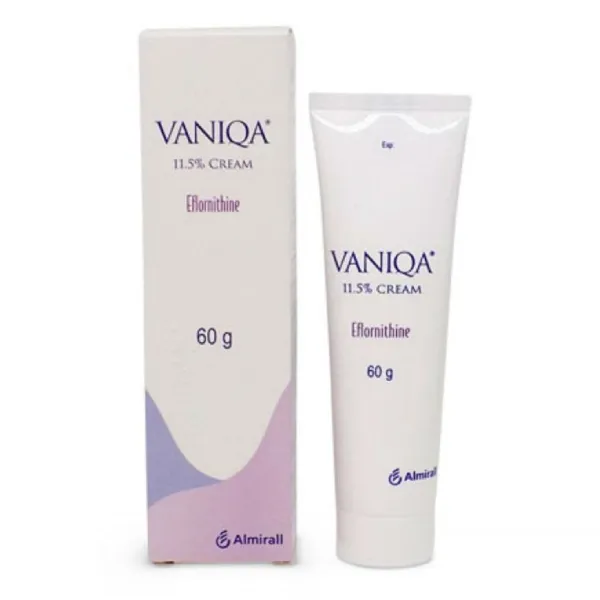
Table of Contents
- Package leaflet: Information for the user
- Introduction
- 1. What Vaniqa is and what it is used for
- 2. What you need to know before using Vaniqa
- 3. How to use Vaniqa
- **Follow exactly the instructions for using this medicine as given by your doctor.**
- 4. Possible adverse effects
- 5. Storage of Vaniqa
- 6. Contents of the package and other information
Package leaflet: Information for the user
Introduction
Package leaflet: information for the user
Vaniqa 11.5% Cream
Eflornithine
Read the entire leaflet carefully before you start using this medicine, because it contains important information for you.
-
Keep this leaflet. You may need to read it again.
-
If you have any questions, ask your doctor or pharmacist.
-
This medicine has been prescribed for you only, and you should not give it to other people, even if they have the same symptoms as you, because it may harm them.
-
If you experience any adverse effects, consult your doctor or pharmacist, even if they are adverse effects not listed in this leaflet. See section 4.
Leaflet contents:
-
What Vaniqa is and what it is used for
-
What you need to know before using Vaniqa
-
How to use Vaniqa
-
Possible side effects
-
How to store Vaniqa
-
Contents of the pack and other information
1. What Vaniqa is and what it is used for
Vaniqa contains the active substance eflornithine. Eflornithine slows down hair growth by acting on a specific enzyme (a protein in the body involved in hair formation).
Vaniqa is used to reduce excessive facial hair growth (hirsutism) in women over 18 years of age.
2. What you need to know before using Vaniqa
Do not use Vaniqa:
- if you are allergic to eflornithine or to any of the other ingredients of this medicine (listed in section 6).
Warnings and precautions
Talk to your doctor or pharmacist before starting to use Vaniqa
-
inform your doctor about any other medical conditions you may have (especially related to your kidneys or liver)
-
if you are unsure whether you can use this medicine, consult your doctor or pharmacist.
Excessive hair growth may be caused by underlying medical conditions. Consult your doctor if you have polycystic ovary syndrome (PCOS) or hormone-producing tumours, or if you are taking medicines that may induce hair growth, e.g. cyclosporine (after organ transplantation), glucocorticoids (e.g. for rheumatic or allergic diseases), minoxidil (for hypertension), phenobarbital (for seizures), phenytoin (for seizures), or hormone replacement therapy with effects similar to male hormones.
Children and adolescents
Vaniqa is not recommended for use in individuals under 18 years of age.
Other medicines and Vaniqa
Inform your doctor or pharmacist if you are using, have recently used, or might need to use any other medicines, including those obtained without a prescription.
Consult your doctor if you need to use other medicines on the areas of skin where you are applying the cream.
Pregnancy and breastfeeding
Do not use this medicine if you are pregnant or breastfeeding. You should use an alternative method to manage your facial hair if you are pregnant or planning to become pregnant.
Driving and using machines
Vaniqa is not expected to have any effect on your ability to drive or operate machinery.
Vaniqa contains cetostearyl alcohol and stearyl alcohol, which may cause local skin reactions (e.g.: contact dermatitis). Vaniqa also contains methyl parahydroxybenzoate (E218) and propyl parahydroxybenzoate (E216), which may cause allergic reactions (possibly delayed).
3. How to use Vaniqa
Follow exactly the instructions for using this medicine as given by your doctor.
If in doubt, consult your doctor or pharmacist again.
-
Use it twice daily, leaving at least 8 hours between applications.
-
If you experience irritation (e.g., stinging), reduce the use of Vaniqa to once a day until the irritation has subsided. If irritation persists, contact your doctor.
-
If you have shaved or used any other hair removal method, wait at least 5 minutes before applying Vaniqa. The cream may sting or burn if applied to broken or irritated skin.
-
Clean and dry the skin areas where you will apply the cream.
-
Apply a thin layer of cream and massage it gently until no visible residue remains on the treated areas.
-
Whenever possible, do not wash these skin areas for at least 4 hours after applying the cream.
-
Wash your hands after applying the cream.
-
Wait at least 5 minutes before applying makeup or sunscreen to the same areas.
-
When using it on the face**, avoid** contact with the eyes, or inside the nose or mouth. If Vaniqa accidentally gets into your eyes, mouth, or nose, rinse them thoroughly with water.
Vaniqa is not a hair removal cream, so you may need to continue using your usual hair removal method, such as shaving or plucking.
It may take up to 8 weeks before results become visible. It is important to continue using the cream regularly. If you do not see any improvement after using it for 4 months, consult your doctor. If you stop using it, your original hair growth may return within 8 weeks.
If you use more Vaniqa than you should
If too much cream is applied to the skin, it is unlikely to cause harm.
If you or someone else accidentally swallows Vaniqa, inform your doctor immediately.
If you forget to use Vaniqa
Apply it as soon as you remember, but wait at least 8 hours before the next application.
If you stop treatment with Vaniqa
To maintain reduced hair growth, continue using Vaniqa continuously as directed.
If you have any further questions about the use of this product, ask your doctor or pharmacist.
4. Possible adverse effects
Like all medicines, this medicine can cause adverse effects, although not everyone will experience them.
Adverse effects are usually limited to the skin and are mild in intensity. In such cases, they normally resolve without discontinuing treatment with Vaniqa.
The frequency of the possible adverse effects listed below is defined using the following convention:
very common (affects more than 1 in 10 users)
common (affects 1 to 10 in 100 users)
uncommon (affects 1 to 10 in 1,000 users)
rare (affects 1 to 10 in 10,000 users)
very rare (affects less than 1 in 10,000 users)
frequency not known (cannot be estimated from available data)
Very common (affects more than 1 in 10 users)
- acne
Common (affects 1 to 10 in 100 users)
- dry skin
- hair loss
- inflammation around the pore
- itching
- skin rash
- redness
- skin irritation and bumps caused by shaving
- skin irritation
- sensation of burning, itching, or tingling of the skin
Uncommon (affects 1 to 10 in 1,000 users)
- rash with bumps (papular exanthema)
- cold sores (herpes labialis)
- redness and irritation at the application site
- eczema
- swollen, numb, cracked, or dry lips
- ingrown hairs
- pale areas of the skin
- skin bleeding
- skin boils
- skin redness
- skin inflammation
- skin sores
- swelling of the mouth or face
- abnormal hair texture or abnormal hair growth
Rare (affects 1 to 10 in 10,000 users)
- abnormal skin growth (skin neoplasia)
- excessive hair growth
- facial redness and pimples, possibly with pus
- other skin disorders
- skin inflammation and redness with scaling and itching (seborrheic dermatitis)
- rash with redness, bumps, or blisters
- skin cysts
- tightness of the skin
Reporting of adverse effects
If you experience any type of adverse effect, consult your doctor, pharmacist, or nurse, even if it is a possible adverse effect not listed in this leaflet. You may also report them directly through the national reporting system detailed in Appendix V. By reporting adverse effects, you can help provide more information on the safety of this medicine.
5. Storage of Vaniqa
Keep this medicine out of the sight and reach of children.
Do not use this medicine after the expiry date stated on the packaging and on the bottom of the tube after EXP. The expiry date refers to the last day of the month indicated.
After opening, discard the tube with any remaining cream after 6 months.
Ensure the cap of the tube is tightly closed after each use.
Do not store above 25 °C.
Medicines must not be disposed of via wastewater or household waste. Ask your pharmacist how to dispose of any unused medicines and their packaging. This helps protect the environment.
6. Contents of the package and other information
Composition of Vaniqa
The active substance is eflornitin.
Each gram of cream contains 115 mg of eflornitin (as monohydrate hydrochloride).
The other components are:
Cetostearyl alcohol, macrogol cetostearyl ether, dimethicone, glyceryl stearate, polyethylene glycol stearate, methylparaben (E218), liquid paraffin, phenoxyethanol, propylparaben (E216), purified water and stearyl alcohol. Very small amounts of sodium hydroxide (E524) may occasionally be added to maintain normal acidity levels (pH levels).
Appearance of the product and pack sizes
Vaniqa is a white to off-white cream. It is available in tubes of 15 g, 30 g and 60 g, although not all pack sizes may be marketed.
Marketing Authorization Holder
Almirall, S.A.
Ronda General Mitre, 151
08022 Barcelona
Spain
Tel.: +34 93 291 30 00
Manufacturer
Almirall Hermal GmbH
Scholtzstrasse 3
D-21465 Reinbek
Germany
Further information on this medicinal product can be obtained from the local representative of the Marketing Authorization Holder.
Belgium/Belgium/Belgium Almirall N.V. Tel/Tel: +32 (0)2 771 86 37 | Ireland Almirall ApS Tel.: +45 70 25 75 75 |
Czech Republic / Czech Republic / Croatia / Estonia / Greece / Spain / Cyprus / Latvia / Lithuania / Hungary / Malta / Romania / Slovenia / Slovakia Almirall, S.A. Tel/Tel/Tlf/Tel/Sími: +34 93 291 30 00 | Netherlands Almirall BV Tel.: +31 (0) 307991155 |
Germany Luxembourg/Luxembourg Almirall Hermal GmbH Tel./ Tél: +49 (0)40 72704-0 | Austria Almirall GmbH Tel.: +43 01/595 39 60 |
Denmark / Iceland / Norway / Finland / Sweden Almirall ApS Tel./Puh.: +45 70 25 75 75 | Poland Almirall Sp. z o.o. Tel.: +48 22 330 02 57 |
France Almirall SAS Tel.: +33(0)1 46 46 19 20 | Portugal Almirall - Produtos Farmacêuticos, Lda. Tel.: +351 21 415 57 50 |
Italy Almirall SpA Tel.: +39 02 346181 | United Kingdom Almirall Limited Tel.: +44 (0) 800 0087399 |
Date of the most recent review of this leaflet:
Detailed information on this medicine is available on the European Medicines Agency website: http://www.ema.europa.eu