Valganciclovir Normon 450 mg film-coated tablets EFG
Spain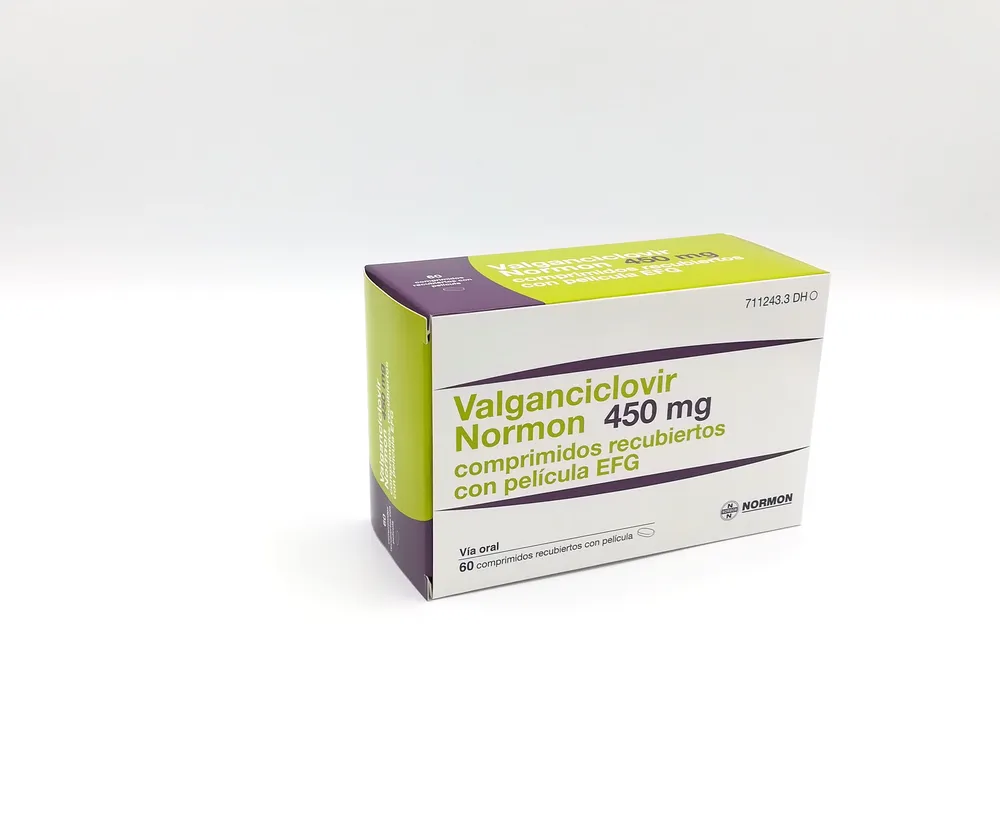
Table of Contents
- Patient Information Leaflet
- Introduction
- 1. What Valganciclovir Normon is and what it is used for
- 2. What you need to know before taking Valganciclovir Normon
- 3. How to take Valganciclovir Normon
- 4. Possible adverse effects
- 5. Storage of Valganciclovir Normon
- 6. Contents of the pack and other information
Patient Information Leaflet
Introduction
Patient Information Leaflet
Valganciclovir Normon 450mg film-coated tablets EFG
Read the entire leaflet carefully before you start taking this medicine, as it contains important information for you.
- Keep this leaflet, as you may need to read it again.
- If you have any questions, consult your doctor or pharmacist.
- This medicine has been prescribed for you only. Do not give it to others, even if they have the same symptoms as you, as it may harm them.
- If you experience any adverse effects, consult your doctor or pharmacist, even if these adverse effects are not listed in this leaflet. See section 4.
Contents of the leaflet
- What Valganciclovir Normon is and what it is used for
- What you need to know before taking Valganciclovir Normon
- How to take Valganciclovir Normon
- Possible side effects
- How to store Valganciclovir Normon
- Contents of the pack and other information
1. What Valganciclovir Normon is and what it is used for
Valganciclovir Normon belongs to a group of medicines that act directly to prevent the growth of viruses. In the body, the active substance in the tablets, valganciclovir, is metabolized to ganciclovir. Ganciclovir prevents the cytomegalovirus (CMV) from multiplying and invading healthy cells. In patients with a weakened immune system, CMV can cause infection in the body's organs. This may be life-threatening.
Valganciclovir Normon is used:
- for the treatment of CMV infection of the eye's retina in adult patients with Acquired Immunodeficiency Syndrome (AIDS). CMV infection in the retina can cause vision problems and even blindness;
- for the prevention of CMV infection in adults and children who have not previously been infected with this virus but who have received a solid organ transplant from a donor who was infected with CMV.
2. What you need to know before taking Valganciclovir Normon
Do not take Valganciclovir Normon:
- if you are allergic to valganciclovir or to any of the other ingredients of this medicine (listed in section 6).
- if you are allergic to ganciclovir, aciclovir, or valaciclovir, which are medicines used to treat other viral infections.
- if you are breastfeeding.
Warnings and precautions
Talk to your doctor or pharmacist before starting Valganciclovir Normon.
- If you have low levels of white blood cells, red blood cells, or platelets (small cells involved in blood clotting). Your doctor will perform a blood test before you start taking Valganciclovir tablets and will carry out further blood tests during treatment.
- If you are undergoing radiotherapy or hemodialysis.
- If you have kidney problems. Your doctor may prescribe a lower dose and may require frequent blood tests during treatment.
- If you are currently taking ganciclovir capsules and your doctor instructs you to switch your treatment to Valganciclovir tablets. It is important not to take more tablets than prescribed by your doctor, as this may increase the risk of overdose.
Taking Valganciclovir Normon with other medicines
Inform your doctor or pharmacist if you are taking, have recently taken, or might need to take any other medicines, including those obtained without a prescription.
Taking other medicines together with Valganciclovir may affect the amount of medicine reaching the bloodstream or may cause harmful effects. Inform your doctor if you are already taking any of the following medicines:
- imipenem-cilastatin (an antibiotic). Taking this medicine together with Valganciclovir may cause seizures (fits).
- zidovudine, didanosine, lamivudine, tenofovir, abacavir, emtricitabine, or similar medicines for the treatment of AIDS.
- ribavirin, pegylated interferons, adefovir, and entecavir, for the treatment of Hepatitis B/C.
- probenecid (a medicine used to treat gout). Taking probenecid and Valganciclovir together may increase the amount of ganciclovir in the blood.
- mycophenolate mofetil (used after organ transplants).
- vincristine, vinblastine, adriamycin, hydroxyurea, or similar medicines used to treat cancer.
- cidofovir or foscarnet, used to treat viral infections.
- trimethoprim, trimethoprim/sulfa combinations, and dapsone (antibiotics).
- pentamidine (a medicine used to treat parasitic or lung infections).
- flucytosine or amphotericin B (antifungal agents).
Taking Valganciclovir Normon with food and drink
Valganciclovir should be taken with food. If for any reason you are unable to eat, you should still continue taking your usual dose of Valganciclovir.
Pregnancy, breastfeeding, and fertility
You must not take Valganciclovir if you are pregnant unless your doctor specifically recommends it. If you are pregnant or planning to become pregnant, inform your doctor. Taking Valganciclovir during pregnancy may harm the unborn baby.
You must not take Valganciclovir while breastfeeding. If your doctor decides to start treatment with Valganciclovir, you must stop breastfeeding before starting treatment.
Women of childbearing potential must use effective contraceptive methods while taking Valganciclovir.
Men whose partners may be pregnant or may become pregnant must use a condom during treatment with Valganciclovir and continue using it for 90 days after treatment has ended.
Driving and using machines
Do not drive or operate machinery if you feel dizzy, tired, agitated, or confused while taking this medicine.
Consult your doctor or pharmacist before using any medicine.
3. How to take Valganciclovir Normon
Follow exactly the instructions given by your doctor or pharmacist for taking this medicine. If in doubt, consult your doctor or pharmacist again.
Valganciclovir tablets must be handled with care. They must not be broken or crushed. You must swallow them whole and with food whenever possible. If you accidentally touch a broken tablet, wash your hands thoroughly with soap and water. If the powder from the tablets comes into contact with your eyes, rinse them with sterile water, or with abundant water if sterile water is not available.
To avoid overdose, you must strictly adhere to the number of tablets prescribed by your doctor.
Valganciclovir tablets should always be taken with food whenever possible — See section 2.
Adults:
Prevention of CMV disease in transplant patients
You should start taking this medicine within 10 days of transplantation. The usual dose is two tablets ONCE daily. You should continue this dose until 100 days after transplantation. If you have received a kidney transplant, your doctor may advise you to take the tablets for 200 days.
Treatment of cytomegalovirus (CMV) retinitis in AIDS patients (also called induction treatment)
The usual dose of Valganciclovir is two tablets taken TWICE daily for 21 days (three weeks). Do not continue this dose for longer than 21 days unless instructed by your doctor, as this dose may increase the risk of possible adverse effects.
Long-term treatment to prevent recurrence of active inflammation in AIDS patients with CMV retinitis (also called maintenance treatment)
The usual dose is two tablets taken ONCE daily. Try to take the tablets at the same time each day. Your doctor will tell you how long you should continue taking Valganciclovir. If your retinitis worsens while taking this dose, your doctor will decide whether to repeat the induction treatment (as above) or prescribe a different medicine to treat the CMV infection.
Elderly patients
Valganciclovir has not been studied in elderly patients.
Patients with kidney problems
If your kidneys are not functioning properly, your doctor will instruct you to take fewer tablets each day, or to take the tablets only on certain days of the week. It is very important that you take only the number of tablets prescribed by your doctor.
Patients with liver problems
Valganciclovir has not been studied in patients with liver problems.
Use in children and adolescents:
Prevention of CMV disease in transplant patients
Children should start taking this medicine within 10 days after transplantation. The dose will depend on the child's size and should be taken ONCE daily. Your doctor will determine the most appropriate dose based on your child's height, weight, and renal function. This dose should be continued until 100 days. If your child has received a kidney transplant, your doctor may recommend continuing the prescribed dose up to 200 days.
If you take more Valganciclovir Normon than you should
Contact your doctor or hospital immediately if you have taken or think you have taken more tablets than you should. Taking more tablets than prescribed may cause serious adverse effects, particularly affecting the blood or kidneys. You may require hospital treatment.
In case of overdose or accidental ingestion, contact your doctor or pharmacist immediately or call the Toxicology Information Service at telephone number 91 562 04 20, indicating the medicine and the amount ingested.
If you forget to take Valganciclovir Normon
If you forget to take your tablets, take the missed dose as soon as you remember, and then take the next dose at your usual time. Do not take a double dose to make up for missed doses.
If you stop taking Valganciclovir Normon
Do not stop treatment unless instructed by your doctor.
If you have any further questions about the use of this medicine, ask your doctor or pharmacist.
4. Possible adverse effects
Like all medicines, this medicine can cause adverse effects, although not everyone will experience them.
Allergic reactions
In 1 out of every 100 people, a sudden and severe allergic reaction to valganciclovir (anaphylactic shock) may occur. STOP taking Valganciclovir and go immediately to the nearest hospital emergency department if you experience any of the following effects:
- Raised, itchy skin rash (urticaria).
- Sudden swelling of the throat, face, lips, and mouth, which may cause difficulty swallowing or breathing.
- Sudden swelling of hands, feet, or ankles.
The adverse effects reported during treatment with valganciclovir or ganciclovir are listed below.
Very common adverse effects (may affect more than 1 in 10 patients):
- Blood effects: decrease in the number of white blood cells in the blood (neutropenia), which increases the likelihood of infections; a decrease in the blood pigment that carries oxygen (anemia), which may cause tiredness and shortness of breath during physical activity.
- Respiratory effects: feeling breathless and difficulty breathing (dyspnea).
- Stomach and digestive system effects: diarrhoea.
Common adverse effects (may affect between 1 and 10 in 100 patients):
- Blood effects: decrease in the number of white blood cells (leukocytes) in the blood (leukopenia); decrease in the number of platelets in the blood (thrombocytopenia), which may cause bruising and bleeding; and a simultaneous decrease in several types of blood cells (pancytopenia).
- Central nervous system effects: headache, difficulty sleeping (insomnia), taste disturbance (dysgeusia), reduced sensitivity to touch (hypoesthesia), tingling or prickling sensations in the skin (paresthesia), loss of sensation in hands or feet (peripheral neuropathy), dizziness, and seizures (convulsions).
- Eye effects: eye pain, swelling inside the eye (edema), separation of the inner layer of the eye (retinal detachment), and floaters.
- Ear effects: ear pain.
- Respiratory effects: cough.
- Stomach and digestive effects: nausea and vomiting, stomach pain, constipation, flatulence, indigestion (dyspepsia), and difficulty swallowing (dysphagia).
- Skin effects: skin inflammation (dermatitis), itching (pruritus), and night sweats.
- Muscle, joint, and bone effects: back pain, muscle pain (myalgia), joint pain (arthralgia), muscle stiffness (rigor), and muscle cramps.
- Infections: fungal infection in the mouth (oral candidiasis), bacterial or viral infections in the blood, skin cell inflammation (cellulitis), and inflammation or infection of the kidneys or bladder.
- Liver effects: increase in certain liver enzymes, which can only be detected in blood tests.
- Kidney effects: changes in normal kidney function.
- Feeding effects: loss of appetite (anorexia) and weight loss.
- General effects: tiredness, fever, pain, chest pain, loss of energy (asthenia), and general malaise.
- Mood and behaviour effects: depression, anxiety, confusion, and disturbed thoughts.
Uncommon adverse effects (may affect between 1 and 10 in 1,000 patients):
- Heart effects: changes in normal heart rhythm (arrhythmias).
- Circulatory effects: low blood pressure (hypotension), which may cause you to feel faint or weak.
- Blood effects: reduced production of blood cells in the bone marrow.
- Nerve effects: restlessness or tremors (tremor).
- Eye effects: redness and inflammation of the eyes (conjunctivitis) and abnormal vision.
- Ear effects: deafness.
- Stomach and digestive effects: inflammation of the stomach, mouth ulcers, and inflammation of the pancreas (pancreatitis), which may cause severe stomach and back pain.
- Skin effects: hair loss (alopecia), itching or swelling (urticaria), and dry skin.
- Kidney effects: blood in the urine (haematuria) and kidney failure.
- Liver effects: increase in the liver enzyme alanine aminotransferase (detected only in blood tests).
- Fertility effects: infertility in men.
- Mood and behaviour effects: unexpected changes in mood and behaviour, loss of contact with reality such as hearing voices or seeing things that are not there, agitation.
Rare adverse effects (may affect between 1 and 10 in 10,000 patients):
- Blood effects: failure in the production of all types of blood cells (red blood cells, white blood cells, and platelets) in the bone marrow.
Retinal detachment (separation of the inner layer of the eye) has occurred only in patients with AIDS treated with Valganciclovir for CMV infection.
Additional adverse effects in children and adolescents
The adverse effects reported in children and adolescents are similar to those reported in adults.
Reporting of adverse effects
If you experience any type of adverse effect, talk to your doctor, pharmacist, or nurse, even if it is an effect not listed in this leaflet. You can also report them directly via the Spanish Pharmacovigilance System for Human Medicines: https://www.notificaRAM.es/. By reporting adverse effects, you can help provide more information on the safety of this medicine.
5. Storage of Valganciclovir Normon
Keep this medicine out of the sight and reach of children.
Do not use this medicine after the expiry date stated on the packaging after EXP. The expiry date refers to the last day of the month indicated.
This medicine does not require any special storage conditions.
Medicines must not be disposed of via wastewater or household waste. Dispose of unused medicines and their containers at the SIGRE Point at your pharmacy. If you have any doubts, ask your pharmacist how to dispose of unused medicines and their containers. This will help protect the environment.
6. Contents of the pack and other information
Composition of valganciclovir Normon
- The active substance is 450 mg of valganciclovir, in the form of 496.3 mg of valganciclovir hydrochloride.
- The other components in the tablet core are: povidone, crospovidone, microcrystalline cellulose, and stearic acid. The coating components are polyvinyl alcohol, titanium dioxide, polyethylene glycol/macrogol, talc, and red iron oxide (E-172).
Appearance of valganciclovir Normon and contents of the pack
Valganciclovir Normon film-coated tablets are pink, elliptical, and biconvex.
Valganciclovir Normon is available in packs containing 60 film-coated tablets.
Marketing Authorization Holder and Manufacturer
LABORATORIOS NORMON, S.A.
Ronda de Valdecarrizo, 6
28760 Tres Cantos – Madrid
(SPAIN)
Date of the most recent review of this leaflet: March 2016
Detailed information about this medicine is available on the website of the Spanish Agency for Medicines and Health Products (AEMPS) http://www.aemps.gob.es/.