Valcyte 50 mg/ml powder for oral solution
Spain
Table of Contents
- Patient Information Leaflet
- Introduction
- 1. What Valcyte is and what it is used for
- 2. What you need to know before taking Valcyte
- **Valcyte contains sodium benzoate and sodium (salt)**
- 3. How to take Valcyte
- 4. Possible adverse effects
- 5. Storage of Valcyte
- 6. Contents of the pack and other information
Patient Information Leaflet
Introduction
Patient Information Leaflet
Valcyte 50 mg/ml powder for oral solution
Valganciclovir
Read the entire leaflet carefully before you start taking this medicine, because it contains important information for you.
- Keep this leaflet, as you may need to read it again.
- If you have any questions, ask your doctor or pharmacist.
- This medicine has been prescribed for you only and must not be given to other people, even if they have the same symptoms as you, as it may harm them.
- If you experience any side effects, tell your doctor or pharmacist, including any side effects not listed in this leaflet. See section 4.
Read all of this leaflet carefully because it contains important information for you.
Contents of the leaflet
- What Valcyte is and what it is used for
- What you need to know before taking Valcyte
- How to take Valcyte
- Possible side effects
- How to store Valcyte
- Contents of the pack and other information
1. What Valcyte is and what it is used for
Valcyte belongs to a group of medicines that act directly to prevent the growth of viruses. In the body, the active substance of the powder, valganciclovir, is metabolized to ganciclovir. Ganciclovir prevents the virus known as cytomegalovirus (CMV) from multiplying and invading healthy cells. In patients with a weakened immune system, CMV can cause infection in the body's organs. This may be life-threatening.
Valcyte is used:
- for the treatment of retinitis (infection of the retina of the eye) caused by cytomegalovirus in adult patients with Acquired Immunodeficiency Syndrome (AIDS). CMV infection in the retina of the eye can lead to vision problems and even blindness.
- for the prevention of cytomegalovirus (CMV) disease in adults and children who have not previously been infected with this virus, but who have received a solid organ transplant from a donor who was infected with CMV.
2. What you need to know before taking Valcyte
Do not take Valcyte
- if you are allergic to valganciclovir, ganciclovir, or any of the other ingredients of this medicine (listed in section 6).
- if you are breastfeeding your baby.
Warnings and precautions
Talk to your doctor or pharmacist before starting to take Valcyte.
-
if you are allergic to aciclovir, penciclovir, valaciclovir, or famciclovir. These are other medicines used for viral infections.
-
if you have low blood counts of white blood cells, red blood cells, or platelets (small cells involved in blood clotting). Your doctor will perform a blood test before you start taking Valcyte and will carry out further blood tests during treatment.
-
if you are receiving radiotherapy.
-
if you have kidney problems. Your doctor may prescribe you a lower dose and you may need frequent blood tests during treatment.
Taking Valcyte with other medicines
Inform your doctor or pharmacist if you are using, have recently used, or might need to use any other medicines, including those obtained without a prescription.
If you take other medicines at the same time as Valcyte, the combination may affect the amount of medicine reaching the bloodstream or could cause harmful effects. Inform your doctor if you are already taking any of the following medicines:
- imipenem-cilastatin (an antibiotic). Taking this medicine together with Valcyte may cause seizures (fits).
- zidovudine, didanosine, lamivudine, stavudine, tenofovir, abacavir, emtricitabine, or similar medicines for the treatment of AIDS.
- adefovir or any other medicine for the treatment of Hepatitis B.
- probenecid (a medicine for the treatment of gout). Taking probenecid and Valcyte together may increase the amount of ganciclovir in the blood.
- mycophenolate mofetil, cyclosporine, or tacrolimus (used after transplants).
- vincristine, vinblastine, doxorubicin, hydroxyurea, or similar medicines for the treatment of cancer.
- trimethoprim, trimethoprim/sulfa combinations, or dapsone (antibiotics).
- pentamidine (a medicine for the treatment of parasites or lung infections).
- flucytosine or amphotericin B (antifungal agents).
Taking Valcyte with food and drink
Valcyte should be taken with food. If for any reason you are unable to eat, you should continue taking your usual dose of Valcyte.
Pregnancy, breastfeeding, and fertility
Consult your doctor or pharmacist before using any medicine.
You must not take Valcyte if you are pregnant unless your doctor specifically recommends it. If you are pregnant or planning to become pregnant, inform your doctor. Taking Valcyte during pregnancy may cause harm to the unborn baby.
You must not take Valcyte while breastfeeding. You must stop breastfeeding before starting treatment.
Women of childbearing age must use an effective method of contraception while taking Valcyte and for at least 30 days after treatment has ended.
Men whose partners may be pregnant or could become pregnant must use a condom while taking Valcyte and continue using it for 90 days after treatment has ended.
Driving and using machines
Do not drive or operate machinery if you feel dizzy, tired, agitated, or confused while taking this medicine.
Consult your doctor or pharmacist before using any medicine.
Valcyte contains sodium benzoate and sodium (salt)
This medicine contains 100 mg of sodium benzoate in each 12 g vial, equivalent to 1 mg/ml after reconstitution. Sodium benzoate may increase the risk of jaundice (yellowing of the skin and eyes) in newborns (up to 4 weeks of age).
This medicine contains less than 1 mmol of sodium (23 mg)/ml after reconstitution; this is essentially "sodium-free".
3. How to take Valcyte
Follow exactly the administration instructions for this medicine as given by your doctor. Consult your doctor or pharmacist if you have any doubts.
You must take special care when handling Valcyte solution. You must avoid contact of the solution with skin and eyes. If the solution accidentally comes into direct contact with the skin, wash the area thoroughly with soap and water. If the solution accidentally gets into the eyes, rinse the eyes immediately with plenty of water.
To avoid overdose, you must adhere strictly to the daily dose of oral solution prescribed by your doctor.
Valcyte oral solution should, whenever possible, be taken with food – see section 2.
It is important that you use the dosing device provided in the package to measure your dose of Valcyte solution. Two dosing devices are included; discard each dosing device after 20 uses. Each dosing device is designed to measure up to 10 ml (500 mg) of solution, with 0.5 ml (25 mg) graduations.
After taking your dose, always thoroughly wash the dosing device with distilled or boiled water and allow it to dry.
Contact your doctor or pharmacist if you have discarded, lost, or broken both dosing devices; they will advise you on how to continue taking your medication.
Adults
Prevention of CMV infection in transplant patients
You should start taking this medicine within 10 days of transplantation. The recommended dose is 900 mg of Valcyte solution ONCE daily. Use the dosing device provided in the pack to take two times 9 ml (450 mg) of solution (i.e., 2 dosing devices filled to the 9 ml (450 mg) mark). Continue this dose until 100 days after transplantation. If you have received a kidney transplant, your doctor may advise you to continue this dose for up to 200 days.
Treatment of cytomegalovirus (CMV) retinitis in patients with AIDS (also known as induction treatment)
The recommended dose is 900 mg of Valcyte solution TWICE daily for 21 days (3 weeks). Use the dosing device provided in the pack to take two times 9 ml (450 mg) of solution (i.e., 2 dosing devices filled to the 9 ml (450 mg) mark) in the morning and two times 9 ml (450 mg) of solution (i.e., 2 dosing devices filled to the 9 ml (450 mg) mark) in the evening.
Do not continue this dose for more than 21 days unless instructed by your doctor, as this dose may increase the risk of possible adverse effects.
Long-term treatment to prevent recurrence of active inflammation in AIDS patients with CMV retinitis (also known as maintenance treatment)
The recommended dose is 900 mg of Valcyte solution ONCE daily. Use the dosing device provided in the pack to take two times 9 ml (450 mg) of solution (i.e., 2 dosing devices filled to the 9 ml (450 mg) mark). Try to take the solution at the same time each day. Your doctor will inform you how long you should continue taking Valcyte. If your retinitis worsens while taking this dose, your doctor will decide whether to repeat the induction treatment (as above) or prescribe a different medicine to treat the CMV infection.
Elderly patients
Valcyte has not been studied in elderly patients.
Patients with kidney problems
If your kidneys are not functioning properly, your doctor will instruct you to take a lower daily dose of Valcyte solution. It is very important that you follow the dose prescribed by your doctor.
Use the dosing device provided in the pack to measure the dose of Valcyte solution.
Patients with liver problems
Valcyte has not been studied in patients with liver problems.
Use in children and adolescents
Prevention of CMV disease in transplant patients
Children should start taking this medicine within 10 days after transplantation. The dose will depend on the child's size and should be taken ONCE daily. Your doctor will determine the most appropriate dose based on your child's height, weight, and renal function. Continue this dose until 100 days after transplantation. If your child has received a kidney transplant, your doctor may recommend continuing the prescribed dose up to 200 days.
Use the dosing devices supplied in the package to measure Valcyte solution.
Contact your doctor or pharmacist if you have discarded, lost, or broken both dosing devices; they will advise you on how to continue taking your medication.
Method and route of administration
It is recommended that the Valcyte solution be prepared by the pharmacist before giving it to you.
Once the solution has been prepared, follow the instructions below to withdraw and take the medication.
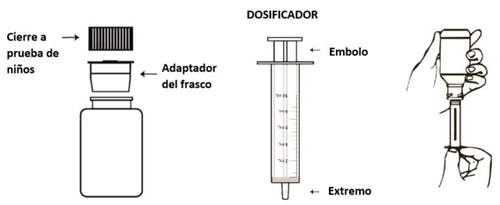
- Shake the closed bottle well for about 5 seconds before each use.
- Remove the child-resistant cap.
- Before inserting the dosing device tip into the bottle adapter, push the plunger fully into the dosing device. Insert the tip firmly into the adapter opening on the bottle.
- Turn the entire unit (bottle and dosing device) upside down.
- Slowly pull back the plunger until the desired amount of medication fills the dosing device (see figure).
- Turn the entire unit upright and slowly separate the dosing device from the bottle.
- Administer the solution directly into the mouth and swallow. Do not mix with any liquid before administration.
- Close the bottle with the child-resistant cap after each use.
- Immediately after administration:
Disassemble the dosing device, rinse under distilled or boiled water, and air-dry before next use.
Take care to avoid contact of the solution with the skin. If contact occurs, wash thoroughly with soap and water.
Do not use the solution after the expiry date, which is 49 days from the date of preparation.
If you take more Valcyte than you should
Contact your doctor or hospital immediately if you have taken or believe you have taken more Valcyte solution than you should. Taking more than the recommended dose may cause serious adverse effects, particularly affecting the blood or kidneys. You may require hospital treatment.
In case of overdose or accidental ingestion, contact your doctor or pharmacist immediately or call the Toxicology Information Service at 91 562 04 20, indicating the medicine and the amount ingested.
If you forget to take Valcyte
If you forget to take your dose of Valcyte, take the missed dose as soon as you remember, and then take the next dose at the usual time. Do not take a double dose to make up for a missed dose.
If you stop taking Valcyte
Do not stop treatment unless instructed by your doctor.
If you have any further questions about the use of this medicine, ask your doctor or pharmacist.
4. Possible adverse effects
Like all medicines, this medicine can cause adverse effects, although not everyone experiences them.
Allergic reactions
In up to 1 in 1,000 people, a sudden and severe allergic reaction to valganciclovir (anaphylactic shock) may occur. STOP taking Valcyte and go immediately to the nearest hospital emergency department if you experience any of the following:
- Raised, itchy skin rash (wheals or hives)
- Sudden swelling of the throat, face, lips, or mouth that may cause difficulty swallowing or breathing
- Sudden swelling of hands, feet, or ankles
Serious adverse effects
Tell your doctor immediately if you notice any of the following serious adverse effects. Your doctor may ask you to stop taking Valcyte, and you may require urgent medical treatment:
Very common adverse effects (may affect more than 1 in 10 patients)
- Decrease in the number of white blood cells in the blood, with signs of infection such as sore throat, mouth ulcers, or fever
- Decrease in the number of red blood cells in the blood, with signs including shortness of breath or fatigue, palpitations, or paleness
Common adverse effects (may affect up to 1 in 10 people)
- Blood infection (sepsis), with signs including fever, chills, palpitations, confusion, and difficulty speaking
- Decrease in the number of platelets, with signs including bleeding or bruising more easily than normal, blood in urine or stools, or bleeding gums, which may become severe
- Severe decrease in blood cells
- Pancreatitis, with signs such as severe stomach pain spreading to the back
- Seizures
Uncommon adverse effects (may affect up to 1 in 100 people)
- Failure of the bone marrow to produce blood cells
- Hallucinations (seeing or hearing things that are not real)
- Disturbed thoughts or feelings, loss of contact with reality
- Kidney function failure
The adverse effects reported with valganciclovir or ganciclovir are as follows:
Other adverse effects
Tell your doctor, pharmacist, or nurse if you notice any of the following adverse effects:
Very common adverse effects (may affect more than 1 in 10 people)
- Candidiasis and oral candidiasis
- Upper respiratory tract infection (e.g., sinusitis, tonsillitis)
- Loss of appetite
- Headache
- Cough
- Feeling short of breath
- Diarrhea
- Feeling unwell or illness
- Abdominal pain
- Eczema
- Fatigue
- Fever
Common adverse effects (may affect up to 1 in 10 people)
- Influenza (flu)
- Urinary tract infection, with signs including fever, more frequent urination, pain during urination
- Skin and subcutaneous tissue infection
- Mild allergic reactions, with signs including redness and swelling of the skin
- Weight loss
- Feeling depressed, anxious, or confused
- Sleep disorders
- Numbness or weakness in hands and feet, which may affect your balance
- Changes in sense of touch, tingling, pins and needles, pricking, or burning sensations
- Changes in taste
- Chills
- Eye inflammation (conjunctivitis), eye pain, or vision problems
- Ear pain
- Low blood pressure, which may make you feel dizzy or cause blurred vision
- Difficulty swallowing
- Constipation, gas, indigestion, stomach pain, abdominal distension
- Mouth ulcers
- Abnormal laboratory test results for liver and kidney function
- Night sweats
- Itching, rash
- Hair loss
- Back, muscle, or joint pain, muscle spasms
- Dizziness, weakness, or general malaise
Uncommon adverse effects (may affect up to 1 in 100 people)
- Restlessness
- Tremors
- Deafness
- Irregular heartbeat
- Hives and dry skin
- Blood in urine
- Infertility in men (see section on fertility)
- Chest pain
Retinal detachment (separation of the inner layer of the eye) has occurred only in patients with AIDS treated with Valcyte for CMV infection.
Additional adverse effects in children and adolescents
The adverse effects reported in children and adolescents are similar to those reported in adults.
Reporting of adverse effects
If you experience any adverse effect, consult your doctor or pharmacist, even if it is a possible adverse effect not listed in this leaflet. You may also report them directly via the Spanish Pharmacovigilance System for Human Medicines: www.notificaRAM.es
By reporting adverse effects, you can help provide more information on the safety of this medicine.
5. Storage of Valcyte
Keep this medicine out of the sight and reach of children.
Do not use the powder after the expiry date stated on the packaging and on the label of the bottle following EXP. The expiry date refers to the last day of the month indicated.
Powder: no special storage conditions required.
Reconstituted solution: Store in a refrigerator (2°C - 8°C).
The shelf life of the oral solution is 49 days. Do not use the solution 49 days after preparation, or after the expiry date indicated on the bottle by the pharmacist.
Medicines must not be disposed of via wastewater or household waste. Dispose of containers and unused medicines at the SIGRE point in your pharmacy. If you have any doubts, ask your pharmacist how to dispose of containers and unused medicines. This will help protect the environment.
6. Contents of the pack and other information
Composition of Valcyte
- The active substance is valganciclovir hydrochloride. After dissolving the powder, 1 ml of solution contains 55 mg of valganciclovir hydrochloride, equivalent to 50 mg of valganciclovir.
- The other components (excipients) are: povidone, fumaric acid, sodium benzoate (E211), sodium saccharin, and mannitol, tutti-frutti flavour [maltodextrin (corn), propylene glycol, gum arabic (E414), and natural flavouring substances mainly from banana, pineapple, and peach].
Appearance of Valcyte and contents of the container
Valcyte powder is a granulate with a white to slightly yellowish colour. The glass bottle contains 12 g of powder. When reconstituted, the solution volume is 100 ml, providing a minimum usable volume of 88 ml. The solution is clear and colourless to slightly brownish. The package also includes a bottle adapter and 2 dosing syringes graduated up to 10 ml (500 mg), with 0.5 ml (25 mg) graduations.
Pack size: one bottle containing 12 g of powder.
Marketing Authorization Holder and Manufacturer
Marketing Authorization Holder
CHEPLAPHARM Arzneimittel GmbH
Ziegelhof 24
17489 Greifswald
Germany
Manufacturer
CHEPLAPHARM Arzneimittel GmbH
Ziegelhof 23 - 24
17489 Greifswald, Germany
Prestige Promotion Verkaufsfoerderung & Werbeservice GmbH
Borsigstrasse 2
63755 Alzenau
Germany
Local representative
Laboratorios Rubió, S.A.
Industria, 29 – Pol. Ind. Comte de Sert
08755 Castellbisbal (Barcelona)
Spain
This medicinal product is authorized in the Member States of the European Economic Area and the United Kingdom under the following names:
Valcyte: Austria, Belgium, Croatia, Cyprus, Czech Republic, Denmark, Finland, Germany, Greece, Hungary, Iceland, Ireland, Italy, Liechtenstein, Luxembourg, Netherlands, Norway, Poland, Slovenia, Spain, Sweden, United Kingdom.
RoValcyte: France, Portugal
Date of the most recent review of this leaflet: November 2023
Other sources of information
Detailed information on this medicinal product is available on the website of the Spanish Agency of Medicines and Health Products (AEMPS) http://www.aemps.gob.es/.
This information is intended exclusively for physicians or healthcare professionals.
It is recommended that the Valcyte solution be reconstituted by a pharmacist as follows:
- Measure 91 ml of water in a graduated cylinder.
- Remove the child-resistant cap, add the water to the bottle, and close the bottle with the child-resistant cap. Shake the closed bottle until all the powder dissolves, forming a clear, colourless to slightly brownish solution.
- Remove the child-resistant cap and place the adapter onto the neck of the bottle.
- Close the bottle tightly with the child-resistant cap. This will ensure proper seating of the adapter onto the bottle and proper functioning of the child-resistant cap.
- Write the expiry date of the reconstituted solution on the bottle label.
Disposable gloves are recommended during reconstitution and when cleaning the external surface of the bottle/cap and the work surface afterwards.
Avoid inhalation and direct contact of the powder and solution with skin and mucous membranes. In case of such contact, wash thoroughly with soap and water; rinse eyes thoroughly with water.