Vaborem 1 g/1 g powder for concentrate for solution for infusion
Spain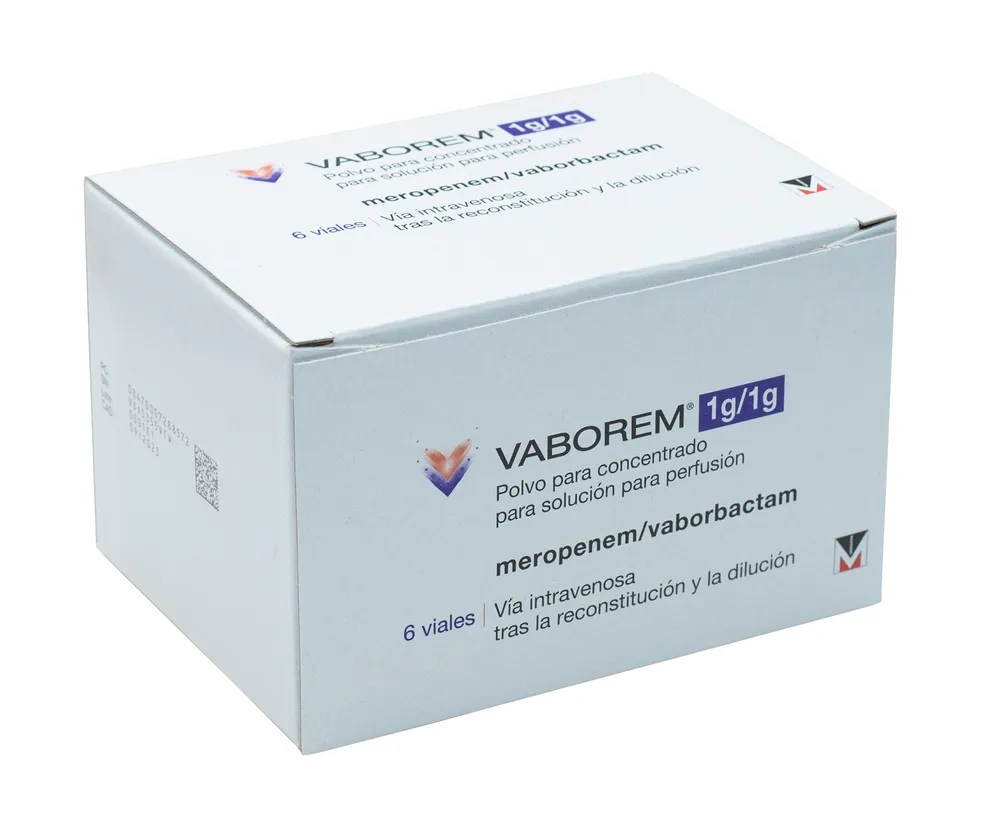
Table of Contents
Package leaflet: Information for the user
Introduction
Package leaflet: information for the patient
Vaborem 1g/1g powder for concentrate for solution for infusion
meropenem/vaborbactam
Read the entire leaflet carefully before you start using this medicine, because it contains important information for you.
- Keep this leaflet, as you may need to read it again.
- If you have any questions, ask your doctor or nurse.
- If you experience any adverse reactions, consult your doctor or nurse, even if they are possible adverse reactions not listed in this leaflet. See section 4.
Leaflet contents
- What Vaborem is and what it is used for
- What you need to know before receiving Vaborem
- How Vaborem is administered
- Possible adverse reactions
- How to store Vaborem
- Contents of the pack and other information
1. What Vaborem is and what it is used for
What Vaborem is
Vaborem is an antibiotic that contains two active substances: meropenem and vaborbactam.
- Meropenem belongs to a group of antibiotics called "carbapenems". These can kill many types of bacteria by preventing them from building the protective walls surrounding their cells.
- Vaborbactam is a "beta-lactamase inhibitor". It blocks the action of an enzyme that enables some bacteria to resist the effects of meropenem. This helps meropenem to kill certain bacteria that it cannot kill on its own.
What Vaborem is used for
Vaborem is used in adults to treat certain serious bacterial infections:
- of the bladder or kidneys (urinary tract infections)
- of the stomach and intestine (intra-abdominal infections)
- of the lungs (pneumonia)
It is also used to treat infections:
- of the blood associated with any of the infections listed above
- caused by bacteria that may not be killed by other antibiotics
2. What you need to know before receiving Vaborem
Do not use Vaborem if
- you are allergic to meropenem, vaborbactam, or any of the other ingredients of this medicine (listed in section 6).
- you are allergic to other carbapenem antibiotics (the group to which meropenem belongs).
- you have ever had a serious allergic reaction to other antibiotics belonging to the beta-lactam group (including penicillins, cephalosporins, or monobactams).
Warnings and precautions
Talk to your doctor or nurse before receiving Vaborem if:
- you have ever had an allergic reaction to other related antibiotics belonging to the beta-lactam group (including carbapenems, penicillins, cephalosporins, or monobactams).
- you have ever had severe diarrhea during or after antibiotic treatment.
- you have ever had seizures.
If any of the above applies to you or if you are unsure, speak with your doctor or nurse before using Vaborem.
You may develop signs and symptoms of serious skin reactions (see section 4). If this happens, inform your doctor or nurse immediately so that symptoms can be treated.
Talk to your doctor or nurse if you develop diarrhea during treatment.
Liver problems
This medicine may affect the liver. Your doctor may take blood samples to check how your liver is functioning while you are taking this medicine. Inform your doctor if you notice yellowing of the skin or eyes, itching, dark urine, or pale stools. These may be signs of liver problems that your doctor needs to investigate.
New infection
Although Vaborem can fight certain bacteria, there is a possibility that you may develop a different infection caused by another microorganism during or after treatment. Your doctor will monitor you closely for any new infection and will provide additional treatment if necessary.
Blood tests
If you are to undergo any blood tests, inform your doctor that you are taking Vaborem, as you may get an abnormal result in a test called the "Coombs test." This test detects the presence of antibodies that may destroy red blood cells or that may be affected by your immune system's response to Vaborem.
Children or adolescents
Vaborem must not be used in children or adolescents under 18 years of age, as it is unknown whether the medicine is safe in these age groups.
Other medicines and Vaborem
Inform your doctor if you are taking, have recently taken, or might need to take any other medicines.
It is especially important that you inform your doctor if you are taking any of the following medicines:
- medicines used to treat epilepsy called valproic acid, sodium valproate, or valpromide, as Vaborem may reduce their effect.
- a medicine for gout called probenecid.
- oral anticoagulants such as warfarin (used to treat or prevent blood clots).
- hormonal oral contraceptives containing estrogens and/or progestogens, as Vaborem may reduce their effectiveness. Women of childbearing potential should be advised to use alternative effective contraceptive methods during treatment with Vaborem and for a period of 28 days after stopping treatment.
- medicines predominantly metabolized by CYP1A2 (e.g., theophylline), CYP3A4 (e.g., alprazolam, midazolam, tacrolimus, sirolimus, cyclosporine, simvastatin, omeprazole, nifedipine, quinidine, and ethinylestradiol) and/or CYP2C (e.g., warfarin, phenytoin) and/or transported by P-gp (e.g., dabigatran, digoxin), as Vaborem may reduce their effect.
If any of the above applies to you, inform your doctor before using Vaborem.
Pregnancy and breastfeeding
If you are pregnant, think you might be pregnant, or are planning to become pregnant, consult your doctor before receiving this medicine.
As a precautionary measure, you should not take this medicine during pregnancy.
It is important that you inform your doctor if you are breastfeeding or intend to breastfeed before receiving Vaborem. Small amounts of this medicine may pass into breast milk and may affect the baby. Therefore, you must stop breastfeeding before starting treatment with Vaborem.
Driving and using machines
Vaborem may make you feel dizzy, drowsy, or sluggish, may cause headache or tingling sensations (pins and needles), or, rarely, may cause epileptic seizures or convulsions. This may affect your ability to drive, operate tools, or machinery.
Vaborem contains sodium
This medicine contains 250 mg of sodium (the main component of table/cooking salt) per vial. This is equivalent to 12.5% of the maximum daily recommended sodium intake for an adult.
3. How Vaborem will be administered to you
The recommended dose is 2 vials (a total of 2 g of meropenem and 2 g of vaborbactam), administered every 8 hours. Your doctor will decide how many days of treatment are needed, depending on the type of infection.
A doctor or nurse will administer Vaborem to you by intravenous infusion (drip) into a vein over 3 hours.
Patients with kidney problems
If you have kidney problems, your doctor may reduce your dose. Your doctor may want to perform blood tests to check how well your kidneys are working.
If you are given more Vaborem than you should
A doctor or nurse will administer Vaborem to you, so it is unlikely that you will be given the wrong dose. If you think you have been given too much Vaborem, inform your doctor or nurse immediately.
If you miss a dose of Vaborem
If you think you have missed a dose, inform your doctor or nurse immediately.
If you have any further questions about the use of this medicine, ask your doctor or nurse.
4. Possible adverse effects
Like all medicines, this medicine can cause adverse effects, although not everyone experiences them.
Serious adverse effects
If you notice any of the following adverse effects, tell your doctor immediately because you may require urgent treatment:
- Severe allergic reactions which may include sudden swelling of the lips, face, throat or tongue, difficulty swallowing or breathing, a severe skin rash or other serious skin reactions, or a drop in blood pressure (which may make you feel dizzy or weak). These reactions can be potentially life-threatening.
- Diarrhea that is getting worse or does not go away, or stools containing blood or mucus. This may occur during treatment with Vaborem or after stopping it. It may be due to bacteria called Clostridioides difficile. If this happens, do not take medicines that stop or reduce the number of bowel movements.
- Liver problems. Yellowing of the skin or eyes, itching of the skin, dark-colored urine or pale stools. If you notice these signs or symptoms, consult a doctor immediately.
Other adverse effects
If you notice any of the following adverse effects, inform your doctor or nurse:
Frequent: (may affect up to 1 in 10 people)
- Increase in the number of platelets (a type of blood cell); detected in blood tests
- Decrease in the amount of potassium (which may cause weakness, muscle cramps, tingling, and changes in heart rhythm) or sugar; detected in blood tests
- Headache
- Low blood pressure
- Diarrhea
- Nausea or vomiting
- Swelling, redness and/or pain around the needle site where the medicine is administered into a vein
- Fever
- Increase in the level of certain liver enzymes called alanine aminotransferase or aspartate aminotransferase; detected in blood tests
- Increase in the level of an enzyme called alkaline phosphatase, which may indicate that the liver, gallbladder, or bones are not functioning as well as they should; detected in blood tests
- Increase in the level of an enzyme called lactate dehydrogenase, which may indicate damage to one or more of your organs; detected in blood tests
Uncommon: (may affect up to 1 in 100 people)
- Inflammation and irritation of the large intestine or colon; this may cause diarrhea, fever, and cramps and may be due to another colon infection
- Fungal infections, including those of the vagina or mouth
- Decrease in the number of white blood cells or certain types of white blood cells called neutrophils, and a decrease in platelets; detected in blood tests
- Increase in a type of white blood cells called eosinophils; detected in blood tests
- Severe and sudden allergic reaction requiring urgent medical treatment, which may include itching, skin discoloration, cramps, swelling, difficulty breathing, fainting, and sudden drop in blood pressure
- Less severe allergic reaction which may include redness, red spots, skin peeling, itching, and general discomfort
- Loss of appetite
- Increase in the amount of potassium or sugar; detected in blood tests
- Difficulty falling asleep
- Seeing, hearing, or sensing things that are not real
- Dizziness
- Tremor or shakiness
- Tingling sensation (pins and needles)
- Feeling drowsy and sluggish
- Irritated, red, and swollen veins
- Pain in the veins
- Difficulty breathing
- Bloating or feeling of fullness in the abdomen
- Stomach pain
- Itching of the skin
- Skin rash
- Itchy raised rash (hives)
- Difficulty controlling the bladder
- Reduced kidney function
- Abnormal sensation in the chest
- At the site where Vaborem is administered into a vein, the following reactions may occur alone or in combination: redness of the skin (erythema); swollen, painful, and warm vein around the needle (phlebitis); blood clot in the vein where the needle was inserted through the skin (thrombosis at the infusion site)
- Pain
- Increase in the level of a substance in the blood called creatine phosphokinase, which may indicate possible damage to certain tissues such as muscles and/or other organs; detected in blood tests
- Increase in the level of a substance in the blood called bilirubin, which may indicate possible damage to red blood cells or impaired liver function; detected in blood tests
- Increase in the level of certain substances in the blood called urea and creatinine, which may indicate impaired kidney function; detected in blood tests
- Reaction occurring during or shortly after administration of Vaborem, presenting symptoms of general malaise (general feeling of being unwell), such as: low blood pressure, nausea, vomiting, cramps, fever, flushing, rapid heartbeat, difficulty breathing, headache
Rare: (may affect up to 1 in 1,000 people)
- Seizures (epileptic fits)
Frequency not known: (cannot be estimated from available data)
- A very large and severe decrease in the number of white blood cells; detected in blood tests
- Hemolytic anemia (a condition in which red blood cells are damaged and their number decreases), which may make you feel tired and cause the skin and eyes to turn yellow
- Swelling of the tongue, face, lips, or throat
- Sudden appearance of a severe skin rash with blister-like spots or skin peeling, possibly with high fever, joint pain, or abnormal liver, kidney, or lung function (these may be signs of more serious conditions known as toxic epidermal necrolysis, Stevens-Johnson syndrome, erythema multiforme, acute generalized exanthematous pustulosis, or a condition known as drug reaction with eosinophilia and systemic symptoms (DRESS))
- A positive result in a test called the "Coombs test," used to identify hemolytic anemia (see above) or an immune system reaction to Vaborem
- Disorientation and acute confusion (delirium)
Reporting of adverse effects
If you experience any adverse effect, talk to your doctor or nurse, even if it is a possible adverse effect not listed in this leaflet. You can also report them directly through the national reporting system included in Appendix V. By reporting adverse effects, you can help provide more information on the safety of this medicine.
5. Storage of Vaborem
Keep this medicine out of the sight and reach of children.
Do not use this medicine after the expiry date stated on the container. The expiry date refers to the last day of the month indicated.
Do not store above 25 °C.
6. Contents of the pack and other information
Composition of Vaborem
- The active substances are meropenem and vaborbactam. Each vial contains 1 g of meropenem (as meropenem trihydrate) and 1 g of vaborbactam.
- The other ingredient is sodium carbonate.
Appearance of the product and contents of the pack
Vaborem is a white to pale yellow powder for concentrate for solution for infusion supplied in a vial.
Vaborem is available in packs containing 6 vials.
Marketing Authorization Holder
Menarini International Operations Luxembourg S.A.
1, Avenue de la Gare
L-1611, Luxembourg
Luxembourg
Manufacturer
ACS Dobfar, S.p.A.
Nucleo Industriale S. Atto
(loc. S. Nicolo’ a Tordino)
64100 Teramo (TE)
Italy
More information about this medicinal product can be requested by contacting the local representative of the Marketing Authorization Holder:
Belgium/Belgium/Belgium Menarini Benelux NV/SA Tel/Tel: + 32 (0)2 721 4545 | Lithuania UAB “BERLIN-CHEMIE MENARINI BALTIC” Tel: +370 52 691 947 |
| Luxembourg/Luxembourg Menarini Benelux NV/SA Tél/Tel: + 32 (0)2 721 4545 |
Czech Republic Berlin-Chemie/A.Menarini Czech Republic s.r.o. Tel: +420 267 199 333 | Hungary Berlin-Chemie/A. Menarini Kft. Tel.: +36 17997320 |
Denmark Menarini International Operations Luxembourg S.A. Tlf: +352 264976 | Malta Menarini International Operations Luxembourg S.A. Tel: +352 264976 |
Germany Berlin-Chemie AG Tel: +49 (0) 30 67070 | Netherlands Menarini Benelux NV/SA Tel: +32 (0)2 721 4545 |
Estonia OÜ Berlin-Chemie Menarini Eesti Tel: +372 667 5001 | Norway Menarini International Operations Luxembourg S.A. Tlf: +352 264976 |
Greece MENARINI HELLAS AE Tel: +30 210 8316111-13 | Austria
Tel: +43 1 879 95 85-0 |
Spain Laboratorios Menarini S.A. Tel: +34-93 462 88 00 | Poland Berlin-Chemie/Menarini Polska Sp. z o.o. Tel.: +48 22 566 21 00 |
France MENARINI France Tél: +33 (0)1 45 60 77 20 | Portugal
Tel: +351 210 935 500 |
Croatia Berlin-Chemie Menarini Hrvatska d.o.o. Tel: + 385 1 4821 361 | Romania Berlin-Chemie A.Menarini S.R.L. Tel: +40 21 232 34 32 |
Ireland
Tel: +353 1 284 6744 | Slovenia Berlin-Chemie / A. Menarini Distribution Ljubljana d.o.o. Tel: +386 01 300 2160 |
Iceland Menarini International Operations Luxembourg S.A. Sími: +352 264976 | Slovakia Berlin-Chemie / A. Menarini Distribution Slovakia s.r.o Tel: +421 2 544 30 730 |
Italy
| Finland/Suomi Berlin-Chemie/A.Menarini Suomi OY Puh/Tel: +358 403 000 760 |
Cyprus MENARINI HELLAS AE Tel: +30 210 8316111-13 | Sweden Berlin-Chemie/A.Menarini Suomi OY Tel: +358 403 000 760 |
Latvia SIA Berlin-Chemie/Menarini Baltic Tel: +371 67103210 |

Date of the most recent review of this summary:
Other sources of information
Detailed information on this medicine is available on the European Medicines Agency website: http://www.ema.europa.eu.
This information is intended for healthcare professionals only:
Vaboreme is intended for intravenous (i.v.) administration only, following reconstitution and dilution.
Aseptic techniques must be used for the preparation and administration of the solution.
The number of vials used for a single dose will depend on the patient's creatinine clearance (CrCl).
Reconstitution:
Withdraw 20 ml of 9 mg/ml (0.9%) sodium chloride injectable solution (normal saline) from a 250 ml infusion bag of 9 mg/ml (0.9%) sodium chloride injectable solution for each vial, and reconstitute with the appropriate number of meropenem/vaborbactam vials for the corresponding Vaborem dose:
- Reconstitute 2 vials for the 2 g/2 g dose of Vaborem
- Reconstitute 1 vial for the 1 g/1 g and 0.5 g/0.5 g doses of Vaborem
After gentle mixing to ensure dissolution, the reconstituted meropenem/vaborbactam solution will have an approximate concentration of 0.05 g/ml of meropenem and an approximate concentration of 0.05 g/ml of vaborbactam. The final volume is approximately 21.3 ml. The reconstituted solution is not for direct injection. The reconstituted solution must be diluted prior to intravenous infusion.
Dilution:
To prepare the 2 g/2 g dose of Vaborem for intravenous infusion: immediately after reconstituting two vials, withdraw the entire contents from each reconstituted vial and transfer them into a 250 ml infusion bag of 9 mg/ml (0.9%) sodium chloride injectable solution (normal saline). The final concentration of meropenem and vaborbactam in the infusion will be approximately 8 mg/ml each.
To prepare the 1 g/1 g dose of Vaborem for intravenous infusion: immediately after reconstituting one vial, withdraw the entire contents of the reconstituted vial and transfer them into a 250 ml infusion bag of 9 mg/ml (0.9%) sodium chloride injectable solution (normal saline). The final concentration of meropenem and vaborbactam in the infusion will be approximately 4 mg/ml each.
To prepare the 0.5 g/0.5 g dose of Vaborem for intravenous infusion: immediately after reconstituting one vial, withdraw 10.5 ml of the contents from the reconstituted vial and transfer them into a 250 ml infusion bag of 9 mg/ml (0.9%) sodium chloride injectable solution (normal saline). The final concentration of meropenem and vaborbactam in the infusion will be 2 mg/ml each.
The diluted solution should be inspected visually for particulate matter. The color of the diluted solution is clear to pale yellow.
After dilution, the infusion should be administered within 4 hours if stored at 25°C, or within 22 hours if refrigerated at 2–8°C.
From a microbiological standpoint, the medicine should be used immediately after reconstitution and dilution.
Vaborem is not chemically compatible with glucose-containing solutions. This medicinal product must not be mixed with others except those mentioned in section 6.6 of the Summary of Product Characteristics.