Uronid 200 mg film-coated tablets
Spain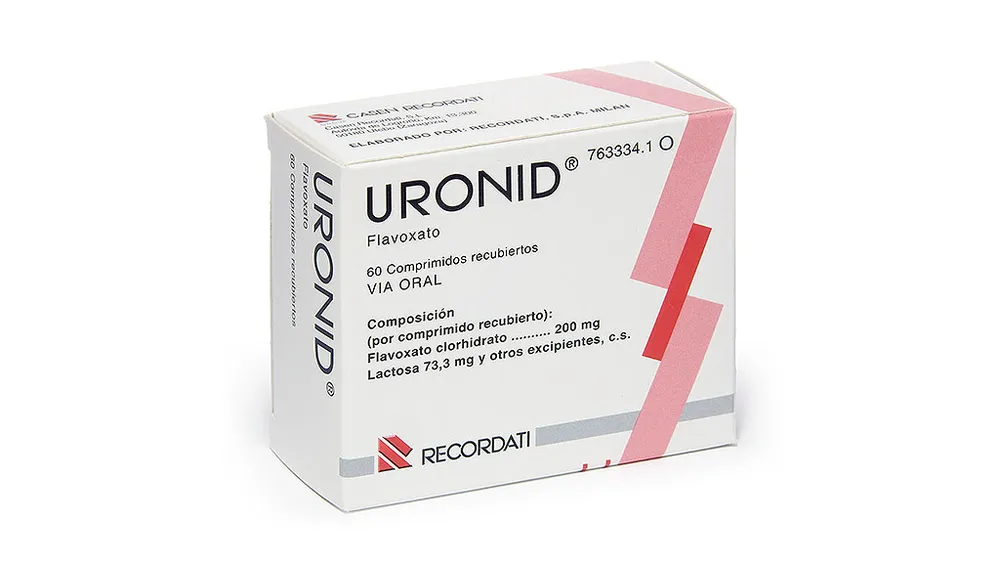
Table of Contents
Package leaflet: Information for the user
Introduction
Package leaflet: information for the user
Uronid 200 mg film-coated tablets
Flavoxate hydrochloride
Read the entire leaflet carefully before you start taking this medicine, because it contains important information for you.
- Keep this leaflet, as you may need to read it again.
- If you have any questions, ask your doctor or pharmacist.
- This medicine has been prescribed for you only and must not be given to other people, even if they have the same symptoms as you. It could harm them.
- If you experience any adverse effects, consult your doctor or pharmacist, even if they are adverse effects not listed in this leaflet. See section 4.
Leaflet contents:
- What Uronid is and what it is used for
- What you need to know before taking Uronid
- How to take Uronid
- Possible side effects
- How to store Uronid
- Contents of the pack and other information
1. What Uronid is and what it is used for
What is Uronid
Uronid belongs to a group of medicines that relieve and prevent muscle spasms. Uronid contains an antispasmodic agent that works by inhibiting contractions in the urinary tract, thereby reducing urinary symptoms and associated pain.
What Uronid is used for
Uronid is indicated for the treatment of urinary symptoms such as: difficulty starting urination (intermittent micturition), sudden need to urinate (urinary urgency), strong and uncontrollable urge to urinate (frequency), even at night (nocturia), suprapubic bladder pain, and involuntary loss of urine (incontinence).
2. What you need to know before taking Uronid
Do not take Uronid
- if you are allergic to flavoxate hydrochloride or any of the other ingredients of this medicine (listed in section 6)
- if you have a gastrointestinal disorder affecting the normal passage of food (obstruction)
- if you have intestinal bleeding
- if you suffer from a muscular disorder that impairs swallowing (achalasia)
- if you are unable to empty your bladder completely (urinary retention)
- if you are being treated for the eye condition known as glaucoma
- if you have a disease causing generalized muscle weakness and fatigue (myasthenia gravis)
Warnings and precautions
Talk to your doctor or pharmacist before taking Uronid:
- if you have impaired kidney function.
Children
Uronid must not be used in children under 12 years of age.
Taking Uronid with other medicines
Tell your doctor or pharmacist if you are taking, have recently taken, or might need to take any other medicines.
Pregnancy, breastfeeding and fertility
If you are pregnant or breastfeeding, think you may be pregnant, or are planning to become pregnant, consult your doctor or pharmacist before using this medicine.
The safety of this medicine during pregnancy and breastfeeding has not been established. Use of this medicine is not recommended if you are pregnant or breastfeeding.
Driving and using machines
Do not drive or operate machinery if you experience drowsiness or blurred vision while taking Uronid.
Uronid contains Lactose
This medicine contains lactose. If your doctor has diagnosed you with an intolerance to certain sugars, consult with him before taking this medicine.
3. How to take Uronid
Follow exactly the instructions for use provided by your doctor or pharmacist. If in doubt, consult your doctor or pharmacist again.
Use in adults
The recommended daily dose is 1 film-coated tablet of 200 mg every 6-8 hours (3 or 4 times daily) taken orally.
Do not break the tablet; swallow it whole, preferably with a glass of water.
Tablets should be taken after meals in order to prevent nausea.
If you take more Uronid than you should
If you have taken more Uronid than you should, contact your doctor, pharmacist, or call the Poison Information Service at telephone number 91 562 04 20, indicating the medication and the amount taken.
If you forget to take Uronid
Do not worry if you have forgotten to take a dose. Take the next dose at the scheduled time. Do not take a double dose to make up for missed doses.
If you stop taking Uronid
If you have any further questions about the use of this medicine, ask your doctor or pharmacist.
4. Possible adverse effects
Like all medicines, this medicine can cause adverse effects, although not everyone will experience them.
Consult your doctor or pharmacist if any of the adverse effects worsen or if you experience any adverse effects not listed below:
Frequent adverse effects (may affect up to 1 in 10 patients)
Nausea
Uncommon adverse effects (may affect up to 1 in 100 patients)
Somnolence
Visual disturbances
Vomiting, dry mouth, gastric pain, indigestion (dyspepsia)
Rash
Rare (may affect up to 1 in 1,000 patients)
Urticaria, pruritus
Inability to completely empty the bladder (urinary retention)
Fatigue
Frequency not known (cannot be estimated from available data)
Hypersensitivity, anaphylactic reaction, anaphylactic shock
Confusion
Glaucoma
Rapid or irregular heartbeat (palpitations)
Yellowing of the skin and whites of the eyes (jaundice), liver disorder, abnormal results in liver function tests (abnormal liver enzyme)
Skin redness
Reporting of adverse effects
If you experience any type of adverse effect, talk to your doctor, pharmacist, or nurse, even if it is a possible adverse effect not listed in this leaflet. You may also report them directly via the Spanish Pharmacovigilance System for Human Medicinal Products: www.notificaram.es.
By reporting adverse effects, you can help provide more information on the safety of this medicine.
5. Storage of Uronid
No special storage conditions are required.
Keep this medicine out of the sight and reach of children.
Do not use this medicine after the expiry date stated on the carton and blister. The expiry date refers to the last day of the month indicated.
Do not use this medicine if it appears damaged or shows signs of tampering.
Medicines must not be disposed of via wastewater or household waste. Instead, return any unused medicines and their containers to the SIGRE collection point at your pharmacy. If you are unsure, ask your pharmacist how to properly dispose of unused medicines and their packaging. This will help protect the environment.
6. Contents of the pack and other information
Composition of Uronid
- The active substance is flavoxate hydrochloride. Each film-coated tablet contains 200 mg of flavoxate hydrochloride.
- The other components are:
Excipients in the core:
Lactose
Povidone (E-1201)
Modified carboxymethylcellulose (E-466)
Talc (E-533b)
Magnesium stearate (E-572)
Colloidal silica (E-551)
Microcrystalline cellulose (E-460)
Excipients in the coating:
Hydroxypropylmethylcellulose
Polyethylene glycol 300
Titanium dioxide (E-171)
Polyethylene glycol 6000
Magnesium stearate (E-572)
Nature of the product and pack contents
Uronid 200 mg film-coated tablets are presented as homogeneous white film-coated tablets, in PVC/Al blisters, in packs containing 60 tablets.
Marketing Authorization Holder and Manufacturer
Marketing Authorization Holder
Casen Recordati, S.L
Autovía de Logroño, km. 13,300
50180 Utebo (Zaragoza), Spain
Manufacturer
Recordati Industria Chimica e Farmaceutica S.p.A.
Via Matteo Civitali, 1
20148 Milan, Italy
Date of the most recent revision of this leaflet: December 2017
Other sources of information
Detailed and up-to-date information on this medicinal product is available on the website of the Spanish Agency of Medicines and Health Products (AEMPS) http://www.aemps.gob.es/