Urapidil Kalceks 5 mg/ml solution for injection and infusion EFG
Spain
Table of Contents
Package leaflet: Information for the user
Introduction
Package leaflet: Information for the user
Urapidil Kalceks 5 mg/ml solution for injection and infusion EFG
urapidil
Read all of this leaflet carefully before you start using this medicine, because it contains important information for you.
- Keep this leaflet, as you may need to read it again.
- If you have any questions, consult your doctor or nurse.
- If you experience any adverse effects, consult your doctor or nurse, even if they are not listed in this leaflet. See section 4.
Leaflet contents
- What Urapidil Kalceks is and what it is used for
- What you need to know before using Urapidil Kalceks
- How to use Urapidil Kalceks
- Possible side effects
- How to store Urapidil Kalceks
- Contents of the pack and other information
1. What Urapidil Kalceks is and what it is used for
Urapidil Kalceks contains the active substance urapidil. Urapidil is a medicine that lowers blood pressure (antihypertensive) and belongs to a group of medicines called alpha-adrenergic blockers. This medicine exerts its effects on the blood vessels (i.e., arteries and veins). It reduces blood pressure by relaxing the walls of the blood vessels.
This medicine is used in adults:
- in emergency situations due to elevated blood pressure (such as a sudden, significant rise in blood pressure known as "hypertensive crisis");
- to treat severe or extremely severe forms of high blood pressure or high blood pressure that does not respond to treatment;
to reduce high blood pressure during and/or after a surgical procedure.
2. What you need to know before using Urapidil Kalceks
Do not use Urapidil Kalceks
- if you are allergic to urapidil or to any of the other ingredients of this medicine (listed in section 6);
- if you have narrowing of the main artery (aortic stenosis) or a blood vessel abnormality called an arteriovenous shunt (except for a hemodynamically inactive arteriovenous shunt for hemodialysis);
- breastfeeding
Warnings and precautions
If blood pressure drops too quickly, it may cause a decrease in heart rate or cardiac arrest.
Consult your doctor or nurse before starting to use this medicine if any of the following apply to you, as special precautions may be required:
- you have had diarrhoea or vomiting (or any other cause of reduced body fluids);
- in patients with heart failure caused by mechanical obstruction, for example, narrowing of the heart valve (aortic or mitral valve stenosis);
- in patients with blockage of an artery in the lungs (pulmonary embolism);
- in patients with heart failure caused by inflammation of the tissue surrounding the heart (pericardial disease);
- in patients with liver problems;
- in patients with moderate or severe kidney problems;
- in elderly patients;
- in patients who are taking cimetidine concomitantly (a medicine used to reduce stomach acidity).
If you are unsure whether any of the above situations apply to you, speak with your doctor or nurse.
If you are undergoing eye surgery due to cataract (clouding of the lens), inform your ophthalmologist before the operation that you are currently using or have previously used urapidil. This is because urapidil may cause complications during surgery, which can be managed if your specialist is prepared in advance.
If you have been given another medicine to lower blood pressure before urapidil, your doctor will wait a sufficient amount of time for the previously administered medicine to take effect. Your doctor may reduce the dose of urapidil. A too rapid drop in blood pressure may cause a decrease in heart rate or cardiac arrest.
Children
This medicine must not be used in children or adolescents.
Other medicines and Urapidil Kalceks
Tell your doctor or nurse if you are taking, have recently taken, or might need to take any other medicines.
Inform your doctor or nurse before this medicine is administered if you are taking any of the following medicines, as they may interact with Urapidil Kalceks, altering the effects of the medicines or increasing the likelihood of side effects:
- alpha-adrenergic blockers (medicines used to treat urinary tract disorders associated with prostate disease);
- any medicine to lower blood pressure;
- cimetidine (used to inhibit gastric acid production);
- barbiturates (medicines used to treat epilepsy).
Use of Urapidil Kalceks with alcohol
Alcohol may enhance the effect of this medicine.
Pregnancy, breastfeeding and fertility
If you are pregnant or breastfeeding, think you may be pregnant, or are planning to become pregnant, consult your doctor before this medicine is administered.
There are insufficient data on the safety of urapidil in pregnant women. This medicine should not be used during pregnancy unless the woman's clinical condition requires treatment. If blood pressure increases during pregnancy and treatment with this medicine is needed, blood pressure reduction should be gradual and always monitored by a doctor.
It is unknown whether this medicine is excreted in breast milk; therefore, for safety reasons, this medicine should not be used during breastfeeding.
This medicine is not recommended for women of childbearing potential who are not using a contraceptive method.
Animal studies have shown that urapidil affects fertility. However, this effect is unknown in humans.
Driving and use of machines
This medicine may impair your ability to drive or operate machinery, especially at the beginning of treatment, when the dose is increased, when switching medications, or when taken together with alcohol.
Urapidil Kalceks contains propylene glycol (E1520) and sodium
Propylene glycol:
- This medicine contains 1,000 mg of propylene glycol per 10 ml of solution, equivalent to 100 mg/ml.
- If you are pregnant or breastfeeding, you should not receive this medicine unless your doctor has recommended it. Your doctor may perform additional monitoring while you are receiving this medicine.
- If you have liver or kidney disease, you should not be given this medicine unless your doctor has recommended it. Your doctor may perform additional monitoring while you are receiving this medicine.
- The propylene glycol in this medicine may have effects similar to alcohol and may increase the likelihood of side effects.
Sodium:
This medicine contains less than 1 mmol of sodium (23 mg) per ml of solution; hence, it is essentially “sodium-free”.
3. How to Use Urapidil Kalceks
How to use this medicine
-
This medicine will be administered by a healthcare professional.
-
This medicine will be given as an injection or infusion into a vein. It may be given as a single injection, repeated injections, or as prolonged infusions. Injections may be followed by prolonged infusions.
-
You must remain lying down (supine position) during administration of this medicine.
-
Your blood pressure will be continuously monitored throughout treatment.
Dosage
Your doctor will determine the appropriate dose based on your clinical condition.
Hypertensive crises and severe or extremely severe high blood pressure, or high blood pressure unresponsive to treatment
By intravenous injection
As an injection, 10–50 mg of urapidil is administered slowly intravenously, with continuous monitoring of blood pressure. A reduction in blood pressure is expected within 5 minutes after injection. The urapidil injection may be repeated depending on the blood pressure response.
By intravenous infusion (by intravenous drip or syringe pump)
For intravenous drip, 250 mg of urapidil is added to 500 ml of a compatible infusion solution (0.9% sodium chloride or 5% or 10% glucose solution).
When using a syringe pump, 100 mg of urapidil is drawn into a syringe and diluted to a volume of 50 ml with a compatible infusion solution (see above) (maximum 4 mg of urapidil per ml of infusion solution).
The initial infusion rate is 2 mg/min. The average maintenance dose is 9 mg/hour. The extent of blood pressure reduction is determined by the dose infused during the first 15 minutes. Subsequently, the established blood pressure can be maintained with much lower doses.
Reduction of high blood pressure during and/or after surgery
To maintain blood pressure levels achieved with injection, continuous infusion via syringe pump or intravenous drip is used.
By intravenous injection
Initially, 25 mg of urapidil is administered. This dose may be repeated if an adequate reduction in blood pressure is not achieved after 2 minutes. If blood pressure reduction remains insufficient within 2 minutes after the second dose, 50 mg of urapidil will be administered.
Once blood pressure has sufficiently decreased within 2 minutes after the administered dose, maintenance dosing will begin.
By intravenous infusion (by intravenous drip or syringe pump)
Initially, up to 6 mg will be administered over 1–2 minutes. Afterward, the dose will be reduced.
Special patient groups
Dosage reduction may be necessary in patients with hepatic and/or renal impairment.
In elderly patients, this medicine should be administered with caution. Lower initial doses should be used, as sensitivity to this type of medication is often altered in this population.
Duration of treatment
Treatment with this medicine should not exceed 7 days.
If you receive more Urapidil Kalceks than you should
If you receive an excessive amount of this medicine, you may experience dizziness, mild lightheadedness or fainting upon standing, fatigue, and slowed reaction time. In such a case, lie down on your back with your legs elevated. If symptoms persist, inform your doctor or nurse immediately.
If you have any further questions about the use of this medicine, ask your doctor or nurse.
4. Possible adverse effects
Like all medicines, this medicine can cause adverse effects, although not everyone will experience them.
The adverse effects described below are generally due to a sudden drop in blood pressure.
However, according to experience, they disappear within a few minutes, even during prolonged infusions. The doctor will decide whether or not to interrupt treatment depending on the severity of the adverse effects.
Common (may affect up to 1 in 10 people)
Dizziness, headache, nausea.
Uncommon (may affect up to 1 in 100 people)
Sleep disorders, palpitations, increased or decreased heart rate, sensation of pressure or pain in the chest (like angina pectoris), difficulty breathing, drop in blood pressure when standing up from a sitting or lying position (orthostatic dysregulation), vomiting, diarrhoea, dry mouth, sweating, fatigue, irregular heartbeat.
Rare (may affect up to 1 in 1,000 people)
Nasal congestion, allergic reactions (itching, skin redness, rash), prolonged and painful erection.
Very rare (may affect up to 1 in 10,000 people)
Restlessness, increased urgency to urinate, increased urinary incontinence, decrease in the number of platelets (blood cells that help the body form clots to stop bleeding).
Frequency not known (frequency cannot be estimated from available data)
Hives, severe allergic reaction with swelling of the face, lips, tongue and throat.
Reporting of adverse effects
If you experience any type of adverse effect, consult your doctor or nurse, even if it is a possible adverse effect not listed in this leaflet. You may also report them directly via the Spanish Pharmacovigilance System for Human Medicinal Products: www.notificaRAM.es. By reporting adverse effects, you can help provide more information on the safety of this medicine.
5. Storage of Urapidil Kalceks
Keep this medicine out of the sight and reach of children.
This medicine does not require any special storage conditions.
After dilution
Chemical and physical in-use stability has been demonstrated for the prepared formulation for up to 50 hours at 25 °C and 2-8 °C when diluted in an infusion solution of 9 mg/ml (0.9%) sodium chloride or in 50 mg/ml (5%) glucose or in 100 mg/ml (10%) glucose.
From a microbiological standpoint, the diluted solution should be used immediately. If not used immediately, the storage time in use and the conditions prior to use are the responsibility of the user and normally should not exceed 24 hours at a temperature of 2 to 8 °C, unless the dilution was carried out under controlled and validated aseptic conditions.
Do not use this medicine after the expiry date stated on the cardboard box and on the ampoule after "EXP". The expiry date refers to the last day of the month indicated.
Medicines should not be disposed of via wastewater or household waste. Unused containers and medicines should be returned to the SIGRE Point at your pharmacy. If in doubt, ask your pharmacist how to dispose of containers and medicines you no longer need. This will help protect the environment.
6. Contents of the pack and other information
Composition of Urapidil Kalceks
• The active substance is urapidil. 1 ml of solution contains 5 mg of urapidil.
Each 10 ml vial of solution contains 50 mg of urapidil.
• The other ingredients are concentrated hydrochloric acid, sodium dihydrogen phosphate dihydrate, disodium phosphate dihydrate, propylene glycol (E1520), sodium hydroxide (for pH adjustment), water for injections.
Appearance of the product and contents of the container
Clear, colourless solution, free from visible particles.
Clear glass vials of 10 ml with a break point.
The vials are packed in a tray of 5 vials. The tray is placed in a cardboard box.
Marketing Authorization Holder and Manufacturer
AS KALCEKS
Krustpils iela 71E, Riga, LV‑1057, Latvia
Tel.: +371 67083320
E‑mail: [email protected]
For further information about this medicinal product, please contact the local representative of the Marketing Authorization Holder
EVER Pharma Therapeutics Spain SL
Toledo Street 170
28005 Madrid
Spain
This medicinal product is authorized in the Member States of the European Economic Area under the following names:
Estonia, Czech Republic, Italy, Portugal: Urapidil Kalceks
Austria: Urapidil Kalceks 25 mg, 50 mg Injektions-/Infusionslösung
France: URAPIDIL KALCEKS 25 mg/5 ml, solution injectable/pour perfusion
URAPIDIL KALCEKS 50 mg/10 ml, solution injectable/pour perfusion
Germany: Urapidil Ethypharm 25 mg, 50 mg Injektions-/Infusionslösung
Hungary: Urapidil Kalceks 25 mg, 50 mg oldatos injekció vagy infúzió
Latvia: Urapidil Kalceks 25 mg, 50 mg škidums injekcijam/infuzijam
Poland: Urapidil KALCEKS
Romania: Urapidil Kalceks 25 mg, 50 mg solu?ie injectabila/perfuzabila
Slovakia: Urapidil Kalceks 25 mg, 50 mg injekcný/infúzny roztok
Spain: Urapidil Kalceks 5 mg/ml solution for injection and infusion
The Netherlands: Urapidil Kalceks 25 mg, 50 mg oplossing voor injectie/infusie
Date of the most recent revision of this leaflet: February 2021
Detailed information on this medicinal product is available on the website of the Spanish Agency of Medicines and Health Products (AEMPS) (http://www.aemps.gob.es/)
This information is intended for healthcare professionals only:
Dosage
Hypertensive emergencies, severe or extremely severe forms of hypertensive disease, treatment-resistant hypertension
- Intravenous injection
For intravenous injection, 10–50 mg of urapidil should be administered slowly by intravenous route, with continuous monitoring of blood pressure.
A hypotensive effect is expected within 5 minutes after injection. The urapidil injection may be repeated according to the blood pressure response.
- Infusion via intravenous drip or syringe pump
To maintain the blood pressure levels achieved with the injection, continuous infusion via syringe pump or intravenous drip is used. For instructions on how to prepare the diluted solution, see “Instructions for use and disposal” and “Preparation of the diluted solution” below.
The maximum compatible concentration is 4 mg of urapidil per ml of infusion solution.
Administration rate
The administration rate must be adjusted according to each patient's blood pressure response.
Initial reference rate: 2 mg/min.
The degree of blood pressure reduction is determined by the dose infused during the first 15 minutes. Subsequently, the established blood pressure level can be maintained with significantly lower doses.
Maintenance dose: 9 mg/h as average value, based on 250 mg of urapidil in 500 ml of infusion solution, equivalent to 1 mg = 44 drops = 2.2 ml.
Controlled reduction of blood pressure in peri- and/or postoperative hypertension.
To maintain the blood pressure levels achieved with the injection, continuous infusion via syringe pump or intravenous drip is used.
Dosing regimen
Intravenous injection | If blood pressure decreases | Blood pressure stabilized |
After 2 min | ||
After 2 min | no blood pressure response | |
Intravenous injection | If blood pressure decreases | |
After 2 min | ||
After 2 min | no blood pressure response | |
Slow intravenous injection | If blood pressure decreases | |
After 2 min |
Special patient populations
The dose of urapidil may need to be reduced in patients with hepatic and/or renal dysfunction.
In elderly patients, antihypertensive agents should be administered with due caution and in lower initial doses, as sensitivity to these medications is often altered in this population.
Paediatric population
The safety and efficacy of urapidil in children and adolescents have not been established. No data are available.
Method of administration
Intravenous route.
Urapidil Kalceks is administered intravenously as an intravenous injection or infusion in patients in the supine position.
Single or multiple injections, as well as prolonged infusions, may be given. Injections may be followed by prolonged infusions.
If overlapping with a short-term or emergency parenteral treatment, it may be switched to maintenance treatment with oral antihypertensive agents.
As a precautionary measure against toxicological effects, treatment duration should not exceed 7 days, which is also typical for parenteral antihypertensive treatments. Parenteral treatment may be repeated if hypertension recurs.
Incompatibilities
This medicinal product must not be mixed with alkaline injection or infusion solutions, as cloudiness or flocculation may occur due to the acidic properties of the solution.
This medicinal product must not be mixed with other medicinal products except those mentioned below.
Instructions for use and disposal
For single use only.
Use immediately after opening the ampoule. Any unused portion must be discarded.
The medicinal product should be inspected visually before use. It should only be used if the solution is clear and free from particles.
Preparation of diluted solution
- Intravenous infusion by drip: add 250 mg of urapidil to 500 ml of a compatible infusion solution (see below).
- Syringe pump: withdraw 20 ml of the injectable and infusion solution (= 100 mg of urapidil) into a syringe pump and dilute to a final volume of 50 ml with a compatible infusion solution (see below).
Compatible diluents:
- 9 mg/ml (0.9%) sodium chloride solution for infusion;
- 50 mg/ml (5%) glucose solution for infusion;
- 100 mg/ml (10%) glucose solution for infusion.
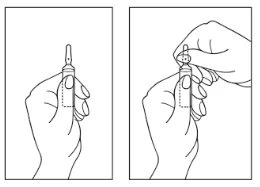
Instructions for opening the ampoule:
- Hold the ampoule with the coloured dot facing upwards. If any solution remains in the upper part of the ampoule, gently tap with the finger to allow all solution to flow down to the bottom of the ampoule.
- Use both hands to open it: while holding the lower part of the ampoule with one hand, use the other hand to snap off the top of the ampoule in the direction opposite to the coloured dot (see images below).
Disposal of unused medicinal product and all materials that have come into contact with it must be carried out in accordance with local regulations.