Urapidil Accord 5 mg/ml solution for injection and infusion EFG
Spain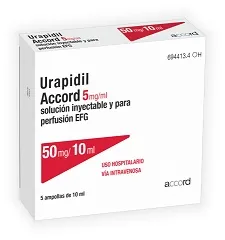
Table of Contents
Patient Information Leaflet
Introduction
Package Leaflet: Information for the Patient
Urapidil Accord 5 mg/ml Solution for Injection and Infusion EFG
Read the entire leaflet carefully before you start using this medicine, because it contains important information for you.
- Keep this leaflet as you may need to read it again. If you have any questions, consult your doctor, pharmacist, or nurse.
- This medicine has been prescribed for you only, and you should not give it to other people, even if they have the same symptoms as you, because it may harm them.
- If you experience any adverse effects, consult your doctor, pharmacist, or nurse, even if they are adverse effects not listed in this leaflet. See section 4.
Leaflet Contents
- What Urapidil Accord is and what it is used for
- What you need to know before using Urapidil Accord
- How to use Urapidil Accord
- Possible side effects
- How to store Urapidil Accord
- Contents of the pack and other information
1. What Urapidil Accord is and what it is used for
Urapidil Accord belongs to a group of medicines called α-adrenergic blockers (i.e., they block α-adrenergic receptors responsible for the constriction of blood vessels and thus for increased blood pressure), producing a balanced reduction in blood pressure.
This medicine is indicated for the treatment of hypertensive crises (sudden high blood pressure in the periods before and after surgery, especially in neurology and cardiac surgery in adults and children), and for protection before and after surgery against increases in blood pressure caused by essential procedures during anaesthesia (intubation: insertion of a tube through the mouth into the trachea to secure breathing, and extubation: removal of the same).
2. What you need to know before using Urapidil Accord
Do not use Urapidil Accord
- If you are allergic to urapidil or to any of the other ingredients of this medicine (listed in section 6).
- If you have stenosis (narrowing) of the aortic isthmus or an arteriovenous shunt (except for a hemodynamically inactive dialysis shunt).
Warnings and precautions
Talk to your doctor, pharmacist, or nurse before using Urapidil Accord.
Special care is needed when Urapidil Accord is used in:
- Patients with heart disorders.
- Children, as studies have not been conducted in this patient group.
- Patients with liver disease.
- Patients with kidney disease.
- Elderly patients.
- Patients being treated concomitantly with cimetidine (see section “Use of Urapidil Accord with other medicines”).
- If you have previously taken or been administered other antihypertensive medicines.
Please consult your doctor if any of the above circumstances have ever applied to you.
Use of Urapidil Accord with other medicines
Urapidil, at high doses, may prolong the duration of action of barbiturates.
The antihypertensive effect of urapidil may be enhanced when administered concomitantly with other α-adrenergic receptor blockers and other antihypertensive agents, as well as in conditions of hypovolemia (reduced blood volume, e.g., due to diarrhoea or vomiting) or with alcohol consumption.
If cimetidine is taken or administered at the same time as this medicine, urapidil blood levels may increase.
If you have taken or have been administered angiotensin-converting enzyme (ACE) inhibitors (antihypertensive drugs, also known as ACE inhibitors), you must inform your doctor, as the combination of urapidil with these medicines is not recommended. Inform your doctor or pharmacist if you are taking, have recently taken, or might need to take any other medicines.
Pregnancy, breastfeeding, and fertility
If you are pregnant or breastfeeding, think you may be pregnant, or are planning to become pregnant, consult your doctor or pharmacist before using this medicine.
The use of urapidil during pregnancy is not recommended unless the potential benefit to the mother outweighs the potential risk to the fetus.
It is unknown whether urapidil is excreted in human breast milk; therefore, urapidil should not be used during breastfeeding.
Driving and using machines
Do not drive, as this medicine may impair your ability to drive.
Do not operate tools or machinery. This medicine may impair your ability to use machinery or work without firm support, especially at the beginning of treatment, when treatment is changed, or when taken together with alcohol.
Urapidil Accord contains propylene glycol and sodium
This medicine contains 1000 mg of propylene glycol in 10 ml, equivalent to 100 mg/ml.
If you are pregnant or breastfeeding, do not take this medicine unless recommended by your doctor. Your doctor may carry out additional monitoring while you are taking this medicine.
If you have hepatic or renal impairment, do not take this medicine unless recommended by your doctor. Your doctor may carry out additional monitoring while you are taking this medicine.
If the child is under 5 years of age, consult your doctor or pharmacist, particularly if other medicines containing propylene glycol or alcohol have been administered.
This medicine contains less than 23 mg (1 mmol) of sodium per ampoule and is therefore considered essentially “sodium-free”.
3. How to use Urapidil Accord
Urapidil Accord will only be administered to you in a hospital setting by healthcare professionals. This medicine is given intravenously.
Follow exactly the administration instructions for this medicine as indicated by your doctor, pharmacist, or nurse. If in doubt, consult your doctor, pharmacist, or nurse again. The duration of treatment with urapidil will be a maximum of seven days.
Adults
Hypertensive emergencies:
Intravenous injection:
Initial dose:
You will be given 1/2 ampoule (25 mg) of urapidil over 20 seconds. If, after 5 minutes, there is a sufficient reduction in blood pressure, your doctor will proceed to administer the maintenance dose. If the reduction in blood pressure has not been sufficient, you will be given another 1/2 ampoule (25 mg) of urapidil over 20 seconds. If, after 5 minutes, the reduction in blood pressure is sufficient, your doctor will proceed to administer the maintenance dose. If, however, the reduction is insufficient, you will be given 1 ampoule (50 mg) of urapidil over 20 seconds, followed by the maintenance dose if the reduction in blood pressure after 5 minutes is sufficient.
Maintenance dose:
- Infusion: 9 to 30 mg/h (average 15) (7 to 22 drops/min) (average 11).
- Electric syringe: 9 to 30 mg/h (average 15) (4.5 to 15 ml/h) (average 7.5).
Intravenous infusion or electric syringe:
Initial dose:
- Infusion: 2 mg/min (88 drops: 4.4 ml/min). If the reduction in blood pressure is sufficient, your doctor will proceed to administer the maintenance dose.
- Electric syringe: 2 mg/min (1 ml/min). If the reduction in blood pressure is sufficient, your doctor will proceed to administer the maintenance dose.
Maintenance dose:
- Infusion: 9 to 30 mg/h (average 15) (7 to 22 drops/min) (average 11).
- Electric syringe: 9 to 30 mg/h (average 15) (4.5 to 15 ml/h) (average 7.5).
Perioperative use:
Intravenous injection:
Initial dose:
1/2 ampoule (25 mg) of urapidil over 20 seconds. If, after 2 minutes, there is a sufficient reduction in blood pressure, your doctor will proceed to administer the maintenance dose. If the reduction in blood pressure has not been sufficient, you will be given another 1/2 ampoule (25 mg) of urapidil over 20 seconds, and if after 2 minutes the reduction in blood pressure is sufficient, your doctor will proceed to administer the maintenance dose. If, however, the reduction is insufficient, you will be given 1 ampoule (50 mg) of urapidil over 20 seconds, and the maintenance dose will be initiated if the reduction in blood pressure after 2 minutes is sufficient.
Maintenance dose:
- Infusion: 60 to 180 mg/h (average 120) (44 to 132 drops/min) (average 88).
- Electric syringe: 60 to 180 mg/h (average 120) (30 to 90 ml/h) (average 60).
Intravenous infusion or electric syringe:
Initial dose:
- Infusion: 6 mg/min (264 drops: 13.2 ml/min). If the reduction in blood pressure is sufficient, your doctor will proceed to administer the maintenance dose.
- Electric syringe: 6 mg/min (3 ml/min). If the reduction in blood pressure is sufficient, your doctor will proceed to administer the maintenance dose.
Maintenance dose:
- Infusion: 60 to 180 mg/h (average 120) (44 to 132 drops/min) (average 88).
- Electric syringe: 60 to 180 mg/h (average 120) (30 to 90 ml/h) (average 60).
Children: Initial dose: 2 mg/kg/h. Maintenance dose: 0.8 mg/kg/h.
In patients with renal impairment or elderly patients:
Your doctor will evaluate the dose to be administered to you.
If you feel that the effect of urapidil is too strong or too weak, inform your doctor.
If you receive more Urapidil Accord than you should
This medicine will only be administered to you in a hospital by healthcare professionals, so it is unlikely that you will receive more urapidil than you should. However, if you think you have been given more urapidil than prescribed, inform your doctor immediately. In case of accidental overdose, contact the Toxicology Information Service (telephone: 91-562.04.20), indicating the product and the amount administered. Take this leaflet with you.
In case of overdose, the following symptoms may occur:
Circulatory symptoms: dizziness, orthostatic hypotension (a sudden drop in blood pressure occurring when standing up quickly, with a brief sensation of dizziness), collapse (sudden failure of the circulatory system).
Central nervous system symptoms: fatigue and altered reaction speed.
Information for the physician:
Excessive reduction in blood pressure can be counteracted by placing the patient with legs elevated and performing volume expansion. If these measures are not sufficient, a vasoconstrictor agent may be administered by slow intravenous injection, with careful monitoring of blood pressure levels.
Intravenous injection of catecholamines (such as adrenaline, 0.5–1.0 mg in 10 ml of isotonic saline solution) may be necessary in very rare cases.
If you interrupt treatment with Urapidil Accord:
This medicine will only be administered to you in a hospital by healthcare professionals, so it is unlikely that you will miss a dose of urapidil. However, if you believe that your dose has been missed, inform your doctor immediately.
4. Possible adverse effects
Like all medicines, this medicine may cause adverse effects, although not everyone experiences them. Most of the adverse effects listed below are due to a rapid decrease in blood pressure, which, according to experience, disappears within a few minutes, even during infusion.
The following adverse effects have been observed and are listed by organ systems and frequencies. Frequencies are defined as:
Frequent (may affect up to 1 in 10 people)
Uncommon (may affect up to 1 in 100 people)
Rare (may affect up to 1 in 1,000 people)
Very rare (may affect up to 1 in 10,000 people)
Cardiac disorders
Uncommon: palpitations, tachycardia (increased heart rate), bradycardia (decreased heart rate), sensation of precordial tightness (in front of the heart)
Vascular disorders
Uncommon: decrease in blood pressure upon changing position, for example, when standing up after lying down (orthostatic hypotension)
Gastrointestinal disorders
Frequent: nausea
Uncommon: vomiting
General disorders and administration site conditions
Uncommon: fatigue
Investigations
Uncommon: irregular heartbeats
Very rare: A decrease in platelet count has been observed in temporal association with oral administration of urapidil, although a causal relationship with urapidil treatment has not been established.
Nervous system disorders
Frequent: dizziness, headache
Psychiatric disorders
Very rare: agitation
Reproductive system and breast disorders
Rare: priapism (persistent, painful erection)
Respiratory, thoracic and mediastinal disorders
Rare: nasal congestion
Skin and subcutaneous tissue disorders
Frequency not known: angioedema, urticaria
Uncommon: excessive sweating
Very rare: allergic reactions such as pruritus (itching), skin redness, and exanthema (skin rash with redness)
If you consider any of the adverse effects you experience to be severe, or if you notice any adverse effects not listed in this leaflet, inform your doctor or pharmacist.
Reporting of adverse effects
If you experience any type of adverse effect, consult your doctor, pharmacist, or nurse, even if it is a possible adverse effect not listed in this leaflet. You can also report them directly via the Spanish Pharmacovigilance System for Human Medicinal Products: www.notificaRAM.es. By reporting adverse effects, you can help provide more information on the safety of this medicine.
5. Storage of Urapidil Accord
Keep this medicine out of the sight and reach of children.
Do not use this medicine after the expiry date stated on the packaging and on the ampoule, following EXP. The expiry date refers to the last day of the month indicated.
After dilution with 0.9% NaCl, 5% glucose or 10% glucose, the prepared solution is physically and chemically stable for 50 hours at 15 – 25 ºC. The prepared solution should be used immediately for microbiological reasons. If the prepared solution is not used immediately, the user is responsible for the storage period and conditions.
Medicines must not be disposed of via wastewater or household waste. Dispose of empty containers and unused medicines at the SIGRE collection point at your pharmacy. If in doubt, please consult your pharmacist on how to dispose of unused containers and medicines. This will help protect the environment.
6. Contents of the pack and other information
Composition of Urapidil Accord
- The active substance is urapidil. One 10 ml ampoule contains 50 mg of urapidil.
- The other components are propylene glycol, sodium hydrogen phosphate dihydrate, sodium dihydrogen phosphate dihydrate, hydrochloric acid, sodium hydroxide, and water for injections.
Appearance of the medicinal product and contents of the pack
This medicine is presented as a clear, transparent or slightly brown injectable solution in ampoules. Each pack contains 5 ampoules.
Marketing Authorization Holder and Manufacturer:
Marketing Authorization Holder
Accord Healthcare, S.L.U.
World Trade Center
Moll de Barcelona s/n, Edifici Est,
6th floor, 08039 Barcelona, Spain
Manufacturer
Combino Pharm S.L.
Fructuós Gelabert, 6 – 8
08970 Sant Joan Despí - Barcelona, Spain
or
CENEXI
52, rue Marcel et Jacques Gaucher
94120 Fontenay Sous Bois, France
Date of the most recent review of this leaflet: February 2020
Detailed and up-to-date information on this medicinal product is available on the website of the Spanish Agency of Medicines and Health Products (AEMPS) http://www.aemps.gob.es/
This information is intended for healthcare professionals only:
Incompatibilities: Urapidil Accord must not be mixed with alkaline injection or infusion solutions, as cloudiness or flocculation may occur due to the acidic properties of the injection solution.
Instructions for use and handling: Chemical and physical stability of the prepared formulation has been demonstrated for 50 hours at 15–25°C. From a microbiological standpoint, the prepared formulation should be used immediately.
If not used immediately, the storage conditions and duration of storage prior to use are the responsibility of the user.
Administration should follow the attached dosing regimen. Considering the duration of the available toxicological studies, the duration of use of Urapidil Accord should not exceed seven days.
PERIOPERATIVE USE
Intravenous injection:
Initial dose:
25 mg of urapidil administered over 20 seconds. If a sufficient reduction in blood pressure is achieved within 2 minutes, your doctor will proceed to administer the maintenance dose.
If the reduction in blood pressure is insufficient after 5 minutes, an additional 25 mg of urapidil will be administered over 20 seconds. If a sufficient reduction in blood pressure is achieved within 2 minutes, your doctor will proceed to the maintenance dose. If, however, the reduction in blood pressure remains insufficient after 5 minutes, 50 mg of urapidil will be administered over 20 seconds, and the maintenance dose will be initiated if a sufficient reduction in blood pressure is achieved within 2 minutes.
Maintenance dose:
- Infusion: 60 to 180 mg/h (average 120 mg/h) (44 to 132 drops/min) (average 88 drops/min)
- Electric syringe pump: 60 to 180 mg/h (average 120 mg/h) (30 to 90 ml/h) (average 60 ml/h)
Intravenous infusion or electric syringe pump:
Initial dose:
- Infusion: 6 mg/min (264 drops = 13.2 ml/min). If blood pressure reduction is sufficient, your doctor will proceed to the maintenance dose.
- Electric syringe pump: 6 mg/min (3 ml/min). If blood pressure reduction is sufficient, your doctor will proceed to the maintenance dose.
Preparation of solutions:
Infusions: Add 5 ampoules of Urapidil Accord 5 mg/ml to 500 ml of solution.
Electric syringe pump: Add 2 ampoules of Urapidil Accord 5 mg/ml to 50 ml of solution.
Recommended dosage regimen for use prior to surgery
Children:
Initial dose: 2 mg/kg/h
Maintenance dose: 0.8 mg/kg/h
Urapidil Accord injectable ampoules may be used for a maximum of 7 days.
HYPERTENSIVE EMERGENCIES
Intravenous injection:
Initial dose:
25 mg of urapidil administered over 20 seconds. If a sufficient reduction in blood pressure is achieved within 5 minutes, your doctor will proceed to the maintenance dose. If the reduction in blood pressure is insufficient after 5 minutes, an additional 25 mg of urapidil will be administered over 20 seconds. If blood pressure reduction is sufficient within the next 5 minutes, your doctor will proceed to the maintenance dose. If, however, the reduction remains insufficient after 5 minutes, 50 mg of urapidil will be administered over 20 seconds, and the maintenance dose will be initiated if a sufficient reduction in blood pressure is achieved within 5 minutes.
Maintenance dose:
- Infusion: 9 to 30 mg/h (average 15 mg/h) (7 to 22 drops/min) (average 11 drops/min)
- Electric syringe pump: 9 to 30 mg/h (average 15 mg/h) (4.5 to 15 ml/h) (average 7.5 ml/h)
Intravenous infusion or electric syringe pump:
Initial dose:
- Infusion: 2 mg/min (88 drops = 4.4 ml/min). If blood pressure reduction is sufficient, your doctor will proceed to the maintenance dose.
- Electric syringe pump: 2 mg/min (1 ml/min). If blood pressure reduction is sufficient, your doctor will proceed to the maintenance dose.
Preparation of solutions:
Infusions: Add 5 ampoules of Urapidil Accord 5 mg/ml to 500 ml of solution.
Electric syringe pump: Add 2 ampoules of Urapidil Accord 5 mg/ml to 50 ml of solution.
Recommended dosage regimen for the treatment of hypertensive episodes