Uplizna 100 mg concentrate for solution for infusion
Spain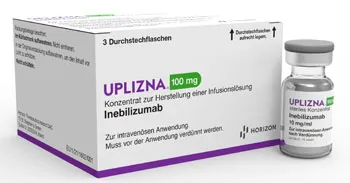
Table of Contents
Package leaflet: Information for the user
Introduction
Package leaflet: information for the user
Uplizna 100 mg concentrate for solution for infusion
inebilizumab
This medicinal product is subject to additional monitoring, which will allow rapid identification of new information on its safety. You can help by reporting any adverse reactions you may experience. Information on how to report adverse reactions is included at the end of section 4.
Read this entire leaflet carefully before this medicine is administered to you, because it contains important information for you.
- Keep this leaflet, as you may need to read it again.
- If you have any questions, consult your doctor, pharmacist, or nurse.
- If you experience any adverse reactions, consult your doctor, pharmacist, or nurse, even if they are adverse reactions not listed in this leaflet. See section 4.
- Your doctor will provide you with a patient alert card containing important safety information you should know before and during treatment with Uplizna.
Contents of the leaflet
- What Uplizna is and what it is used for
- What you need to know before being given Uplizna
- How Uplizna is administered
- Possible adverse reactions
- How to store Uplizna
- Contents of the pack and other information
1. What Uplizna is and what it is used for
Uplizna contains the active substance inebilizumab and belongs to a class of medicines called monoclonal antibodies. It is a protein that targets antibody-producing cells in the immune system (the body's natural defences) known as B-lymphocytes.
Uplizna is used to treat adults with:
- Neuromyelitis optica spectrum disorder (NMOSD), a rare disease that affects the optic nerves and spinal cord. The disorder is believed to occur because the immune system mistakenly attacks the body's own nerves. Uplizna is administered to NMOSD patients whose B-lymphocytes produce antibodies against aquaporin-4, a protein that plays an important role in nerve function
- Immunoglobulin G4-related disease (IgG4-RD), a rare disease affecting multiple organs in the body. The disease occurs because the immune system damages the body's own tissues. Patients with IgG4-RD may have high levels of a specific type of antibody called IgG4. IgG4-producing B-cells accumulate in affected tissues and contribute to organ damage.
- Generalized myasthenia gravis (gMG), a rare condition in which the immune system attacks and damages muscle cells, causing muscle weakness throughout the body. Patients with gMG produce IgG autoantibodies against specific proteins, which disrupt or block nerve-to-muscle communication.
2. What you need to know before Uplizna is administered to you
Do not use Uplizna
- if you are allergic to inebilizumab or to any of the other ingredients of this medicine (listed in section 6).
- if you have an active serious infection such as hepatitis B.
- if you have untreated active or latent tuberculosis.
- if you have a history of progressive multifocal leukoencephalopathy (PML), a rare but serious brain infection caused by a virus.
- if you have been diagnosed with serious immune system disorders.
- if you have cancer.
Warnings and precautions
Talk to your doctor, pharmacist, or nurse before receiving Uplizna if:
- you have or think you may have an infection.
- you have previously taken, are currently taking, or are planning to take medications that affect the immune system or other treatments for your disease. These medications may increase your risk of developing an infection.
- you have ever had hepatitis B or are a carrier of the hepatitis B virus.
- you have ever had hepatitis C or are a carrier of the hepatitis C virus.
- you have recently received or are scheduled to receive any vaccination. You should receive any required vaccinations at least 4 weeks before starting treatment with Uplizna.
Infusion-related reactions
Uplizna may cause infusion-related reactions, which may include headache, feeling unwell (nausea), drowsiness, shortness of breath, fever, muscle pain, rash, palpitations, or other symptoms. If symptoms occur, treatment may be interrupted or discontinued.
Children and adolescents
This medicine should not be given to children and adolescents because it has not been studied in this population.
Other medicines and Uplizna
Tell your doctor or pharmacist if you are taking, have recently taken, or might need to take any other medicines.
Pregnancy, breastfeeding, and fertility
If you are pregnant, think you may be pregnant, or plan to become pregnant, consult your doctor before receiving this medicine.
Pregnancy
Uplizna must not be used during pregnancy, as the medicine may cross the placenta and harm the unborn baby. If you are able to become pregnant, you must use a continuous method of contraception (birth control) once you start receiving Uplizna. If your doctor advises stopping treatment, continue using contraception for 6 months after the last infusion.
Breastfeeding
It is unknown whether Uplizna passes into breast milk. If you are breastfeeding, speak with your healthcare provider about the best way to feed your baby if you start treatment with Uplizna.
Driving and using machines
Uplizna is not expected to affect your ability to drive or operate machinery.
Uplizna contains sodium
This medicine contains 48 mg of sodium (a main component of cooking/table salt) per infusion. This is equivalent to 2% of the maximum daily recommended intake of sodium for an adult.
Uplizna contains polysorbate
This medicine contains 1 mg of polysorbate 80 per vial, equivalent to 0.1 mg/ml.
Polysorbates may cause allergic reactions. Inform your doctor if you have any known allergies.
3. How Uplizna is administered
Uplizna is administered by intravenous infusion (drip) under the supervision of a physician experienced in managing patients with your condition.
The recommended dose is 300 mg.
The first dose is followed by a second dose 2 weeks later, and then a dose every 6 months.
You will be given other medications between 30 minutes and 1 hour before the infusion to reduce the risk of adverse effects. A physician or nurse will monitor you during the infusion and for one hour after.
If in doubt, consult your physician again.
4. Possible adverse effects
Like all medicines, this medicine can cause adverse effects, although not everyone experiences them. Your doctor will discuss the possible adverse effects with you and explain the risks and benefits of Uplizna before starting treatment.
Serious adverse effects
The most serious adverse effects are infusion-related reactions and infections (see section 2). These adverse effects may occur at any time during treatment or even after your treatment has ended. You may experience more than one adverse effect simultaneously. If you experience an infusion-related reaction or an infection, contact or see your doctor immediately.
Other adverse effects
Very common (may affect more than 1 in 10 people)
- bladder infection
- infection of the nose, throat, sinuses and/or lungs
- common cold (nasopharyngitis)
- influenza (flu)
- joint pain
- back pain
- decreased immunoglobulins
- lower than normal number of lymphocytes (a type of white blood cells) in the blood (lymphopenia)
- reaction to Uplizna infusion (see Infusion-related reactions, above)
- headache
Common (may affect up to 1 in 10 people)
- lower than normal number of neutrophils (a type of white blood cells) in the blood, which sometimes occurs 4 weeks or more after the last dose of Uplizna (neutropenia; delayed-onset neutropenia)
- sinus inflammation, usually caused by an infection
- pneumonia (lung infection)
- cellulitis, a potentially serious bacterial skin infection
- shingles (herpes zoster, a painful, blistering rash affecting one area of the body)
- muscle pain (myalgia)
- fever (pyrexia)
- cough
Uncommon (may affect up to 1 in 100 people)
- blood infection (sepsis), an exceptionally severe response to an infection
- progressive multifocal leukoencephalopathy (PML), a rare but serious viral brain infection
- abscess (an infection beneath the skin, usually caused by bacteria)
- bronchiolitis, a viral infection of the airways
Reporting of adverse effects
If you experience any adverse effect, talk to your doctor, pharmacist, or nurse, even if it is a possible adverse effect not listed in this leaflet. You can also report them directly through the national reporting system included in Appendix V. By reporting adverse effects, you can help provide more information on the safety of this medicine.
5. Storage of Uplizna
Keep this medicine out of the sight and reach of children.
Do not use this medicine after the expiry date which is stated on the carton after EXP.
The expiry date refers to the last day of the month indicated.
Store in a refrigerator between 2 °C and 8 °C.
Keep in the original carton to protect from light. Do not freeze.
Do not use this medicine if you notice particles or any change in colour.
6. Contents of the pack and other information
Composition of Uplizna
- The active substance is inebilizumab.
- Each vial contains 100 mg of inebilizumab.
- The other components are histidine, histidine monohydrochloride monohydrate, polysorbate 80, sodium chloride, trehalose dihydrate, and water for injections.
Appearance of the medicinal product and contents of the pack
Uplizna 100 mg concentrate for solution for infusion is a clear to slightly opalescent, colourless to slightly yellow solution supplied in a carton containing 3 vials.
Marketing Authorisation Holder
Amgen Europe B.V.
Minervum 7061
4817 ZK Breda
The Netherlands
Manufacturer
Horizon Therapeutics Ireland DAC
Pottery Road
Dun Laoghaire
Co. Dublin
A96 F2A8
Ireland
Manufacturer
Amgen NV
Telecomlaan 5-7
1831 Diegem
Belgium
You can request further information regarding this medicinal product by contacting the local representative of the Marketing Authorisation Holder:
Belgium/Belgium/Belgium s.a. Amgen n.v. Tel/Tel: +32 (0)2 7752711 | Lithuania Amgen Switzerland AG Vilnius Branch Tel. +370 5 219 7474 |
| Luxembourg/Luxembourg s.a. Amgen Belgium/Belgium Tel/Tel: +32 (0)2 7752711 |
Czech Republic Amgen s.r.o. Tel: +420 221 773 500 | Hungary Amgen Kft. Tel.: +36 1 35 44 700 |
Denmark Amgen, branch of Amgen AB, Sweden Tlf.: +45 39617500 | Malta Amgen S.r.l. Italy Tel: +39 02 6241121 |
Germany Amgen GmbH Tel.: +49 89 1490960 | Netherlands Amgen B.V. Tel: +31 (0)76 5732500 |
Estonia Amgen Switzerland AG Vilnius Branch Tel: +372 586 09553 | Norway Amgen AB Tlf: +47 23308000 |
Greece Amgen Hellas Pharmaceuticals E.P.E. Tel: +30 210 3447000 | Austria Amgen GmbH Tel: +43 (0)1 50 217 |
Spain Amgen S.A. Tel: +34 93 600 18 60 | Poland Amgen Biotechnologia Sp. z o.o. Tel.: +48 22 581 3000 |
France Amgen S.A.S. Tel: +33 (0)9 69 363 363 | Portugal Amgen Biofarmaceutica, Lda. Tel: +351 21 4220606 |
Croatia Amgen d.o.o. Tel: +385 (0)1 562 57 20 | Romania Amgen Romania SRL Tel: +4021 527 3000 |
Ireland Amgen Ireland Limited Tel: +353 1 8527400 | Slovenia AMGEN zdravila d.o.o. Tel: +386 (0)1 585 1767 |
Iceland Vistor Sími: +354 535 7000 | Slovakia Amgen Slovakia s.r.o. Tel: +421 2 321 114 49 |
Italy Amgen S.r.l. Tel: +39 02 6241121 | Finland Amgen AB, branch in Finland / Amgen AB, filial i Finland Puh/Tel: +358 (0)9 54900500 |
Cyprus C.A. Papaellinas Ltd Tel: +357 22741 741 | Sweden Amgen AB Tel: +46 (0)8 6951100 |
Latvia Amgen Switzerland AG Riga Branch Tel: +371 257 25888 |
Date of the most recent review of this leaflet:
Other sources of information
Detailed information on this medicine is available on the European Medicines Agency website: http://www.ema.europa.eu.