Uniket 20 mg tablets
Spain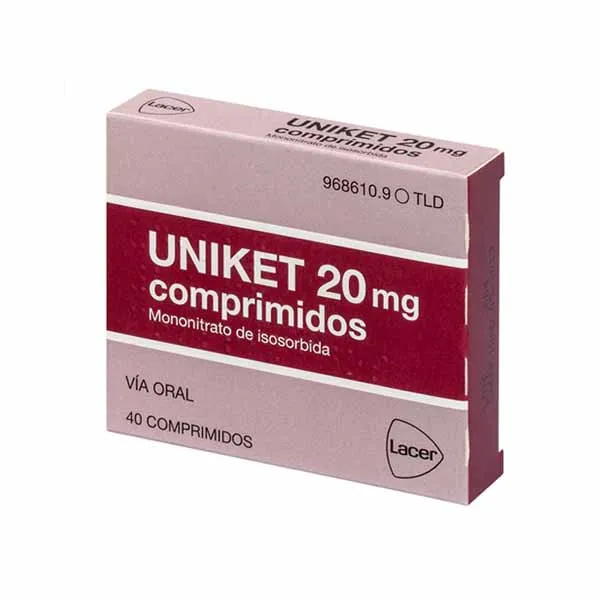
Table of Contents
- Package leaflet: Information for the user
- Introduction
- **Uniket 20 mg tablets**
- isosorbide mononitrate
- **Read the entire leaflet carefully before starting to take this medicine, as it contains important information for you.**
- 1. What Uniket is and what it is used for
- 2. What you need to know before starting to take Uniket
- 3. How to take Uniket
- 4. Possible adverse effects
- 5. Storage of Uniket
- 6. Contents of the pack and other information
Package leaflet: Information for the user
Introduction
Package leaflet: information for the user
Uniket 20 mg tablets
isosorbide mononitrate
Read the entire leaflet carefully before starting to take this medicine, as it contains important information for you.
- Keep this leaflet, as you may need to read it again.
- If you have any questions, consult your doctor or pharmacist.
- This medicine has been prescribed for you only and must not be given to other people, even if they have the same symptoms as you, as it may harm them.
- If you experience any adverse effects, consult your doctor or pharmacist, even if they are adverse effects not listed in this leaflet. See section 4.
Leaflet contents:
1.- What Uniket is and what it is used for
2.- What you need to know before taking Uniket
3.- How to take Uniket
4.- Possible adverse effects
5.- Storage of Uniket
6.- Contents of the pack and other information
1. What Uniket is and what it is used for
Uniket belongs to a group of medicines called organic nitrates, which relax the muscle in blood vessels, widening arteries and veins. This improves blood circulation, reducing the heart's workload and its oxygen requirements.
This medicine is indicated for the treatment and prevention of angina pectoris.
2. What you need to know before starting to take Uniket
Do not take Uniket
• If you are allergic to isosorbide mononitrate, to organic nitrates in general, or to any of the other ingredients of this medicine (listed in section 6).
• If you have very low blood pressure (systolic blood pressure below 90 mmHg).
• In case of acute circulatory failure (shock, collapse).
• If you suffer from severe anemia.
• In case of severe hypovolemia (decreased total blood volume).
• In case of cardiogenic shock (circulatory collapse of cardiac origin), unless diastolic filling pressure is maintained by appropriate measures.
• If you have constrictive pericarditis (inflammation of the pericardium that compresses the heart).
• In case of cardiac tamponade (acute compression of the heart).
• If you suffer from obstructive hypertrophic cardiomyopathy (abnormal thickening of the heart muscle).
• If you are taking medications containing sildenafil, tadalafil, or vardenafil (medicines used to treat erectile dysfunction), as the effect of Uniket on the heart may be altered.
Warnings and precautions
Consult your doctor or pharmacist before starting to take Uniket Retard.
• This medicine is not indicated for sudden (acute) attacks of angina pectoris. In such cases, your doctor has likely prescribed another medication.
• If you have reduced filling pressure, for example, acute myocardial infarction, left ventricular failure. Systolic blood pressure should be maintained above 90 mmHg.
• If you suffer from aortic and/or mitral stenosis (narrowing of the heart valves).
• If you suffer from orthostatic hypotension (decrease in blood pressure upon standing).
• If you have conditions associated with increased intracranial pressure (however, so far, increased intracranial pressure has only been observed after intravenous administration of high doses of nitroglycerin).
• Tolerance and cross-tolerance (loss of efficacy with continued treatment) have been reported with other drugs containing nitrates as the active ingredient.
• It is important that prolonged treatment with Uniket is not stopped abruptly, but gradually tapered off. Your doctor will advise you on how to do this (see also "Instructions for correct administration of the preparation").
• It is important that this medicine is taken while sitting, especially at the beginning of treatment or if you are over 65 years old.
Children and adolescents
The efficacy and safety of use in children have not been established. Therefore, the use of Uniket is not recommended in children and adolescents (under 18 years of age).
Other medicines and Uniket
Inform your doctor or pharmacist if you are currently using, have recently used, or might need to use any other medicines, including those obtained without a prescription, homeopathic medicines, herbal remedies, and other health-related products, as it may be necessary to interrupt treatment or adjust the dose of one or more of them.
It is especially important that you inform your doctor if you are taking any of the following medicines:
• Beta-blockers, calcium antagonists, diuretics, ACE inhibitors (used to treat high blood pressure).
• Vasodilators (used in heart and blood vessel diseases).
• Tricyclic antidepressants (for the treatment of depression).
• Neuroleptics (used in nervous system disorders).
• Sildenafil, tadalafil, vardenafil (used for erectile dysfunction).
Interference with diagnostic tests
If you are due to have any diagnostic tests (blood, urine, or other analyses), inform your doctor that you are being treated with Uniket, as it may alter test results.
Taking Uniket with food, drinks, and alcohol
Uniket tablets are taken orally, swallowed whole with a glass of water, without chewing. The tablet may be taken either on an empty stomach or with food (see also "3. How to take Uniket").
Alcohol must not be consumed during treatment with this medicine, as it may cause a drop in blood pressure.
Pregnancy, breastfeeding, and fertility
If you are pregnant or breastfeeding, think you may be pregnant, or plan to become pregnant, consult your doctor or pharmacist before using this medicine.
Consult your doctor or pharmacist before using any medicine.
Uniket should not be taken during the first three months of pregnancy unless, in the strict opinion of the doctor, it is absolutely necessary. Therefore, if you are pregnant or think you might be, inform your doctor as soon as possible.
Caution is advised if Uniket is administered to a breastfeeding mother. Current information is insufficient to determine the risk during lactation.
Driving and using machines
Observe your response to the medication, as in some cases your ability to drive or operate machinery may be reduced due to decreased reflexes, which could be worsened by alcohol consumption. Therefore, do not drive or operate potentially dangerous machinery until you know how you tolerate the medicine.
Uniket contains lactose
This medicine contains lactose. If your doctor has informed you that you have an intolerance to certain sugars, consult with him before taking this medicine.
3. How to take Uniket
Follow exactly the administration instructions for Uniket provided by your doctor or pharmacist. If in doubt, consult your doctor or pharmacist again.
The following dosing schedule is recommended:
- Days 1 and 2 of treatment: half a tablet twice daily.
- Days 3 and 4 of treatment: 1 tablet twice daily.
- From day 4 of treatment onwards: 1 tablet two or three times daily.
The maximum recommended daily dose of this medicine is 60 mg (3 tablets per day). However, your doctor will indicate how you should take the medicine and how many tablets you should take each day.
Instructions for correct administration of the preparation
The Uniket tablet, or part thereof, should be swallowed whole without chewing, with a sufficient amount of liquid (for example, a glass of water). Remember to take your medication.
Your doctor will inform you about the duration of your treatment with Uniket and may adjust your dose if necessary. Do not change the dose prescribed by your doctor and do not stop treatment without first consulting your doctor, as this could be harmful to your health.
It is important that you start and stop treatment with Uniket gradually and never abruptly. Your doctor will advise you on how to gradually increase or reduce the dose.
If you feel that the effect of Uniket is too strong or too weak, inform your doctor or pharmacist.
If you take more Uniket than you should
If, for any reason, you take more Uniket tablets than you should, the following symptoms may occur: rapid drop in blood pressure, paleness, sweating, weak pulse, increased heart rate (tachycardia), dizziness, headache, feeling of weakness, nausea, vomiting, and diarrhea.
In patients treated with organic nitrates, cases of methemoglobinemia (a blood disorder in which the body cannot reuse the protein (hemoglobin) used for oxygen transport) and cyanosis (bluish discoloration of the skin and mucous membranes) have been reported, followed by rapid breathing, anxiety, loss of consciousness, and cardiac arrest. It cannot be ruled out that an overdose of Uniket may cause this adverse reaction.
Very high doses may cause increased intracranial pressure with cerebral symptoms.
The following measures should be taken in case of a possible Uniket overdose:
? General measures
- Discontinue administration of the medicine.
- In case of a significant drop in blood pressure:
- place the patient lying down with legs elevated and head tilted downwards,
- if necessary, administer intravenous fluids and oxygen,
- if shock occurs, admit to an intensive care unit.
? Special measures
- Increase blood pressure if it is very low.
- Treatment with medications that raise blood pressure (vasopressors), (only in patients who do not respond to fluid administration).
- Treatment of methemoglobinemia:
- vitamin C, methylene blue, or toluidine blue,
- oxygen (if necessary),
- assisted ventilation,
- hemodialysis (if necessary).
? Resuscitation measures
- In case of signs of cardiorespiratory arrest, initiate resuscitation measures immediately.
In case of overdose or accidental ingestion, contact the Toxicology Information Service. Telephone 915 62 04 20, indicating the name of the medicine and the amount taken.
If you forget to take Uniket
If you miss a dose, take the medicine as soon as possible and continue treatment as prescribed. However, if the next dose is due soon, it is better not to take the missed dose and wait for the next scheduled dose. Do not take a double dose to make up for missed doses.
If you stop taking Uniket
If you stop treatment with Uniket abruptly, you may experience a sudden increase in blood pressure. Therefore, it is recommended that prolonged treatments not be stopped abruptly, but gradually, following your doctor's instructions.
If you have any further questions about the use of this medicine, ask your doctor or pharmacist.
4. Possible adverse effects
Like all medicines, Uniket may cause adverse effects, although not everyone experiences them.
The following adverse effects have been observed with Uniket:
• Very common adverse effects (may affect more than 1 in 10 people): headache.
• Common adverse effects (may affect up to 1 in 100 people): increased heart rate (tachycardia), dizziness (including postural dizziness), drowsiness, decrease in blood pressure upon standing (orthostatic hypotension), feeling of weakness (asthenia).
• Uncommon adverse effects (may affect up to 1 in 100 people): nausea, vomiting, allergic skin reactions (for example, rash, redness of the skin (rubefaction), circulatory collapse (sometimes accompanied by decreased heart rate and fainting), worsening of angina symptoms.
• Very rare adverse effects (may affect up to 1 in 10,000 people): muscle pain, stomach burning.
• Frequency not known (cannot be estimated from available data): exfoliative dermatitis (widespread skin peeling that usually causes itching, skin redness, and hair loss), decreased blood pressure (hypotension).
Reporting of adverse effects
If you experience any type of adverse effect, consult your doctor or pharmacist, even if it is a possible adverse effect not listed in this leaflet. You may also report them directly via the Spanish Pharmacovigilance System for Human Medicines: https://www.notificaram.es. By reporting adverse effects, you can help provide more information on the safety of this medicine.
5. Storage of Uniket
Keep this medicine out of the sight and reach of children.
No special storage conditions are required.
Do not use Uniket after the expiry date stated on the packaging and blister after "EXP". The expiry date refers to the last day of the month indicated.
Medicines should not be disposed of via wastewater or household waste. Dispose of unused containers and medicines at the Sigre Collection Point at your pharmacy. If in doubt, ask your pharmacist how to dispose of containers and medicines you no longer need. This will help protect the environment.
6. Contents of the pack and other information
Composition of Uniket
The active substance is isosorbide mononitrate. Each tablet contains 20 mg of isosorbide mononitrate.
The other components (excipients) are: monohydrate lactose, microcrystalline cellulose, potato starch, talc, anhydrous colloidal silica, aluminium stearate and magnesium stearate.
Appearance of the product and contents of the pack
Uniket is presented as white, round, flat tablets, with a score line on one side and the imprint “20” on the other side. The score line allows the tablet to be divided into two equal parts and facilitates swallowing.
Packs containing 40 and 80 tablets are available.
Marketing Authorization Holder and Manufacturer
LACER, S.A. - Boters, 5
08290 Cerdanyola del Vallès
Barcelona – Spain
Date of the most recent revision of this leaflet: August 2016
Detailed and up-to-date information on this medicinal product is available on the website of the Spanish Agency for Medicines and Health Products (AEMPS) http://www.aemps.gob.es/