Ubtest 100 mg film-coated tablets
Spain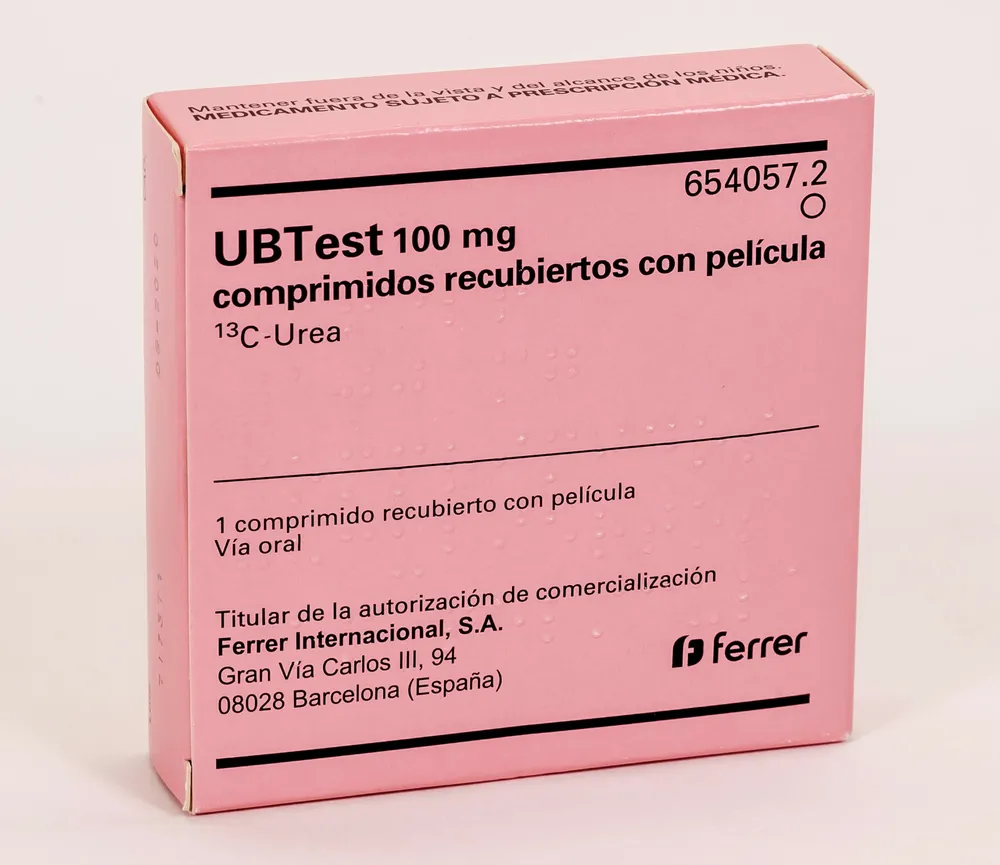
Table of Contents
- Patient Information Leaflet
- Introduction
- 1. What UBTest is and what it is used for
- 2. What you need to know BEFORE taking UBTest
- 3. How to TAKE UBTest
- 4. Possible adverse effects
- 5. Storage of UBTest
- 6. Contents of the pack and OTHER INFORMATION
- **Analysis of Breath Samples and Analytical Specifications**
- **Specifications for the determination of the 13C/12C ratio**
- **A) Validation of infrared spectrophotometry**
Patient Information Leaflet
Introduction
Patient Information Leaflet
UBTest 100mg film-coated tablets
Urea (13C)
Read the entire leaflet carefully before you start taking this medicine, as it contains important information for you.
- Keep this leaflet as you may need to read it again.
- If you have any questions, ask your doctor or pharmacist.
- This medicine has been prescribed for you; do not give it to others, even if they have the same symptoms, as it may harm them.
- If you consider any of the side effects you experience to be severe, or if you notice any side effects not listed in this leaflet, inform your doctor or pharmacist.
Leaflet Contents:
- What UBTest is and what it is used for
- What you need to know before taking UBTest
- How to take UBTest
- Possible side effects
- How to store UBTest
- Contents of the pack and other information
1. What UBTest is and what it is used for
This medicine is for diagnostic use only.
UBTest is a tablet for a breath test. It is used to determine whether the bacterium Helicobacter pylori (H. pylori) is present in your stomach. This type of bacteria can cause stomach problems. If this bacterium is present in your stomach, it will be detected by analyzing your breath samples.
2. What you need to know BEFORE taking UBTest
You must have fasted (not eaten or drunk anything) for at least eight hours before taking the test. Before the test, you should rest for 10 minutes.
Do not take UBTest
- If you are allergic (hypersensitive) to 13C-urea or any of the other components of UBTest.
Take special care with UBTest
- A positive breath test result with UBTest alone is not the sole basis for initiating treatment to eradicate H. pylori. Depending on factors such as your age, medical history, and symptoms, your doctor will decide whether further tests are needed to rule out possible complications.
- If you have a type of gastritis called atrophic gastritis, because the UBTest breath test may give a falsely positive result and additional tests may be required to confirm the presence of H. pylori.
- If the test needs to be repeated, for example, due to vomiting during the test, because it cannot be repeated until the following day.
- If you have undergone partial gastrectomy (surgical removal of part of the stomach), because the UBTest breath test is not recommended.
Children
There is insufficient information on the use of the UBTest breath test in children under 18 years of age. Therefore, its use is not recommended in children and adolescents.
Use of other medicines
To avoid falsely negative results, the UBTest breath test should not be used until four weeks after taking antibiotics and two weeks after the last dose of antacids (a type of medicine used to relieve heartburn). This is especially important if you have previously received antibiotic treatment for H. pylori infection.
If you are taking antibiotics or antacids, inform your doctor before undergoing the UBTest breath test.
Tell your doctor or pharmacist if you are using or have recently used any other medicines, including those obtained without a prescription.
Pregnancy and breastfeeding
The use of UBTest is not recommended if you are pregnant, possibly pregnant, or breastfeeding, as there is insufficient data on the use of this product.
Consult your doctor or pharmacist before using any medicine.
Driving and using machines
There are no known effects on the ability to drive and use machines.
Important information about some of the components of UBTest
This medicine contains lactose. If your doctor has informed you that you have an intolerance to certain sugars, consult with them before taking this medicine.
3. How to TAKE UBTest
Follow exactly the administration instructions for UBTest provided by your doctor. Consult your doctor or pharmacist if you have any questions.
The test takes approximately 30 minutes. The breath test must be performed in the presence of a qualified medical professional or under the supervision of a physician.
Special instructions for the UBTest breath test
- The test procedure begins with labeling the sample containers, and a breath sample will be collected to compare with the results after the test.
- Next, you will be required to take one tablet with 100 ml of water. The tablet must be swallowed quickly (within 5 seconds), whole; do not crush or chew it.
- You will be instructed to lie on your left side for 5 minutes, and then you must remain seated and still for the remainder of the test.
- After 20 minutes, a breath sample will be collected into a properly labeled sample container.
If you take more UBTest than you should
Urea (13C) is a substance naturally present in food. Even if you take a higher dose than recommended, no effects from this overdose are expected.
4. Possible adverse effects
Like all medicines, UBTest can cause adverse effects, although not everyone will experience them.
These symptoms (difficulty breathing, facial swelling, hives, skin rash, and flushing) could indicate a serious allergic reaction, and you should consult a doctor immediately.
Uncommon adverse effects (may affect up to 1 in 100 people)
- Abdominal swelling
- Diarrhea
- Increased blood potassium concentration
Rare adverse effects (may affect up to 1 in 1,000 people)
- Stomach pain
Frequency not known (cannot be estimated from available data)
- Difficulty breathing
- Facial swelling
- Hives (urticaria)
- Skin rash
- Flushing
- Nausea
- Vomiting
Reporting of adverse effects
If you experience any adverse effect, consult your doctor or pharmacist, even if it is a possible adverse effect not listed in this leaflet. You may also report them directly via the Spanish Pharmacovigilance System for Human Medicinal Products: www.notificaRAM.es. By reporting adverse effects, you can help provide more information on the safety of this medicine.
5. Storage of UBTest
Keep out of the reach and sight of children.
Do not use UBTest after the expiry date stated on the individual sachets and on the packaging after "EXP".
No special storage conditions are required.
Medicines must not be disposed of via wastewater or household waste. Dispose of unused medicines and their containers at the SIGRE Point in your pharmacy. If you have any doubts, ask your pharmacist how to properly dispose of unused medicines and their packaging. This will help protect the environment.
6. Contents of the pack and OTHER INFORMATION
Composition of UBTest
The active substance is urea (13C). One tablet of UBTest contains 100 mg of urea (13C).
The other components are:
- In the tablet core: lactose monohydrate, microcrystalline cellulose (E460), maize starch, magnesium stearate.
- In the film coating: hypromellose (E464), macrogol 8000, talc, titanium dioxide (E171).
Appearance of UBTest and contents of the pack
UBTest is a film-coated tablet, white in colour, with the inscription “OG 73” in relief on one side. UBTest is supplied in packs containing 1, 10, 20 or 100 sachets, each containing one tablet. Only certain pack sizes may be marketed.
Marketing Authorization Holder and Manufacturer
Marketing Authorization Holder:
Ferrer Internacional, S.A.
Gran Vía Carlos III, 94
08028 Barcelona (Spain)
Under license from Otsuka Pharmaceutical Co., Ltd.
Manufacturer:
Otsuka Pharmaceutical, S.A.
Avenida Diagonal, 609-615
08028 Barcelona
Spain
or
Ferrer Internacional, S.A.
Joan Buscallà, 1-9
08173 - Sant Cugat del Vallès (Barcelona)
Spain
Local representative:
Ferrer Farma, S.A.
Avenida Diagonal, 549, 5th floor
08029 Barcelona, Spain
This medicinal product is authorized in the Member States of the European Economic Area (EEA) under the following names:
Spain: UBTest 100 mg film-coated tablets
Date of the most recent revision of this summary: October 2013
Detailed and up-to-date information on this medicinal product is available on the website of the Spanish Agency of Medicines and Health Products (AEMPS): http://www.aemps.es/
This information is intended for healthcare professionals only.
The urea breath test must be performed in the presence of qualified medical personnel, preferably under the supervision of a physician. Depending on the analytical method used for determination, an appropriate container for breath samples (tube or bag) must be selected.
The analytical method will also determine the number of samples required at each sampling time point and the sample volume necessary for analysis.
The patient should attend the physician's office in the morning. The urea breath test must be performed with the patient fasting (both solids and liquids) for at least 8 hours, preferably overnight. The patient should rest for 10 minutes before the test.
The patient must remain seated during the test.
- The test procedure begins with labelling the sample containers and obtaining the baseline sample.
- The patient will gently but continuously exhale into the sample container, which must be closed immediately afterwards. If breath samples are to be analysed using infrared spectrophotometry, it is recommended that the patient hold their breath for a few seconds immediately before sample collection.
- Immediately after, the patient will swallow one whole UBTest 100 mg tablet without crushing or chewing it, together with 100 ml of water.
- The person performing the urea breath test must record the time of ingestion.
- The patient will then assume the left lateral decubitus position for 5 minutes, and afterwards remain seated, upright and calm until the second sample is collected.
- Twenty minutes after ingestion of the film-coated tablet, the second breath sample will be collected into the appropriately labelled container, as described in point 2.
Analysis of Breath Samples and Analytical Specifications
The enrichment of 13C in exhaled air is expressed as an absolute difference (Δ13CO2 value [‰]) between the 13C/12C ratio before administration of the tablet (baseline value) and 20 minutes after administration. A Δ13CO2 value equal to or greater than 2.5 ‰ indicates infection with H. pylori.
Two methods have been validated in clinical studies conducted to analyze the urea breath test: infrared spectrophotometry (IRIS) and online gas chromatography coupled with isotope ratio mass spectrometry (GC/IRMS).
In a Phase III clinical trial using UBTest 100 mg film-coated tablets, the urea breath test was performed in 130 patients infected with H. pylori and 124 patients not infected with H. pylori. Analysis by isotope ratio mass spectrometry of breath samples collected 20 minutes after administration of the film-coated tablet showed a diagnostic sensitivity of 97.7% [95% CI: 93.4 to 99.5%], a specificity of 98.4% [95% CI: 94.3 to 99.8%], and an accuracy of 98.0% [95% CI: 95.5 to 99.4%], using a cutoff value for Δ13C of 2.5‰.
It must be ensured that the CO2 concentration and the 13C/12C ratio do not change from the moment of exhalation until analysis of the breath samples. This occurs when containers with moisture traps are used. Such containers should be avoided.
Specifications for the determination of the 13C/12C ratio
A) Validation of infrared spectrophotometry
CO2 concentration range: 1% - 6%
Linearity: y = 1.01x - 0.20; r² = 1.000
Sensitivity: 0.5 ‰ (detection limit for Δ13C)
Reproducibility: SD: ± 0.5 ‰ or lower at a CO2 concentration of 3% in expired air
Accuracy: Measurement error: ± 0.5‰ or lower (in Δ13C: 0 - 50‰); Measurement error: ± 1 ‰ or lower (in Δ13C: 100‰)
- Validation of on-line gas chromatography with isotope ratio mass spectrometry
CO2 concentration range: 1% - 5% (for a breath sample volume of 10 ml)
Linearity: y = 1.0183x + 0.5686; r² = 1.000
Sensitivity: 0.2 ‰ (detection limit for Δ13C)
Reproducibility: SD (δ13C): ± 0.2‰ or lower at a CO2 concentration of 3% in expired air
Accuracy: SD (δ13C, n = 5): ± 0.3‰ or lower at a CO2 concentration between 1% and 5% in expired air
The reference gas must be normalized against an appropriate international reference standard to allow comparison of results between laboratories.
Explanation of results:
δ13C: difference in parts per thousand (‰) relative to an accepted international standard. Δ13C, Δ13CO2: difference between measurements from samples taken before and after administration of 13C-urea. A patient is diagnosed as uninfected if the Δ13CO2 value is below 2.5‰.