Tygacil 50 mg powder for solution for infusion
Spain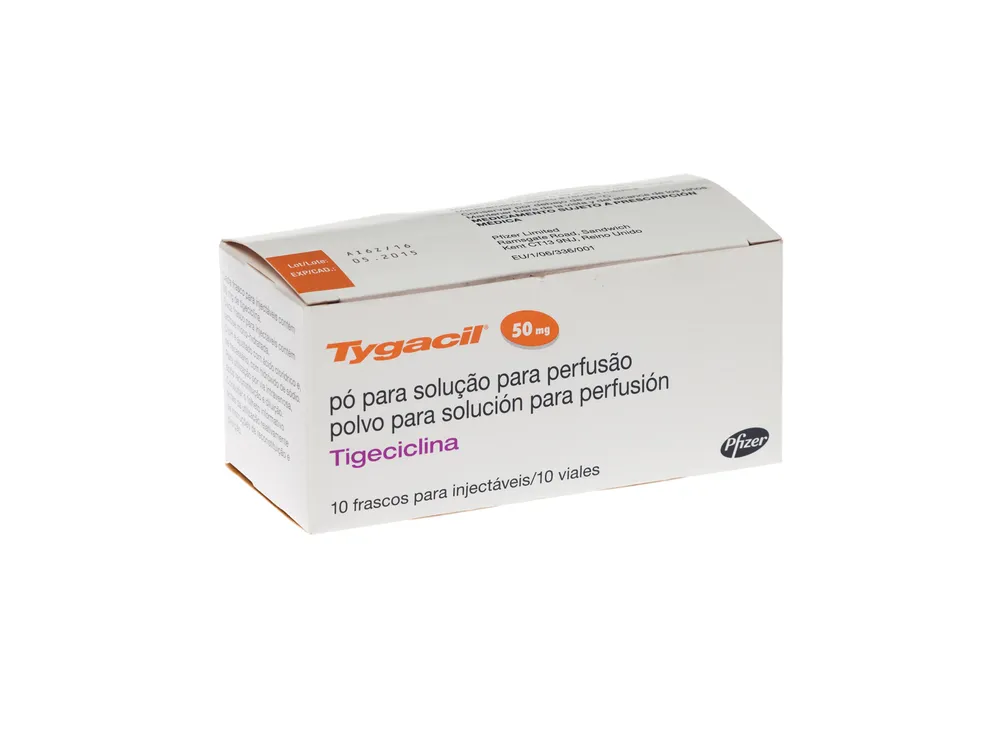
Table of Contents
Package leaflet: Information for the user
Introduction
Package leaflet: information for the user
Tygacil 50 mg powder for solution for infusion
tigecycline
Read all of this leaflet carefully before this medicine is administered to you or your child, because it contains important information for you.
- Keep this leaflet. You may need to read it again.
- If you have any questions, ask your doctor or nurse.
- If you experience any side effects, talk to your doctor or nurse, even if it is a side effect not listed in this leaflet. See section 4.
Contents of the leaflet
- What Tygacil is and what it is used for
- What you need to know before receiving Tygacil
- How to use Tygacil
- Possible side effects
- How to store Tygacil
- Contents of the pack and other information
1. What Tygacil is and what it is used for
Tygacil is an antibiotic belonging to the glycylcycline group that works by inhibiting the growth of the bacteria causing the infection.
Your doctor has prescribed Tygacil because you or your child is at least 8 years old and has one of the following serious types of infections:
-
Complicated skin and soft tissue infections (the tissue beneath the skin), excluding diabetic foot infections.
-
Complicated intra-abdominal infections.
Tygacil is only used when the doctor considers that alternative antibiotics are not suitable.
2. What you need to know before using Tygacil
Do not use Tygacil
- If you are allergic to tigecycline or to any of the other ingredients of this medicine (listed in section 6). If you are allergic to antibiotics belonging to the tetracycline group (e.g. minocycline, doxycycline, etc.), you may also be allergic to tigecycline.
Warnings and precautions
Inform your doctor or nurse immediately before taking Tygacil:
- If you have poor or delayed wound healing.
- If you have diarrhoea before taking Tygacil. If you develop diarrhoea during or after treatment, inform your doctor immediately. Do not take any medicine for diarrhoea without first consulting your doctor.
- If you have had or currently have any side effects from using antibiotics belonging to the tetracycline group (e.g. skin sensitivity to sunlight, staining of developing teeth, inflammation of the pancreas, or changes in certain laboratory tests used to monitor blood clotting).
- If you have or have previously had liver problems. Depending on the condition of your liver, your doctor may reduce the dose to avoid possible side effects.
- If you have biliary obstruction (cholestasis).
- If you have a bleeding disorder or are taking anticoagulant medicines, as this medicine may interfere with blood clotting.
During treatment with Tygacil:
- Inform your doctor immediately if you develop symptoms of an allergic reaction.
- Inform your doctor immediately if you develop severe abdominal pain, nausea, and vomiting. These may be symptoms of acute pancreatitis (inflammation of the pancreas that may cause severe abdominal pain, nausea, and vomiting).
- In certain serious infections, your doctor may consider using Tygacil in combination with other antibiotics.
- Your doctor will closely monitor you for the development of any additional bacterial infections. If you develop another bacterial infection, your doctor may prescribe a different antibiotic specific to the type of infection.
- Although antibiotics such as Tygacil target certain types of bacteria, other bacteria and fungi may continue to grow. This process is known as overgrowth. Your doctor will closely monitor you for any possible infections and treat you if necessary.
Children
Tygacil must not be used in children under 8 years of age due to the lack of safety and efficacy data in this age group and because it may cause permanent dental defects, such as staining of developing teeth.
Using Tygacil with other medicines
Tell your doctor if you are taking, have recently taken, or might need to take any other medicines.
Tygacil may prolong certain tests that measure whether your blood clots properly. It is important that you inform your doctor if you are taking certain medicines to prevent excessive blood clotting (called anticoagulants). If so, your doctor will monitor you closely.
Tygacil may interfere with the oral contraceptive pill (birth control pill). Ask your doctor about the need to use an additional contraceptive method while receiving treatment with Tygacil.
Tygacil may increase the effect of medicines used to suppress the immune system (such as tacrolimus or cyclosporine). It is important that you inform your doctor if you are taking these medicines so that you can be closely monitored.
Pregnancy and breastfeeding
Tygacil may harm the unborn baby. If you are pregnant or breastfeeding, think you may be pregnant, or are planning to become pregnant, consult your doctor before using Tygacil.
It is unknown whether Tygacil passes into breast milk. Consult your doctor before starting breastfeeding.
Driving and using machines
Tygacil may cause side effects such as dizziness. This could reduce your ability to drive or operate machinery.
Tygacil contains sodium
This medicine contains less than 1 mmol of sodium (23 mg) per 5 ml of solution; essentially “sodium-free”.
3. How to use Tygacil
Tygacil must be administered by a doctor or nurse.
The recommended dose of Tygacil in adults is an initial dose of 100 mg, followed by 50 mg every 12 hours. These doses are given intravenously (directly into the bloodstream) over a period of 30 to 60 minutes.
The recommended dose for children aged 8 to <12 years is 1.2 mg/kg administered intravenously every 12 hours, up to a maximum dose of 50 mg every 12 hours.
The recommended dose for adolescents aged 12 to <18 years is 50 mg administered every 12 hours.
The usual duration of treatment is 5 to 14 days. Your doctor will decide the appropriate duration of treatment for you.
If you receive more Tygacil than you should
If you think you may have received too much Tygacil, inform your doctor or nurse immediately.
If a dose of Tygacil is missed
If you are concerned that a dose has been missed, inform your doctor or nurse immediately.
4. Possible adverse effects
Like all medicines, this product may cause adverse effects, although not everyone experiences them.
Pseudomembranous colitis may occur with most antibiotics, including Tygacil. Pseudomembranous colitis is characterized by severe, persistent or bloody diarrhoea associated with abdominal pain or fever, which may be a sign of serious intestinal inflammation and may occur during or after treatment.
Very common adverse effects (may affect more than 1 in 10 people):
- Nausea, vomiting, diarrhoea.
Common adverse effects (may affect up to 1 in 10 people):
- Abscesses (accumulation of pus), infections.
- Abnormalities in certain laboratory tests indicating reduced blood clotting ability.
- Dizziness.
- Vein irritation at the injection site, including pain, inflammation, swelling and blood clot formation.
- Abdominal pain, dyspepsia (stomach pain and indigestion), anorexia (loss of appetite).
- Increased liver enzymes, hyperbilirubinemia (excess bilirubin in blood).
- Pruritus (itching), skin rash.
- Poor or delayed wound healing.
- Headache.
- Increased amylase levels (an enzyme found in the salivary glands and pancreas), increased blood urea nitrogen (BUN).
- Pneumonia.
- Low blood sugar levels.
- Sepsis (a serious infection affecting the whole body and blood) / septic shock (a life-threatening medical condition resulting from sepsis that may lead to multiple organ failure and death).
- Local reaction at the injection site (pain, redness, swelling).
- Low levels of protein in blood.
Uncommon adverse effects (may affect up to 1 in 100 people):
- Acute pancreatitis (inflammation of the pancreas causing severe abdominal pain, nausea and vomiting).
- Jaundice (yellowing of the skin), liver inflammation.
- Low platelet count in blood (which may lead to increased tendency to bleed and bruising).
Rare adverse effects (may affect up to 1 in 1,000 people):
- Low fibrinogen levels in blood (a protein involved in blood clotting).
Adverse effects with unknown frequency (frequency cannot be estimated from available data):
- Anaphylactic/anaphylactoid reactions (ranging from mild to severe, including sudden and generalized allergic reactions that may lead to life-threatening shock [e.g. difficulty breathing, decreased blood pressure, rapid pulse]).
- Liver failure.
- Skin rash, which may progress to blistering and severe skin peeling (Stevens-Johnson Syndrome).
Tigecycline belongs to the class of antibiotics known as tetracyclines, and therefore may cause similar adverse effects. These may include: fixed drug eruption (circular or oval patches of red, swollen skin), blister formation (urticarial wheal), and itching.
Reporting of adverse effects
If you experience any adverse effects, consult your doctor or nurse, even if they are possible adverse effects not listed in this leaflet. You can also report them directly through the national reporting system listed in Annex V. By reporting adverse effects, you can help provide more information on the safety of this medicine.
5. Storage of Tygacil
Keep this medicine out of the sight and reach of children.
Store below 25°C. Do not use this medicine after the expiry date stated on the vial. The expiry date refers to the last day of the month indicated.
Storage after preparation
Once the powder has been reconstituted and diluted and is ready for use, it should be administered immediately.
The Tygacil solution should be yellow to orange in colour after dissolution; if not, it must be discarded immediately.
Medicines must not be disposed of via wastewater or household waste. Ask your pharmacist how to dispose of medicines and packaging you no longer need. This will help protect the environment.
6. Contents of the pack and other information
Composition of Tygacil
The active substance is tigecycline. Each vial contains 50 mg of tigecycline.
The other components are lactose monohydrate, hydrochloric acid, and sodium hydroxide.
Appearance of Tygacil and contents of the pack
Tygacil is supplied as a powder for solution for infusion in vials containing orange-coloured powder or compacted powder before dilution. Tygacil is available in packs of ten vials. The powder must be mixed in the vial with a small amount of solution. The vial should be gently shaken until the medicine is dissolved. The solution should then be immediately withdrawn from the vial and added to a 100 ml intravenous infusion bag or another suitable hospital infusion container.
Marketing Authorization Holder Pfizer Europe MA EEIG Boulevard de la Plaine 17 1050 Bruxelles Belgium | Manufacturer Responsible Wyeth Lederle S.r.l. Via Franco Gorgone Z.I. 95100 Catania (CT) Italy |
You can request further information about this medicinal product by contacting the local representative of the marketing authorization holder:
Belgium/Belgium/Belgium Luxembourg/Luxembourg Pfizer NV/SA Tel/Tel: +32 (0)2 554 62 11 | Lithuania Pfizer Luxembourg SARL branch in Lithuania Tel. +370 5 251 4000 |
| Hungary Pfizer Kft. Tel: +36 1 488 37 00 |
Czech Republic Pfizer, spol. s r.o. Tel: +420-283-004-111 Denmark Pfizer ApS Tlf.: +45 44 20 11 00 | Malta Vivian Corporation Ltd. Tel: +356 21344610 Netherlands Pfizer BV Tel: +31 (0)800 63 34 636 |
Germany PFIZER PHARMA GmbH Tel: +49 (0)30 550055-51000 | Norway Pfizer AS Tlf: +47 67 52 61 00 |
Estonia Pfizer Luxembourg SARL Estonia branch Tel.: +372 666 7500 | Austria Pfizer Corporation Austria Ges.m.b.H. Tel: +43 (0)1 521 15-0 |
Greece Pfizer Hellas S.A. Tel.: +30 210 67 85 800 | Poland Pfizer Polska Sp. z o.o., Tel.: +48 22 335 61 00 |
Spain Pfizer, S.L. Tel: +34 91 490 99 00 | Portugal Laboratórios Pfizer, Lda. Tel: (+351) 21 423 5500 |
France Pfizer Tél +33 (0) 1 58 07 34 40 | Romania Pfizer Romania S.R.L Tel: +40 (0) 21 207 28 00 |
Croatia Pfizer Croatia d.o.o. Tel: +385 1 3908 777 | Slovenia Pfizer Luxembourg SARL Pfizer, branch for consulting in the field of pharmaceutical activities, Ljubljana Tel: +386 (0)1 52 11 400 |
Ireland Pfizer Healthcare Ireland Unlimited Company Tel: +1800 633 363 (toll free) Tel: +44 (0) 1304 616161 Iceland Icepharma hf. Simi: +354 540 8000 | Slovakia Pfizer Luxembourg SARL, organizational unit Tel: +421 2 3355 5500 Finland Pfizer Oy Puh/Tel: +358 (0)9 430 040 |
Italy Pfizer S.r.l. Tel: +39 06 33 18 21 | Sweden Pfizer AB Tel: +46 (0)8 550 520 00 |
Cyprus Pfizer Hellas S.A. (Cyprus Branch) Tel: +357 22817690 | |
Latvia Pfizer Luxembourg SARL branch Latvia Tel.: +371 670 35 775 |
Date of the most recent review of this summary
Detailed information on this medicine is available on the European Medicines Agency website: http://www.ema.europa.eu/.
The following information is intended for healthcare professionals only:
Instructions for use and handling (see also section 3. of the summary “How to use Tygacil”):
The powder must be reconstituted with 5.3 ml of sodium chloride 9 mg/ml (0.9%) injection solution, 50 mg/ml (5%) dextrose injection solution, or Ringer's lactate injection solution to achieve a concentration of 10 mg/ml of tigecycline. The vial should be gently shaken until the active substance is completely dissolved. Immediately thereafter, 5 ml of the reconstituted solution should be withdrawn from the vial and added to an intravenous infusion bag containing 100 ml, or to another appropriate infusion container (e.g. a glass vial).
To obtain a 100 mg dose, two vials should be reconstituted into an intravenous infusion bag of 100 ml or another appropriate infusion container (e.g. a glass vial).
Note: The vial contains a 6% overage. Thus, 5 ml of reconstituted solution are equivalent to 50 mg of active substance. The reconstituted solution should be yellow to orange in colour; if not, the solution must be discarded. Parenteral products should be inspected visually for particulate matter and discolouration (e.g. green or black particles) prior to administration.
Tigecycline must be administered intravenously via a dedicated line or through a Y-site. If the same intravenous line is used for sequential infusion of other active substances, the line must be flushed before and after tigecycline infusion with either 9 mg/ml (0.9%) sodium chloride injection solution or 50 mg/ml (5%) dextrose injection solution. The injection should be administered using an infusion solution compatible with tigecycline and any other drug administered through this common line.
Compatible intravenous solutions include: 9 mg/ml (0.9%) sodium chloride injection solution, 50 mg/ml (5%) dextrose injection solution, and Ringer's lactate injection solution.
When administration is performed via a Y-site, the compatibility of tigecycline diluted in 0.9% sodium chloride for injection has been established with the following drugs or diluents: amikacin, dobutamine, dopamine HCl, gentamicin, haloperidol, Ringer's lactate, lidocaine HCl, metoclopramide, morphine, norepinephrine, piperacillin/tazobactam (EDTA formulation), potassium chloride, propofol, ranitidine HCl, theophylline, and tobramycin.
Tygacil must not be mixed with other medicinal products for which compatibility data are not available.
Once reconstituted and diluted in an infusion bag or other suitable infusion container (e.g. a glass vial), tigecycline must be used immediately.
This medicine is intended for single-dose administration only; any unused solution must be discarded.