Tuberculin PPD Evans 2 UT/0.1 ml solution for injection
Spain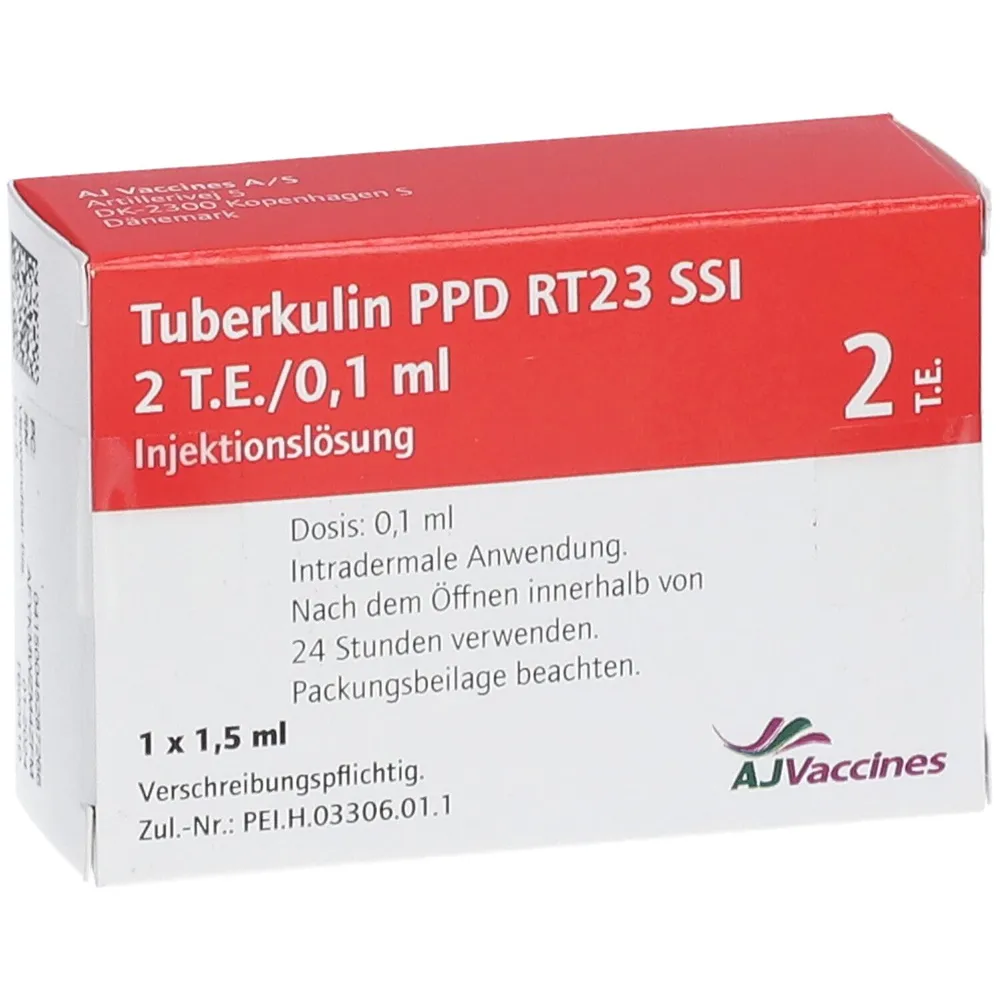
Table of Contents
- Package leaflet: Information for the user
- Introduction
- 1. What Tuberculina PPD Evans is and what it is used for
- 2. What you need to know before having a skin test with Tuberculin PPD Evans
- 3. How to Perform a Tuberculin Skin Test with Tuberculina PPD Evans
- 4. Possible adverse effects
- 5. Storage of Tuberculin PPD Evans
- 6. Package Contents and Additional Information
Package leaflet: Information for the user
Introduction
Package leaflet: Information for the user
Tuberculine PPD Evans 2UT/0.1ml solution for injection
Tuberculin PPD (Purified Protein Derivative)
Read all of this leaflet carefully before having a skin test because it contains important information for you
- Keep this leaflet as you may need to read it again.
- If you have any questions, ask your doctor, pharmacist or nurse.
- This medicine has been prescribed for you only, and you should not give it to other people, even if they have the same symptoms as you, because it could harm them.
- If you experience any adverse effects, consult your doctor, pharmacist or nurse, even if they are effects not listed in this leaflet. See section 4.
Contents of this leaflet:
- What Tuberculin PPD Evans is and what it is used for
- What you need to know before having a skin test with Tuberculin PPD Evans
- How to have a skin test with Tuberculin PPD Evans
- Possible side effects
- How to store Tuberculin PPD Evans
- Contents of the pack and other information
1. What Tuberculina PPD Evans is and what it is used for
This medicine is for diagnostic use only.
The active substance is tuberculin (purified protein derivative, batch RT 23). It is used as an aid in diagnosing, by means of the Mantoux test, whether an individual has been infected with the tuberculosis bacterium.
Tuberculina PPD Evans is supplied in 1.5 ml vials containing 30 TU (tuberculin units). Each dose (0.1 ml) contains 2 TU (tuberculin units).
2. What you need to know before having a skin test with Tuberculin PPD Evans
You should not have a test with Tuberculin PPD Evans
- if you are allergic to Tuberculin PPD RT 23 or to any of the other components of this medicine (listed in section 6).
- if you know from a previous test that you have been infected with the tuberculosis bacterium, you should not be given the tuberculin test, as a severe reaction may occur at the injection site.
- if you have previously experienced a severe local reaction to tuberculin products. A severe local reaction may include blistering and ulceration (wounds) at the injection site and skin necrosis (blackening of the skin due to cell death) in the central area of the tuberculin reaction. Necrosis usually resolves within a few days.
Warnings and precautions
Talk to your doctor, pharmacist, or nurse before having a skin test with Tuberculin PPD Evans.
- If you have recently been vaccinated against tuberculosis (BCG vaccine) or with any other type of vaccine.
Although acute allergic reactions (anaphylactic events) are extremely rare, appropriate facilities for managing such reactions must always be available when performing the skin test.
Subcutaneous or intramuscular injection of tuberculin should be avoided. If this occurs, no local reaction will develop, and general febrile symptoms may appear in highly sensitive individuals.
If acute anaphylactic symptoms (acute allergic reaction) occur after tuberculin injection, adrenaline (a vasoconstrictor medicine) will be administered immediately to relieve the symptoms of the allergic reaction.
Topical corticosteroid preparations may be applied to relieve local discomfort if a strong reaction occurs.
Other medicines and Tuberculin PPD Evans
Tell your doctor or pharmacist if you are taking, have recently taken, or might need to take any other medicines.
An individual's sensitivity to tuberculin may be reduced or temporarily disappear due to several factors, such as:
- being young (children) or elderly,
- malnutrition (nutrient deficiency states),
- immunosuppression (reduced immune defenses) due to disease (e.g., cancer) or medications (such as corticosteroids, drugs that reduce inflammation),
- viral infections (particularly measles, mononucleosis, chickenpox, and influenza).
If you have been vaccinated against measles, mumps, rubella, or with vaccines containing live viruses, the reaction to tuberculin may be reduced, potentially leading to false-negative results. You should wait 4 to 6 weeks after vaccination before undergoing the test, or have the test performed at the same time as vaccination.
Many HIV-positive patients infected with the tuberculosis bacterium do not react to tuberculin, although they may react to other types of skin tests.
In patients with severe tuberculosis (e.g., disseminated tuberculosis), the reaction to tuberculin may be suppressed.
Recent vaccination with BCG (tuberculosis vaccine) or recent infection with other bacteria belonging to the same family as the tuberculosis bacterium may lead to a false-positive result in the Mantoux test.
Use of Tuberculin PPD Evans RT23 2 U.T. with food and drink
No interactions with food and drink are known.
Pregnancy, breastfeeding, and fertility
If you are pregnant or breastfeeding, think you may be pregnant, or are planning to become pregnant, consult your doctor or pharmacist before having a skin test.
The use of the test for diagnosis of infection with the tuberculosis bacterium (Mantoux test) with Tuberculin PPD Evans is considered safe during pregnancy and breastfeeding.
Driving and using machines
Tuberculin PPD Evans has no effect or an effect that is negligible on the ability to drive and use machines.
Tuberculin PPD Evans contains potassium and sodium
This medicine contains less than 39 mg (1 mmol) of potassium per dose (0.1 ml), and is therefore considered essentially “potassium-free”.
This medicine contains less than 23 mg (1 mmol) of sodium per dose (0.1 ml); thus, it is essentially “sodium-free”.
3. How to Perform a Tuberculin Skin Test with Tuberculina PPD Evans
This test will be performed by a healthcare professional (physician or nurse).
The recommended dose is 0.1 ml for children and adults.
A healthcare professional will administer the tuberculin solution by injection into the superficial layer of the skin on the anterior surface of the arm. A white papule (raised area of skin) with a diameter of 8–10 mm will appear at the injection site, which will disappear after about 10 minutes. Subsequently, the area where the injection was given may become reddened, and within a few hours, induration (slight raised area of skin with a wheal) may appear at the center. Do not rub or scratch the area. Do not apply bandages or adhesive tape to the site.
Between 48 and 72 hours later, your doctor will examine the skin reaction and inform you of the test result. After approximately 72 hours, the size of the induration is expected to decrease.
These skin reactions are normal and expected with this test.
If you use more Tuberculina PPD Evans than you should:
In case of overdose or accidental ingestion, contact your doctor or pharmacist immediately or call the Toxicology Information Service at telephone number 91 562 04 20, indicating the medication and the amount ingested.
4. Possible adverse effects
Like all medicines, Tuberculina PPD Evans may cause adverse effects, although not everyone experiences them.
The adverse effects of Tuberculina PPD Evans are classified by frequency as follows:
Frequent (may affect up to 1 in 10 people):
? Pain
? Irritation
? Discomfort at the injection site (immediately after injection).
Uncommon (may affect up to 1 in 100 people):
? Headache
? Fever
? Swelling of regional lymph nodes.
Rare (may affect up to 1 in 1,000 people):
? Acute allergic reactions (anaphylactic reactions)
? Blistering (vesiculation)
? Urticaria
? Cutaneous necrosis (blackening of the area due to death of skin cells).
Frequency not known (cannot be estimated from available data):
? Ulcers at the injection site
Reporting of adverse effects
If you experience any type of adverse effect, consult your doctor, pharmacist, or nurse, even if it is a possible adverse effect not listed in this leaflet. You may also report them directly via the Spanish Pharmacovigilance System for Human Medicinal Products: www.notificaRAM.es. By reporting adverse effects, you can help provide more information on the safety of this medicine.
5. Storage of Tuberculin PPD Evans
Keep this medicine out of the sight and reach of children.
Do not use Tuberculin PPD Evans after the expiry date stated on the container after EXP. The expiry date refers to the last day of the month indicated.
Store in a refrigerator (between 2°C - 8°C). Keep in the original packaging to protect from light.
From a microbiological standpoint, the product should be used immediately. If after the first withdrawal the remaining medicine is not used immediately, the duration and conditions of storage during use are the responsibility of the user and should normally not exceed 24 hours at 2°C - 8°C.
Use after 24 hours from the first withdrawal is not recommended.
Medicines must not be disposed of via wastewater or household waste. Dispose of containers and unused medicines at the SIGRE collection point at your pharmacy. If in doubt, ask your pharmacist how to dispose of unused containers and medicines. This will help protect the environment.
6. Package Contents and Additional Information
Composition of Tuberculin PPD Evans
• The active substance is PPD tuberculin (purified protein derivative from RT 23 lot). Each 0.1 ml dose contains 2 TU (tuberculin units) = 0.04 micrograms of PPD tuberculin.
Each 1.5 ml vial contains 30 TU (tuberculin units) = 0.6 micrograms of PPD tuberculin.
• The other components are: disodium hydrogen phosphate dihydrate, sodium chloride, potassium dihydrogen phosphate, potassium hydroxyquinoline sulfate, polysorbate 80, and water for injectable preparations.
Appearance of the Product and Contents of the Container
Tuberculin PPD Evans for injection is a clear, colorless to pale yellow solution, free from particles.
Clear type 1 glass vials with chlorobutyl rubber stoppers: each vial contains 1.5 ml of Tuberculin PPD Evans solution.
Each pack contains 1 or 10 vials.
Only certain pack sizes may be marketed.
Marketing Authorization Holder and Manufacturer
AJ Vaccines A/S
Artillerivej 5
DK-2300 Copenhagen S
Denmark
Telephone: +45 7229 7000
Email: [email protected]
For further information about this medicinal product, please contact the local representative of the Marketing Authorization Holder:
MEDICARE PHARMA, S.L.
Pº de la Castellana, 177 3ºB
28046 Madrid
Spain
Tel. 91 339.54.89
Date of most recent review of this leaflet: 06/2019
This information is intended solely for physicians or healthcare professionals:
Guidelines for Correct Administration:
- For performing the test, short-bevel needles (25 or 26 gauge) and sterile, disposable, single-use 1 ml syringes graduated in tenths should be used.
- The rubber stopper of the vial should be cleaned with an alcohol-impregnated cotton swab. Insert the needle gently through the stopper, invert the vial, withdraw 0.1 ml, and eliminate air bubbles.
- Clean the skin of the forearm with alcohol and allow it to dry. Do not use any topical dermatological anesthetic products on the skin area where the tuberculin injection will be administered.
- The route of administration is intradermal, in the middle third of the anterior surface of the forearm. Administration close to the wrist or elbow joint may reduce the reaction.
- Slightly stretch the skin and insert the needle tip (keeping it almost parallel to the skin surface, bevel facing upward) into the superficial layer of the dermis, along the longitudinal axis of the forearm. The needle should remain visible through the epidermis during insertion.
- Inject slowly 0.1 ml, measured as precisely as possible. If correctly administered, a wheal of 8–10 mm in diameter will form, lasting approximately 10 minutes. If no wheal appears, the solution has been injected too deeply (subcutaneously) or too superficially, resulting in significant leakage of the dose from the injection site; in such cases, the test should be repeated on the other arm. If the same arm is used, the new injection site should be at least 4 cm away from the previous one.
- Each vial contains 1.5 ml, sufficient for several doses of 0.1 ml each. When testing multiple individuals simultaneously, a separate needle and 1 ml syringe must be used for each person.
The injection may cause induration surrounding the erythematous area within a few hours after administration.
Reading and Evaluation of the Reaction:
The reaction should be evaluated 48–72 hours after injection. After approximately 72 hours, the size of the induration is expected to decrease.
Reading is based on the presence or absence of induration.
A positive reaction to tuberculin is defined as a flat, irregular, slightly raised induration with a diameter of at least 5 mm, surrounded by a more or less well-defined reddened area. Only the induration should be assessed. The diameter of the induration, in millimeters, should be measured perpendicularly to the longitudinal axis of the forearm using a transparent, flexible plastic ruler.
An induration of 5 mm or more is considered positive in unvaccinated individuals, whereas in individuals vaccinated with BCG less than 10 years ago, an induration of 15 mm or more is required to be considered positive (no method is available to distinguish between tuberculin reaction caused by BCG vaccination and that caused by mycobacterial infections).
According to current criteria, the test will be considered positive depending on the individual's risk of tuberculosis. The following are the induration size criteria for considering a tuberculin reaction as positive:
Induration ≥ 5 mm:
• HIV-positive patients
• Individuals with recent cases of tuberculosis (less than two years)
• Radiological evidence of prior tuberculosis
• Organ transplant recipients and other immunosuppressed patients (receiving the equivalent of more than 15 mg/day of prednisone for over one month)
Induration ≥ 10 mm:
• Residents or employees of the following institutions: prisons, nursing homes, hospitals and other healthcare facilities, drug rehabilitation centers, and homeless shelters
• Individuals with conditions considered to be at risk, such as: silicosis, diabetes, chronic renal failure, hematological malignancies, gastrectomized patients or those with intestinal bypass, intestinal malabsorption syndrome, prolonged steroid therapy, low body weight (defined as 10% or less of ideal body weight), cancer (e.g., head and neck, lung)
• History of drug use (e.g., cocaine, alcohol)
• HIV-negative parenteral drug users
• Immigrants (arrived within the last five years) from countries with high tuberculosis prevalence
• Children under 4 years of age, or children and adolescents exposed to high-risk adults
Induration ≥ 15 mm:
• Individuals without risk factors for tuberculosis
Repeat Tuberculin Testing:
If repeat Mantoux testing is likely, for example in healthcare workers potentially exposed to tuberculosis infection, a two-step method is recommended. Individuals with an initially weak or negative tuberculin skin test should undergo a second tuberculin skin test 2 to 4 weeks after the first. The result of the second test will be considered the valid result.
Booster Effect:
In most individuals not vaccinated with BCG, sensitivity to tuberculin persists throughout life. However, in some individuals, this sensitivity may diminish or disappear over time (see section 4.5).
In individuals vaccinated with BCG, sensitivity to tuberculin decreases after several years. If tuberculin is administered to BCG-vaccinated individuals or to M. tuberculosis-infected individuals with diminished sensitivity, the reaction to the first test may be weak or even absent. If the test is repeated 7–10 days later, the response may be enhanced. This is interpreted as a booster effect—a reinforcement of the weakened immune response to tuberculin (not absent)—and should not be interpreted as tuberculin conversion. The result of the second test will be considered valid.
Repeated tuberculin skin tests do not induce a positive reaction in individuals who lack prior cell-mediated immunity to PPD RT 23 antigens.
Tuberculin Conversion:
Tuberculin does not cause sensitization, even when administered multiple times. Therefore, if a previously negative individual tests positive, this indicates tuberculin conversion due to tuberculous infection.
Recent tuberculin conversion or conversion is defined as a change from negative to positive within less than two years, or an increase in induration diameter of 6 mm or more compared to the first test, with a second test induration exceeding 10 mm. This indicates recent acquisition of tuberculous infection, provided the booster effect has been ruled out.
Causes of False Results:
False Negatives: Causes may include viral infections (measles, mumps, chickenpox, HIV), bacterial infections (typhoid fever, brucellosis, typhus, leprosy), or fungal infections (South American blastomycosis), live virus vaccinations (measles, mumps, polio, varicella), metabolic disorders (chronic renal failure, diabetes), low protein states (severe protein loss, afibrinogenemia), diseases affecting lymphoid organs (Hodgkin's disease, lymphoma, chronic leukemia, sarcoidosis), medications (corticosteroids and other immunosuppressants), age (neonates, elderly patients with reduced sensitivity), stress (surgery, burns, mental illness), incorrect use of tuberculin (improper storage, incorrect dilution, chemical denaturation of tuberculin, contamination), errors in administration technique (injection of too small an antigen amount, subcutaneous injection, delay in performing the test after preparation, performing the test too close to other skin tests), or errors in reading the test.
The Mantoux test may be negative in disseminated tuberculosis.
False Positives: Causes may include infections with atypical mycobacteria, previous BCG vaccination, technical errors, preparation errors, or improper storage of the product.
In elderly individuals, the response may appear later, at 72 hours, but this does not invalidate the reading.