Trialmin 900 mg film-coated tablets
Spain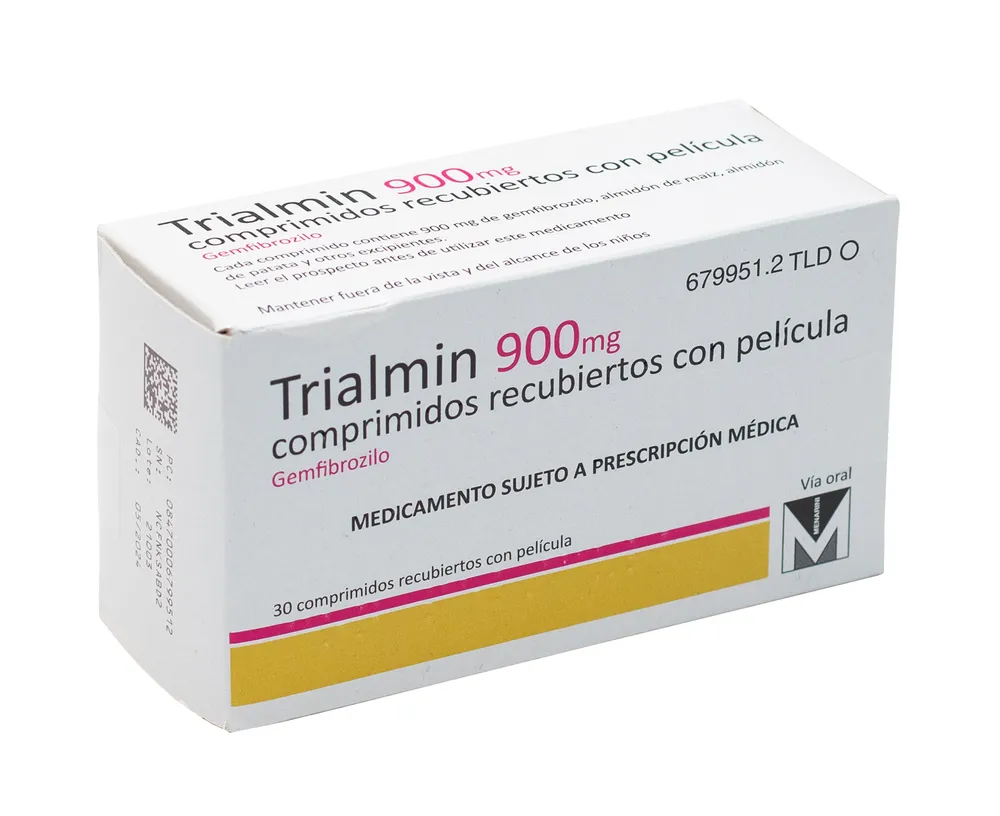
Table of Contents
Package leaflet: Information for the user
Introduction
Package leaflet: information for the user
Trialmin 900 mg film-coated tablets
gemfibrozil
Read the entire leaflet carefully before you start taking this medicine, as it contains important information for you.
- Keep this leaflet, as you may need to read it again.
- If you have any questions, ask your doctor or pharmacist.
- This medicine has been prescribed for you only, and you should not give it to others, even if they have the same symptoms as you, because it could harm them.
- If you experience any adverse effects, consult your doctor or pharmacist, even if they are adverse effects not listed in this leaflet. See section 4.
Leaflet contents
- What Trialmin is and what it is used for
- What you need to know before taking Trialmin
- How to take Trialmin
- Possible side effects
- How to store Trialmin
- Contents of the pack and other information
1. What TRIALMIN 900 mg tablets are and what they are used for
Trialmin belongs to a group of medicines commonly known as fibrates. These medicines are used to reduce the level of fats (lipids) in the blood, such as fats called triglycerides.
Trialmin is used, together with a low-fat diet and other non-medical treatments such as exercise and weight loss, to reduce fat levels in the blood.
Trialmin may be used when other medicines [statins] are not suitable, to reduce the risk of heart problems in men at high risk and who have higher levels of "bad cholesterol".
Trialmin may also be prescribed to reduce blood cholesterol levels in people who cannot be prescribed other lipid-lowering medicines.
2. What you need to know before taking Trialmin
Do not take Trialmin:
- If you are allergic to gemfibrozil or to any of the other ingredients of this medicine (listed in section 6);
- If you have hepatic insufficiency;
- If you have severe renal insufficiency;
- If you have a history of, or have suffered from, gallbladder or biliary tract disease, including gallstones;
- If you are taking repaglinide (a medicine used in the treatment of type 2 diabetes);
- If you have a history of photosensitivity or phototoxic reactions (skin disorders when exposed to sunlight) during treatment with fibrates (other cholesterol-lowering medicines in the same class as gemfibrozil).
Warnings and precautions
Consult your doctor or pharmacist before starting Trialmin.
- If you experience muscle pain, tenderness, or weakness, inform your doctor immediately.
This risk is higher in patients taking Trialmin together with a medicine that increases Trialmin blood levels, thereby increasing the risk of muscle disorders. (see section 2. Use of other medicines).
- Inform your doctor if you have renal insufficiency, hypothyroidism, are over 70 years old, have a family history of, or have previously experienced, muscle disorders, or if you regularly consume alcohol, as these factors may increase the risk of muscle disorders.
- If you are at risk of developing gallstones.
- If you are taking hypoglycemic medicines (for the treatment of diabetes).
- If you are taking anticoagulant medicines (to prevent blood clots in veins).
Your doctor may want to perform blood tests or liver function tests to ensure your liver is working properly before and during treatment with gemfibrozil.
Other medicines and Trialmin
Inform your doctor or pharmacist if you are taking, have recently taken, or might need to take any other medicines.
Do not take Trialmin at the same time as the following medicines:
- Repaglinide (see section 2. Do not take Trialmin)
Certain medicines may interact with Trialmin; in such cases, it may be necessary to adjust the dose or discontinue treatment with one of them.
It is important that you inform your doctor if you are taking or have recently taken any of the following medicines:
- HMG-CoA reductase inhibitors or statins (medicines used to treat high blood cholesterol);
- Hypoglycemic medicines (medicines for treating type 2 diabetes);
- Rosiglitazone (a medicine for treating type 2 diabetes);
- Anticoagulant medicines;
- Bexarotene (an anticancer medicine);
- Resins (medicines used to treat high blood cholesterol).
Pregnancy, breastfeeding, and fertility
If you are pregnant or breastfeeding, think you may be pregnant, or are planning to become pregnant, consult your doctor or pharmacist before using this medicine.
It is unknown whether Trialmin is safe in pregnant women; therefore, Trialmin should only be used during pregnancy when, in the opinion of your doctor, the expected therapeutic benefits justify its use.
It is unknown whether Trialmin is excreted in human breast milk; therefore, Trialmin should not be used during breastfeeding.
Driving and using machines
There is no evidence that Trialmin impairs the ability to drive or operate machinery. However, in isolated cases, dizziness and visual disturbances may occur, which could negatively affect driving ability. Therefore, do not drive until you know how you tolerate the treatment.
Trialmin contains sodium
This medicine contains less than 23 mg of sodium (1 mmol) per tablet; this is essentially “sodium-free”.
3. How to take Trialmin
Follow exactly the instructions given by your doctor or pharmacist for taking this medicine. If in doubt, consult your doctor or pharmacist again.
The recommended dose is 900 to 1,200 mg per day.
The 1,200 mg dose is taken as 600 mg twice daily, half an hour before breakfast and dinner. The 900 mg dose is taken as a single dose half an hour before dinner.
Remember to take your medicine. Your doctor will determine how long you should continue treatment with Trialmin. Do not stop treatment prematurely, even if you begin to feel better.
If you think that the effect of Trialmin is too strong or too weak, do not change the dose yourself; inform your doctor or pharmacist.
Use in children and adolescents
Trialmin is not recommended for use in children and adolescents.
Elderly patients
No dose adjustment is required for patients over 65 years of age.
If you take more Trialmin than you should
In case of overdose or accidental ingestion, contact your doctor or pharmacist immediately or call the Toxicology Information Service at telephone number 91 562 04 20, indicating the name of the medicine and the amount ingested.
If you forget to take Trialmin
Do not take a double dose to make up for missed doses.
If you have any further questions about the use of this medicine, ask your doctor or pharmacist.
4. Possible adverse effects
Like all medicines, this medicine may produce adverse effects, although not everyone experiences them.
The adverse effects observed are:
Very common (approximately in 7% of patients): Indigestion (dyspepsia).
Common (less than 1 in 10 but more than 1 in 100): Abdominal pain, diarrhoea, gas (flatulence), nausea, vomiting, constipation, dizziness, headache, eczema, rashes, and fatigue.
Uncommon (less than 1 in 100 but more than 1 in 1,000): Heart rhythm disorders (atrial fibrillation).
Rare (less than 1 in 1,000 but more than 1 in 10,000): Blood disorders, dizziness, somnolence, tingling (paraesthesia), nerve inflammation (peripheral neuritis), depression, reduced libido, blurred vision, inflammation of the pancreas (pancreatitis), appendicitis, blockage of the gallbladder (cholestatic jaundice), liver function abnormalities, gallstones (cholelithiasis), inflammation of the gallbladder (cholecystitis), rashes (dermatitis, urticaria), itching (pruritus), hair loss (alopecia), joint pain (arthralgia), inflammation of the joint membranes (synovitis), muscle pain (myalgia, myopathy, myasthenia, myositis), limb pain, impotence, allergic skin reaction to light (photosensitivity), allergic inflammation of the eyes and lips, which may also affect the hands, feet, and throat (angioedema), and inflammation of the larynx (laryngeal oedema).
Reporting of adverse effects
If you experience any type of adverse effect, consult your doctor or pharmacist, even if they are possible adverse effects not listed in this leaflet. You may also report them directly via the Spanish Pharmacovigilance System for Human Medicines: https://www.notificaram.es. By reporting adverse effects, you can help provide more information on the safety of this medicine.
5. Storage of Trialmins
No special storage conditions are required.
Keep this medicine out of the sight and reach of children.
Do not use this medicine after the expiry date which is stated on the packaging after EXP. The expiry date is the last day of the month indicated.
Medicines must not be disposed of via wastewater or household waste. Dispose of unused medicines and their containers at the SIGRE collection point at the pharmacy. If you are unsure, ask your pharmacist how to dispose of medicines and containers you no longer need. This will help protect the environment.
6. Contents of the container and additional information
Composition of Trialmin:
- The active substance is gemfibrozil. Each tablet contains 900 mg of gemfibrozil.
- The other components (excipients) are:
Excipients of the core: pregelatinized corn starch, colloidal silica (E-551), polysorbate 80 (E-433), magnesium stearate (E-572), sodium carboxymethyl starch type A (from potato), silicon dioxide, and microcrystalline cellulose (E-460(i)).
Excipients of the coating: hypromellose (E-464), titanium dioxide (E-171), macrogol 6000, and talc (E-553(b)).
Appearance of the product and contents of the container:
Trialmin is presented as film-coated tablets, biconvex elliptical white tablets with a shiny surface. Each container contains 30 or 500 tablets (hospital pack).
Only some pack sizes may be marketed.
Marketing Authorization Holder and Manufacturer
Laboratorios Menarini, S.A.
C/ Alfons XII 587 E 08918 - Badalona (Barcelona)
-
- 34 934 628 800 e-mail: [email protected]
Date of the most recent review of this leaflet: 05/2021
Other sources of information
Detailed and up-to-date information on this medicinal product is available on the website of the Spanish Agency for Medicines and Health Products (AEMPS) (http://www.aemps.gob.es/)