Treosulfan Zentiva 5 g powder for solution for infusion EFG
SpainTable of Contents
- Package leaflet: Information for the user
- Introduction
- 1. What Treosulfan Zentiva is and what it is used for
- 2. What you need to know before using Treosulfan Zentiva
- 3. How to use Treosulfan Zentiva
- 4. Possible adverse effects
- 5. Storage of Treosulfan Zentiva
- 6. Contents of the container and other information
Package leaflet: Information for the user
Introduction
Package leaflet: information for the user
Treosulfan Zentiva 5 g powder for solution for infusion EFG
Read all of this leaflet carefully before you start using this medicine, because it contains important information for you.
- Keep this leaflet, as you may need to read it again.
- If you have any questions, ask your doctor or nurse.
- If you experience any adverse reactions, consult your doctor or nurse, even if they are not listed in this leaflet. See section 4.
Contents of the leaflet
- What Treosulfan Zentiva is and what it is used for
- What you need to know before you use Treosulfan Zentiva
- How to use Treosulfan Zentiva
- Possible side effects
- How to store Treosulfan Zentiva
- Contents of the pack and other information
1. What Treosulfan Zentiva is and what it is used for
Treosulfan Zentiva contains the active substance treosulfan. Treosulfan belongs to the group of alkylating agents. These agents work by stopping the growth of cancer cells.
Treosulfan Zentiva has been prescribed by your doctor for the treatment of advanced ovarian cancer after at least one prior standard therapy.
2. What you need to know before using Treosulfan Zentiva
Do not use Treosulfan Zentiva:
- if you are allergic to treosulfan;
- if you have insufficient blood cells (severe bone marrow suppression);
- if you are breastfeeding.
Before each administration, a blood test must be performed to verify that you have enough blood cells to receive Treosulfan Zentiva.
Warnings and precautions
Talk to your doctor or nurse before starting treatment with Treosulfan Zentiva:
Bone marrow damage and blood count monitoring
The dose-limiting adverse reaction of treosulfan is suppression of bone marrow function, which usually resolves after treatment is discontinued. This manifests as a reduction in white blood cells (leukocytes) and platelets (thrombocytes), and a decrease in red blood cells (hemoglobin).
Since bone marrow function disorders accumulate, your doctor will monitor your blood counts at shorter intervals starting from the third cycle. This is especially important when combined with other therapies that affect the bone marrow, such as radiotherapy. If bone marrow function is impaired, there is an increased risk of infection.
In general, white blood cells (leukocytes) and platelets (thrombocytes) return to baseline levels within 28 days.
Pulmonary toxicity
Difficulty breathing, cough, or high fever may indicate lung disease. If there are severe limitations in lung function, such as inflammation, scarring, or infections, treatment with treosulfan must be discontinued.
You should consider the following aspects while undergoing treatment with Treosulfan Zentiva:
- your risk of developing certain types of infection increases;
- different types of blood cancer may occur after prolonged treatment;
- if you have kidney problems, treosulfan is excreted through the kidneys; therefore, strict monitoring of your blood counts is required and your dose may need to be adjusted;
- cancer treatment may increase the risk of generalized infection following certain vaccinations. Therefore, you must avoid live vaccines;
- due to the potential development of bladder inflammation causing pain, increased frequency or urgency of urination, with or without blood in the urine (hemorrhagic cystitis), you are advised to drink more fluids than usual for up to 24 hours after your treosulfan treatment;
- if you are a woman of childbearing age, you must also use effective contraceptive methods (i.e., pregnancy prevention) during treatment and for six months after treatment (see section Pregnancy and breastfeeding).
Extravasation
Infusion of treosulfan must be performed using a safe technique, as extravasation of the treosulfan solution into surrounding tissue may cause inflammatory and painful reactions at the injection site. If extravasation occurs, the infusion must be stopped immediately and the remaining dose administered into another vein.
Other medicines and Treosulfan Zentiva
Inform your doctor if you are taking, have recently taken, or might need to take any other medicines, including over-the-counter medications and herbal remedies.
The effect of treatment with ibuprofen/chloroquine may be reduced when administered concomitantly with Treosulfan Zentiva.
Pregnancy and breastfeeding
If you are pregnant or breastfeeding, think you may be pregnant, or plan to become pregnant, consult your doctor before using this medicine. There are no data, or data are limited, regarding the use of Treosulfan Zentiva 5 g powder for solution for infusion in pregnant or breastfeeding women.
Pregnancy
Because fetal harm cannot be ruled out, Treosulfan Zentiva 5 g powder for solution for infusion must not be used during pregnancy unless your doctor considers it absolutely necessary. You must not become pregnant during treatment with Treosulfan Zentiva 5 g powder for solution for infusion.
If you become pregnant during treatment with Treosulfan Zentiva 5 g powder for solution for infusion, you must inform your doctor immediately.
Contraception in women
During treatment and for six months after treatment with Treosulfan Zentiva 5 g powder for solution for infusion, you must use adequate contraceptive methods if you are of childbearing age.
Breastfeeding
Since transfer of the substance into breast milk cannot be ruled out, you must not breastfeed during treatment with Treosulfan Zentiva 5 g powder for solution for infusion.
Driving and use of machines
No studies have been conducted on the effects on the ability to drive and use machines. Do not drive or operate machinery if you experience nausea and vomiting, as these effects may impair your ability to drive or operate machinery.
3. How to use Treosulfan Zentiva
Treosulfan Zentiva is normally administered by a doctor or nurse directly into the bloodstream. Your doctor will calculate the correct dose for you, which will be given as an intravenous infusion over 15 to 30 minutes.
Your doctor will determine the correct dose of Treosulfan Zentiva based on the values of your blood counts. Your doctor may reduce your dose if you have previously received another anticancer medicine or radiotherapy treatment. The dose will also depend on your body size and will vary according to your body surface area.
During treatment with Treosulfan Zentiva, infusions are usually administered every 3 to 4 weeks. In general, 6 treatment cycles are given.
Your doctor may adjust the dose and frequency of your treatment based on the results of your blood tests, your general condition, any additional treatments you are receiving, and your response to treatment with Treosulfan Zentiva. If in doubt, please consult your doctor or nurse.
If you experience pain at the injection site, inform your doctor or nurse immediately.
Use in children
Use in children is not recommended.
If you receive more Treosulfan Zentiva than you should
If you have been given too high a dose of this medicine, you may feel unwell or your blood cells may be reduced. Your doctor may administer a blood transfusion and take other necessary measures.
If you have any questions about how to use this medicine, ask your doctor, pharmacist, or nurse.
In case of overdose or accidental ingestion, contact your doctor or pharmacist immediately or call the Toxicology Information Service at telephone number: 91 562 04 20, indicating the medicine and the amount ingested.
4. Possible adverse effects
Like all medicines, this medicine can cause adverse effects, although not everyone experiences them. If you experience any adverse effect, it is important to inform your doctor before the next treatment.
Contact your doctor immediately if you notice any of the following symptoms:
- Allergic reactions [rare (may affect up to 1 in 1,000 people)]: if you develop itching, skin rash, swelling of the face, lips, tongue, and/or throat, which may cause difficulty swallowing or breathing, or a drop in blood pressure.
- Fever or infection [very common (may affect more than 1 in 10 people)]: if your body temperature is 38°C or higher, you experience sweating, or notice any other signs of infection (you may have lower than normal white blood cell counts).
- Weakness [very common (may affect more than 1 in 10 people)], difficulty breathing, or if your skin becomes pale (you may have lower than normal red blood cell counts).
- Bleeding [very common (may affect more than 1 in 10 people)] from gums, mouth, or nose, or unusual bruising (you may have lower than normal platelet counts).
- Difficulty breathing [very rare (may affect up to 1 in 10,000 people)] (you may have an allergic reaction, lung inflammation, or lung infection).
Very common adverse effects (may affect more than 1 in 10 people):
- Reduction in white blood cells (increases risk of infection), platelets (may cause bruising and bleeding from gums, mouth, and nose), and red blood cells (may cause paleness, weakness, and difficulty breathing) – therefore, regular blood count monitoring is required.
- Gastrointestinal problems, including nausea (feeling sick), with or without vomiting (being sick).
- Mild hair loss. After treatment ends, normal hair growth returns.
- Bronze-like skin discoloration.
Common adverse effects (may affect up to 1 in 10 people):
- Infections caused by fungi, viruses, or bacteria (may lead to fever, sweating, and general malaise).
- Gastrointestinal discomfort.
Uncommon adverse effects (may affect up to 1 in 100 people):
- Different types of blood cancer (after long-term treatments).
- Inflammation of the oral mucous membrane (stomatitis).
Rare adverse effects (may affect up to 1 in 10,000 people):
- Severe and simultaneous reduction in all blood cells (pancytopenia); may cause weakness and bruising, and increase the risk of infection.
- Addison’s disease, a condition in which the adrenal glands do not function properly, resulting in bronze-colored skin, stomach discomfort, low blood pressure (dizziness), and a general feeling of weakness.
- Sweating, tremors, and hunger due to a drop in blood glucose levels (hypoglycemia).
- Tingling and numbness (paresthesia).
- Heart muscle weakness due to structural changes (cardiomyopathy).
- Difficulty breathing (lung inflammation, scarring, and lung infections).
- Increased liver function test values (may cause fatigue, feeling of pressure in the upper right abdomen, and yellowing of the skin and whites of the eyes).
- Hives or itchy rash; skin inflammation with or without scaling (scleroderma and psoriasis), skin redness (erythema).
- Bladder inflammation, causing pain or more frequent and urgent urination, with or without blood in the urine (hemorrhagic cystitis).
- Feeling unwell (flu-like symptoms).
- Painful redness or swelling at the injection site (if treosulfan solution leaks and comes into contact with the skin).
Frequency not known: cannot be estimated from available data
- Septicemia (sepsis).
Inform your doctor or nursing staff immediately if you notice any of the symptoms listed above.
Reporting of adverse effects
If you experience any adverse effect, talk to your doctor or nurse, even if it is a possible adverse effect not listed in this leaflet. You can also report them directly via the Spanish Pharmacovigilance System for Human Medicines: https://www.notificaram.es. By reporting adverse effects, you can help provide more information on the safety of this medicine.
5. Storage of Treosulfan Zentiva
Keep this medicine out of the sight and reach of children.
Do not use this medicine after the expiry date stated on the packaging after EXP. The expiry date refers to the last day of the month indicated.
After reconstitution, do not store the medicine in the refrigerator (2 - 8°C), as precipitation may occur. Do not use if the solution contains precipitates.
Do not refrigerate.
Physicochemical stability in use has been demonstrated for 12 hours at 30°C. From a microbiological standpoint, unless reconstitution has been carried out under controlled and validated aseptic conditions, the product should be used immediately. Otherwise, the in-use storage times and conditions prior to use are the responsibility of the user.
Medicines should not be disposed of via wastewater or household waste. Ask your pharmacist how to dispose of medicines and packaging that you no longer need. This will help protect the environment.
6. Contents of the container and other information
Composition of Treosulfan Zentiva
- The active substance is treosulfan. Each vial contains 5 g of treosulfan.
- After reconstitution, each milliliter of solution contains 50 mg of treosulfan.
Appearance of the product and contents of the pack
White crystalline powder or compact aggregate supplied in clear glass vials, each vial containing 5 g of treosulfan.
The powder is reconstituted with water for injections in the vial to form a solution prior to administration.
Treosulfan Zentiva is available in packs containing 1 vial or 5 vials.
Vials with or without a plastic shrink wrap with protective base (disc). The shrink wrap does not come into contact with the product and provides additional protection during transport. It also improves safe handling of the product by healthcare professionals.
Marketing Authorization Holder
Zentiva k.s.,
U kabelovny 130,
Prague 10 – Dolní Mecholupy,
102 37 Czech Republic
Manufacturer
MIAS Pharma Limited
Suite 2, Stafford House, Strand Road
Portmarnock, Co. Dublin
Ireland
Tillomed Malta Limited,
Malta Life Sciences Park,
LS2.01.06 Industrial Estate,
San Gwann, SGN 3000, Malta
Further information on this medicinal product is available from the local representative of the Marketing Authorization Holder:
Zentiva Spain S.L.U.
Avenida de Europa, 19, Edificio 3, Planta 1
28224 Pozuelo de Alarcón, Madrid
Spain
This medicinal product is authorized in the Member States of the European Economic Area under the following names:
Germany | Treosulfan Tillomed 5g powder for solution for infusion |
France | Treosulfan Tillomed 5g powder for solution for infusion |
Spain | Treosulfan Zentiva 5 g powder for solution for infusion EFG |
Austria: | Treosulfan Tillomed 5g powder for solution for infusion |
Czech Republic: | Treosulfan Tillomed |
Greece: | Treosulfan Tillomed 5g powder for solution for infusion |
Poland: | Treosulfan Tillomed |
Romania: | Treosulfan Tillomed 5g powder for solution for infusion |
Denmark: | Treosulfan Tillomed |
Finland: | Treosulfan Tillomed 5g powder for solution for infusion |
Norway: | Treosulfan Tillomed 5g powder for solution for infusion |
Sweden: | Treosulfan Tillomed 5g powder for solution for infusion |
Belgium: | Treosulfan Tillomed 5g powder for solution for infusion Treosulfan Tillomed 5g powder for solution for infusion Treosulfan Tillomed 5g powder for solution for infusion |
Ireland: | Treosulfan Tillomed 5g powder for solution for infusion |
Netherlands: | Treosulfan Tillomed 5g powder for solution for infusion |
Portugal: | Treosulfan Tillomed 5g powder for solution for infusion |
Date of last review of this summary: May 2025
Detailed information on this medicine is available on the website of the Spanish Agency of Medicines and Health Products (AEMPS) (http://www.aemps.gob.es/)
This information is intended for healthcare professionals only:
For single use only.
Handling and disposal procedures for cytotoxic drugs:
- Only trained personnel should reconstitute the solution.
- A designated preparation area must be available for this purpose.
- Personnel must wear appropriate protective clothing, masks, and gloves.
- Precautions must be taken to avoid accidental contact of the drug with the eyes. If the solution comes into contact with skin or eyes, immediately rinse the affected area thoroughly with abundant water or saline solution. A cream may be used to treat transient skin irritation. In case of ocular irritation, consult an ophthalmologist.
- Pregnant individuals must not handle this medication.
- Adequate precautions must be taken for the disposal of materials used in the reconstitution of cytotoxic drugs (syringes, needles, etc.).
- Work surfaces must be covered with disposable plastic and absorbent paper.
- Use Luer-lock fittings for all equipment and syringes. Large-bore needles are recommended to minimize pressure and the potential for aerosol formation. The latter can also be reduced by using a venting needle.
Instructions for reconstitution of Treosulfan Zentiva
To avoid solubility issues during reconstitution, the following points should be considered:
- The solvent, water for injection, should be warmed to 25–30°C using a water bath.
- Treosulfan must be carefully removed from the inner surface of the infusion vial by swirling.
This procedure is very important because wetting of powder adhering to the surface may result in clumping. If clumping occurs, the vial should be shaken vigorously.
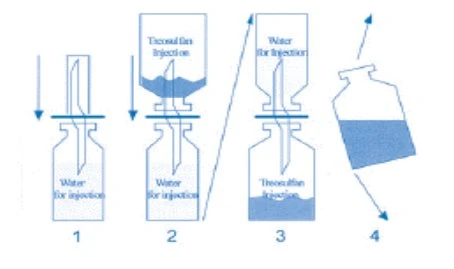
- One end of the cannula is inserted into the rubber stopper of the water vial, and the treosulfan vial is then placed upside down onto the other end of the cannula.
Rotate the entire system to allow water to flow into the lower vial while gently agitating.
Following these instructions, the reconstitution process should take no more than 2 minutes. See the diagram below to assist in the reconstitution process: