Tremfya 200 mg concentrate for solution for infusion
Spain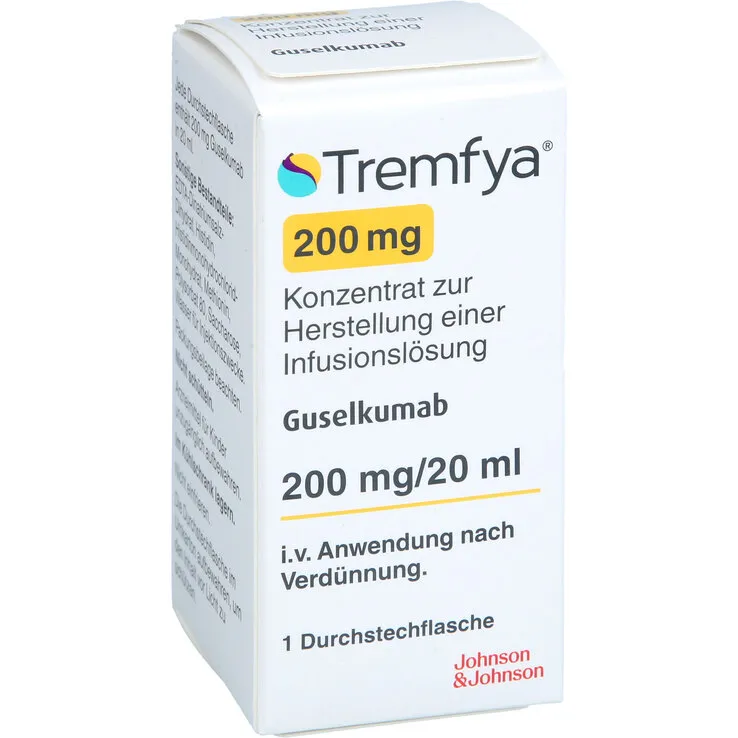
Table of Contents
Package leaflet: Information for the user
Introduction
Package leaflet: information for the user
Tremfya 200 mg concentrate for solution for infusion
guselkumab
Read the entire leaflet carefully before you start using this medicine, because it contains important information for you.
- Keep this leaflet, as you may need to read it again.
- If you have any questions, ask your doctor, pharmacist, or nurse.
- This medicine has been prescribed for you only, and you should not give it to other people, even if they have the same symptoms as you, because it may harm them.
- If you experience any adverse reactions, consult your doctor, pharmacist, or nurse, even if they are adverse reactions not listed in this leaflet. See section 4.
Contents of the leaflet
- What Tremfya is and what it is used for
- What you need to know before using Tremfya
- How to use Tremfya
- Possible side effects
- How to store Tremfya
- Contents of the pack and other information
1. What Tremfya is and what it is used for
Tremfya contains the active substance guselkumab, which is a type of protein called a monoclonal antibody.
This medicine works by blocking the activity of a protein called IL-23, which is present in higher amounts in people with ulcerative colitis or Crohn's disease.
Ulcerative colitis
Tremfya is used to treat adults with moderate to severe ulcerative colitis, an inflammatory bowel disease. If you have ulcerative colitis, you will first be given other medicines. If you do not respond adequately or cannot tolerate these medicines, Tremfya may be given to you.
The use of Tremfya in ulcerative colitis may benefit you by reducing the signs and symptoms of the disease, including bloody stools, the urgent need to go to the bathroom and the number of times you go, abdominal pain, and inflammation of the intestinal lining. These effects may improve your ability to carry out normal daily activities and reduce fatigue.
Crohn's disease
Tremfya is used to treat adults with moderate to severe Crohn's disease, an inflammatory bowel disease. If you have Crohn's disease, you will first be given other medicines. If you do not respond adequately or cannot tolerate these medicines, Tremfya may be given to you.
The use of Tremfya in Crohn's disease may benefit you by reducing the signs and symptoms of the disease, such as diarrhea, abdominal pain, and inflammation of the intestinal lining. These effects may improve your ability to carry out normal daily activities and reduce fatigue.
2. What you need to know before using Tremfya
Do not use Tremfya
- If you are allergic to guselkumab or to any of the other ingredients of this medicine (listed in section 6). If you think you may be allergic, consult your doctor before using Tremfya.
- If you have an active infection, including active tuberculosis.
Warnings and precautions
Talk to your doctor, pharmacist, or nurse before starting Tremfya:
- if you are receiving treatment for an infection;
- if you have a persistent infection or one that has recurred;
- if you have tuberculosis or have been in close contact with someone who has tuberculosis;
- if you think you have an infection or symptoms of an infection (see “Monitoring for infections and allergic reactions” below);
- if you have recently been vaccinated or need to receive a vaccine during treatment with Tremfya.
If you are unsure whether any of the above conditions apply to you, speak with your doctor, pharmacist, or nurse before using Tremfya.
As directed by your doctor, blood tests may be needed before and during treatment with Tremfya to check whether your liver enzyme levels are elevated. Increases in liver enzymes may occur more frequently in patients receiving Tremfya every 4 weeks than in those receiving Tremfya every 8 weeks (see “How to use Tremfya” in section 3).
Monitoring for infections and allergic reactions
Tremfya has the potential to cause serious adverse reactions, including allergic reactions and infections. You should monitor for signs of these conditions while receiving Tremfya.
Signs or symptoms of infection may include fever or flu-like symptoms; muscle aches; cough; difficulty breathing; burning sensation when urinating or more frequent urination than usual; blood in the sputum (mucus); weight loss; diarrhea or stomach pain; skin that is hot, red, or painful, or sores on the body.
Serious allergic reactions have occurred with Tremfya. Symptoms may include swelling of the face, lips, mouth, tongue, or throat, difficulty swallowing or breathing, dizziness or lightheadedness, or hives (see “Serious adverse reactions” in section 4).
Stop using Tremfya and contact your doctor or seek immediate medical help if you notice any sign suggesting a possible serious allergic reaction or infection.
Children and adolescents
Do not administer this medicine to children or adolescents under 18 years of age, as the medicine has not been studied in this age group.
Other medicines and Tremfya
Inform your doctor or pharmacist:
- if you are taking, have recently taken, or might need to take any other medicines.
- if you have recently been vaccinated or if you need to be vaccinated. You should not receive certain types of vaccines (live organism vaccines) while using Tremfya.
Pregnancy and breastfeeding
- Tremfya should not be used during pregnancy, as the effects of this medicine in pregnant women are unknown. If you are a woman of childbearing potential, you are advised to avoid becoming pregnant and to use an effective method of contraception during treatment with Tremfya and for at least 12 weeks after the last dose of Tremfya. Inform your doctor if you are pregnant, think you may be pregnant, or plan to become pregnant.
- Inform your doctor if you are breastfeeding or plan to breastfeed. You and your doctor should decide whether you can breastfeed or use Tremfya.
Driving and using machines
It is unlikely that Tremfya will affect your ability to drive or operate machinery.
Tremfya contains polysorbate 80
This medicine contains 10 mg of polysorbate 80 per vial, equivalent to 0.5 mg/ml. Polysorbates may cause allergic reactions. Inform your doctor if you have any known allergies.
Tremfya contains sodium
This medicine contains less than 1 mmol of sodium (23 mg) per dose, which is essentially “sodium-free.”
However, before administering Tremfya, it is mixed with a solution containing sodium. Talk to your doctor if you are on a low-salt diet.
3. How to use Tremfya
Tremfya is intended to be used under the guidance and supervision of a physician experienced in the diagnosis and treatment of ulcerative colitis and Crohn's disease.
How much Tremfya to use and for how long
Your doctor will decide how long you need to use Tremfya.
Ulcerative colitis
Starting treatment:
Treatment initiation can be done either via intravenous infusion or subcutaneous administration:
- Intravenous infusion: the first dose of Tremfya is 200 mg, administered by your doctor or nurse as an intravenous infusion (a drip into a vein in the arm). After the first dose, you will receive a second dose 4 weeks later and a third dose 4 weeks after that.
- Subcutaneous administration: the first dose of Tremfya is 400 mg, administered under the skin (subcutaneous injection) at different body sites. After the first dose, you will receive a second dose 4 weeks later and a third dose 4 weeks after that.
Maintenance treatment:
You will receive a maintenance dose of Tremfya by subcutaneous injection (injection under the skin) of either 100 mg or 200 mg. Your doctor will decide which maintenance dose you will receive:
- A dose of 100 mg will be administered 8 weeks after the third induction dose, and then every 8 weeks thereafter.
- A dose of 200 mg will be administered 4 weeks after the third induction dose, and then every 4 weeks thereafter.
Crohn's disease:
Starting treatment:
Treatment initiation can be done either via intravenous infusion or subcutaneous administration:
- Intravenous infusion: the first dose of Tremfya is 200 mg, administered by your doctor or nurse as an intravenous infusion (a drip into a vein in the arm). After the first dose, you will receive a second dose 4 weeks later and a third dose 4 weeks after that.
- Subcutaneous administration: the first dose of Tremfya is 400 mg, administered under the skin (subcutaneous injection) at different body sites. After the first dose, you will receive a second dose 4 weeks later and a third dose 4 weeks after that.
Maintenance treatment:
You will receive a maintenance dose of Tremfya by subcutaneous injection (injection under the skin) of either 100 mg or 200 mg. Your doctor will decide which maintenance dose you will receive:
- A dose of 100 mg will be administered 8 weeks after the third induction dose, and then every 8 weeks thereafter.
- A dose of 200 mg will be administered 4 weeks after the third induction dose, and then every 4 weeks thereafter.
If you use more Tremfya than you should
If you have received more Tremfya than you should, or if the dose was administered earlier than prescribed, inform your doctor.
If you forget to use Tremfya
If you have forgotten to inject a dose of Tremfya, inform your doctor.
If you stop using Tremfya
Do not stop using Tremfya without first talking to your doctor. If you discontinue treatment, your symptoms may return.
If you have any further questions about the use of this medicine, ask your doctor, pharmacist, or nurse.
4. Possible side effects
Like all medicines, this medicine can cause side effects, although not everybody gets them.
Serious side effects
Stop using Tremfya and speak to your doctor or seek immediate medical help if you experience any of the following side effects:
Possible severe allergic reaction (may affect up to 1 in 1,000 people) – signs or symptoms may include:
- difficulty breathing or swallowing
- swelling of the face, lips, tongue, or throat
- intense itching of the skin, with a red rash or raised bumps
- dizziness, low blood pressure (hypotension), or feeling faint
Other side effects
The following side effects are all mild to moderate. If any of these side effects become severe, consult your doctor, pharmacist, or nurse immediately.
Very common (may affect more than 1 in 10 people)
- respiratory tract infections
Common (may affect up to 1 in 10 people)
- headache
- joint pain (arthralgia)
- diarrhea
- increased blood levels of liver enzymes
- skin rash
- redness, irritation, or pain at the injection site
Uncommon (may affect up to 1 in 100 people)
- decrease in the number of a type of white blood cells called neutrophils
- herpes simplex infections
- fungal skin infections, for example between the toes (e.g., athlete’s foot)
- stomach upset (gastroenteritis)
- hives
Rare (may affect up to 1 in 1,000 people)
- allergic reaction
Reporting of side effects
If you experience any side effect, talk to your doctor, pharmacist, or nurse, including any possible side effects not listed in this leaflet. You can also report them directly through the national reporting system included in Appendix V. By reporting side effects, you can help provide more information on the safety of this medicine.
5. Storage of Tremfya
Tremfya 200 mg concentrate for solution for infusion is administered in a hospital or clinic, and patients must not store or handle it.
Keep this medicine out of the sight and reach of children.
Do not use this medicine after the expiry date stated on the vial label and outer packaging after “EXP”. The expiry date refers to the last day of the month indicated.
Store the vial in its outer packaging to protect it from light.
Store in a refrigerator (2 °C to 8 °C). Do not freeze.
Do not shake.
Do not use this medicine if it appears cloudy, shows a change in colour, or contains large particles.
This medicine is for single use only.
Medicines must not be disposed of via wastewater or household waste. Ask your pharmacist how to dispose of medicines and packaging you no longer need. This helps protect the environment.
6. Contents of the container and additional information
Composition of Tremfya
- The active substance is guselkumab. Each vial contains 200 mg of guselkumab in 20 ml of solution.
- The other components are disodium EDTA dihydrate, histidine, monohydrochloride monohydrate of histidine, methionine, polysorbate 80 (E433), sucrose, and water for injectable preparations (see section 2, “Tremfya contains polysorbate 80”).
Appearance of the product and contents of the container
Tremfya is a clear, colorless to pale yellow, intravenous infusion solution.
Each pack contains 1 vial.
Marketing Authorization Holder
Janssen-Cilag International NV
Turnhoutseweg 30
B-2340 Beerse
Belgium
Manufacturer responsible
Janssen Biologics B.V.
Einsteinweg 101
2333CB Leiden
The Netherlands
For further information about this medicinal product, please contact the local representative of the Marketing Authorization Holder:
Belgium/Belgium/Belgium Janssen-Cilag NV Tel/Tel: +32 14 64 94 11 | Lithuania UAB "JOHNSON & JOHNSON" Tel: +370 5 278 68 88 |
| Luxembourg/Luxembourg Janssen-Cilag NV Tel/Tel: +32 14 64 94 11 |
Czech Republic Janssen-Cilag s.r.o. Tel: +420 227 012 227 | Hungary Janssen-Cilag Kft. Tel.: +36 1 884 2858 |
Denmark Janssen-Cilag A/S Tlf.: +45 4594 8282 | Malta AM MANGION LTD Tel: +356 2397 6000 |
Germany Janssen-Cilag GmbH Tel: 0800 086 9247 / +49 2137 955 6955 | Netherlands Janssen-Cilag B.V. Tel: +31 76 711 1111 |
Estonia UAB "JOHNSON & JOHNSON" Estonian Branch Tel: +372 617 7410 | Norway Janssen-Cilag AS Tlf: +47 24 12 65 00 |
Greece Janssen-Cilag Φαρμακευτική Μονοπρόσωπη Ε.Ε.Β.Ε. Tel: +30 210 80 90 000 | Austria Janssen-Cilag Pharma GmbH Tel: +43 1 610 300 |
Spain Janssen-Cilag, S.A. Tel: +34 91 722 81 00 | Poland Janssen-Cilag Polska Sp. z o.o. Tel.: +48 22 237 60 00 |
France Janssen-Cilag Tél: 0 800 25 50 75 / +33 1 55 00 40 03 | Portugal Janssen-Cilag Farmacêutica, Lda. Tel: +351 214 368 600 |
Croatia Johnson & Johnson S.E. d.o.o. Tel: +385 1 6610 700 | Romania Johnson & Johnson România SRL Tel: +40 21 207 1800 |
Ireland Janssen Sciences Ireland UC Tel: 1 800 709 122 | Slovenia Johnson & Johnson d.o.o. Tel: +386 1 401 18 00 |
Iceland Janssen-Cilag AB c/o Vistor ehf. Tel: +354 535 7000 | Slovakia Johnson & Johnson, s.r.o. Tel: +421 232 408 400 |
Italy Janssen-Cilag SpA Tel: 800.688.777 / +39 02 2510 1 | Finland Janssen-Cilag Oy Tel/Tel: +358 207 531 300 |
Cyprus Barnabas Hadjipanagis Ltd Tel: +357 22 207 700 | Sweden Janssen-Cilag AB Tfn: +46 8 626 50 00 |
Latvia UAB "JOHNSON & JOHNSON" Latvian Branch Tel: +371 678 93561 |
Date of the most recent review of this summary:
Detailed information on this medicine is available on the website of the European Medicines Agency: https://www.ema.europa.eu, and on the website of the Spanish Agency of Medicines and Medical Devices (AEMPS) (http://www.aemps.gob.es/).

Tremfya 200 mg concentrate for solution for infusion
guselkumab
This information is intended for healthcare professionals only.
Traceability
In order to improve the traceability of biological medicinal products, the name and batch number of the administered medicine should be clearly recorded.
Tremfya 200 mg/20 ml (10 mg/ml) vial for intravenous infusion
Tremfya intravenous infusion solution must be diluted, prepared, and infused by a healthcare professional using an aseptic technique. Each vial is for single use only.
Visually inspect Tremfya for particles and discoloration prior to administration. Tremfya is a clear, colorless to pale yellow solution that may contain small translucent particles. Do not use if the solution contains large particles, is discolored, or appears cloudy.
Instructions for dilution and administration
Add Tremfya to a 250 ml intravenous infusion bag of 0.9% sodium chloride injectable solution as follows:
- Remove and then discard 20 ml of 0.9% sodium chloride injectable solution from the 250 ml infusion bag, equal to the volume of Tremfya to be added.
- Withdraw 20 ml of Tremfya from the vial and add it to the 250 ml intravenous infusion bag of 0.9% sodium chloride injectable solution to achieve a final concentration of 0.8 mg/ml. Gently mix the diluted solution. Discard the vial with any remaining solution.
- Visually inspect the diluted solution for particles and discoloration before infusion. Infuse the diluted solution over at least one hour.
- Use only an intravenous infusion set with an in-line, sterile, pyrogen-free, low protein-binding filter (pore size 0.2 micrometers).
- Do not co-infuse Tremfya simultaneously through the same intravenous line with other medicinal products.
- Dispose of any unused medicine and all materials that have come into contact with it according to local regulations.