Trelegy Ellipta 92 micrograms/55 micrograms/22 micrograms powder for inhalation (single dose)
Spain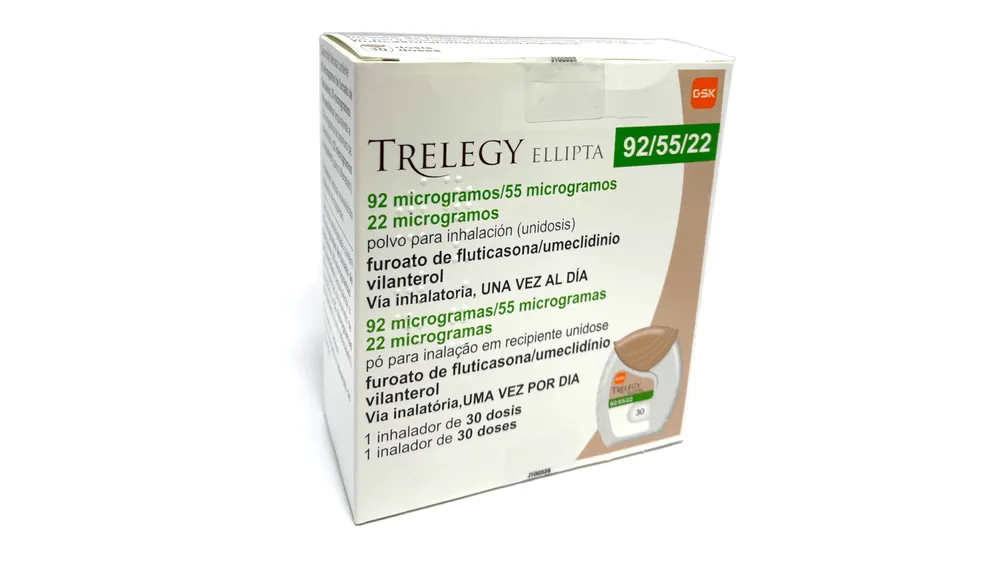
Table of Contents
Package leaflet: Information for the user
Introduction
Package leaflet: information for the user
Trelegy Ellipta 92 micrograms/55 micrograms/22 micrograms inhalation powder, single dose
fluticasone furoate/umeclidinium/vilanterol
Read the entire leaflet carefully before you start using this medicine, because it contains important information for you.
- Keep this leaflet, as you may need to read it again.
- If you have any questions, ask your doctor, pharmacist or nurse.
- This medicine has been prescribed for you only, and you must not give it to other people, even if they have the same symptoms as you, because it may harm them.
- If you experience any side effects, talk to your doctor, pharmacist or nurse, even if they are side effects not listed in this leaflet. See section 4.
Contents of the leaflet
- What Trelegy Ellipta is and what it is used for
- What you need to know before you use Trelegy Ellipta
- How to use Trelegy Ellipta
- Possible side effects
- How to store Trelegy Ellipta
- Contents of the pack and other information
Step-by-step instructions for use
1. What Trelegy Ellipta is and what it is used for
What Trelegy Ellipta is
Trelegy Ellipta contains three active substances called fluticasone furoate, umeclidinium bromide, and vilanterol.
Fluticasone furoate belongs to a group of medicines known as corticosteroids, often referred to simply as steroids.
Umeclidinium bromide and vilanterol belong to a group of medicines called bronchodilators.
What Trelegy Ellipta is used for
Trelegy Ellipta is used to treat chronic obstructive pulmonary disease (COPD ) in adults. COPD is a chronic disease that slowly worsens and is characterized by causing difficulty in breathing.
In COPD, the muscles surrounding the airways contract, making it difficult to breathe. This medicine relaxes the muscles in the lungs, reduces swelling and irritation in the smaller airways, and helps air flow in and out of the lungs more easily. When used regularly, it helps control breathing difficulties and reduces the impact of COPD on your daily life.
Trelegy Ellipta should be used every day and not only when you have breathing problems or other symptoms of COPD. It should not be used to relieve a sudden attack of breathlessness or wheezing. If you experience such attacks, you should use a fast-acting inhaler (such as salbutamol). If you do not have a fast-acting inhaler, contact your doctor.
2. What you need to know before using Trelegy Ellipta
Do not use Trelegy Ellipta
- if you are allergic to fluticasone furoate, umeclidinium, vilanterol, or any of the other ingredients of this medicine (listed in section 6).
Warnings and precautions
Talk to your doctor before starting to use Trelegy Ellipta
- if you have asthma (do not use Trelegy Ellipta to treat asthma)
- if you have heart problems or high blood pressure
- if you have liver problems
- if you have pulmonary tuberculosis (TB) or any other long-standing or untreated infection
- if you have a condition of the eye called narrow-angle glaucoma
- if you have enlarged prostate, difficulty passing urine, or bladder obstruction
- if you suffer from epilepsy
- if you have thyroid gland problems
- if you have low potassium levels in the blood
- if you have a history of diabetes
- if you experience blurred vision or other visual disturbances.
Talk to your doctor if you think any of the above conditions apply to you.
Urgent breathing difficulties If you experience chest tightness, cough, wheezing, or difficulty breathing immediately after using your Trelegy Ellipta inhaler:
stop using this medicine and seek immediate medical attention, as you may have a serious condition called paradoxical bronchospasm.
Eye problems during treatment with Trelegy Ellipta
If you experience eye pain or discomfort, blurred vision, colored halos or images, or redness of the eyes during treatment with Trelegy Ellipta:
stop using this medicine and seek immediate medical help. These symptoms may be due to an acute attack of narrow-angle glaucoma.
Lung infection
If you are using this medicine to treat COPD, you may have an increased risk of developing a lung infection known as pneumonia. See section 4, "Possible side effects," for information about symptoms to watch for while using this medicine.
Contact your doctor as soon as possible if you develop any of these symptoms.
Children and adolescents
This medicine must not be given to children or adolescents under 18 years of age.
Other medicines and Trelegy Ellipta
Tell your doctor or pharmacist if you are taking, have recently taken, or might need to take any other medicines. If you are unsure about the contents of your medicine, consult your doctor or pharmacist.
Some medicines may affect how this medicine works, or may increase the likelihood of side effects. These include:
- medicines called beta-blockers (such as propranolol), used to treat high blood pressure or other heart conditions
- ketoconazole or itraconazole, used to treat fungal infections
- clarithromycin or telithromycin, used to treat bacterial infections
- ritonavir or cobicistat, used to treat HIV
- medicines that lower potassium levels in the blood, such as certain diuretics or certain medicines used to treat COPD and asthma (such as methylxanthines or steroids)
- other long-acting medicines for respiratory conditions similar to this medicine, for example, tiotropium, indacaterol. Do not use Trelegy Ellipta if you are already taking these medicines.
Talk to your doctor or pharmacist if you are taking any of these medicines. Your doctor may carry out careful monitoring if you are taking any of these medicines, as they may increase the side effects of Trelegy Ellipta.
Pregnancy and breastfeeding
If you are pregnant or breastfeeding, think you may be pregnant, or are planning to become pregnant, consult your doctor before using this medicine. Do not use this medicine during pregnancy unless your doctor has instructed you to do so.
It is not known whether the components of Trelegy Ellipta pass into breast milk. If you are breastfeeding, you should consult your doctor before using Trelegy Ellipta. Do not use this medicine while breastfeeding unless your doctor has instructed you to do so.
Driving and using machines
It is unlikely that this medicine will affect your ability to drive or operate machinery.
Trelegy Ellipta contains lactose
If your doctor has informed you that you have an intolerance to certain sugars, consult with them before using this medicine.
3. How to use Trelegy Ellipta
Follow exactly the instructions for using this medicine as given by your doctor. If in doubt, consult your doctor or pharmacist again.
The recommended dose is one inhalation every day, at the same time each day. You only need one inhalation per day, as the effect of this medicine lasts for 24 hours.
Do not use more medicine than your doctor has prescribed.
Use Trelegy Ellipta regularly
It is very important that you use Trelegy Ellipta every day as instructed by your doctor. This will help you to avoid symptoms throughout the day and night.
Trelegy Ellipta must not be used to relieve a sudden attack of breathlessness or wheezing. If you have such an attack, you must use a fast-acting "rescue" inhaler (such as salbutamol).
How to use the inhaler
For complete information, read the “Step-by-step instructions for use” at the end of this leaflet.
Trelegy Ellipta is for inhalation use only.
Trelegy Ellipta is ready to use once the tray is opened.
If symptoms do not improve
If your COPD symptoms (breathlessness, wheezing, cough) do not improve or worsen, or if you are using your fast-acting "rescue" inhaler more often than usual:
contact your doctor as soon as possible.
If you use more Trelegy Ellipta than you should
If you accidentally use more medicine than you should, contact your doctor or pharmacist immediately, as you may need medical attention. If possible, show them the inhaler, the packaging, or your leaflet. You may notice your heart beating faster than normal, feel shaky, experience visual disturbances, have a dry mouth, or have a headache.
If you forget to use Trelegy Ellipta
Do not inhale a double dose to make up for a missed dose. Inhale the next dose at your usual time. If you have wheezing or breathlessness, use your fast-acting "rescue" inhaler (for example, salbutamol), and seek medical advice.
If you stop using Trelegy Ellipta
Use this medicine for as long as your doctor has recommended. Do not stop using it until your doctor tells you to, even if you feel better, as your symptoms may worsen.
If you have any further questions about the use of this medicine, ask your doctor, pharmacist, or nurse.
4. Possible side effects
Like all medicines, this medicine can cause side effects, although not everybody gets them.
Allergic reactions
Allergic reactions to Trelegy Ellipta are rare (may affect up to 1 in 1,000 people).
If you experience any of the symptoms listed below after taking Trelegy Ellipta, stop using it and contact your doctor immediately:
- skin rash or redness, hives (urticaria)
- swelling, sometimes of the face or mouth (angioedema)
- wheezing, coughing, or difficulty breathing
- sudden feeling of weakness or dizziness (which may lead to collapse or loss of consciousness).
Urgent breathing problems
If your breathing or wheezing worsens immediately after using this medicine, stop using it and seek medical help immediately.
Pneumonia (lung infection) in patients with COPD (common side effect)
If you experience any of the symptoms listed below while using Trelegy Ellipta, consult your doctor. These could be symptoms of a lung infection:
- fever or chills
- increased mucus production, change in the colour of phlegm
- increased cough or increased difficulty breathing.
Other side effects
Common (may affect up to 1 in 10 people)
- mouth ulcers, lumps (bumps) in the mouth or throat caused by a fungal infection (candidiasis). Rinsing the mouth with water immediately after using Trelegy Ellipta may help prevent this side effect
- infection of the nose, sinuses, or throat
- upper respiratory tract infection
- itching, runny or blocked nose
- pain at the back of the mouth and throat
- sinus inflammation
- lung inflammation (bronchitis)
- flu
- common cold
- headache
- cough
- painful and frequent urination (may be signs of urinary tract infection)
- joint pain
- back pain
- constipation.
Uncommon (may affect up to 1 in 100 people)
- irregular heartbeat
- faster heartbeat
- hoarseness
- weakening of the bones that may lead to fractures
- dry mouth
- altered taste
- blurred vision
- increased eye pressure
- eye pain.
Rare (may affect up to 1 in 1,000 people)
- allergic reactions (see above in Section 4)
- difficulty passing urine (urinary retention)
- pain or discomfort when passing urine (dysuria)
- awareness of heartbeat (palpitations)
- anxiety
- tremor
- muscle spasms
- increased blood sugar (hyperglycaemia).
Reporting of side effects
If you get any side effects, talk to your doctor, pharmacist, or nurse. This includes any possible side effects not listed in this leaflet. You can also report them directly through the national reporting system listed in Appendix V. By reporting side effects, you can help provide more information on the safety of this medicine.
5. Storage of Trelegy Ellipta
Keep this medicine out of the sight and reach of children.
Do not use this medicine after the expiry date stated on the pack after EXP. The expiry date is the last day of the month indicated.
Do not store above 30 °C.
Keep the inhaler in the sealed tray to protect it from moisture, and only remove it immediately before first use. Once the tray has been opened, the inhaler may be used for a period of 6 weeks from the date the tray was opened. Write the date by which the inhaler should be discarded in the space provided for this purpose on the inhaler label. This date should be recorded as soon as the inhaler is removed from the tray.
If stored in a refrigerator, allow the inhaler to reach room temperature for at least one hour before use.
Medicines should not be disposed of via wastewater or household waste. Ask your pharmacist how to dispose of medicines and packaging that you no longer need. This will help protect the environment.
6. Contents of the pack and other information
Composition of Trelegy Ellipta
The active substances are fluticasone furoate, umeclidinium bromide and vilanterol.
Each inhalation provides a delivered dose (dose released from the mouthpiece) of 92 micrograms of fluticasone furoate, 65 micrograms of umeclidinium bromide equivalent to 55 micrograms of umeclidinium, and 22 micrograms of vilanterol (as trifenatoate).
The other components are lactose monohydrate (see section 2 "Trelegy Ellipta contains lactose") and magnesium stearate.
Nature of the product and contents of the container
Trelegy Ellipta is an inhalation powder (single dose).
The Ellipta inhaler consists of a light grey plastic body, a beige mouthpiece cover, and a dose counter. It is packaged in a laminated aluminium tray with a folding aluminium lid. The tray contains a desiccant sachet to reduce moisture within the package.
The active substance is presented as a white powder in separate blister strips inside the inhaler. Trelegy Ellipta is available in packs containing 1 inhaler with 14 or 30 doses (for a 14- or 30-day treatment) and in clinical packs containing 90 doses (3 inhalers of 30 doses each, for a 90-day treatment). Only certain pack sizes may be marketed.
Marketing Authorisation Holder
GlaxoSmithKline Trading Services Limited
12 Riverwalk
Citywest Business Campus
Dublin 24
Ireland
Manufacturer:
Glaxo Wellcome Production
Zone Industrielle No.2
23 Rue Lavoisier
27000 Evreux
France
Further information on this medicinal product is available upon request from the local representative of the Marketing Authorisation Holder:
Belgium/Belgium/Belgium GlaxoSmithKline Pharmaceuticals s.a./n.v. Tel/Tel: + 32 (0) 10 85 52 00 | Lithuania UAB “BERLIN-CHEMIE MENARINI BALTIC” Tel: + 370 52 691 947 |
| Luxembourg/Luxembourg GlaxoSmithKline Pharmaceuticals s.a./n.v. Belgium/Belgium Tel/Tel: + 32 (0) 10 85 52 00 |
Czech Republic GlaxoSmithKline s.r.o. Tel: + 420 222 001 111 | Hungary Berlin-Chemie/A. Menarini Kft. Tel.: + 36 23501301 |
Denmark GlaxoSmithKline Pharma A/S Tlf: + 45 36 35 91 00 | Malta GlaxoSmithKline Trading Services Limited Tel: + 356 80065004 |
Germany GlaxoSmithKline GmbH & Co. KG Tel.: + 49 (0)89 36044 8701 | Netherlands GlaxoSmithKline BV Tel: + 31 (0)33 2081100 |
Estonia OÜ Berlin-Chemie Menarini Eesti Tel: + 372 667 5001 | Norway GlaxoSmithKline AS Tlf: + 47 22 70 20 00 |
Greece Menarini Hellas A.E. Tel: + 30 210 83161 11-13 | Austria GlaxoSmithKline Pharma GmbH Tel: + 43 (0)1 97075 0 |
Spain GlaxoSmithKline, S.A. Tel: + 34 900 202 700 | Poland GSK Services Sp. z o.o. Tel.: + 48 (0)22 576 9000 |
France Laboratoire GlaxoSmithKline Tél: + 33 (0)1 39 17 84 44 Croatia Berlin-Chemie Menarini Hrvatska d.o.o. Tel: + 385 1 4821 361 | Portugal GlaxoSmithKline – Produtos Farmacêuticos, Lda. Tel: + 351 21 412 95 00 Romania GlaxoSmithKline Trading Services Limited Tel: + 40 800672524 |
Ireland GlaxoSmithKline (Ireland) Limited Tel: + 353 (0)1 4955000 | Slovenia Berlin-Chemie / A. Menarini Distribution Ljubljana d.o.o. Tel: + 386 (0)1 300 2160 |
Iceland Vistor hf. Tel: + 354 535 7000 | Slovakia Berlin-Chemie / A. Menarini Distribution Slovakia s.r.o. Tel: + 421 2 544 30 730 |
Italy GlaxoSmithKline S.p.A. Tel: + 39 (0)45 7741 111 | Finland/Finland GlaxoSmithKline Oy Tel/Tel: + 358 (0)10 30 30 30 |
Cyprus GlaxoSmithKline Trading Services Limited Tel: + 357 80070017 | Sweden GlaxoSmithKline AB Tel: + 46 (0)8 638 93 00 |
Latvia SIA Berlin-Chemie/Menarini Baltic Tel: + 371 67103210 | United Kingdom (Northern Ireland) GlaxoSmithKline Trading Services Limited Tel: + 44 (0)800 221441 |
Date of the most recent review of this leaflet:
Other sources of information
Detailed information on this medicine is available on the European Medicines Agency website: http://www.ema.europea.eu.
Step-by-step instructions for use
What is the inhaler?
The first time you use Trelegy Ellipta, you do not need to ensure the inhaler is working properly, as it contains pre-measured doses and is ready to use directly.
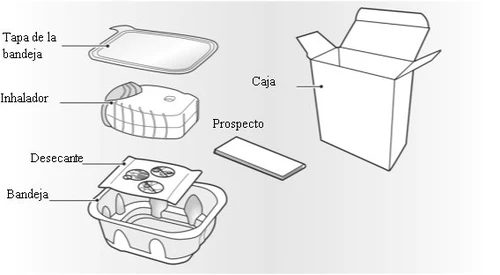 Your Trelegy Ellipta inhaler pack contains:
The inhaler is packaged in a tray. Do not open the tray until you are ready to inhale a dose of the medicine. When you are ready to use the inhaler, remove the lid to open the tray. The tray contains a desiccant bag, to reduce moisture. Discard the desiccant bag; do not open, swallow, or inhale it.
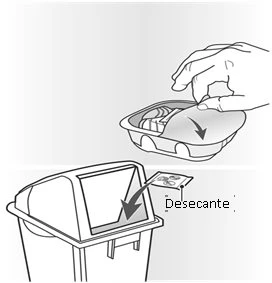
When you remove the inhaler from its tray, it will be in the “closed” position. Do not open the inhaler until you are ready to inhale a dose of the medicine. You must record the “Discard after” date in the space provided on the label of the inhaler and on the pack. The “Discard after” date is 6 weeks from the date the tray is opened. After this date, the inhaler must not be used. The tray may be discarded once opened.
If stored in the refrigerator, allow the inhaler to reach room temperature for at least one hour before use.
The step-by-step instructions for using the inhaler provided below apply to both the 30-dose Ellipta inhaler (30-day treatment) and the 14-dose Ellipta inhaler (14-day treatment).
- Read the following instructions before using the inhaler
If the inhaler’s lid is opened and closed without inhaling the medicine, the dose will be lost. The lost dose will be safely retained within the inhaler but will not be available for inhalation.
It is not possible to accidentally administer an extra or double dose by inhaling again.
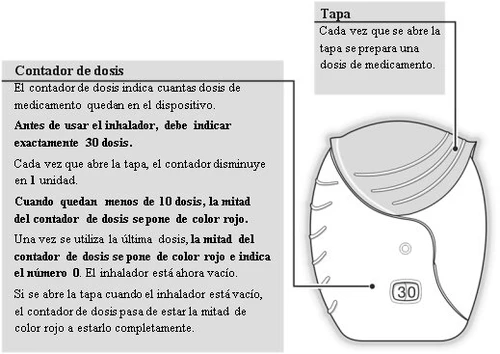
For the 14-dose inhaler, the dose counter will also show half in red when fewer than 10 doses remain, and then display half in red with the number 0 after the last dose is used. The dose counter will appear completely red if the lid is opened again.
- Prepare a dose
When you are ready to inhale a dose, open the inhaler’s lid.
Do not shake the inhaler.
- Slide the lid down until you hear a ‘click’.
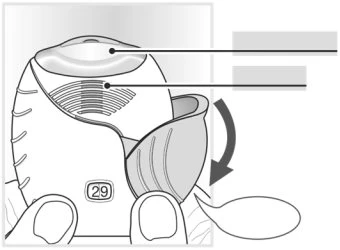


The medicine is now ready to inhale.
As confirmation, the dose counter decreases by 1 unit.
- If the dose counter does not decrease when you hear the ‘click’, the inhaler will not release the medicine dose. Take it to your pharmacist and ask for assistance.
- Do not shake the inhaler at any time.
- Inhale the medicine
- While holding the inhaler away from your mouth, breathe out as much as possible.
Do not breathe out into the inhaler.
- Place the mouthpiece between your lips and close your lips firmly around it.
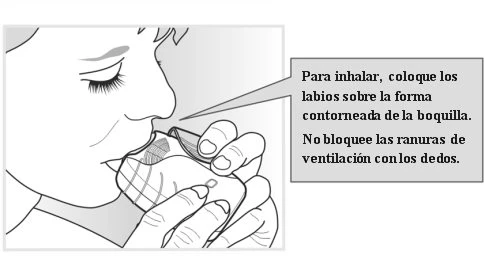 Do not block the air vents with your fingers.
- Take a long, continuous, and deep breath in. Hold your breath for as long as possible (at least 3–4 seconds).
- Remove the inhaler from your mouth.
- Breathe out slowly and gently.
You may not taste or feel the medicine, even when using the inhaler correctly.
Before closing the lid, the inhaler’s mouthpiece may be cleaned using a dry tissue.
- Close the inhaler and rinse your mouth
- Slide the lid up fully to cover the mouthpiece.
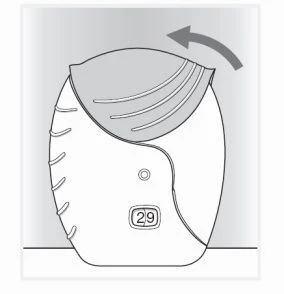
- Rinse your mouth with water after using the inhaler; do not swallow.
This will make it less likely that side effects such as mouth or throat ulcers occur.