Trandate 5 mg/ml solution for injection
Spain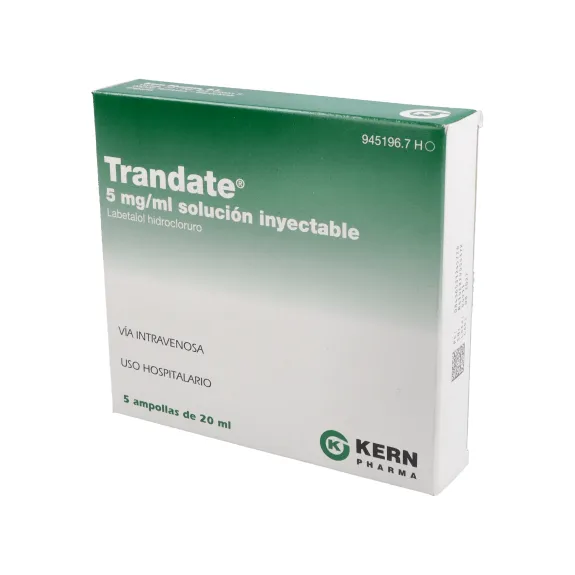
Table of Contents
Patient Information Leaflet
Introduction
Patient Information Leaflet
Trandate 5 mg/ml injectable solution
Labetalol hydrochloride
Read the entire leaflet carefully before you start using this medicine, as it contains important information for you.
- Keep this leaflet, as you may need to read it again.
- If you have any questions, ask your doctor, pharmacist, or nurse.
- This medicine has been prescribed for you only. Do not give it to others, even if they have the same symptoms, as it may harm them.
- If you experience any adverse effects, consult your doctor, pharmacist, or nurse, even if they are not listed in this leaflet.
Leaflet Contents:
- What Trandate is and what it is used for
- What you need to know before using Trandate
- How to use Trandate
- Possible side effects
- How to store Trandate
- Contents of the pack and other information
1. What Trandate is and what it is used for
Trandate belongs to a group of medicines called alpha- and beta-blockers.
Trandate is indicated for the treatment of:
- Severe hypertension (high blood pressure), including during pregnancy, when rapid control of blood pressure is essential
- Anaesthesia, when a hypotensive technique is indicated
- Hypertensive episodes (high blood pressure) following acute myocardial infarction.
Trandate does not have harmful effects on kidney function and is particularly suitable for use in hypertensive patients with kidney dysfunction.
2. What you need to know before using Trandate
Do not use Trandate
- If you are allergic to labetalol hydrochloride or to any of the other components of Trandate.
- If you have second- or third-degree atrioventricular block (heart block).
- In case of cardiogenic shock (heart failure).
- In case of prolonged and severe hypotension (low blood pressure).
- If you have severe bradycardia (slowed heart rate).
- If you have asthma or airway obstruction.
- In case of hypertension (high blood pressure) following acute myocardial infarction, when peripheral vasoconstriction suggests low cardiac output.
Warnings and precautions
Special caution is required in patients with limited cardiac reserve (the heart's ability to function above its normal level) and heart failure. These patients should be stabilized with a cardiac glycoside (a medicine used to control heart rhythm) and a diuretic (a medicine to increase fluid elimination) before starting therapy with Trandate.
There is no need to discontinue Trandate treatment before anesthesia; however, patients should receive intravenous atropine prior to induction.
Risk of anaphylactic reaction (severe allergic reaction): Patients with a history of severe anaphylactic reactions to various allergens (substances that may cause allergic reactions) who are taking beta-blockers (medicines used to treat high blood pressure) may be more sensitive upon re-exposure, whether accidental, diagnostic, or therapeutic. These patients may not respond to the usual doses of adrenaline used to treat allergic reactions.
Children and adolescents
The safety and efficacy of this medicine have not been established in children.
Interaction of Trandate with other medicines
Inform your doctor or pharmacist if you are using, or have recently used, any other medicines, including those obtained without a prescription, as it may be necessary to interrupt treatment or adjust the dose of one of them.
You should exercise particular caution when administering Trandate concomitantly with the following medicines:
Class I antiarrhythmic agents or calcium antagonists of the verapamil type (medicines used to suppress or prevent heart rhythm disturbances).
Trandate may enhance the hypotensive effects of halothane.
Pregnancy, breastfeeding, and fertility
Consult your doctor or pharmacist before using any medicine.
Cases of nipple pain and Raynaud's phenomenon in the nipples have been reported (see section 4).
Pregnancy
Trandate should only be used during the first trimester of pregnancy if the potential benefit outweighs the potential risk.
Breastfeeding
Trandate is excreted in breast milk, although adverse effects in breastfed infants have not been reported.
Driving and use of machines
No effects on the ability to drive or use machines have been reported with this medicine.
Use in athletes
Athletes should be informed that this medicine contains a component that may result in a positive analytical finding in doping controls.
3. How to use Trandate
Follow exactly the instructions for administration of Trandate provided by your doctor. Consult your doctor or pharmacist if you have any doubts.
If you feel that the effect of Trandate is too strong or too weak, inform your doctor or pharmacist.
Trandate is indicated for intravenous use in hospitalized patients.
Patients should always receive the drug while lying in the supine position (on their back) or in the left lateral decubitus position (lying on the left side).
Avoid raising the patient before 3 hours have passed, as excessive postural hypotension may occur.
Adults
Bolus injection
If a rapid reduction in blood pressure is essential, a dose of 50 mg should be administered by intravenous injection over at least one minute, and repeated, if necessary, at 5-minute intervals until a satisfactory response is achieved. The total dose must not exceed 200 mg.
Maximum effect usually occurs within the first 5 minutes and lasts about 6 hours, although it may be prolonged up to 18 hours.
Intravenous infusion
A 1 mg/ml solution should be used. For example, dilute the contents of two ampoules (200 mg) in 200 ml with sodium chloride and glucose injection solution or 5% glucose.
Hypertension in pregnancy
Begin the infusion at 20 mg/hour, then the dose may be doubled every 30 minutes until a satisfactory response is obtained or until a dose of 160 mg/hour is reached. Occasionally, higher doses may be required.
Hypertensive episodes following acute myocardial infarction
Begin the infusion at 15 mg/hour and gradually increase up to a maximum of 120 mg/hour, depending on blood pressure control.
Hypertension due to other causes
Infuse at a rate of approximately 2 mg/min until a satisfactory response is achieved, then discontinue the infusion. The effective dose is generally 50–200 mg, but larger doses may be required, especially in patients with pheochromocytoma. The infusion rate may be adjusted according to the response, at the physician's discretion.
It is advisable to monitor blood pressure and heart rhythm after injection and during infusion.
In most patients, there is a slight decrease in heart rate; severe bradycardia is uncommon but may be controlled by intravenous injection of 1–2 mg of atropine. Respiratory function should be monitored, particularly in patients with known respiratory impairment.
Once blood pressure has been adequately reduced by bolus or infusion, maintenance therapy should be switched to Trandate tablets, starting with a dose of 100 mg twice daily.
Trandate has been administered to patients with uncontrolled hypertension who were already receiving other antihypertensive agents, including β-blockers, without adverse effects.
Hypotensive anesthesia
Induction should be performed with standard agents, e.g., sodium thiopentone, and anesthesia should be maintained with nitrous oxide and oxygen with or without halothane. The recommended initial dose of Trandate is 10–20 mg intravenously, depending on the patient's age and condition. Patients for whom halothane is contraindicated generally require a higher initial dose of Trandate (25–30 mg).
If satisfactory hypotension is not achieved within 5 minutes, increments of 5–10 mg should be administered until the desired blood pressure level is reached.
Halothane and labetalol act synergistically. Therefore, the concentration of halothane should not exceed 1–1.5%, as a significant drop in blood pressure may occur.
After Trandate injection, blood pressure can be rapidly and easily adjusted by modifying the halothane concentration and/or adjusting the tilt of the operating table. The mean duration of hypotension after 20–25 mg of Trandate is 50 minutes.
Labetalol-induced hypotension is easily reversible by administering 0.6 mg of atropine and discontinuing halothane.
If you use more Trandate than you should
In case of overdose or accidental injection, consult your doctor or pharmacist immediately, or contact the Toxicology Information Service. Telephone: 91 562 04 20. It is recommended to bring the package and the leaflet of the medicine to the healthcare professional.
Profound cardiovascular effects are expected, such as excessive postural hypotension (drop in blood pressure due to sudden changes in position) and, sometimes, bradycardia (decrease in heart rate). Patients should remain lying down in the supine position with legs elevated. Gastric lavage or induction of vomiting may be justified within the first few hours after ingestion; use a cardiac glycoside (a medicine to control heart rhythm) and a diuretic (a medicine to increase fluid elimination) in case of heart failure; in case of bronchospasm, administer a β2 agonist by aerosol (medicines to dilate the bronchi). Administer 0.25 to 3 mg of atropine intravenously to relieve bradycardia. To improve circulation, administer an initial dose of 5 to 10 mcg of noradrenaline intravenously (preferred over isoprenaline), repeating according to response.
Alternatively, noradrenaline may be infused at a rate of 5 mcg per minute until the response is satisfactory.
In severe overdose, glucagon should preferably be administered intravenously. An initial dose of 5 to 10 mg in glucose or saline should be given, followed by an intravenous infusion of 5 mg/hour or as needed to maintain cardiac output.
Oliguric renal failure has been reported following massive oral overdose of labetalol. In one case, the use of dopamine to increase blood pressure may have worsened renal failure.
Hemodialysis removes less than 1% of labetalol hydrochloride from the circulation.
If you have any further questions about the use of this product, ask your doctor or pharmacist.
4. Possible adverse effects
Like all medicines, Trandate can have adverse effects, although not everybody gets them.
Trandate is generally well tolerated. Postural hypotension may occur if patients are allowed to assume an upright position before 3 hours have elapsed after administration.
Rare cases of hypersensitivity have included: rash, pruritus, angioedema, and dyspnea.
There have also been some cases of nasal congestion.
Rare cases of elevated liver function tests, jaundice (yellowish discoloration of the skin of both hepatocellular and cholestatic types), hepatitis (inflammation of the liver), and hepatic necrosis (death of liver tissue) have been reported. These signs and symptoms are generally reversible upon discontinuation of treatment.
There have been some reports of bradycardia and cardiac block.
Pain in the nipples has been reported with frequency not known (cannot be estimated from available data): intermittent decrease in blood flow to the nipples, which may cause numbness, pallor, and pain in the nipples (Raynaud's phenomenon).
If you consider any of the adverse effects you experience to be severe, or if you notice any adverse effect not mentioned in this leaflet, inform your doctor or pharmacist.
5. Storage of Trandate
Keep this medicine out of the sight and reach of children.
Store in the original packaging to protect from light.
Do not use Trandate after the expiry date stated on the container after EXP. The expiry date refers to the last day of the month indicated.
Medicines should not be disposed of via wastewater drains or household waste. Dispose of unused medicines and their containers at the SIGRE Point located at the pharmacy. If you have any doubts, ask your pharmacist how to properly dispose of medicines and containers you no longer need. This will help protect the environment.
6. Contents of the pack and other information
Composition of Trandate
- The active substance is labetalol hydrochloride. Each 20 ml vial contains 100 mg of labetalol hydrochloride.
- The other components (excipients) are: sodium hydroxide, hydrochloric acid and water for injections.
Nature and contents of the container
Packs containing 5 clear glass vials of 20 ml with 100 mg of labetalol hydrochloride.
Other presentations
Trandate 100 mg tablets: Pack containing 30 tablets.
Trandate 200 mg tablets: Pack containing 30 tablets.
Marketing Authorization Holder and Manufacturer
Kern Pharma, S.L.
Polígono Ind. Colón II
Venus, 72
08228 Terrassa (Barcelona)
This leaflet was approved in December 2021.
Detailed and up-to-date information on this medicine is available on the website of the Spanish Agency of Medicines and Health Products (AEMPS) http://www.aemps.es/.
This information is intended for healthcare professionals only:
Trandate is compatible with the following intravenous fluids:
- Glucose 5%
- 0.18% Sodium chloride in 4% Glucose
- 0.3% Potassium chloride in 5% Glucose
- Compound sodium lactate solution.
Discard any unused mixtures 24 hours after preparation.
Trandate is incompatible with 4.2% w/v sodium bicarbonate injectable solution.