Trandate 100 mg, film-coated tablets
Spain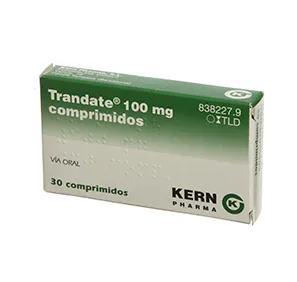
Table of Contents
Patient Information Leaflet
Introduction
Patient Information Leaflet
Trandate 100 mg coated tablets
Labetalol hydrochloride
Read the entire leaflet carefully before you start using this medicine, as it contains important information for you.
- Keep this leaflet, as you may need to read it again.
- If you have any questions, ask your doctor, pharmacist, or nurse.
- This medicine has been prescribed for you and should not be given to other people, even if they have the same symptoms, as it may harm them.
- If you experience any adverse effects, consult your doctor, pharmacist, or nurse, even if the effects are not listed in this leaflet.
Leaflet Contents:
- What Trandate is and what it is used for
- What you need to know before taking Trandate
- How to take Trandate
- Possible side effects
- How to store Trandate
- Contents of the pack and other information
1. What Trandate is and what it is used for
Trandate belongs to a group of medicines called alpha- and beta-blockers.
Trandate is indicated for the treatment of:
- Hypertension (high blood pressure)
- Hypertension in pregnancy
- Angina pectoris (chest pain) with coexisting hypertension.
Trandate does not have a harmful effect on kidney function and is particularly suitable for use in hypertensive patients with kidney dysfunction.
2. What you need to know before starting Trandate
Do not take Trandate
- If you are allergic to labetalol hydrochloride or to any other component of Trandate.
- If you have second- or third-degree atrioventricular block (heart block).
- In case of cardiogenic shock (heart failure).
- In case of prolonged and severe hypotension (low blood pressure).
- If you have severe bradycardia (slowed heart rate).
- If you have asthma or airway obstruction.
Take special care with Trandate
Special caution is required in patients with limited cardiac reserve (the heart's ability to function above its normal level) and heart failure. These cases should be managed with a cardiac glycoside (a medicine to control heart rhythm) and a diuretic (a medicine to increase fluid elimination) prior to initiating therapy with Trandate.
It is not necessary to discontinue Trandate tablets before anesthesia, although patients should receive intravenous atropine prior to induction.
Patients, especially those with ischemic heart disease, must not abruptly interrupt or discontinue Trandate therapy.
Risk of anaphylactic reaction: Patients with a history of severe anaphylactic reactions to various allergens who are taking β-blockers may be more sensitive to accidental, diagnostic, or therapeutic re-exposure. These patients may not respond to the usual doses of adrenaline used to treat allergic reactions.
Use with other medicines
Inform your doctor or pharmacist if you are taking, or have recently taken, any other medicines, including those obtained without a prescription, as it may be necessary to interrupt treatment or adjust the dose of one or more of them.
Special caution is required when administering Trandate concomitantly with the following medicines:
Tricyclic antidepressants, as they may increase the incidence of tremors.
Cimetidine, which may increase the bioavailability of labetalol, requiring careful attention to oral dosing.
Class I antiarrhythmic agents or calcium antagonists such as verapamil.
Trandate may enhance the hypotensive effects of halothane.
Trandate produces fluorescence in alkaline solution and may therefore interfere with assays of certain fluorescent substances, including catecholamines.
Use of Trandate with food and drinks
Trandate tablets should be taken with food.
Pregnancy and breastfeeding
Consult your doctor or pharmacist before using any medicine.
Pregnancy
Trandate should only be used during the first trimester of pregnancy if the potential benefit outweighs the potential risk.
Breastfeeding
Trandate is excreted in breast milk, although adverse effects in breastfed infants have not been reported. Cases of nipple pain and Raynaud's phenomenon in the nipples have been reported (see section 4).
Use in children
The safety and efficacy of this medicine have not been established in children.
Use in athletes
Athletes should be informed that this medicine contains a component that may result in a positive analytical finding in doping controls.
Driving and using machines
No effects on the ability to drive or use machines have been reported with this medicine.
Important information about some of the components of Trandate
This medicine contains lactose. If your doctor has informed you that you have an intolerance to certain sugars, consult with him before taking this medicine.
This medicine may cause allergic reactions as it contains sunset yellow (E-110). It may cause asthma, especially in patients allergic to acetylsalicylic acid.
3. How to take Trandate
Follow exactly the Trandate dosing instructions provided by your doctor. Consult your doctor or pharmacist if you have any doubts.
Remember to take your medication.
If you feel that the effect of Trandate is too strong or too weak, inform your doctor or pharmacist.
Administration is to be oral. The tablets should be swallowed with an adequate amount of liquid (a glass of water).
Your doctor will determine the duration of treatment with Trandate.
Hypertension
Treatment should be initiated with doses of 100 mg twice daily. If necessary, this dose may be progressively increased by 100 mg twice daily every 2–14 days. Blood pressure in many patients is controlled with 200 mg twice daily, and doses up to 400 mg twice daily may be given. A total daily dose exceeding 800 mg should not be exceeded.
Elderly patients
A starting dose of 50 mg twice daily is recommended. Lower maintenance doses than those required in younger patients may satisfactorily control blood pressure.
Hypertension in pregnancy
If necessary, the initial dose of 100 mg twice daily may be increased at weekly intervals.
The severity of hypertension may require a regimen of three times daily. A total daily dose exceeding 800 mg should not be exceeded.
Hypertension associated with angina
The dose of Trandate should be that required to control hypertension. A total daily dose exceeding 800 mg should not be exceeded.
For long-term control of hypertension following treatment with injectable Trandate, oral therapy with tablets should be initiated at 100 mg twice daily.
Additive hypotensive effects may occur if Trandate tablets are administered concomitantly with other antihypertensives, e.g., diuretics, methyldopa, etc. In patients already receiving such medications and in whom treatment is to be switched to Trandate tablets, therapy should be initiated at a dose of 100 mg twice daily, with gradual tapering of the previous treatment. Abrupt withdrawal of clonidine or beta-blocking agents is not advisable.
If you take more Trandate than you should
If you have taken more Trandate than you should, contact your doctor or pharmacist immediately, or contact the Toxicology Information Service at telephone number: 91 562 04 20. It is recommended to bring the medicine packaging and leaflet to the healthcare professional.
Profound cardiovascular effects such as excessive postural hypotension and, occasionally, bradycardia are expected. Patients should remain lying down in a supine position with legs elevated. Gastric lavage or induction of vomiting may be justified within the first few hours after ingestion; administer a cardiac glycoside and a diuretic in case of heart failure; in case of bronchospasm, administer an inhaled β2 agonist. Intravenous atropine in doses of 0.25 to 3 mg should be given to relieve bradycardia.
To improve circulation, an initial dose of 5 to 10 mcg of noradrenaline intravenously should be administered—preferred over isoprenaline—repeated according to response. Alternatively, noradrenaline may be infused at a rate of 5 mcg per minute until response is satisfactory.
In cases of severe overdose, glucagon should preferably be administered intravenously. An initial dose of 5 to 10 mg in glucose or saline should be given, followed by a continuous intravenous infusion of 5 mg/hour, or as needed to maintain cardiac output.
Oliguric renal failure has been reported following massive oral overdose of labetalol. In one case, the use of dopamine to increase blood pressure may have worsened renal failure.
Hemodialysis removes less than 1% of labetalol hydrochloride from the circulation.
If you forget to take Trandate
Do not take a double dose to make up for missed doses. Take the next dose as soon as possible.
Then continue treatment as directed by your doctor.
If you stop treatment with Trandate
Do not discontinue treatment earlier than instructed, especially if you have ischemic heart disease (lack of oxygen in heart cells).
If you have any further questions about the use of this product, ask your doctor or pharmacist.
4. Possible adverse effects
Like all medicines, Trandate may have adverse effects, although not everyone experiences them.
Most side effects are transient and occur during the first weeks of treatment. They include headache, fatigue, dizziness, depression and lethargy, nasal congestion, sweating, and rarely, maleolar edema.
Postural hypotension is rare, except at very high doses or if the dose is increased too rapidly.
At the beginning of treatment, some patients may experience a sensation of tingling in the scalp, usually transient.
Tremors have been reported during treatment of pregnancy-induced hypertension. Acute urinary retention, difficulty in micturition, ejaculatory failure, epigastric pain, nausea, and vomiting have also been described.
Rarely, positive antinuclear antibodies not associated with disease have appeared, as well as rare cases of systemic lupus erythematosus and, very rarely, drug fever.
Very rarely, cases of toxic myopathy have been reported.
Among rare cases of hypersensitivity: rash, pruritus, angioedema, and dyspnea.
A reversible lichenoid eruption has rarely occurred.
Rare cases of elevated liver function tests, jaundice (both hepatocellular and cholestatic), hepatitis, and hepatic necrosis have been reported. These signs and symptoms are generally reversible upon discontinuation of treatment.
Blurred vision, eye irritation, and cramps have been reported, although not necessarily associated with Trandate.
Cases of bradycardia and cardiac block have been described.
Pain in the nipples has been reported with unknown frequency (cannot be estimated from available data): intermittent decrease in blood flow to the nipples, which may cause numbness, pallor, and pain in the nipples (Raynaud's phenomenon).
Skin rashes and/or dry eyes associated with the use of beta-adrenergic blocking drugs have been reported. The incidence is small, and in most cases, symptoms disappeared upon discontinuation of treatment. Gradual withdrawal of the drug should be considered if such a reaction cannot be otherwise explained.
Rare cases of severe hepatocellular injury, usually reversible, have been reported during short- and long-term therapy with labetalol. Appropriate laboratory tests should be performed at the first sign or symptom of hepatic dysfunction. If laboratory evidence of liver injury is present or if the patient becomes jaundiced, labetalol should be permanently discontinued.
If bronchospasm occurs after the use of Trandate, it should be treated by inhalation of a β2 agonist, e.g., salbutamol (a higher than usual asthma dose may be required), and, if necessary, atropine 1 mg intravenously.
If you consider any of the adverse effects you are experiencing to be severe, or if you notice any adverse effects not mentioned in this leaflet, inform your doctor or pharmacist.
5. Storage of Trandate
Keep out of the reach and sight of children.
Do not store above 25°C.
Do not use Trandate after the expiry date stated on the packaging after EXP. The expiry date refers to the last day of the month indicated.
Medicines must not be disposed of via wastewater or household waste. Dispose of unused medicines and their packaging at the SIGRE collection point at your pharmacy. If in doubt, ask your pharmacist how to properly dispose of medicines and packaging you no longer need. This will help protect the environment.
6. Contents of the pack and other information
Composition of Trandate
- The active substance is labetalol hydrochloride. Each tablet contains 100 mg of labetalol hydrochloride.
- The other components (excipients) are: lactose, microcrystalline cellulose, magnesium stearate, hypromellose, sodium benzoate (E211), titanium dioxide (E171), and sunset yellow (E110).
Appearance of the product and contents of the pack
Film-coated, circular, orange tablets.
Pack containing 30 tablets.
Other presentations
Trandate 200 mg tablets: Pack with 30 tablets.
Trandate 5 mg/ml injectable solution: Pack with 5 vials of 20 ml.
Marketing Authorization Holder and Manufacturer Responsible
Kern Pharma, S.L.
Polígono Ind. Colón II
Venus, 72
08228 Terrassa (Barcelona)
Date of the most recent review of this leaflet: March 2024
Detailed and up-to-date information on this medicinal product is available on the website of the Spanish Agency of Medicines and Health Products (AEMPS) http://www.aemps.es/.