Tovanor Breezhaler 44 micrograms powder for inhalation
Spain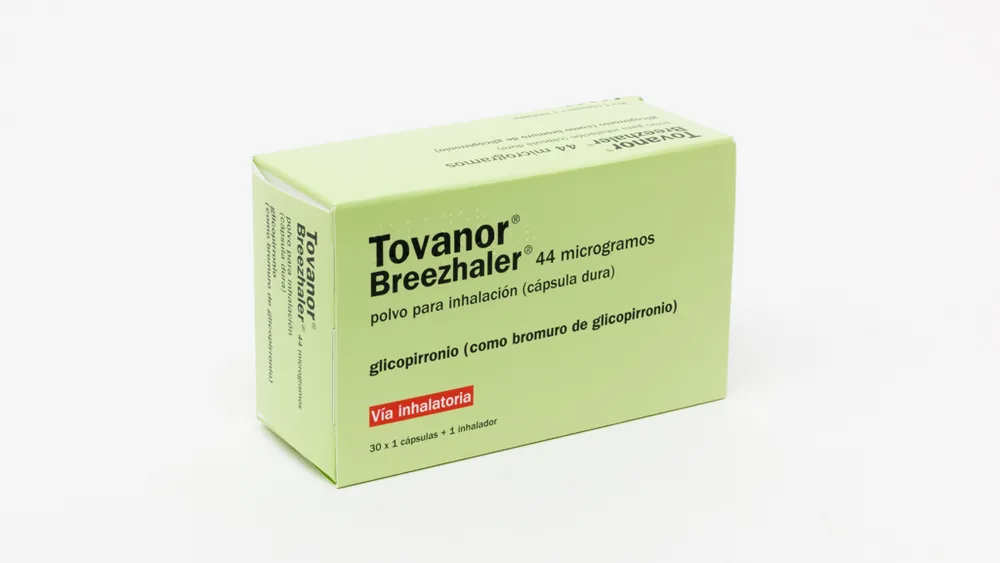
Table of Contents
- Patient Information Leaflet
- Introduction
- 1. What Tovanor Breezhaler is and what it is used for
- 2. What you need to know before starting to use Tovanor Breezhaler
- 3. How to use Tovanor Breezhaler
- 4. Possible adverse effects
- 5. Storage of Tovanor Breezhaler
- 6. Contents of the pack and other information
Patient Information Leaflet
Introduction
Patient Information Leaflet
Tovanor Breezhaler 44 micrograms powder for inhalation (hard capsule)
glycopyrronium
(as glycopyrronium bromide)
Read the entire leaflet carefully before you start using this medicine, as it contains important information for you.
- Keep this leaflet, as you may need to read it again.
- If you have any questions, ask your doctor, pharmacist or nurse.
- This medicine has been prescribed for you only. Do not pass it on to others, even if they have the same symptoms as you, since it may harm them.
- If you experience any side effects, talk to your doctor, pharmacist or nurse, even if the side effects are not listed in this leaflet. See section 4.
Leaflet Contents
- What Tovanor Breezhaler is and what it is used for
- What you need to know before using Tovanor Breezhaler
- How to use Tovanor Breezhaler
- Possible side effects
- How to store Tovanor Breezhaler
- Contents of the pack and other information
1. What Tovanor Breezhaler is and what it is used for
What Tovanor Breezhaler is
This medicine contains an active substance called glycopyrronium bromide, which belongs to a class of medicines known as bronchodilators.
What Tovanor Breezhaler is used for
This medicine is used to make breathing easier in adult patients who have difficulty breathing due to a lung disease called chronic obstructive pulmonary disease (COPD).
In COPD, the muscles around the airways contract, making it difficult to breathe. This medicine blocks the contraction of these muscles in the lungs, allowing air to flow in and out more easily.
If you use this medicine once daily, it will help reduce the impact of COPD on your daily life.
2. What you need to know before starting to use Tovanor Breezhaler
Do not use Tovanor Breezhaler
- if you are allergic to glycopyrronium bromide or to any of the other ingredients of this medicine (listed in section 6).
Warnings and precautions
Talk to your doctor before starting to use Tovanor Breezhaler if you have any of the following conditions:
- if you have kidney problems.
- if you have a known eye condition called narrow-angle glaucoma.
- if you have difficulty urinating.
During treatment with Tovanor Breezhaler, stop using this medicine and contact your doctor immediately if:
- you experience chest tightness, cough, wheezing, or difficulty breathing immediately after using Tovanor Breezhaler (signs of bronchospasm).
- you develop breathing or swallowing difficulties, swelling of the tongue, lips or face, skin rash, itching, or hives (signs of an allergic reaction).
- you notice eye pain or discomfort, temporary blurred vision, visual halos, colored images, or redness of the eyes. These may be signs of an acute attack of narrow-angle glaucoma.
Tovanor Breezhaler is used as a maintenance treatment for your COPD. Do not use this medicine to treat a sudden attack of breathlessness (difficulty breathing) or wheezing (whistling sounds when breathing).
Children and adolescents
Do not give this medicine to children or adolescents under 18 years of age.
Other medicines and Tovanor Breezhaler
Tell your doctor or pharmacist if you are taking, have recently taken, or might need to take any other medicines. This includes medicines similar to Tovanor Breezhaler used for your lung disease, such as ipratropium, oxitropium, or tiotropium (also known as anticholinergics).
No specific adverse effects have been reported when Tovanor Breezhaler has been administered together with other medicines used to treat COPD, such as rescue inhalers (e.g. salbutamol), methylxanthines (e.g. theophylline), and/or oral and inhaled steroids (e.g. prednisolone).
Pregnancy, breast-feeding and fertility
If you are pregnant, breast-feeding, think you may be pregnant, or are planning to become pregnant, consult your doctor or pharmacist before using this medicine.
There are no data available on the use of this medicine in pregnant women, and it is unknown whether the active substance of this medicine passes into breast milk.
Driving and using machines
This medicine is unlikely to affect your ability to drive or operate machinery.
Tovanor Breezhaler contains lactose
This medicine contains lactose. If your doctor has informed you of an intolerance to certain sugars, consult with him before taking this medicine.
3. How to use Tovanor Breezhaler
Follow exactly the instructions for administering this medicine as given by your doctor or pharmacist. If in doubt, consult your doctor or pharmacist again.
Amount of Tovanor Breezhaler to use
The usual dose is to inhale the contents of one capsule each day.
You only need to inhale the medicine once daily, as the effect of this medicine lasts for 24 hours.
Do not use more than the dose indicated by your doctor.
Elderly patients
If you are 75 years of age or older, you may use this medicine at the same dose as other adults.
When to inhale Tovanor Breezhaler
Use this medicine at the same time each day. This will help you remember to take it.
You may inhale this medicine at any time before or after food or drinks.
How to inhale Tovanor Breezhaler
- This pack contains an inhaler and capsules (in blisters) containing the medicine as an inhalation powder. Use the capsules only with the inhaler provided in this pack (Tovanor Breezhaler inhaler). The capsules should remain in the blister until you are ready to use them.
- Do not push the capsule through the foil.
- When starting a new pack, use the new Tovanor Breezhaler inhaler provided in the pack.
- Discard the inhaler from each pack once all capsules have been used.
- Do not swallow the capsules.
- For more information on how to use the inhaler, please read the instructions at the end of this leaflet.
If you use more Tovanor Breezhaler than you should
If you have inhaled too much of this medicine, or if someone accidentally uses your capsules, inform your doctor immediately or go to the nearest emergency department. Show the Tovanor Breezhaler pack. Medical attention may be required.
If you forget to use Tovanor Breezhaler
If you forget to inhale a dose, inhale it as soon as possible. However, do not inhale two doses on the same day. Then inhale the next dose at your usual time.
How long you should continue treatment with Tovanor Breezhaler
- Continue using this medicine for as long as your doctor tells you to.
- COPD is a long-term condition and you must use this medicine every day, not only when you have breathing problems or other symptoms of COPD.
Consult your doctor or pharmacist if you have any questions about how long you should continue treatment with this medicine.
If you have any further questions about the use of this medicine, ask your doctor, pharmacist, or nurse.
4. Possible adverse effects
Like all medicines, this medicine can cause adverse effects, although not everyone experiences them.
Some adverse effects may be serious but are uncommon
(may affect up to 1 in 100 patients)
- Irregular heartbeat
- High blood sugar level (hyperglycaemia: typical symptoms include excessive thirst or hunger and frequent urination)
- Skin rash, itching, hives, difficulty breathing or swallowing, dizziness (possible signs of an allergic reaction)
- Swelling, mainly of the tongue, lips, face or throat (possible signs of angioedema)
If you experience any of these adverse effects, inform your doctor immediately.
Some adverse effects may be serious but their frequency is unknown
(cannot be estimated from available data)
- Difficulty breathing with wheezing (whistling sounds when breathing) or cough (signs of paradoxical bronchospasm)
Some adverse effects are common
(may affect up to 1 in 10 patients)
- Dry mouth
- Difficulty sleeping
- Runny or stuffy nose, sneezing, sore throat
- Diarrhoea or abdominal pain
- Musculoskeletal pain
Some adverse effects are uncommon
(may affect up to 1 in 100 patients)
- Difficulty and pain when urinating
- Painful and frequent urination
- Palpitations
- Skin rash
- Loss of sensation
- Cough with sputum
- Dental caries
- Feeling of pain or pressure in the cheeks and forehead
- Nosebleeds
- Pain in arms or legs
- Pain in the muscles, bones or joints of the chest
- Stomach discomfort after meals
- Sore throat
- Fatigue
- Weakness
- Itching
- Voice alteration (hoarseness)
- Nausea
- Vomiting
Some patients over 75 years of age experienced headache (commonly) and urinary tract infection (commonly).
Reporting of adverse effects
If you experience any type of adverse effect, consult your doctor or pharmacist, even if it is a possible adverse effect not listed in this leaflet. You may also report them directly through the national reporting system included in Appendix V. By reporting adverse effects, you can help provide more information on the safety of this medicine.
5. Storage of Tovanor Breezhaler
Keep this medicine out of the sight and reach of children.
Do not use this medicine after the expiry date stated on the carton and blister after «CAD»/«EXP». The expiry date refers to the last day of the month indicated.
Do not store above 25°C.
Keep the capsules in the original blister pack to protect them from moisture. Remove them from the blister pack just before use.
The inhaler from each package should be discarded once all capsules have been used.
Do not use this medicine if you notice that the packaging is damaged or shows signs of deterioration.
Medicines must not be disposed of via wastewater or household waste. Ask your pharmacist how to dispose of any unused containers and medicines. This will help protect the environment.
6. Contents of the pack and other information
Composition of Tovanor Breezhaler
- The active substance is glycopyrronium bromide. Each capsule contains 63 micrograms of glycopyrronium bromide (equivalent to 50 micrograms of glycopyrronium). The delivered dose (the dose released by the inhaler mouthpiece) is equivalent to 44 micrograms of glycopyrronium.
- The other components of the inhalation powder are lactose monohydrate and magnesium stearate.
What Tovanor Breezhaler looks like and contents of the pack
Tovanor Breezhaler 44 microgram inhalation powder hard capsules are transparent and orange in colour and contain a white powder. They have the product code "GPL50" printed in black above a black line and the company logo () printed in black below the same line.
Each pack contains a device known as an inhaler, together with capsules in blisters. Each blister strip contains 6 or 10 hard capsules.
The following pack sizes are available:
Packs containing 6 x 1, 10 x 1, 12 x 1 or 30 x 1 hard capsules, together with one inhaler.
Multiple pack containing 90 (3 packs of 30 x 1) hard capsules and 3 inhalers.
Multiple pack containing 96 (4 packs of 24 x 1) hard capsules and 4 inhalers.
Multiple pack containing 150 (15 packs of 10 x 1) hard capsules and 15 inhalers.
Multiple pack containing 150 (25 packs of 6 x 1) hard capsules and 25 inhalers.
Only certain pack sizes may be marketed.
Marketing Authorisation Holder
Novartis Europharm Limited
Vista Building
Elm Park, Merrion Road
Dublin 4
Ireland
Manufacturer
Novartis Farmacéutica SA
Gran Via de les Corts Catalanes, 764
08013 Barcelona
Spain
Novartis Pharma GmbH
Roonstraße 25
D-90429 Nuremberg
Germany
For further information about this medicinal product, please contact the local representative of the Marketing Authorisation Holder:
Belgium/Belgium/Belgium Novartis Pharma N.V. Tel/Tel: +32 2 246 16 11 | Lithuania SIA Novartis Baltics Lithuania Branch Tel: +370 5 269 16 50 |
| Luxembourg/Luxembourg Novartis Pharma N.V. Tel/Tel: +32 2 246 16 11 |
Czech Republic Novartis s.r.o. Tel: +420 225 775 111 | Hungary Novartis Hungária Kft. Tel.: +36 1 457 65 00 |
Denmark Novartis Healthcare A/S Tlf: +45 39 16 84 00 | Malta Novartis Pharma Services Inc. Tel: +356 2122 2872 |
Germany Novartis Pharma GmbH Tel: +49 911 273 0 | Netherlands Novartis Pharma B.V. Tel: +31 26 37 82 111 |
Estonia SIA Novartis Baltics Estonia Branch Tel: +372 66 30 810 | Norway Novartis Norge AS Tlf: +47 23 05 20 00 |
Greece Novartis (Hellas) A.E.B.E. Tel: +30 210 28 11 712 INNOVIS PHARMA S.A. Tel: +30 210 66 64 805 | Austria Novartis Pharma GmbH Tel: +43 1 86 6570 |
Spain Laboratorios Gebro Pharma, S.A. Tel: +34 93 205 86 86 | Poland Novartis Poland Sp. z o.o. Tel.: +48 22 375 4888 |
France Novartis Pharma S.A.S. Tél: +33 1 55 47 66 00 | Portugal Laboratório Medinfar - Produtos Farmacêuticos, S.A. Tel: +351 21 499 7400 |
Croatia Novartis Hrvatska d.o.o. Tel. +385 1 6274 220 | Romania Novartis Pharma Services Romania SRL Tel: +40 21 31299 01 |
Ireland Novartis Ireland Limited Tel: +353 1 260 12 55 | Slovenia Novartis Pharma Services Inc. Tel: +386 1 300 75 50 |
Iceland Vistor hf. Tel: +354 535 7000 | Slovakia Novartis Slovakia s.r.o. Tel: +421 2 5542 5439 |
Italy Alfasigma S.p.A. Tel: +39 06 91 39 4666 | Finland/Finland Novartis Finland Oy Tel/Tel: +358 (0)10 6133 200 |
Cyprus Novartis Pharma Services Inc. Tel: +357 22 690 690 | Sweden Novartis Sverige AB Tel: +46 8 732 32 00 |
Latvia SIA Novartis Baltics Tel: +371 67 887 070 | United Kingdom (Northern Ireland) Novartis Ireland Limited Tel: +44 1276 698370 |
Date of the most recent revision of this leaflet:
Other sources of information
Detailed information on this medicine is available on the website of the European Medicines Agency: http://www.ema.europa.eu
Instructions for use of the Tovanor Breezhaler inhaler
Read the full Instructions for Use before using Tovanor Breezhaler | |||
|
|
|
|
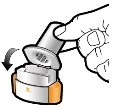
Insert | Pierce and release | Breathe in deeply | Check that the capsule is empty |
|
|
| |
|
|
|
|
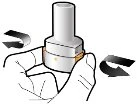
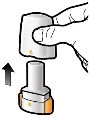
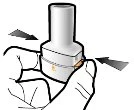
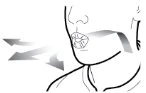
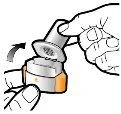
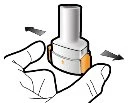
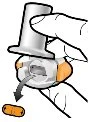
Step 1a: Remove the cap | Step 2a: Pierce the capsule once only Hold the inhaler in an upright position. Pierce the capsule by pressing both buttons down firmly at the same time. | Step 3a: Breathe out fully Do not blow into the inhaler. | Check that the capsule is empty Open the inhaler to check whether any powder remains in the capsule. |
| You should hear a clicking sound when the capsule is pierced. Pierce the capsule only once. |
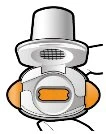
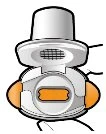
| If powder remains in the capsule:
|
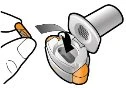
Step 1b: Open the inhaler |
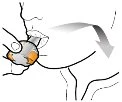
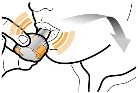
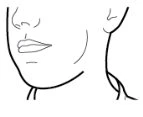
Step 2b: Release the buttons completely | Step 3b: Breathe in the medicine deeply Hold the inhaler as shown in the figure. Place the mouthpiece in your mouth and close your lips tightly around it. Do not press the buttons. | Remaining powderEmpty |
| Breathe in quickly and as deeply as possible. During inhalation, you will hear a humming sound. You may taste the medicine when inhaling. |
| |
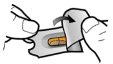
Step 1c: Remove the capsule Peel off one blister from the strip. Open the blister and remove one capsule. Do not push the capsule through the foil. Do not swallow the capsule. |
Step 3c: Hold your breath Hold your breath for 5 seconds. | Remove the empty capsule Dispose of the empty capsule in your household waste. Close the inhaler and replace the cap. | |
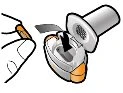
Step 1d: Insert the capsule Never place the capsule directly into the mouthpiece. | Important information
| ||
Step 1e: Close the inhaler | |||
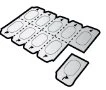
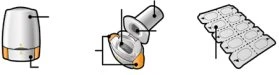
Your Tovanor Breezhaler package contains:
| Frequently asked questions Why didn't the inhaler make a sound when I inhaled? The capsule may be stuck in the chamber. If this happens, carefully dislodge the capsule by tapping the base of the inhaler. Then inhale the medicine again by repeating steps 3a to 3c. What should I do if powder remains inside the capsule? You have not received enough of your medicine. Close the inhaler and repeat steps 3a to 3c. I coughed after inhaling, is this important? This may happen. If the capsule is empty, you have received an adequate dose of your medicine. I noticed small fragments of the capsule on my tongue, is this important? This may happen. It is not harmful. The likelihood of capsule fragments increases if the capsule is pierced more than once. | Cleaning the inhaler Wipe the mouthpiece inside and out with a clean, dry, lint-free cloth to remove any powder residue. Keep the inhaler dry. Never wash your inhaler with water. | |
Disposal of the inhaler after use Each inhaler should be discarded after all capsules have been used. Ask your pharmacist how to dispose of medicines and inhalers that you no longer need. |