Toseine 2 mg/ml oral solution
Spain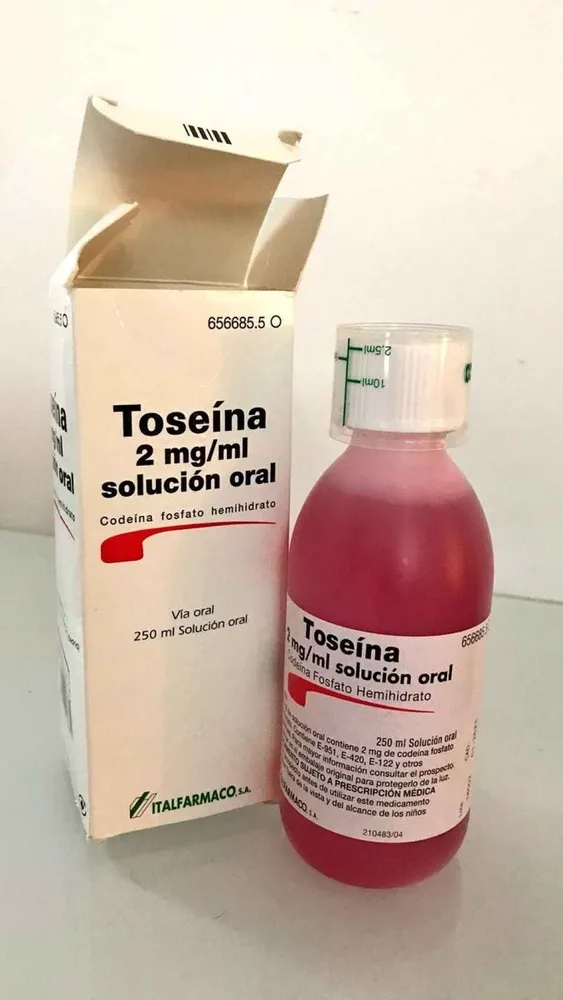
Table of Contents
Package leaflet: Information for the user
Introduction
Package leaflet: information for the user
Toseina 2 mg/ml oral solution
codeine phosphate hemihydrate
Read all of this leaflet carefully before you start taking this medicine because it contains important information for you.
- Keep this leaflet. You may need to read it again.
- If you have any questions, ask your doctor or pharmacist.
- This medicine has been prescribed for you only. Do not give it to other people, even if they have the same symptoms as you, because it may harm them.
- If you experience any adverse effects, consult your doctor or pharmacist, even if they are adverse effects not listed in this leaflet. See section 4.
Leaflet contents
-
What Toseina is and what it is used for
-
What you need to know before taking Toseina
-
How to take Toseina
-
Possible side effects
-
How to store Toseina
-
Contents of the container and other information
1. What Toseína is and what it is used for
Toseína contains codeine phosphate hemihydrate.
This medicine is used for the symptomatic treatment of dry cough (not accompanied by mucus) in adults and adolescents over 12 years of age.
2. What you need to know before starting to take Toseina
Do not take Toseina:
- If you are allergic to codeine or to any of the other components of this medicine (listed in section 6).
- If you have breathing problems such as chronic obstructive pulmonary disease (COPD), respiratory depression (slow or weak breathing), or acute asthma attacks.
- If you have paralytic ileus (intestinal obstruction) or are at risk of developing it.
- If you have diarrhea associated with pseudomembranous colitis (inflammation of the colon) caused by antibiotic medicines (such as cephalosporins, lincomycins or penicillins) or diarrhea caused by poisoning.
- If you are under 12 years of age.
- If you know that you metabolize codeine very rapidly into morphine.
- If you are pregnant or breastfeeding.
Warnings and precautions
Consult your doctor or pharmacist before starting to take Toseina:
- If you have heart, lung, liver, gallbladder or kidney problems, or conditions such as prostate disorders (prostatic hypertrophy), narrowing of the urethra (urethral stenosis), obstructive or inflammatory intestinal disorders, chronic ulcerative colitis, acute pancreatitis, hypothyroidism, or multiple sclerosis.
- Elderly or debilitated individuals are usually more sensitive to the effects and adverse reactions of this medicine, especially respiratory depression (slow or insufficient breathing).
- In case of severe head injury (cranial trauma) and increased pressure inside the brain (intracranial pressure), codeine may increase cerebrospinal fluid pressure, potentially worsening respiratory depression (slow or inadequate breathing).
- Like other opioids, codeine may inhibit intestinal motility, thereby worsening constipation in patients with chronic constipation.
- If you experience pain or increased sensitivity to pain (hyperalgesia) that does not respond to a higher dose of your medication.
- This medicine should not be taken for longer than three days. If your cough has not improved after three days, you should consult your doctor.
Tolerance, dependence and addiction
This medicine contains codeine, which is an opioid. It may cause dependence and/or addiction. |
Repeated use of opioids may lead to reduced effectiveness of the medicine (becoming accustomed to it, known as tolerance). Repeated use of Toseina may also lead to dependence, abuse, and addiction, which could result in a potentially fatal overdose. The risk of these adverse effects may be higher with higher doses and prolonged use.
Dependence or addiction may cause a feeling of lack of control over the amount of medicine you need to take or how frequently you need to take it.
The risk of dependence or addiction varies from person to person. You may have a higher risk of dependence or addiction to Toseina if:
- You or any member of your family have abused alcohol or have experienced dependence on alcohol, prescription medicines, or illegal drugs ("addiction").
- You smoke.
- You have ever had mood disorders (depression, anxiety, or a personality disorder) or have received treatment from a psychiatrist for other mental illnesses.
If you notice any of the following symptoms while taking Toseina, it could be a sign of dependence or addiction:
- You need to take the medicine for longer than recommended by your doctor
- You need to take a higher dose than recommended
- You may feel the need to continue taking the medicine, even though it does not help relieve your cough
- You are using the medicine for reasons other than those prescribed, for example, "to stay calm" or "to help you sleep"
- You have made repeated unsuccessful attempts to stop using the medicine or to control its use
- You feel unwell when you stop using the medicine, and feel better once you take it again ("withdrawal effects")
If you experience any of these symptoms, consult your doctor to determine the best course of treatment for your case, when it is appropriate to stop the medicine, and how to do so safely (see section 3 "If you stop taking Toseina").
Sleep-related breathing disorders
Toseina may cause sleep-related breathing disorders, such as sleep apnea (pauses in breathing during sleep) and sleep-related hypoxemia (low blood oxygen levels). Symptoms may include breathing pauses during sleep, nighttime awakening due to shortness of breath, difficulty maintaining sleep, or excessive daytime sleepiness. If you or someone else notice these symptoms, contact your doctor. Your doctor may consider reducing the dose.
Codeine is converted into morphine in the liver by an enzyme. Morphine is the substance responsible for codeine's effects. Some people have a variant of this enzyme that may affect them differently. In some individuals, morphine is not produced or is produced in very low amounts, and therefore will not relieve cough symptoms. Other individuals are more likely to experience serious adverse reactions because they produce very high levels of morphine. If you experience any of the following adverse effects, you must stop taking this medicine and seek immediate medical help: slow or shallow breathing, confusion, drowsiness, pinpoint pupils, discomfort or feeling unwell, constipation, loss of appetite.
Contact your doctor if you experience severe upper abdominal pain that may radiate to the back, nausea, vomiting, or fever, as these could be symptoms associated with inflammation of the pancreas (pancreatitis) and bile ducts.
Children and adolescents
Adolescents over 12 years of age: codeine is not recommended for adolescents with respiratory problems for the treatment of cough.
Other medicines and Toseina
Inform your doctor or pharmacist if you are taking, have recently taken, or might need to take any other medicines.
- Gabapentin or pregabalin for the treatment of epilepsy or nerve-related pain (neuropathic pain).
In particular, if you are taking any of the following medicines, it may be necessary to adjust the dose or discontinue treatment:
- Narcotic analgesics (for pain), antipsychotics (tranquilizers), anxiolytics (for anxiety), neuromuscular blockers (medicines used to facilitate mechanical ventilation), and other central nervous system depressants (including alcohol); consumption of medicines containing alcohol should be avoided during treatment;
- Buprenorphine (analgesic medicine) and naltrexone (medicine used in the treatment of acute intoxication from codeine, morphine, heroin, and alcohol);
- Anticholinergics (drugs to reduce the effects of acetylcholine);
- MAO inhibitors (medicines used to treat depression or Parkinson's disease) or tricyclic antidepressants;
- Hydroxyzine (medicines to treat allergy);
- Certain phenothiazines (medicines to treat nervous, mental, and emotional disorders, also used to control severe nausea and vomiting);
- Antidiarrheal medicines that inhibit intestinal motility.
Taking Toseina with food, drinks, and alcohol
Avoid drinking alcoholic beverages, as alcohol enhances the central nervous system depressant effect of codeine.
Pregnancy, breastfeeding, and fertility
If you are pregnant or breastfeeding, think you may be pregnant, or plan to become pregnant, consult your doctor or pharmacist before using this medicine.
Pregnancy:
Do not take Toseina during pregnancy.
Breastfeeding:
Do not take codeine while breastfeeding. Codeine and morphine pass into breast milk.
Driving and use of machines
Codeine may cause drowsiness, affecting mental and/or physical ability. If you experience these effects, avoid driving or operating machinery.
Toseina contains aspartame (E-951)
This medicine contains 2 mg of aspartame (E-951) per ml, equivalent to 10 mg/5 ml and 20 mg/10 ml. Aspartame (E-951) contains a source of phenylalanine, which may be harmful if you have phenylketonuria (PKU), a rare genetic disorder in which phenylalanine accumulates because the body cannot eliminate it properly.
Toseina contains sorbitol (E-420)
This medicine contains 175 mg of sorbitol (E-420) per ml, equivalent to 875 mg/5 ml and 1,750 mg/10 ml. Sorbitol (E-420) is a source of fructose. If your doctor has informed you (or your child) that you have an intolerance to certain sugars, or if you (or your child) have been diagnosed with hereditary fructose intolerance (HFI), a rare genetic disorder in which the patient cannot break down fructose, consult your doctor before taking this medicine.
Toseina contains sodium benzoate (E-211)
This medicine contains 2 mg of sodium benzoate (E-211) per ml, equivalent to 10 mg/5 ml and 20 mg/10 ml.
Toseina contains cochineal red A (E-122)
This medicine may cause allergic reactions as it contains cochineal red A (carmoisine) (E-122). It may trigger asthma, especially in patients allergic to acetylsalicylic acid.
Toseina contains sodium
This medicine contains less than 23 mg of sodium (1 mmol) per ml; therefore, it is essentially "sodium-free."
Use in athletes
This medicine contains codeine, which may result in a positive doping test.
3. How to take Toseína
Follow exactly the instructions for use of this medicine as given by your doctor or pharmacist. If in doubt, consult your doctor or pharmacist again.
Dosages should be individualized for each patient. The lowest effective dose required to control symptoms should be used. The dose may be divided into up to 4 daily doses administered at intervals of no less than 6 hours.
Administration of the medicine depends on the presence of symptoms, and the dosage may be reduced as symptoms gradually disappear.
The duration of treatment should be limited to 3 days.
Toseína should be used for the shortest time necessary to relieve symptoms.
Adults and adolescents over 12 years of age: 10 to 20 mg of codeine (5 to 10 ml) at intervals of at least 6 hours.
Paediatric population: Toseína is contraindicated in children under 12 years of age.
Elderly population: Dosage should be determined by the physician, as lower doses or longer dosing intervals may be required. See sections Warnings and Precautions.
Method of administration
To open the bottle, remove the dosing cup, press the cap downwards and turn in the direction indicated by the arrows, as shown in the drawing on the top of the cap. The bottle should be closed after each use.
If you take more Toseína than you should
In case of overdose or accidental ingestion, contact the Toxicology Information Service. Tel.: 91 562 04 20.
Accidental ingestion of very high doses may cause initial excitation, anxiety, insomnia, and subsequently in some cases drowsiness progressing to stupor or coma, headache, miosis, changes in blood pressure, arrhythmias, dry mouth, hypersensitivity reactions, cold and clammy skin, tachycardia, convulsions, gastrointestinal disturbances, nausea, vomiting, and respiratory depression. In severe poisoning, apnea, circulatory collapse, cardiac arrest, and death may occur.
In general, symptomatic treatment should be provided:
Restore adequate respiratory exchange by ensuring a patent airway and assisted ventilation.
Administration of activated charcoal.
Gastric aspiration and gastric lavage may be useful to remove unabsorbed drug. These should be followed by administration of activated charcoal.
The opioid antagonist naloxone hydrochloride is an antidote against respiratory depression and should be administered intravenously at appropriate doses.
If you forget to take Toseína
Do not take a double dose to make up for missed doses.
If you stop taking Toseína
Your doctor will advise you on the duration of treatment. Administration should be gradually discontinued after prolonged treatment.
If you have any further questions about the use of this medicine, ask your doctor or pharmacist.
4. Possible adverse effects
Like all medicines, this medicine may cause adverse effects, although not everyone will experience them.
Be aware that many of these effects may be symptoms of your illness and will therefore improve as you start to feel better.
Although the frequency of the adverse effects is unknown, as it cannot be estimated from the available data, they include:
- Constipation, nausea, vomiting, dizziness, and somnolence.
- Seizures, mental confusion, changes in mood (happiness or sadness), and itching have also been reported. Skin rashes may occur in allergic patients.
- Symptoms associated with inflammation of the pancreas (pancreatitis) and of the biliary duct system (a condition affecting a valve in the digestive tract, known as Oddi sphincter dysfunction), for example, severe upper abdominal pain that may radiate to the back, nausea, vomiting, or fever.
- At high doses and with long-term use, respiratory depression (slow or inadequate breathing) may occur.
Reporting of adverse effects
If you experience any type of adverse effect, consult your doctor or pharmacist, even if it is a possible adverse effect not listed in this leaflet. You may also report them directly through the Spanish Pharmacovigilance System for Human Medicines: https://www.notificaram.es. By reporting adverse effects, you can help provide more information on the safety of this medicine.
5. Storage of Toseína
Keep in the original packaging to protect from light.
Store this medicine in a secure, protected place where others cannot access it. This medicine may cause serious harm or be fatal to individuals who take it without a prescription.
Keep this medicine out of sight and reach of children.
Do not use this medicine after the expiry date stated on the packaging after EXP. The expiry date refers to the last day of the month indicated.
Medicines must not be disposed of via wastewater or household waste. Dispose of unused medicines and their containers at a SIGRE collection point at your pharmacy. If you are unsure, ask your pharmacist how to properly dispose of unused medicines and their packaging. This helps protect the environment.
6. Contents of the container and additional information
Composition of Toseina
The active substance is codeine phosphate hemihydrate. Each ml of oral solution contains 2 mg of codeine phosphate hemihydrate.
The other components (excipients) are: sodium benzoate (E-211), monohydrated citric acid, hydroxyethylcellulose, sodium saccharin, aspartame (E-951), sorbitol (E-420), contramaro flavour, raspberry essence, cochineal red (E-122), and purified water.
Appearance of the medicine and contents of the container
This medicine is a red-coloured solution supplied in 100 ml and 250 ml bottles, accompanied by a dosing cup.
Marketing Authorisation Holder and Manufacturer:
ITALFARMACO S.A.
C/ San Rafael, 3, 28108 - Alcobendas (Madrid)
Tel.: 916572323
Date of the most recent revision of this leaflet: January 2026
Detailed and up-to-date information on this medicine is available on the website of the Spanish Agency of Medicines and Medical Devices (AEMPS) http://www.aemps.gob.es/