Torasemide Sandoz 10 mg tablets EFG
Spain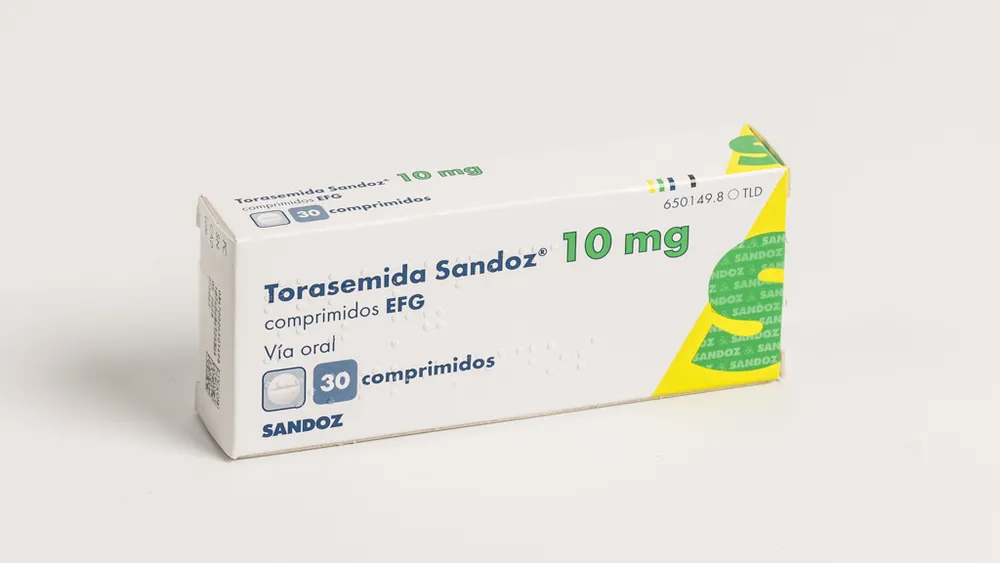
Table of Contents
- Package leaflet: Information for the user
- Introduction
- 1. What Torasemida Sandoz SANDOZ 10 mg tablets is and what it is used for
- 2. What you need to know before taking Torasemide Sandoz
- **Taking Torasemide Sandoz with food and drink**
- **Pregnancy, breastfeeding, and fertility**
- 3. How to take Torasemida Sandoz
- 4. Possible adverse effects
- 5. Storage of Torasemide Sandoz
- 6. Contents of the pack and other information
Package leaflet: Information for the user
Introduction
Package leaflet: information for the patient
Torasemide Sandoz 5 mg tablets EFG
Torasemide Sandoz 10 mg tablets EFG
Read the entire leaflet carefully before you start taking this medicine, because it contains important information for you.
-
Keep this leaflet. You may need to read it again.
-
If you have any questions, ask your doctor or pharmacist.
-
This medicine has been prescribed for you only, and you should not give it to other people, even if they have the same symptoms as you, because it could harm them.
- If you experience any adverse effects, consult your doctor or pharmacist, even if they are adverse effects not listed in this leaflet. See section 4.
Contents of the leaflet
- What Torasemide Sandoz is and what it is used for
- What you need to know before taking Torasemide Sandoz
- How to take Torasemide Sandoz
- Possible adverse effects
- How to store Torasemide Sandoz
- Contents of the pack and other information
1. What Torasemida Sandoz SANDOZ 10 mg tablets is and what it is used for
Torasemida Sandoz contains torasemide, a medicine that belongs to a group of medicines called antihypertensive diuretics.
Torasemide is indicated for:
- Treatment of essential arterial hypertension.
- Treatment and prevention of oedema (swelling due to fluid retention) due to congestive heart, hepatic, and renal failure.
2. What you need to know before taking Torasemide Sandoz
Do not take Torasemide Sandoz:
- if you are allergic to the active substance or to any of the other ingredients of this medicine (listed in section 6),
- if you have anuria (absence of urine production) due to kidney failure,
- if you have severe impairment of liver function.
Warnings and precautions
Consult your doctor or pharmacist before taking Torasemide Sandoz.
- During long-term treatment, and especially in elderly patients, your doctor will periodically perform blood tests to monitor various parameters such as potassium, glucose, uric acid, creatinine, and lipids.
- Urinary retention must be corrected before and during treatment with this medicine.
- If you have a kidney disease, it should be treated.
- If you have severe liver disease, especially if it has affected the brain.
- This medicine may affect muscle cells of the heart, skeleton, and intestine. Potassium levels should be monitored during treatment with this medicine.
- Sodium levels should be monitored before or during treatment.
- In patients with reduced blood volume, this medicine should be administered under medical supervision.
- If you have hypotension, it should be corrected before or during treatment with this medicine.
- If you have arrhythmias, blood tests should be performed to monitor levels of sodium, calcium, and magnesium.
- If you have gout (accumulation of uric acid in the body).
- If you are allergic to sulfonamides.
Children
Since the safety and efficacy of torasemide have not been established in children (< 18 years), its use is not recommended in this population group.
Elderly
No differences in efficacy or safety have been observed according to patient age.
Taking Torasemide Sandoz with other medicines
Inform your doctor or pharmacist if you are taking, have recently taken, or might need to take any other medicines.
You should also inform your doctor if you are taking any of the following medicines, with which torasemide may interact:
- Cardiac glycosides such as digoxin (heart medications), which may have increased adverse effects,
- antidiabetic medicines, whose action may be reduced,
- aminoglycoside antibiotics, platinum-derived cytostatics such as cisplatin (a medicine for cancer treatment), and cephalosporins: may increase kidney or ear toxicity,
- salicylates, as they may increase the risk of gout attacks,
- coumarin derivatives,
- non-steroidal anti-inflammatory drugs (e.g., ibuprofen, indomethacin), which may reduce the effect of diuretics and increase the risk of kidney failure,
- antihypertensives (particularly ACE inhibitors) which may cause hypotension and increase the risk of kidney failure,
- probenecid, which may reduce the effect of torasemide,
- muscle relaxants and theophylline,
- lithium, as torasemide may increase the adverse effects of lithium,
- cholestyramine (a medicine used to lower blood cholesterol levels): may reduce the effect of torasemide.
Taking Torasemide Sandoz with food and drink
The tablets can be taken with or without food. They should be swallowed whole, with some liquid, preferably in the morning.
Pregnancy, breastfeeding, and fertility
If you are pregnant or breastfeeding, think you may be pregnant, or are planning to become pregnant, consult your doctor or pharmacist before using any medicine. Torasemide is not recommended during pregnancy or in breastfeeding women, as it is unknown whether torasemide passes into breast milk.
Driving and use of machines
This medicine may affect your ability to drive or operate machinery, especially if taken simultaneously with alcohol.
Torasemide Sandoz contains lactose and sodium
This medicine contains lactose. If your doctor has informed you of an intolerance to certain sugars, consult him before taking this medicine.
This medicine contains less than 23 mg of sodium (1 mmol) per tablet; this is, essentially "sodium-free".
3. How to take Torasemida Sandoz
Follow exactly the instructions given by your doctor for taking this medicine. If in doubt, consult your doctor or pharmacist again.
Remember to take your medicine.
Can be taken at any time in relation to meals, as convenient. Swallow whole, without chewing, with a little liquid, preferably with breakfast.
Your doctor will determine the duration of your treatment with Torasemida Sandoz. Do not stop treatment earlier, as this could worsen your condition.
The recommended dose in adults is:
In edema associated with congestive heart failure, kidney or liver disease: The recommended initial dose ranges from 5 mg to 20 mg once daily. However, your doctor may increase it up to approximately double if considered appropriate.
In hypertension: The recommended initial dose is 2.5 mg to 5 mg once daily. Your doctor may increase it up to 10 mg daily or prescribe an additional antihypertensive.
If you take more Torasemida Sandoz than you should
If you have taken more Torasemida Sandoz than you should, contact your doctor, pharmacist, or call the Toxicology Information Service immediately at telephone number: 91 562 04 20, indicating the medicine and amount taken. In case of overdose, increased urine output may occur, along with drowsiness, confusion, weakness, and dizziness.
If you forget to take Torasemida Sandoz
Do not take a double dose to make up for forgotten doses.
Take your dose as soon as you remember, and the next day take it at your usual time.
4. Possible adverse effects
Like all medicines, this medicine may cause adverse effects, although not everyone experiences them.
Adverse effects may occur with the following frequencies:
Very common adverse effects: may affect more than 1 in 10 patients
Common adverse effects: may affect up to 1 in 10 patients
Uncommon adverse effects: may affect up to 1 in 100 patients
Rare adverse effects: may affect up to 1 in 1,000 patients
Very rare adverse effects: may affect up to 1 in 10,000 patients
Frequency not known: cannot be estimated from available data
The following adverse effects have been reported:
Common adverse effects:
Increase in blood pH (metabolic alkalosis), electrolyte and fluid imbalance (e.g., decreased total blood volume, decreased sodium and/or potassium in blood), headache, dizziness, gastrointestinal disturbances (e.g., loss of appetite, abdominal pain, nausea, vomiting, diarrhea, constipation), muscle spasms, fatigue, tiredness.
Uncommon adverse effects:
Increased liver enzymes, urinary retention, gallbladder distension, increased blood levels of uric acid, glucose, and lipids such as triglycerides or cholesterol.
Rare adverse effects:
Increased blood levels of urea and/or creatinine.
Very rare adverse effects:
Skin allergic reactions (itching and skin rashes), photosensitivity reaction.
Frequency not known:
Severe skin reactions (e.g., Stevens-Johnson syndrome, toxic epidermal necrolysis), decreased number of platelets and/or leukocytes in blood, anaemia, cerebral ischaemia (reduced blood flow to the brain), sensation of numbness in the body (paraesthesia), confusional state, visual disturbance, ringing in the ears (tinnitus), deafness, infarction (acute myocardial infarction), lack of blood flow to the heart (myocardial ischaemia), angina pectoris, loss of consciousness (syncope), hypotension, blockage of blood vessels (embolism), dry mouth, inflammation of the pancreas (pancreatitis).
Reporting of adverse effects
If you experience any type of adverse effect, consult your doctor or pharmacist, even if it is a possible adverse effect not listed in this leaflet. You may also report them directly via the Spanish Pharmacovigilance System for Human Medicinal Products: www.notificaram.es. By reporting adverse effects, you can help provide more information on the safety of this medicine.
5. Storage of Torasemide Sandoz
Keep this medicine out of the sight and reach of children.
Do not store above 30°C.
Do not use this medicine after the expiry date stated on the packaging after EXP. The expiry date refers to the last day of the month indicated.
Medicines should not be disposed of via wastewater or household waste. Dispose of unused medicines and their containers at the SIGRE collection point at your pharmacy. If you are unsure, please ask your pharmacist how to dispose of medicines and containers you no longer need. This will help protect the environment.
6. Contents of the pack and other information
Composition of Torasemide Sandoz:
Torasemide Sandoz 5 mg tablets:
- The active substance is torasemide. Each tablet contains 5 mg of torasemide.
- The other components (excipients) are: monohydrate lactose, corn starch, sodium carboxymethylstarch (type A), colloidal anhydrous silica and magnesium stearate.
Torasemide Sandoz 10 mg tablets:
- The active substance is torasemide. Each tablet contains 10 mg of torasemide.
- The other components (excipients) are: monohydrate lactose, corn starch, sodium carboxymethylstarch (type A), colloidal anhydrous silica and magnesium stearate.
Nature of the product and pack contents
Torasemide Sandoz 5 mg are biconvex, round, white or almost white tablets, scored on one side and marked with 915 on the other. Packaged in containers of 30 tablets.
Torasemide Sandoz 10 mg are biconvex, round, white or almost white tablets, scored on one side and marked with 916 on the other. Packaged in containers of 30 tablets.
Marketing Authorisation Holder and Manufacturer
Marketing Authorisation Holder
Sandoz Farmacéutica, S.A.
Centro Empresarial Parque Norte
Edificio Roble
C/ Serrano Galvache, 56
28033 Madrid
Spain
Manufacturer
PLIVA HRVATSKA D.O.O.
Prilaz Baruna Filipovica 25
ZAGREB – 10000
Croatia
Date of the most recent revision of this leaflet: May 2020
Detailed and up-to-date information on this medicine is available on the website of the Spanish Agency of Medicines and Medical Devices (AEMPS) http://www.aemps.gob.es/