Topotecan Hospira 4 mg/4 ml concentrate for solution for infusion
Spain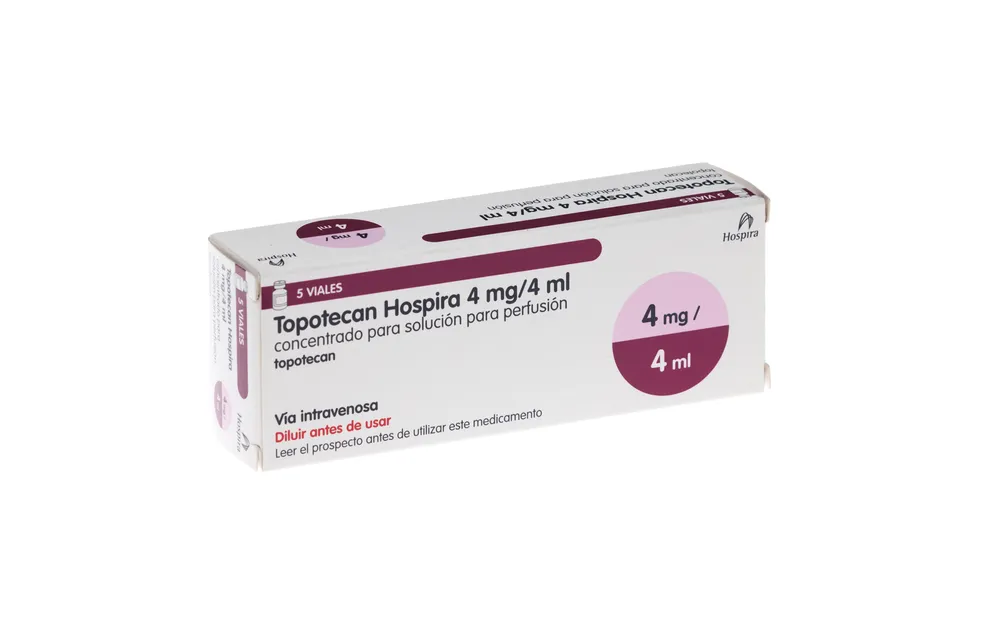
Table of Contents
- Package leaflet: Information for the user
- Introduction
- 1. What Topotecan Hospira is and what it is used for
- 2. What you need to know before Topotecan Hospira is administered to you
- 3. How to use Topotecan Hospira
- 4. Possible adverse effects
- 5. Storage of Topotecan Hospira
- 6. Contents of the container and other information
Package leaflet: Information for the user
Introduction
Package leaflet: information for the user
Topotecan Hospira 4 mg/4 ml concentrate for solution for infusion
topotecan
Read all of this leaflet carefully before you start using this medicine, because it contains important information for you.
- Keep this leaflet, as you may need to read it again.
- If you have any questions, ask your doctor or pharmacist.
- If you experience any side effects, talk to your doctor, even if it is a side effect not listed in this leaflet. See section 4.
Contents of the leaflet
- What Topotecan Hospira is and what it is used for
- What you need to know before Topotecan Hospira is administered to you
- How Topotecan Hospira is used
- Possible side effects
- How to store Topotecan Hospira
- Contents of the pack and other information
1. What Topotecan Hospira is and what it is used for
Topotecan Hospira helps to destroy tumors. A doctor or nurse will administer your medication as an intravenous infusion in the hospital.
Topotecan Hospira is used to treat:
- ovarian cancer or small cell lung cancer that has recurred after prior chemotherapy.
- advanced cervical cancer, when surgery or radiotherapy is not possible. When used to treat cervical cancer, Topotecan Hospira is given in combination with another medicine called cisplatin.
Your doctor will decide together with you whether treatment with Topotecan Hospira is preferable to your initial chemotherapy regimen.
2. What you need to know before Topotecan Hospira is administered to you
Do not receive Topotecan Hospira
- if you are allergic to topotecan or to any of the other ingredients of this medicine (listed in section 6).
- if you are breastfeeding.
- if your blood cell count is very low. Your doctor will determine whether this applies to you, based on the results of your most recent blood test.
Tell your doctor if you are in any of these situations.
Warnings and precautions
Before this medicine is administered, your doctor needs to know:
-
if you have liver or kidney problems. Your dose of Topotecan Hospira may need to be adjusted.
-
if you are pregnant or think you may be pregnant. See the section “Pregnancy and breastfeeding” below.
-
if you are planning to father a child. See the section “Pregnancy and breastfeeding” below.
Tell your doctor if you are in any of these situations.
Other medicines and Topotecan Hospira
Tell your doctor if you are taking, have recently taken, or might need to take any other medicines, including those obtained without a prescription or any herbal medicines. Remember to inform your doctor if you start taking any medicine while being treated with Topotecan Hospira.
Pregnancy and breastfeeding
The use of topotecan is not recommended in pregnant women. It may cause harm to the fetus before, during, or after treatment. You must use an effective method of contraception. Do not attempt to become pregnant or father a child until your doctor advises it is safe to do so.
Men who wish to father children should seek advice from their doctor regarding family planning. If your partner becomes pregnant during your treatment, inform your doctor immediately.
Avoid breastfeeding if you are being treated with topotecan. Do not resume breastfeeding until your doctor advises it is safe to do so.
Driving and using machines
Topotecan may cause tiredness. If you feel fatigued or weak, do not drive or operate machinery.
Topotecan Hospira contains sodium
This medicine contains less than 1 mmol of sodium (23 mg) per vial; this is, essentially, “sodium-free”.
3. How to use Topotecan Hospira
The dose of topotecan you will receive will be calculated by your doctor based on:
- your body size (body surface area measured in square meters)
- the results of blood tests performed before treatment
- the type of disease being treated.
The usual dose is
- Ovarian cancer and small cell lung cancer: 1.5 mg per square meter of body surface area per day. You will receive treatment once daily for 5 days. This treatment schedule is usually repeated every 3 weeks.
- Cervical cancer: 0.75 mg per square meter of body surface area per day. You will receive treatment once daily for 3 days. This treatment schedule is usually repeated every 3 weeks.
When treating cervical cancer, Topotecan Hospira is combined with another medicine called cisplatin. Your doctor will determine the appropriate dose of cisplatin.
This treatment may vary depending on the results of your periodic blood tests.
How topotecan is administered
A doctor or nurse will administer topotecan to you as an intravenous infusion in your arm lasting approximately 30 minutes.
4. Possible adverse effects
Like all medicines, this medicine can cause adverse effects, although not everyone will experience them.
Serious adverse effects: tell your doctor
These very common adverse effects may affect more than 1 in 10 people treated with Topotecan Hospira:
-
Signs of infection: Topotecan may reduce the number of white blood cells and lower your resistance to infections. This may be life-threatening. Some signs of infection include:
- fever
- severe deterioration in your general condition
- local symptoms such as sore throat or urinary problems (e.g., burning sensation when urinating, which may be due to a urinary tract infection)
-
Occasionally, severe stomach pain, fever, and possible diarrhea (rarely with blood) may be signs of intestinal inflammation (colitis).
This rare adverse effect may affect up to 1 in 1,000 people treated with Topotecan Hospira:
-
Lung inflammation (interstitial lung disease): you are at higher risk if you already have lung disease, have received radiation therapy to your lungs, or have previously taken medicines that caused lung damage. Signs include:
-
difficulty breathing
-
cough
-
fever
Tell your doctor immediately if you notice any of these symptoms, as hospitalization may be required.
Very common adverse effects
May affect more than 1 in 10 people treated with Topotecan Hospira:
- General feeling of weakness and tiredness (transient anemia). In some cases, a blood transfusion may be necessary.
- Bruising or unexplained bleeding, caused by a decrease in the number of blood cells involved in clotting. This may lead to severe bleeding from relatively minor injuries such as small cuts. Rarely, this may result in more serious bleeding (haemorrhage). Talk to your doctor for advice on how to minimize the risk of bleeding.
- Weight loss and loss of appetite (anorexia); tiredness; weakness.
- Nausea; vomiting; diarrhea; stomach pain; constipation.
- Inflammation and ulcers in the mouth, tongue, and gums.
- Increase in body temperature (fever).
- Hair loss.
Common adverse effects
May affect up to 1 in 10 people treated with Topotecan Hospira:
- Allergic reactions or hypersensitivity (including skin rash).
- Yellowing of the skin.
- Malaise.
- Itching sensation.
Rare adverse effects
May affect up to 1 in 1,000 people treated with Topotecan Hospira:
- Severe allergic reactions or anaphylactic reactions.
- Swelling due to fluid retention (angioedema).
- Mild pain and inflammation at the injection site.
- Itchy skin rash (or hives).
Adverse effects of unknown frequency
The frequency of some adverse effects is unknown (effects reported from spontaneous reports and frequency cannot be estimated from the available data):
- Severe stomach pain, nausea, vomiting with blood, black or bloody stools (possible symptoms of gastrointestinal perforation).
- Mouth sores, difficulty swallowing, abdominal pain, nausea, vomiting, diarrhea, bloody stools (possible signs and symptoms of inflammation of the inner lining of the mouth, stomach, and/or intestine [mucositis]).
If you are being treated for cervical cancer, you may experience adverse effects related to another medicine (cisplatin) that will be administered together with Topotecan Hospira. These effects are described in the cisplatin package leaflet.
Reporting of adverse effects
If you experience any adverse effect, consult your doctor or pharmacist, even if it is a possible adverse effect not listed in this leaflet. You may also report them directly through the national reporting system included in Appendix V. By reporting adverse effects, you can help provide more information on the safety of this medicine.
5. Storage of Topotecan Hospira
Keep this medicine out of the sight and reach of children.
Do not use Topotecan Hospira after the expiry date stated on the vial and outer packaging following EXP.
Store in a refrigerator (2°C–8°C). Do not freeze.
Keep the vial in its outer packaging to protect it from light.
This medicine is for single use only. After opening the vial, the product should be used immediately. If not used immediately, Topotecan Hospira may be stored for up to 24 hours either in the refrigerator (protected from light) or at room temperature (under normal daylight conditions).
Do not use this medicine if you see any visible particles in it.
Medicines should not be disposed of via wastewater. Ask your pharmacist how to dispose of medicines and packaging you no longer need. This helps protect the environment.
6. Contents of the container and other information
Composition of Topotecan Hospira
The active substance in Topotecan Hospira is topotecan (as hydrochloride). 1 ml of concentrate for solution for infusion contains 1 mg of topotecan (as hydrochloride). Each 4 ml vial of concentrate contains 4 mg of topotecan (as hydrochloride).
The other components are: tartaric acid (E334), water for injections, hydrochloric acid (E507), and sodium hydroxide (to adjust the pH of the solution).
Appearance of the product and contents of the container
Topotecan Hospira is a clear, yellow to yellow-greenish concentrate for infusion solution, supplied in clear glass vials, each containing 4 ml of concentrate. Topotecan Hospira is available in two pack sizes: 1 vial or 5 vials. Not all pack sizes may be marketed.
Marketing Authorization Holder
Pfizer Europe MA EEIG
Boulevard de la Plaine 17
1050 Brussels
Belgium
Manufacturer
Pfizer Service Company BVBA
Hoge Wei 10
1930 Zaventem
Belgium
For further information about this medicine, please contact the local representative of the Marketing Authorization Holder:
BE Pfizer SA/NV Tel/Tel: +32 2 554 62 11 | LT Pfizer Luxembourg SARL filialas Lietuvoje Tel. + 370 52 51 4000 |
BG Pfizer Bulgaria EOOD, Sofia office Tel.: +359 2 970 4333 | LU Pfizer SA/NV Tél/Tel: +32 2 554 62 11 |
CZ Pfizer, spol. s r.o. Tel: +420-283-004-111 | HU Pfizer Kft. Tel.: + 36 1 488 37 00 |
DK Pfizer ApS Tlf: + 45 44 20 11 00 | MT Drugsales Ltd Tel: + 356 21 419 070/1/2 |
DE Pfizer Pharma GmbH Tel: + 49 (0)800 8535555 | NL Pfizer bv Tel: +31 (0)10 406 43 01 |
EE Pfizer Luxembourg SARL Eesti filiaal Tel: +372 666 7500 | NO Pfizer AS Tlf: +47 67 52 61 00 |
EL Pfizer ΕΛΛΑΣ A.E. Tel: +30 210 6785 800 | AT Pfizer Corporation Austria Ges.m.b.H. Tel: +43 (0)1 521 15-0 |
ES Pfizer, S.L. Tel: +34 91 490 99 00 | PL Pfizer Polska Sp. z o.o. Tel.: +48 22 335 61 00 |
FR Pfizer Tél: + 33 (0)1 58 07 34 40 | PT Laboratórios Pfizer, Lda. Tel: +351 21 423 55 00 |
HR Pfizer Croatia d.o.o. Tel: +385 1 3908 777 | RO Pfizer România S.R.L. Tel: +40 (0)21 207 28 00 |
IE Pfizer Healthcare Ireland Tel: 1800 633 363 (toll free) +44 (0) 1304 616161 | SI Pfizer Luxembourg SARL Pfizer, podružnica za svetovanje s podrocja farmacevtske dejavnosti, Ljubljana Tel: +386 (0)1 52 11 400 |
IS Icepharma hf. Tel: +354 540 8000 | SK Pfizer Luxembourg SARL, organizačná zložka Tel: +421–2–3355 5500 |
IT Pfizer Italia Srl Tel: +39 06 33 18 21 | FI Pfizer Oy Tel/Tel: +358 (0)9 430 040 |
CY Pharmaceutical Trading Co Ltd Tel: 24656165 | SE Pfizer AB Tel: +46 (0)8 550 520 00 |
LV Pfizer Luxembourg SARL filiale Latvija Tel.: + 371 670 35 775 | UK Hospira UK Limited Tel: + 44 (0) 1628 515500 |
Date of the most recent review of this leaflet:
Other sources of information
Detailed information on this medicine is available on the European Medicines Agency website: http://www.ema.europa.eu/
This information is intended for healthcare professionals only:
Instructions for storage, use, handling, and disposal of Topotecan Hospira
Storage
Unopened vial: Store in a refrigerator (2-8°C). Do not freeze. Keep the vial in its outer packaging to protect from light.
Instructions for use
Refer to the Summary of Product Characteristics of Topotecan Hospira for more detailed information.
Topotecan Hospira 4 mg/4 ml concentrate for solution for infusion must be diluted to a final concentration between 25 and 50 micrograms/ml before administration to the patient. Approved diluents for the concentrate are either 9 mg/ml (0.9%) sodium chloride solution for injection or 50 mg/ml (5%) glucose solution for infusion. Use aseptic technique during any further dilution of the infusion solution.
Parenteral medicines should be inspected visually for particulate matter or discoloration prior to administration. Topotecan Hospira is a yellow to yellow-green solution.
Prior to the first cycle of topotecan administration, patients should have a baseline neutrophil count ≥1.5 x 10⁹/l, a platelet count ≥100 x 10⁹/l, and a hemoglobin level >9 g/dl (after transfusion, if necessary). Neutropenia and thrombocytopenia must be monitored. For further details, refer to the Summary of Product Characteristics.
Dosage: Ovarian and small cell lung cancer
Initial dose: 1.5 mg/m² of body surface area per day administered as a daily 30-minute intravenous infusion for 5 consecutive days, with a 3-week interval between the start of each cycle.
Subsequent doses: Topotecan should not be re-administered unless the neutrophil count is ≥1 x 10⁹/l, the platelet count is ≥100 x 10⁹/l, and hemoglobin level is ≥9 g/dl (after transfusion, if necessary).
Dosage: Cervical cancer
Initial dose: 0.75 mg/m²/day administered as a daily 30-minute intravenous infusion on days 1, 2, and 3. Cisplatin is administered as an intravenous infusion on day 1 at a dose of 50 mg/m²/day, following the dose of topotecan. This treatment regimen is repeated every 21 days for 6 cycles or until disease progression.
Subsequent doses: Topotecan should not be re-administered unless the neutrophil count is ≥1.5 x 10⁹/l, the platelet count is ≥100 x 10⁹/l, and hemoglobin level is ≥9 g/dl (after transfusion, if necessary).
Dosage: Patients with renal impairment
Limited data suggest that the dose should be reduced in patients with moderate renal impairment. Refer to the Summary of Product Characteristics for further details.
Dosage: Paediatric population
Experience in children is limited. Use is not recommended.
The physical and chemical stability of the concentrate has been demonstrated for 24 hours at 25°C under normal light conditions, and between 2°C and 8°C when protected from light. From a microbiological standpoint, the product should be used immediately. If not used immediately, storage times and conditions prior to use are the responsibility of the user and should normally not exceed 24 hours between 2°C and 8°C, unless reconstitution/dilution has been carried out under controlled and validated aseptic conditions.
Handling and disposal
Standard procedures for the safe handling and disposal of cytotoxic anticancer medicinal products should be followed:
- Healthcare personnel should be trained in the preparation and administration of the medicinal product.
- Healthcare personnel who are pregnant should not handle cytotoxic preparations.
- Healthcare personnel should wear appropriate protective clothing, including mask, goggles, and gloves.
- All items used for the preparation, administration, and cleaning of the medicinal product, including gloves, should be placed in disposable high-risk waste bags for high-temperature incineration. Liquid waste may be disposed of with large amounts of water.
- In case of accidental skin or eye contact, immediately flush thoroughly with water. If irritation persists, seek medical advice.
- Disposal of unused medicinal product and of all materials that have come into contact with it must be carried out in accordance with the hospital's standardized procedures for cytotoxic medicinal products.