Tomudex 2 mg powder for solution for infusion
Spain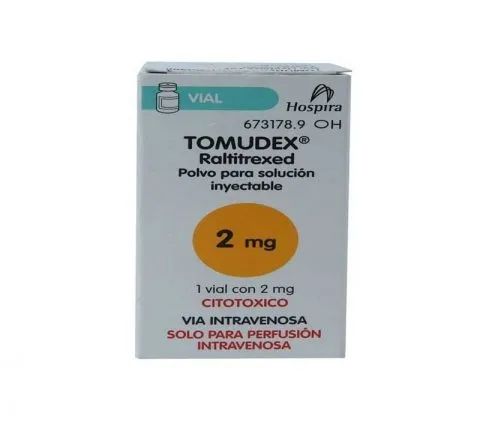
Table of Contents
Patient Information Leaflet
Introduction
Package Leaflet: Information for the Patient
Tomudex 2 mg powder for solution for infusion
Raltitrexed
Read this entire leaflet carefully before you start using this medicine, as it contains important information for you.
- Keep this leaflet as you may need to read it again.
- If you have any questions, ask your doctor, pharmacist, or nurse.
- If you experience any side effects, consult your doctor, pharmacist, or nurse, even if they are side effects not listed in this leaflet. See section 4.
Leaflet Contents:
- What Tomudex is and what it is used for
- What you need to know before using Tomudex
- How to use Tomudex
- Possible side effects
- How to store Tomudex
- Contents of the pack and other information
1. What Tomudex is and what it is used for
Tomudex is used for palliative treatment of advanced colorectal cancer affecting the colon and rectum (parts of your large intestine) when 5FU+LV therapy is unacceptable or inappropriate.
2. What you need to know before using Tomudex
Do not use Tomudex:
- If you are allergic to the active substance or to any of the other ingredients of this medicine (listed in section 6).
- Before being treated with this medicine, you must inform your doctor if you are or suspect you may be pregnant, or if you are breastfeeding, as Tomudex must not be administered in these cases.
- This medicine must not be given to children.
- This medicine must not be administered to patients with severe kidney disease.
- This medicine must not be administered concomitantly with leucovorin (folinic acid), folic acid, or vitamin preparations containing these compounds.
Warnings and precautions
Talk to your doctor, pharmacist, or nurse before starting treatment with Tomudex.
- If you and your partner wish to have children; it is recommended to avoid pregnancy during treatment and for at least 6 months after completion of treatment, if either partner is being treated with Tomudex.
- If you have or have had any blood, kidney, or liver problems.
- If you have or have had any stomach or abdominal (intestinal) problems.
- If you have previously received radiotherapy (treatment with high doses of X-rays).
Children and adolescents
See "Do not use Tomudex"
Other medicines and Tomudex:
Inform your doctor or pharmacist if you are taking, have recently taken, or might need to take any other medicines. In particular, inform them if you are taking folinic acid or folic acid, vitamins, vitamin supplements, or if you are taking an anticoagulant (a medicine to prevent blood clots).
Pregnancy, breastfeeding, and fertility:
If you are pregnant or breastfeeding, think you might be pregnant, or plan to become pregnant, consult your doctor or pharmacist before using this medicine.
Pregnancy
Pregnancy must be ruled out before starting treatment with this medicine.
Pregnancy should be avoided if either partner is being treated with this medicine; likewise, it is recommended to avoid pregnancy for at least 6 months after completion of treatment.
Tomudex must not be administered during pregnancy, or to women who may become pregnant during treatment with this medicine.
Breastfeeding
This medicine must not be administered during breastfeeding.
Fertility
Fertility studies in rats indicate that raltitrexed may cause a reduction in male fertility. Fertility returned to normal 3 months after the end of administration.
Use in elderly patients:
Elderly patients are more vulnerable to the toxic effects of Tomudex. Since kidney function tends to decline with age, there is a risk of accumulation of this compound in elderly patients. Particular care should be taken to ensure adequate monitoring for adverse reactions.
Driving and use of machines:
It is unlikely that this medicine will adversely affect your ability to drive or operate machinery. However, some patients may experience a flu-like syndrome or a general feeling of malaise for a short time after receiving this medicine. If you experience these effects, you should not drive or operate machinery.
Tomudex contains sodium
This medicine contains less than 1 mmol of sodium (23 mg) per vial; i.e., essentially "sodium-free".
3. How to use Tomudex
Follow exactly the administration instructions for this medicine given by your doctor. If in doubt, consult your doctor again.
Your doctor will determine how long your treatment with this medicine should last. Do not stop treatment before your doctor tells you to do so.
-
Your injection will be administered under the supervision of a specialist doctor experienced in using this type of drug.
-
If you are unsure about any particular aspect, ask your doctor.
-
The exact dose you will receive will be decided by your doctor. This will vary depending on your body size and how you respond to the treatment. The results of your blood tests will also help your doctor decide the dose you will receive.
-
The usual dose is 3 mg/m² of body surface area (you will receive 3 mg for each square meter of body surface area, calculated from your height and weight).
-
The dose you receive may vary between treatments.
-
Tomudex will be slowly injected into one of your veins. The injection will usually take 15 minutes to administer.
The medicine is usually given every 3 weeks. This interval may be extended depending on the results of your regular blood tests.
4. Possible adverse effects
Like all medicines, this medicine may cause adverse effects, although not everyone experiences them.
Some of these must be treated immediately. If you experience any of the following, contact your doctor (specialist) immediately, so that you can receive treatment if necessary:
Very common adverse effects (may affect more than 1 in 10 patients) include:
- Diarrhea
- Vomiting
- Fever
Common adverse effects (may affect up to 1 in 10 patients) include:
Infections
- Mouth ulceration or stomatitis (mouth pain)
Other possible adverse effects are:
Very common adverse effects (may affect more than 1 in 10 patients) include:
- Loss of appetite
- Leukopenia (low blood cell count)
- Anemia
- Nausea
- Constipation
- Abdominal pain
- Skin reactions (reddish or peeling skin or itchy rash)
- Weakness (sometimes flu-like)
- Mucositis (inflammation of the mouth and intestines causing mouth pain or ulceration or diarrhea)
- Liver abnormalities
Common adverse effects (may affect up to 1 in 10 patients) include:
- Cellulitis (tenderness and swelling under the skin)
- Infection
- Flu-like symptoms
- Low platelet count
- Dehydration (feeling thirsty and/or dry skin)
- Headache
- Muscle cramps
- Taste disturbances
- Conjunctivitis (red and/or itchy eyes)
- Hair loss
- Itching of the skin
- Sweating
- Joint pain
- Swelling, pain, and discomfort at the site of administration
- Weight loss
In addition, this medicine may cause blood abnormalities due to effects on your bone marrow or liver. Your doctor will perform regular blood tests to detect whether such abnormalities have occurred.
Do not be alarmed by this list of possible adverse effects, as you may not experience any of them.
Inform your doctor if you think you are experiencing these or any other problems with your treatment.
If any other reactions not described in this leaflet occur, consult your doctor or pharmacist.
Reporting of adverse effects:
If you experience any type of adverse effect, talk to your doctor, pharmacist, or nurse, even if it is a possible adverse effect not listed in this leaflet. You can also report them directly through the Spanish Pharmacovigilance System for Human Medicinal Products: https://www.notificaram.es. By reporting adverse effects, you can help provide more information on the safety of this medicine.
5. Storage of Tomudex
Keep this medicine out of the sight and reach of children.
Do not use this medicine after the expiry date stated on the vial label and the carton after EXP. The expiry date refers to the last day of the month indicated.
Store below 25°C. Keep the vial in the outer packaging.
The injection is normally stored in the hospital. Staff are responsible for the correct storage, use, and disposal of the medicine.
Medicines should not be disposed of via wastewater or household waste. Ask your pharmacist how to dispose of medicines and containers you no longer need. This helps protect the environment.
After reconstitution, refer to the section INFORMATION FOR HEALTHCARE PROFESSIONALS at the end of this leaflet.
6. Contents of the pack and other information
Composition of Tomudex
- The active substance is raltitrexed. Each vial of powder contains 2 mg of raltitrexed.
- The other components are: mannitol, dibasic sodium phosphate (heptahydrate), and sodium hydroxide.
Appearance of the product and contents of the pack
Tomudex is a white to off-white powder.
Each pack contains one clear glass vial with 2 mg of powder, closed with a rubber stopper and an aluminium seal.
Marketing Authorization Holder and Manufacturer
The Marketing Authorization Holder is:
HOSPIRA INVICTA, S.A.
Avda. de Europa 20-B - Parque Empresarial La Moraleja
28108-Alcobendas (Madrid)
Spain
The manufacturer is:
Pfizer Service Company BV
Hermeslaan 11
1932 Zaventem
Belgium
Date of the most recent revision of this summary: November 2021
Detailed and up-to-date information on this medicine is available on the website of the Spanish Agency of Medicines and Medical Devices (AEMPS) http://www.aemps.gob.es/
The following information is intended for healthcare professionals only
INFORMATION FOR HEALTHCARE PROFESSIONALS
INSTRUCTIONS FOR CORRECT ADMINISTRATION
Each vial containing 2 mg of raltitrexed must be reconstituted with 4 ml of water for injections in order to provide a solution of 0.5 mg/ml of raltitrexed. The appropriate dose of the solution is prepared by diluting it in 50–250 ml of sodium chloride 9 mg/ml (0.9%) solution or glucose (dextrose) 50 mg/ml (5%) solution and administered by short intravenous infusion over a period of 15 minutes.
Tomudex and the specified reconstitution or dilution solutions do not contain bacteriostatic agents or preservatives; therefore, reconstitution and dilution must be performed under aseptic conditions. It is recommended that Tomudex solutions be used as soon as possible. The reconstituted solution should be stored refrigerated (2°C–8°C) for up to 24 hours.
According to established guidelines, when the medicine is diluted in sodium chloride 9 mg/ml (0.9%) solution or glucose (dextrose) 50 mg/ml (5%) solution, it is recommended that the reconstituted solution be administered as soon as possible. The reconstituted solution must be completely used or discarded within 24 hours after reconstitution of the intravenous injection.
Reconstituted and diluted solutions do not need to be protected from light.
Do not store partially used vials or reconstituted solutions for future administration. Any unused injection or reconstituted solution must be discarded, as recommended for cytotoxic products.
Tomudex injection must be reconstituted by trained personnel in a designated area for the reconstitution of cytotoxic products. These preparations should not be handled by pregnant women.
Reconstitution should normally be carried out in a separate facility with extraction, such as a laminar flow cabinet, and work surfaces should be protected with disposable absorbent paper with a plastic backing.
Appropriate protective clothing should be worn, including standard disposable surgical gloves and goggles. In case of skin contact, wash immediately and thoroughly with water; in case of eye splash, rinse with clean water for at least 10 minutes, keeping the eyelids apart, and consult a physician.
In case of spillage, clean up using standard procedures.
Waste material must be disposed of by incineration, in accordance with established procedures for handling cytotoxic agents.