Tolak 40 mg/g cream
Spain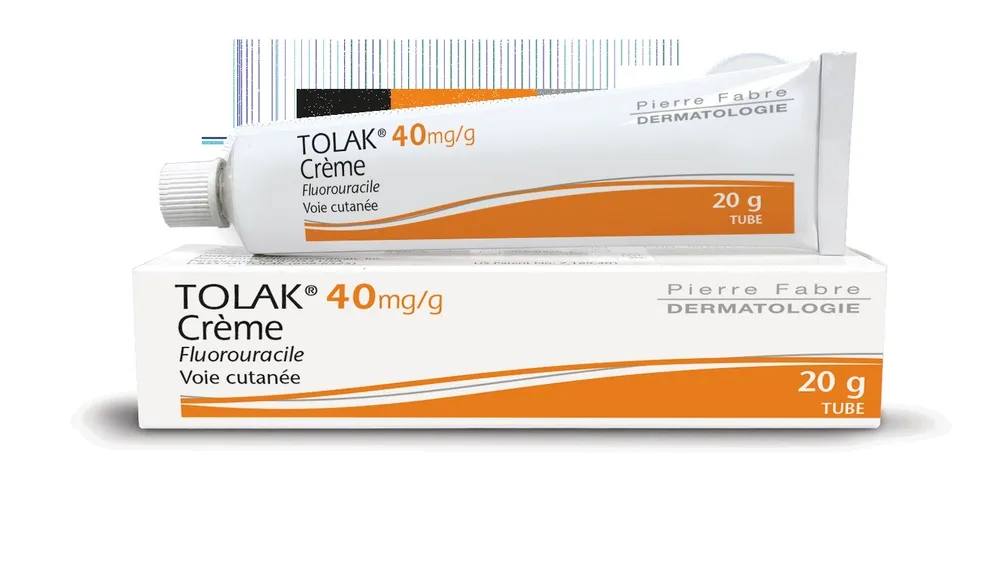
Table of Contents
Package leaflet: Information for the user
Introduction
Package leaflet: information for the patient
Tolak 40 mg/g cream
fluorouracil
Read this entire leaflet carefully before you start using this medicine, because it contains important information for you.
- Keep this leaflet, as you may need to read it again.
- If you have any questions, ask your doctor or pharmacist.
- This medicine has been prescribed for you only, and you should not give it to other people, even if they have the same symptoms as you, because it may harm them.
- If you experience any adverse effects, consult your doctor or pharmacist, even if they are adverse effects not listed in this leaflet. See section 4.
Contents of the leaflet
- What Tolak is and what it is used for
- What you need to know before using Tolak
- How to use Tolak
- Possible side effects
- How to store Tolak
- Contents of the pack and other information
1. What Tolak is and what it is used for
Tolak contains the active substance fluorouracil.
Fluorouracil belongs to a group of medicines known as antimetabolites, which inhibit cell growth (cytostatic agents).
Tolak is used to treat a skin condition called actinic keratosis (sun-damaged skin) grade I and II on the face, ears and/or scalp in adults.
Information on how Tolak works
When using Tolak, the treated area of skin is likely to become red.
Tolak destroys cancerous and precancerous skin cells, but has less effect on normal cells.
Tolak also treats skin abnormalities that are not visible to the naked eye, so areas with such abnormalities may become red and inflamed.
The process will likely progress with redness (erythema), followed by inflammation/swelling, possibly some discomfort, skin damage (erosion), and finally healing. This is the expected normal response to treatment and indicates that Tolak is working.
Sometimes the response may be more severe (see section 4, "Possible side effects"). If your skin worsens significantly, if you experience pain, or if you are concerned about the reaction, consult your doctor. Your doctor may prescribe another cream to relieve discomfort.
Skin reactions are transient, usually mild to moderate in intensity, peaking at around 4 weeks and resolving within 2 to 4 weeks after treatment ends. The treatment response generally occurs during the second week of application. Therefore, after completing treatment, it may take approximately 4 weeks for your skin to heal.
2. What you need to know before using Tolak
Do not use Tolak
- If you are allergic (hypersensitive) to the active substance (fluorouracil) or to any of the other ingredients of this medicine (listed in section 6)
- If you are allergic (hypersensitive) to peanuts or soya
- If you are pregnant
- If you are breastfeeding
- If you are taking any antiviral nucleoside medicines (e.g., brivudine and sorivudine). These are medicines usually used to treat chickenpox or shingles (see section Other medicines and Tolak).
Warnings and precautions
Talk to your doctor or pharmacist before starting to use Tolak.
- Do not apply Tolak directly into the eyes, nose, mouth, or onto other mucous membranes, as it may cause irritation, local inflammation, and ulceration. If contact occurs, wash the cream off with plenty of water.
- Do not apply Tolak on open wounds or damaged skin.
- Redness of the treated skin area is expected, likely followed by inflammation/swelling, possibly some discomfort, skin erosion, and finally healing. This is the normal expected response to treatment and indicates that Tolak is working. Consult your doctor if the skin worsens significantly, if you experience pain, or if you are concerned about the reaction. Your doctor may prescribe another cream to relieve discomfort.
- Do not cover the area where Tolak has been applied with bandages or dressings, as this may increase the inflammatory skin reaction.
- Corneal and conjunctival (layers covering the eye) problems have been reported with topical application of fluorouracil. Avoid applying Tolak around the eyes. To prevent drug transfer to the eyes or contact lenses and the surrounding area, you must wash your hands thoroughly after applying Tolak.
- In case of accidental exposure, rinse the eyes thoroughly with plenty of water.
- Allergic reactions (contact eczema) may occur. Consult your doctor if you experience intense itching or redness of the skin at application sites or elsewhere.
- Sunburn-like reactions following exposure to light (photosensitivity reaction) have been reported with fluorouracil applied to the skin. You should avoid exposure to UV radiation (both natural sunlight and sunbeds) during treatment with Tolak.
- If you know you have no activity of the enzyme dihydropyrimidine dehydrogenase (DPD) (complete DPD deficiency) or reduced activity (partial DPD deficiency), consult your doctor or pharmacist before using Tolak. Indeed, Tolak may cause severe adverse effects in people who do not have sufficient levels of this enzyme. Immediately discontinue treatment with Tolak if you experience any of the following symptoms: mouth and/or throat sores (stomatitis), inflammation of mucous membranes (mucositis), abdominal pain, diarrhea (bloody or not), vomiting, fever, or chills.
Children and adolescents
Tolak is not indicated for use in children and adolescents under 18 years of age.
Other medicines and Tolak
Inform your doctor or pharmacist if you are taking, have recently taken, or might need to take any other medicines. Especially if you are using or have used within the last 4 weeks medicines to treat chickenpox or shingles (brivudine and sorivudine). These medicines may increase the likelihood of experiencing unwanted effects with Tolak. Therefore, they should not be used together with Tolak.
Pregnancy, breastfeeding, and fertility
Tolak must not be used during pregnancy.
If you become pregnant during treatment, Tolak treatment must be stopped immediately. Contact your doctor immediately for advice regarding the risk to the unborn child.
Women of childbearing potential undergoing treatment with Tolak must use an effective method of contraception during treatment and for 6 months after the last dose of Tolak. Consult your doctor if you need advice on contraception.
Men undergoing treatment with Tolak must use effective contraception and must not father a child during treatment and for 3 months after the last dose of Tolak.
It is unknown whether Tolak passes into breast milk. Tolak must not be used during breastfeeding. If its use is absolutely necessary during this period, breastfeeding must be discontinued.
The use of Tolak may affect male and female fertility. Tolak is not recommended for use in men and women who are trying to have children.
Driving and using machines
It is unlikely that treatment will affect the ability to drive or use machines when used according to the dosing instructions.
Tolak contains:
- Butylhydroxytoluene (E 321):
May cause local skin reactions (such as contact dermatitis) or irritation of the eyes and mucous membranes.
- Cetyl alcohol and stearyl alcohol
May cause local skin reactions (such as contact dermatitis).
- Methyl parahydroxybenzoate (E 218) and propyl parahydroxybenzoate
May cause allergic reactions (possibly delayed).
- Refined arachis oil (peanut oil)
Must not be used if you are allergic to peanuts or soya.
3. How to use Tolak
Follow exactly the administration instructions for this medicine given by your doctor. If in doubt, consult your doctor or pharmacist again.
How to apply Tolak
Apply Tolak once daily, covering the skin areas to be treated, for 4 weeks, as follows:
- Wash, rinse, and gently dry the areas to be treated.
- Apply a thin layer of Tolak to the areas to be treated.
- Gently and evenly massage using the fingertips to allow Tolak to penetrate into the skin.
- Avoid contact with other body areas, as well as transfer of Tolak from your body to that of another person.
- Wash your hands thoroughly after applying Tolak.
If you use more Tolak than you should
If Tolak is applied more frequently than once a day, you are more likely to experience application site reactions, and these may be more severe.
If you or a child accidentally swallow Tolak, inform your doctor or go to the emergency room immediately.
In case of accidental ingestion, symptoms of fluorouracil overdose may include: nausea, vomiting, diarrhea, and mouth or throat sores (stomatitis). In severe cases, blood disorders may occur.
In case of overdose, consult your doctor or pharmacist, or call the Toxicology Information Service at telephone number: 91 562 04 20, indicating the medicine and the amount ingested.
If you forget to use Tolak
Do not use a double dose to make up for missed doses. Continue treatment as directed by your doctor or as described in this leaflet.
If you stop using Tolak
Contact your doctor before stopping treatment, unless you experience any of the following symptoms: mouth and/or throat sores (stomatitis), inflammation of mucous membranes (mucositis), stomach (abdominal) pain, diarrhea (with or without blood), vomiting, fever, or chills. In such cases, stop using Tolak and inform your doctor immediately (see section 2).
If you have any further questions about the use of this medicine, ask your doctor or pharmacist.
4. Possible adverse effects
Like all medicines, this medicine can cause adverse effects, although not everyone will experience them.
Frequent adverse effects (may affect up to 1 in 10 patients)
- Skin disorders at the application site: irritation, pain, reaction, redness (erythema), itching (pruritus), inflammation, swelling (edema).
- Eye irritation
Uncommon adverse effects (may affect up to 1 in 100 patients)
- Impetigo (bacterial skin infection)
- Sore throat (pharyngitis)
- Insomnia
- Nasal discomfort
- Cold sore
- Nausea
- Swelling around the eyes (edema)
- Watery eyes (lacrimation)
- Redness
- Skin disorders at the application site: bleeding, erosion, eczema (dermatitis), discomfort, dryness, sensations such as numbness, tingling, prickling (paresthesia), sunburn-like reactions after light exposure (photosensitivity reaction).
Frequency of the following adverse effects is unknown (cannot be estimated from available data)
- Allergic reactions (contact dermatitis)
Reporting of adverse effects
If you experience any type of adverse effect, consult your doctor or pharmacist, even if it is a possible adverse effect not listed in this leaflet. You can also report them directly through the Spanish Pharmacovigilance System for Human Medicines: https://www.notificaram.es. By reporting adverse effects, you can help provide more information on the safety of this medicine.
5. Storage of Tolak
Keep this medicine out of the sight and reach of children.
Do not store Tolak above 25°C.
Do not use this medicine after the expiry date stated on the packaging after EXP. The expiry date refers to the last day of the month indicated.
Discard the tubes 4 weeks after opening, even if they are not empty. They should not be kept for later use. Note the date of first opening of the tube on the outer carton to remember when to discard it.
Medicines must not be disposed of via wastewater or household waste. Dispose of unused medicines and their containers at the SIGRE collection point at your pharmacy. If in doubt, ask your pharmacist how to dispose of medicines and containers you no longer need. This will help protect the environment.
6. Contents of the pack and other information
Composition of Tolak
- The active substance is: fluorouracil
One gram of Tolak contains:
Fluorouracil…………………………………………………………………..40.0 mg
- The other components are:
Purified water
Refined arachis oil (peanut oil)*
Isopropyl myristate
Methyl gluceth-10
Stearoyl macrogolglycerides
Glycerol (E 422)
Cetyl alcohol*
Stearyl alcohol*
Sodium hydroxide (E 524)
Stearic acid
Butylhydroxytoluene* (E 321)
Methyl parahydroxybenzoate* (E 218)
Citric acid (E 330)
Propyl parahydroxybenzoate*
*See section 2 "Tolak contains"
Appearance of the medicine and contents of the pack
White or almost white cream in a 20 g or 40 g tube.
Only certain pack sizes may be marketed.
Marketing Authorization Holder
PIERRE FABRE IBÉRICA, S.A.
C/ Ramón Trias Fargas, 7-11
08005 Barcelona - Spain
Manufacturer
PIERRE FABRE MEDICAMENT PRODUCTION,
Parc Industriel de la Chartreuse
81100 Castres, France
This medicine is authorized in the Member States of the European Economic Area under the following names:
- Tolak: Austria, Czech Republic, Denmark, France, Germany, Greece, Netherlands, Norway, Poland, Slovak Republic, Spain, Sweden
- Efflurak: Belgium, Luxembourg, Portugal
- Tolerak: Finland, Italy
Date of the most recent review of this leaflet: September 2025
Detailed and up-to-date information on this medicine is available on the website of the Spanish Agency of Medicines and Health Products (AEMPS): https://www.aemps.gob.es/