Tobramycin Normon 100 mg/2 ml solution for injection EFG
Spain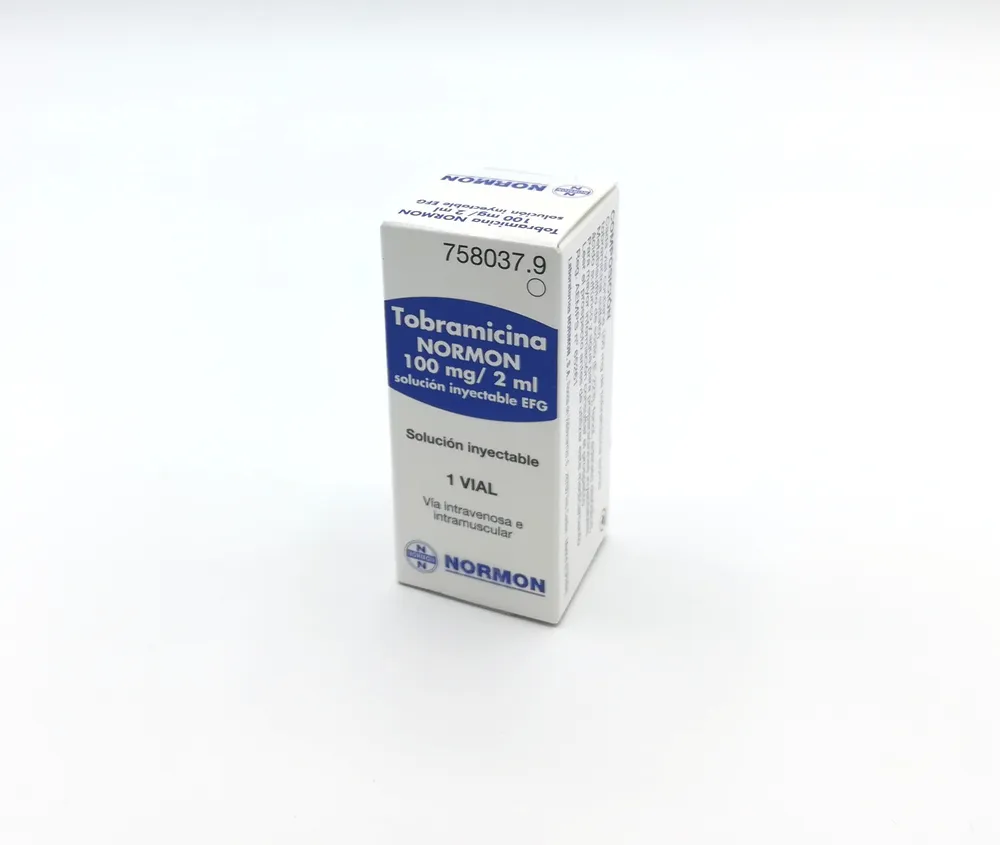
Table of Contents
Patient Information Leaflet
Introduction
Patient Information Leaflet
Tobramycin Normon 100 mg/2 ml solution for injection EFG
Read the entire leaflet carefully before you start using this medicine, as it contains important information for you.
|
Package leaflet contents:
- What Tobramycin Normon is and what it is used for
- Before using Tobramycin Normon
- How to use Tobramycin Normon
- Possible side effects
- Storage of Tobramycin Normon
- Contents of the pack and other information
1. What Tobramycin Normon is and what it is used for
Tobramycin is an antibiotic that belongs to the aminoglycoside group (used to fight bacterial infections).
Tobramycin Normon may be used to treat:
- Infections of the central nervous system such as meningitis, septicemia, and neonatal sepsis.
- Gastrointestinal infections such as peritonitis.
- Complicated and recurrent urinary tract infections such as pyelonephritis and cystitis.
- Lower respiratory tract infections such as pneumonia, bronchopneumonia, and acute bronchitis, including patients with cystic fibrosis.
- Skin, bone, and soft tissue infections such as burns.
Antibiotics are used to treat bacterial infections and are not effective against viral infections such as influenza or the common cold. It is important to follow your doctor's instructions regarding dosage, dosing interval, and duration of treatment. Do not store or reuse this medicine. If you have any leftover antibiotics after completing the treatment, return them to the pharmacy for proper disposal. Do not dispose of medicines via the sink or in household waste. |
2. Before using Tobramycin Normon
Tobramycin must never be injected intrathecally (into the spinal column) under any circumstances.
Do not use Tobramycin Normon
- If you are allergic to tobramycin, to other antibiotics of the aminoglycoside group, or to any of the other ingredients of this medicine (listed in section 6).
- If you are pregnant or breastfeeding.
- If you are taking potent diuretics (water tablets) such as furosemide or ethacrynic acid.
If any of these apply to you, inform your doctor before using this medicine.
Warnings and precautions
Talk to your doctor or pharmacist before starting to use Tobramycin Normon
- If you or members of your maternal family have a disease caused by a mitochondrial mutation (a genetic disorder) or hearing loss due to antibiotics, you are advised to inform your doctor or pharmacist before taking this medicine. Certain mitochondrial mutations may increase your risk of hearing loss with this product. Your doctor may recommend genetic testing before administering tobramycin.
- If you have severe muscle disorders, such as myasthenia gravis (a condition in which muscles become weak and tire easily) or Parkinson's disease (a brain disorder affecting movement).
- If you have kidney problems.
- If you have severe burns.
- If you have endocarditis (inflammation inside the heart).
- If you have neutropenia (low white blood cell count).
- If you are elderly.
- If you are dehydrated.
Special care is also required when this medicine is to be administered to infants under 6 weeks of age, or if you have received a high-volume blood transfusion, or if you have cystic fibrosis.
Use of Tobramycin Normon with other medicines
Special care is needed if you are taking or using other medicines, as they may interact with Tobramycin Normon, for example:
- Aminoglycosides (e.g., amikacin, streptomycin, neomycin, kanamycin, gentamicin, paromomycin).
- Amphotericin B (a medicine used to treat fungal infections), clindamycin, and vancomycin; immunosuppressive agents and cytotoxic agents (such as cyclosporine, cisplatin) increase the risk of kidney toxicity. The use of cephalosporins (such as cephalothin), acetylsalicylic acid, and methoxyflurane may also increase the risk of kidney toxicity.
- Magnesium salts, medicines used to treat myasthenia gravis, pancuronium and tubocurarine, certain inhaled anesthetics, and massive transfusions of citrated blood, as these may increase neuromuscular blockade.
- Certain potent diuretics, such as ethacrynic acid and furosemide, increase ototoxicity (hearing damage).
- Medicines used as general anesthetics, as they may increase respiratory depression.
- Medicines used as muscle relaxants during general anesthesia.
- Antihistamines, buclizine, cyclizine, loxapine, meclizine, phenothiazines, thiothixenes, or trimethobenzamide.
- Neostigmine and pyridostigmine (medicines used to treat muscle weakness).
- Indomethacin, as it may reduce antibiotic elimination, increasing the risk of toxicity.
- Beta-lactam antibiotics, as mutual inactivation of both tobramycin and beta-lactams may occur.
- Malathion.
- Other drugs (e.g., warfarin and phenindione).
Tell your doctor or nurse if you are taking, have recently taken, or might need to take any other medicines.
Pregnancy, breastfeeding and fertility
If you are pregnant or breastfeeding, think you may be pregnant, or plan to become pregnant, consult your doctor or pharmacist before using this medicine.
There may be a risk of congenital malformations if this medicine is used during pregnancy, and some children whose mothers took a similar medicine (streptomycin) have been born deaf. It will only be used if the potential benefits clearly outweigh the risks.
Driving and using machines
Do not drive or operate machinery if you experience any adverse reaction (e.g., dizziness or drowsiness), as this may impair your ability to do so.
Tobramycin Normon contains sodium and sodium metabisulfite
Tobramycin Normon may cause severe allergic reactions and bronchospasm (sudden sensation of suffocation) because it contains sodium metabisulfite (E-223).
This medicine contains less than 23 mg of sodium (1 mmol) per vial; thus, it is essentially "sodium-free".
3. How to use Tobramycin Normon
This medicine is administered by injection (using a syringe) intramuscularly or intravenously, or by infusion (drip) into a vein.
It is given as an infusion and must be diluted before use. The infusion should be administered over a period of 20 to 60 minutes.
Dosage
Your doctor will determine the most appropriate dose of tobramycin for you and how frequently it should be administered.
The dose will depend on your health status, body weight, severity of infection, age, and kidney function. Your doctor will assess your kidney function using blood and urine samples.
Treatment usually lasts between 7 and 10 days. If you take tobramycin for longer than 10 days or exceed the recommended dose, you may experience more severe adverse effects, including life-threatening breathing difficulties. These may also occur if you do not drink enough fluids, have impaired kidney function, or are taking other medicines that may affect your hearing.
Your doctor will periodically take blood samples to ensure you are receiving the correct dose.
Patients with normal kidney function:
- Use in adults: the recommended dose for adults is 3 mg/kg per day given in three equal doses every 8 hours.
In cases of very severe infections, up to 5 mg/kg per day may be administered in three or four equal doses. Your doctor may reduce this dose as appropriate.
- Use in children: the recommended dose is 6 to 7.5 mg/kg per day given in three or four doses.
- Use in premature infants or newborns under one week of age: a dose of up to a maximum of 4 mg/kg per day every 12 hours is recommended.
The usual duration of treatment is 7 to 10 days, although sometimes a longer treatment period may be necessary. In such cases, renal, auditory, and vestibular (balance) functions should be monitored, as the risk of toxicity increases when treatment exceeds 10 days.
Patients with impaired kidney function: if you have any kidney function impairment, inform your doctor, as dose adjustment will be required.
Use in elderly patients: lower maintenance doses may be required compared to younger patients.
Obese patients: your doctor will adjust the dose based on your body weight.
Patients with burns and patients with severe infections: higher doses or more frequent administration may be required.
If you use more Tobramycin Normon than you should
In case of overdose or accidental administration, contact your doctor or pharmacist immediately, or call the Toxicology Information Service (Tel. 91 562 04 20), indicating the product and amount administered.
Information for the physician: In case of overdose or toxic reactions, treatment should be symptomatic. Hemodialysis or peritoneal dialysis helps remove aminoglycosides from the blood in patients with renal dysfunction, but not in those with normal kidney function. Respiratory and renal functions should be monitored. When two or more aminoglycosides are administered simultaneously, neuromuscular blockade may occur, leading to skeletal muscle weakness and prolonged respiratory depression or paralysis. To help reverse the blockade, anticholinesterase agents or calcium salts may be used. Mechanical respiratory support may also be necessary.
If you forget to use Tobramycin Normon
Do not take a double dose to make up for missed doses.
If you have any further questions about the use of this medicine, ask your doctor or pharmacist.
4. Possible adverse effects
Like all medicines, this medicine can cause adverse effects, although not everyone experiences them.
If you experience any of the following symptoms, inform your doctor immediately:
- Severe allergic reaction: you may experience a sudden itchy rash (urticaria), swelling of the hands, feet, ankles, face, lips, mouth or throat (which may cause difficulty swallowing or breathing), and you may feel like you are about to faint.
- Hearing loss.
- Ringing, buzzing, or roaring in the ears.
- Dizziness.
- Vertigo (sensation that you or your surroundings are spinning).
These adverse effects are serious and may require urgent medical attention.
If you experience any of the following symptoms, inform your doctor as soon as possible:
Frequent: may affect up to 1 in 10 people
- Pain or reaction at the injection site.
- Swelling, redness, and tenderness along a vein.
- Changes in white blood cell levels.
- Changes in urinary function, urinating more than usual.
Uncommon: may affect up to 1 in 100 people
- Increase in white blood cell levels.
- Headache.
- Cough.
- Hoarseness or difficulty speaking.
- Sore throat.
- Difficulty breathing.
- Noisy breathing.
- Nausea and vomiting.
- Rash or development of raised, discolored spots.
- Itching.
Rare: may affect up to 1 in 1,000 people
- Confusion and disorientation.
- Increase in the amount of sputum or coughing up blood.
- Diarrhea.
- Fever.
- Feeling of tiredness or drowsiness.
- Palpitations.
- Blurred vision.
- Paresthesia in arms or legs, “tingling”.
- Anaemia (reduction in red blood cells which may cause paleness of the skin).
- Decrease in white blood cells (which may make you more prone to infections).
- Decrease in the number of blood platelets, increasing the risk of bleeding or bruising.
Very rare: may affect up to 1 in 10,000 people
- Seizures or muscle spasms.
- Loss of strength.
Frequency not known: cannot be estimated from available data
- Oral or genital fungal infections.
- Near-unconscious state.
Tobramycin Normon may cause kidney damage (the damage may range from mild renal insufficiency to acute renal failure). Your doctor may perform blood tests to monitor this.
Tobramycin Normon may lead to changes in blood cells. Your doctor may perform blood tests to check blood cell counts and levels of electrolytes in the blood, which may decrease.
In addition, your doctor will check whether you experience hearing problems. Hearing loss is usually irreversible.
Some patients who have received an injection of tobramycin into the eye have experienced serious vision problems. This is not a recommended use for this medicine.
Reporting of adverse effects
If you experience any type of adverse effect, consult your doctor or pharmacist, even if it is a possible adverse effect not listed in this leaflet. You may also report them directly via the Spanish Pharmacovigilance System for Human Medicinal Products: www.notificaram.es. By reporting adverse effects, you can help provide more information on the safety of this medicine.
5. Storage of Tobramycin Normon
Keep this medicine out of the sight and reach of children.
No special storage conditions are required. Occasionally, the solution may have a pale yellow color, which does not indicate any loss of drug potency.
Do not use this medicine after the expiry date stated on the container after EXP. The expiry date refers to the last day of the month indicated.
Medicines must not be disposed of via wastewater or household waste. Dispose of unused medicines and their containers at the SIGRE Point in your pharmacy. If you have any doubts, ask your pharmacist how to properly dispose of medicines and containers you no longer need. This helps protect the environment.
6. Contents of the container and other information
Composition of Tobramycin Normon
- The active substance is tobramycin. Each vial contains 100 mg of tobramycin (sulfate).
- The excipients are: sodium metabisulfite (E-223), phenol, disodium edetate, sulfuric acid (E-513), and water for injection.
Appearance of the product and contents of the container
Tobramycin Normon 100 mg/2 ml is a colorless or slightly yellow, clear, transparent injectable solution containing 100 mg of tobramycin per 2 ml of solution. It is supplied in a pack containing 1 glass vial. Each vial contains 2 ml of solution.
Marketing Authorization Holder and Manufacturer
LABORATORIOS NORMON, S.A.
Ronda de Valdecarrizo, 6 – 28760 Tres Cantos – Madrid (Spain).
Other presentations
Tobramycin Normon 50 mg/2 ml solution for injection EFG
Date of the most recent revision of this summary: October 2023
Detailed and up-to-date information on this medicinal product is available on the website of the Spanish Agency of Medicines and Health Products (AEMPS) http://www.aemps.gob.es/
This information is intended for healthcare professionals only:
Intravenous administration: Dilute with 0.9% sodium chloride or 5% dextrose. The usual volume of diluent is 50 to 100 ml for the adult dose. For pediatric doses, the volume of diluent should be proportionally smaller than for adults. The diluted solution is generally administered directly over a period of 20 to 60 minutes. Periods shorter than 20 minutes are not recommended to avoid exceeding serum levels of 10 µg/ml.
Extemporaneous mixtures of beta-lactam antibiotics and aminoglycosides may result in mutual inactivation. Tobramycin is incompatible with amphotericin B, sodium cephalothin, sodium nitrofurantoin, sodium sulfadiazine, and tetracyclines. Incompatibilities should also be checked whenever any other medicinal product is added to the solution. Handle under standard aseptic conditions used for intravenous infusion solutions.