Tobramycin Altan 300 mg/5 ml solution for inhalation by nebulizer
Spain
Table of Contents
Package leaflet: Information for the user
Introduction
Package leaflet: information for the patient
Tobramycin Altan 300 mg/5 ml Solution for inhalation by nebulizer
Tobramycin
Read the entire leaflet carefully before you start taking this medicine, because it contains important information for you.
- Keep this leaflet, as you may need to read it again.
If you have any questions, consult your doctor or pharmacist.
- This medicine has been prescribed for you only, and you should not give it to other people even if they have the same symptoms as you, because it could harm them.
- If you experience any adverse effects, consult your doctor or pharmacist, even if they are adverse effects not listed in this leaflet. See section 4.
Contents of the leaflet
- What Tobramycin Altan is and what it is used for
- What you need to know before using Tobramycin Altan
- How to use Tobramycin Altan
- Possible adverse effects
- How to store Tobramycin Altan
- Contents of the pack and other information
1. What Tobramycin Altan is and what it is used for
Tobramycin Altan contains a medicine called tobramycin, which is an aminoglycoside antibiotic.
Antibiotics are used to treat bacterial infections and are not effective against viral infections, such as the flu or the common cold. It is important that you follow your doctor's instructions regarding dosage, dosing interval, and duration of treatment. Do not store or reuse this medication. If you have any antibiotic left after completing the treatment, return it to the pharmacy for proper disposal. Do not dispose of medications by flushing them down the drain or in the trash. |
What Tobramycin Altan is used for
Tobramycin Altan is used in patients aged 6 years and older who have cystic fibrosis, for the treatment of lung infections caused by a bacterium called Pseudomonas aeruginosa.
Tobramycin Altan fights the infection caused by the bacterium Pseudomonas in your lungs and helps improve your breathing.
How Tobramycin Altan works
When you inhale Tobramycin Altan, the antibiotic can reach your lungs directly to fight the bacteria causing the infection. For the best outcome with this medicine, follow the instructions in this leaflet.
What is Pseudomonas aeruginosa?
Pseudomonas aeruginosa is a very common bacterium that infects almost all patients with cystic fibrosis at some point in their lives. Some patients do not acquire this infection until later in life, while others are affected at a very young age.
This bacterium is one of the most harmful for people with cystic fibrosis. If the infection is not properly controlled, it may continue to damage the lungs, causing further breathing problems.
Tobramycin Altan kills the bacteria causing lung infections. This infection can be successfully controlled if addressed at an early stage.
2. What you need to know before using Tobramycin Altan
Do not use Tobramycin
- if you are allergic to tobramycin, to any aminoglycoside antibiotic, or to any of the other ingredients of this medicine (listed in section 6).
If any of the above cases apply to you, do not take this medicine and consult your doctor.
Talk to your doctor if you think you may be allergic.
Warnings and precautions:
Talk to your doctor before starting to use Tobramycin if you have or have ever had any of the following conditions:
- Hearing problems (including ringing in the ears and dizziness).
- Kidney problems
- Unusual difficulty breathing with wheezing or coughing, chest tightness
- Blood in your sputum (the substance you cough up)
- Muscle weakness that lasts or worsens over time, symptoms mainly related to myasthenia or Parkinson's disease.
If any of these apply to you, inform your doctor before using Tobramycin.
If you or members of your maternal family have a disease caused by a mitochondrial mutation (a genetic disorder) or hearing loss due to antibiotics, you are advised to inform your doctor or pharmacist before taking this medicine. Certain mitochondrial mutations may increase your risk of hearing loss with this product. Your doctor may recommend genetic testing before administering tobramycin.
Inhaling medications can cause chest tightness and wheezing, and this may occur with Tobramycin. Your doctor will monitor your first dose of Tobramycin and check your lung function before and after the dose. If you are not already doing so, your doctor may ask you to use a bronchodilator (e.g., salbutamol) before using Tobramycin.
If you are using Tobramycin, Pseudomonas strains may over time become resistant to treatment. This means that over time, the medicine may not work as well as it should. Talk to your doctor if you are concerned about this issue.
If administered by injection, tobramycin may occasionally cause hair loss, dizziness, kidney damage, and may harm the fetus.
Children and adolescents
Tobramycin can be given to children and adolescents aged 6 years and older. Tobramycin must not be given to children under 6 years of age.
Elderly
If you are 65 years of age or older, your doctor may carry out additional tests to decide whether Tobramycin is an appropriate treatment for you.
Using Tobramycin with other medicines
Tell your doctor or pharmacist if you are using or have recently used any other medicines, including those obtained without a prescription.
You must not take the following medicines while using Tobramycin:
- Furosemide or etacrynic acid, diuretics
- Intravenous urea or mannitol
- Other medicines that may damage your nervous system, kidneys, or ears.
The following medicines may increase the risk of harmful effects if administered while you are receiving injections of tobramycin:
- Amphotericin B, cephalothin, cyclosporine, tacrolimus, polymyxins: these medicines may damage your kidneys.
- Platinum compounds (such as carboplatin and cisplatin): these medicines may damage your kidneys or ears.
- Anticholinesterases (such as neostigmine and pyridostigmine), or botulinum toxin: these medicines may cause the onset or worsening of muscle weakness.
If you are taking one or more of the medicines listed above, discuss this with your doctor before using Tobramycin.
Do not mix or dilute Tobramycin with any other medicine in your nebulizer.
If you are taking several different treatments for cystic fibrosis, you should take them in the following order:
- bronchodilator treatment, such as salbutamol
- chest physiotherapy
- other inhaled medicines
- Tobramycin – last.
Please also check this order with your doctor.
Pregnancy and breastfeeding
If you are pregnant or planning to become pregnant, consult your doctor about whether this medicine could cause harm to you or the fetus.
It is unknown whether inhaling this medicine during pregnancy causes adverse effects.
When administered by injection, tobramycin and other aminoglycoside antibiotics may cause harm to the fetus, such as deafness.
If you are breastfeeding, consult your doctor before using any medicine.
Driving and using machines
Tobramycin should not affect your ability to drive or operate machinery.
3. How to use Tobramycin Altan
Follow exactly the administration instructions for this medicine as indicated by your doctor. If in doubt, consult your doctor again.
How much of this medicine you should use and how often
- The recommended dose is the same for all individuals aged 6 years and older.
- Use two vials each day for 28 days. Inhale the entire contents of one vial in the morning and another in the evening. Ideally, there should be a 12-hour interval between doses.
- There must be a minimum interval of 6 hours between the two tobramycin inhalations.
- After taking your medicine for 28 days, you will then have a 28-day interval during which you must not inhale any tobramycin doses, before starting another cycle.
- It is important to maintain using the product twice daily throughout your 28-day treatment period and to keep to the 28-day on, 28-day off cycles.
WITH Tobramycin Altan | WITHOUT Tobramycin Altan |
Take Tobramycin Altan twice daily, every day for 28 days | Do not take Tobramycin Altan for the next 28 days |
Repeat the cycle
If you use more Tobramycin than you should
If you inhale too much Tobramycin, your voice may become very hoarse. Make sure to inform your doctor as soon as possible. If you swallow Tobramycin, inform your doctor as soon as possible.
In case of overdose or accidental ingestion, consult your doctor or pharmacist immediately or call the Toxicology Information Service at telephone number: 91 562 04 20, indicating the medication and the amount ingested.
If you forget to use Tobramycin
If you forget to use Tobramycin and there are at least 6 hours remaining before your next dose, take the missed dose as soon as possible. Otherwise, wait until your next scheduled dose. Do not take a double dose to make up for forgotten doses.
Instructions for using Tobramycin
This section of the leaflet explains how to use, care for, and handle Tobramycin. Please read and follow these instructions carefully.
If you have any further questions about the use of this medicine, consult your doctor or pharmacist.
Equipment needed to inhale Tobramycin
Tobramycin must be used with a clean, dry, reusable nebulizer.
The LC PLUS nebulizer (manufactured by PARI GmbH) is suitable for use with Tobramycin.
Your doctor or physiotherapist can advise you on the correct use of Tobramycin and the equipment required. You may need different nebulizers for your other inhaled medications for cystic fibrosis.
Preparation of Tobramycin for inhalation
-
Wash your hands thoroughly with soap and water.
-
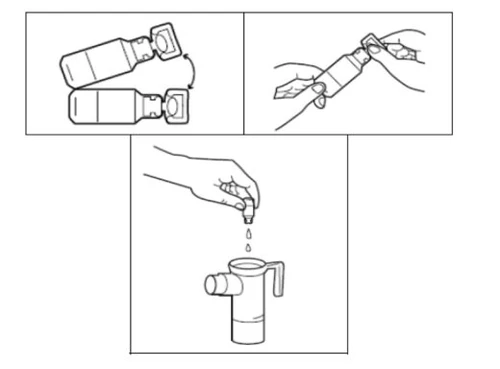
Each aluminum pouch of Tobramycin contains a tray with 14 ampoules. Cut or tear open the pouch. Remove one Tobramycin ampoule from the tray by gently pulling the lower tab to separate it from the others. Return the tray to the aluminum pouch and store it in the refrigerator.
-
Lay out the parts of your nebulizer on a clean, dry paper or cloth towel.
-
Make sure you have the correct compressor and tubing to connect the nebulizer to the compressor.
-
Carefully follow the instructions appropriate for your nebulizer model. Read the instruction manual provided by the manufacturer with the nebulizer. Check that your nebulizer and compressor are working properly according to the manufacturer's instructions before starting to use your medication.
Using Tobramycin with LC PLUS (PARI GmbH)
For more detailed instructions on the use and care of the nebulizer, read the instruction manual provided with the PARI LC PLUS.
-
Remove the top part of the nebulizer by turning it counterclockwise and lifting it off. Place this top part on the towel and stand the nebulizer chamber upright on the towel.
-
Connect one end of the tubing to the air outlet of the compressor. Ensure the tubing fits securely. Plug the compressor into the electrical outlet.
-
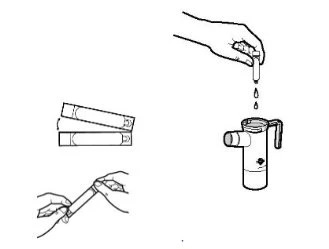
Open the Tobramycin ampoule by holding the lower tab with one hand and twisting and removing the upper tip with the other hand. Empty the entire contents of the ampoule into the nebulizer chamber.
-
Replace the top part of the nebulizer, attach the mouthpiece, and place the inspiratory valve cap onto the nebulizer. Then connect the compressor as indicated in the instruction manual of your PARI LC PLUS nebulizer.
-
Turn on the compressor. Check that a constant mist is coming out of the mouthpiece. If no mist is produced, check all tubing connections and ensure the compressor is functioning properly.
-
Sit or stand in a position that allows you to breathe normally.
-
Place the mouthpiece between your teeth and over the tip of your tongue. Breathe normally, but only through your mouth (you may find a nose clip helpful). Try not to block the airflow with your tongue.
-
Continue until all the Tobramycin Altan has been used and no more mist is produced. The complete inhalation should take approximately 15 minutes. You may hear a gurgling sound when the nebulizer chamber is empty.
-
Remember to clean and disinfect your nebulizer after treatment according to the manufacturer's instruction manual. Never use a dirty or blocked nebulizer. Do not share your nebulizer with other people.
If you are interrupted, or need to cough or rest during administration, turn off the compressor to avoid wasting the medication.
Turn the compressor back on when you are ready to resume treatment. Skip this dose if your next dose is due in less than 6 hours.
4. Possible side effects
Like all medicines, this medicine can cause side effects, although not everybody gets them.
Some side effects may be serious
If you experience any of the following side effects, stop using Tobramycin and contact your doctor immediately:
- Unusual difficulty breathing with wheezing or coughing and chest tightness
- Allergic reactions including hives and itching
If you experience any of the following side effects, contact your doctor immediately:
- Hearing loss (ringing in the ears is a potential warning sign of hearing loss), noises (such as whistling) in the ears
Your underlying lung disease may worsen while you are using Tobramycin. This may be due to lack of effectiveness. Inform your doctor immediately if this occurs.
Some side effects are very common
These side effects may affect more than 1 in 10 people.
- Runny or stuffy nose, sneezing
- Voice changes (hoarseness)
- Discoloration of the phlegm (sputum) you cough up
- Worsening of pulmonary function test results
If any of these affect you severely, contact your doctor.
Some side effects are common
These side effects may affect up to 1 in 10 people.
- General feeling of being unwell
- Muscle pain
- Voice changes with sore throat and difficulty swallowing (laryngitis)
If any of these affect you severely, contact your doctor.
Other side effects:
- Itching
- Itchy skin rash
- Skin rash
- Loss of voice
- Altered sense of taste
- Sore throat
If any of these affect you severely, contact your doctor.
If you have received Tobramycin at the same time or after repeated cycles of injected tobramycin or other aminoglycoside antibiotics, hearing loss has been reported as a side effect.
Injections of tobramycin or other aminoglycosides may cause allergic reactions, hearing problems, and kidney problems.
Patients with cystic fibrosis have various symptoms that are characteristic of the disease. These symptoms may occur even while taking Tobramycin, but should not become more frequent or appear worse than before treatment.
Reporting of side effects
If you experience any type of side effect, talk to your doctor or pharmacist, even if it is a possible side effect not listed in this leaflet. You can also report them directly via the Spanish Pharmacovigilance System for Human Medicines (www.notificaRAM.es). By reporting side effects, you can help provide more information on the safety of this medicine.
5. Storage of Tobramycin Altan
- Keep this medicine out of the sight and reach of children.
- Do not use this medicine after the expiry date stated on the packaging, on the pouch, or printed on the ampoule.
- Do not use this medicine if you notice that it has become cloudy or if there are particles in the solution.
- Store in a refrigerator (between 2°C and 8°C). If a refrigerator is not available (for example, during transport of the medicine), the aluminum pouches (opened or unopened) may be kept at room temperature (not above 25°C) for a maximum of 28 days.
- Do not use the Tobramycin ampoules if they have been stored at room temperature for more than 28 days.
- Store the ampoule in the original packaging to protect it from light. This medicine is usually a light yellow colour, which may vary and sometimes may be dark yellow. This does not affect the activity of the medicine, provided the storage instructions are followed.
Never store an opened ampoule. Once an ampoule is opened, it must be used immediately and any remaining solution must be discarded.
6. Contents of the pack and other information
Composition of Tobramycin Altan
- The active substance is tobramycin. One vial contains 300 mg of tobramycin as a single dose.
- The other components are sodium chloride, water for injections, sodium hydroxide, and sulfuric acid (to adjust the acidity level).
Appearance of the product and contents of the pack
Tobramycin Altan is a clear, slightly yellow solution supplied in ready-to-use vials.
The vials are packaged in aluminum pouches; one aluminum pouch contains 7 vials, corresponding to 7 days of treatment.
Tobramycin Altan is available in packs of 56 vials, which are sufficient for one or more treatment cycles.
Not all pack sizes may be marketed.
Marketing Authorization Holder:
Altan Pharmaceuticals, S.A.
C/ Cólquide, Nº 6, Portal 2, 1st Floor, Office F.
Edificio Prisma,
Las Rozas, 28230 Madrid
Manufacturer:
Altan Pharmaceuticals, S.A.
Polígono Industrial de Bernedo, s/n
01118 Bernedo (Álava)
Spain
Altan Pharmaceuticals, S.A.
Avda. de la Constitución, 198-199
Polígono Industrial Monte Boyal, Casarrubios del Monte, 45950 Toledo
Spain
This medicinal product is authorized in the following EU Member States under the following names:
France: Tobramycine Zentiva 300 mg/5 ml Solution for inhalation by nebulizer
Germany: Tobramycin Zentiva 300 mg/ 5 ml Solution for a nebulizer
Italy: Tobramicina Altan 300 mg/5 ml solution for nebulizer
Portugal: Tobramicina Altan 300 mg/ 5 ml Solution for inhalation by nebulization
Spain: Tobramicina Altan 300 mg/ 5 ml Solución para inhalación por nebulizador
United Kingdom: Tobramycin 300 mg/ 5 ml Nebuliser solution
Date of the most recent review of this leaflet: October 2023
Other sources of information
Detailed and up-to-date information on this medicinal product is available on the website of the Spanish Agency of Medicines and Health Products (AEMPS) http://www.aemps.gob.es/