Tiorinfant 4 mg/ml oral suspension
Spain
Table of Contents
- Package leaflet: Information for the user
- Introduction
- 1. What Tiorinfant 4 mg/ml oral suspension is and what it is used for
- 2. What you need to know before starting Tiorinfant 4 mg/ml oral suspension
- 3. How to take Tiorinfant 4 mg/ml oral suspension
- 4. Possible adverse effects
- 5. Storage of Tiorinfant 4 mg/ml oral suspension
- 6. Package contents and other information
Package leaflet: Information for the user
Introduction
Package leaflet: information for the user
Tiorinfant 4 mg/ml oral suspension
racecadotril
Read the entire leaflet carefully before your child starts taking this medicine, as it contains important information for you.
- Keep this leaflet, as you may need to read it again.
- If you have any questions, ask your doctor or pharmacist.
- This medicine has been prescribed for your child only. Do not give it to others, even if they have the same symptoms as your child, as it could harm them.
- If your child experiences any adverse effects, consult your doctor or pharmacist, even if they are effects not listed in this leaflet. See section 4.
Contents of this leaflet
- What Tiorinfant 4 mg/ml oral suspension is and what it is used for
- What you need to know before your child takes Tiorinfant 4 mg/ml oral suspension
- How to take Tiorinfant 4 mg/ml oral suspension
- Possible side effects
- How to store Tiorinfant 4 mg/ml oral suspension
- Contents of the pack and other information
1. What Tiorinfant 4 mg/ml oral suspension is and what it is used for
Tiorinfant 4 mg/ml oral suspension is a medicine used for the treatment of diarrhoea.
Tiorinfant 4 mg/ml oral suspension is used in addition to oral rehydration and dietary measures for the treatment of symptoms of acute diarrhoea in infants and children over 3 months of age weighing 7 kg or more. It should be used together with fluid intake, as far as possible, and standard dietary measures, when these measures alone are not sufficient to control diarrhoea, and when the underlying cause of the diarrhoea cannot be treated.
When the cause of diarrhoea can be treated, racecadotril may be administered as an adjunctive treatment.
2. What you need to know before starting Tiorinfant 4 mg/ml oral suspension
- If your doctor has informed you that your child has an intolerance to certain sugars, consult your doctor before administering this medicine, as it contains sucrose.
Do not administer Tiorinfant 4 mg/ml oral suspension
- If your child is allergic to racecadotril or to any of the other components of this medicine (listed in section 6).
- If your child has ever developed a severe skin rash, skin peeling, blisters, and/or mouth sores after taking racecadotril.
Warnings and precautions
Consult your doctor or pharmacist before administering Tiorinfant 4 mg/ml to your child if:
- Your child is under 3 months of age or weighs less than 7 kg.
- There is blood or pus in your child’s stools and your child has a fever. The cause of the diarrhea may be a bacterial infection that requires medical treatment.
- Your child suffers from chronic diarrhea or diarrhea caused by antibiotics.
- Your child has renal disease or hepatic insufficiency.
- Your child has more than 6 liquid bowel movements per day or has diarrhea accompanied by weight loss.
- Your child has prolonged or uncontrolled vomiting.
- Your child has diabetes (see section “Tiorinfant 4 mg/ml oral suspension contains sodium, sodium benzoate, sucrose, and propylene glycol”).
Cases of hypersensitivity/angioedema (swelling) have been reported in patients taking racecadotril (the active substance in this product). Angioedema may affect the face, limbs, lips, mucous membranes, etc., or swelling of the upper airways, e.g., tongue, glottis, and/or larynx (throat). These may occur at any time during therapy. If these adverse effects occur, discontinue treatment immediately and contact your doctor.
Patients with a history of angioedema (swelling) unrelated to racecadotril treatment may be at increased risk of angioedema.
Concomitant use of this medicine with other drugs may increase the risk of angioedema (see “Other medicines and Tiorinfant 4 mg/ml oral suspension”).
Skin reactions have been reported with the use of this product. These are mild to moderate in most cases. If severe skin reactions occur, treatment must be stopped immediately. Racecadotril must not be reintroduced.
Use special caution with racecadotril:
Severe skin reactions, including drug reaction with eosinophilia and systemic symptoms (DRESS), have been reported in association with racecadotril treatment. Discontinue the use of racecadotril and seek immediate medical attention if you notice any of the symptoms related to these severe skin reactions described in section 4.
This treatment is given in addition to oral rehydration and dietary measures. Your doctor will decide whether your child needs an oral rehydration solution. You must follow the instructions for use of the prescribed oral rehydration solution and follow dietary advice.
Other medicines and Tiorinfant 4 mg/ml oral suspension
Inform your doctor or pharmacist if your child is taking, has recently taken, or might need to take any other medicines, including:
- An ACE inhibitor (e.g., perindopril or ramipril) to lower blood pressure and ease the heart’s workload.
- Angiotensin II antagonists (e.g., candesartan or irbesartan) to treat high blood pressure and heart failure.
If you have given or recently gave your child any other medicine, including over-the-counter medicines, speak with your doctor or pharmacist.
Pregnancy, breastfeeding, and fertility
Pregnancy
Consult your doctor or pharmacist before using any medicine.
Based on currently available data, this medicine is not recommended during pregnancy at any stage.
Breastfeeding
Due to lack of information on whether the active substance is excreted in breast milk, this medicine should not be used during breastfeeding.
Seek advice from your doctor or pharmacist before taking any medicine.
Driving and using machines
This medicine has little, if any, effect on the ability to drive or operate machinery.
Tiorinfant 4 mg/ml contains sodium, sodium benzoate, sucrose, and propylene glycol
If your doctor has told you that your child has an intolerance to certain sugars, ask your doctor before giving Tiorinfant 4 mg/ml.
This medicine contains 225 mg of sucrose per kg-dose. This should be taken into account for patients with diabetes mellitus.
Patients with hereditary fructose intolerance, glucose-galactose malabsorption syndrome, or sucrase/isomaltase deficiency (rare inherited disorders) must not take this medicine.
This medicine contains 0.84 mg of sodium (the main component of table salt) per kg-dose.
The amount of sodium should be included in the maximum recommended nutritional intake of 1,500 mg per day for children, as defined by the WHO.
This medicine contains 1.13 mg of benzoate per kg-dose.
Sodium benzoate may increase the risk of jaundice (yellowing of the skin and eyes) in newborns (up to 4 weeks of age).
This medicine contains 1.06 mg of propylene glycol per kg-dose.
3. How to take Tiorinfant 4 mg/ml oral suspension
Always administer this medicine to your child exactly as directed by your doctor. Consult your doctor or pharmacist if you are unsure.
This medicine is an oral suspension with a characteristic strawberry odour.
For infants and children only, weighing between 7 kg and 52 kg.
The recommended dose is based on the child's body weight: 1.5 mg/kg/dose (corresponding to one dose-kg).
Day 1: Give a first dose immediately to your child. Then, depending on the timing of the first dose, give up to a maximum of two additional doses spaced throughout the day, not exceeding three doses in total on that day. Doses should preferably be administered at the start of the three main meals.
Subsequent days: Give three doses spaced throughout the day, preferably at the start of the three main meals.
The maximum total daily dosage is three doses.
The medicine is administered orally using a syringe (graduated in kg of body weight), which delivers 1.5 mg of racecadotril per graduation mark corresponding to kg body weight.
For each dose:
- Infants and children up to 26 kg: Use the syringe, filling it to the graduation mark corresponding to the infant's or child's body weight.
- Children between 27 and 38 kg (see table below): Fill the syringe once up to the 13 kg graduation mark and administer the suspension to your child. Then fill the syringe a second time, up to a total volume equivalent to the child's body weight, and administer the suspension again to your child.
- Children between 39 and 52 kg (see table below): Fill the 10 ml syringe once up to the 26 kg graduation mark and administer the suspension to your child. Then fill the 10 ml syringe a second time, up to a total volume equivalent to the child's body weight, and administer the suspension again to your child.
- For weights exceeding 52 kg: Use more appropriate pharmaceutical forms.
Child's weight | Mark for the first syringe filling | Mark for the second syringe filling |
27 kg | 13 kg | 14 kg |
28 kg | 13 kg | 15 kg |
29 kg | 13 kg | 16 kg |
30 kg | 13 kg | 17 kg |
31 kg | 13 kg | 18 kg |
32 kg | 13 kg | 19 kg |
33 kg | 13 kg | 20 kg |
34 kg | 13 kg | 21 kg |
35 kg | 13 kg | 22 kg |
36 kg | 13 kg | 23 kg |
37 kg | 13 kg | 24 kg |
38 kg | 13 kg | 25 kg |
39 kg | 26 kg | 13 kg |
40 kg | 26 kg | 14 kg |
41 kg | 26 kg | 15 kg |
42 kg | 26 kg | 16 kg |
43 kg | 26 kg | 17 kg |
44 kg | 26 kg | 18 kg |
45 kg | 26 kg | 19 kg |
46 kg | 26 kg | 20 kg |
47 kg | 26 kg | 21 kg |
48 kg | 26 kg | 22 kg |
49 kg | 26 kg | 23 kg |
50 kg | 26 kg | 24 kg |
51 kg | 26 kg | 25 kg |
52 kg | 26 kg | 26 kg |
Duration of treatment
Your doctor will indicate the duration of treatment with Tiorinfant 4 mg/mL oral solution. It should be continued until your child has two normal bowel movements, without exceeding 7 days.
Method of administration
Oral use.
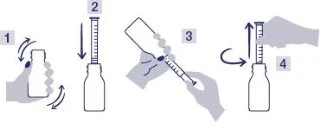
- Shake the bottle vigorously before use. Diagram 1
- Open the bottle by turning and pressing down the child-resistant safety closure.
- Insert the oral syringe fully into the sampling tip. Diagram 2
- To fill the syringe, keep the bottle upside down. Hold the syringe firmly in place and slowly pull the plunger continuously up to the graduation mark in kg. Diagram 3
- Place the bottle upright again and remove the syringe. Diagram 4
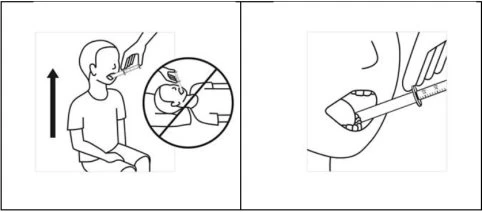
- Keep the child in an upright position during administration. Insert the oral syringe into the child's mouth without force, directing it towards the inner surface of the cheek. Completely administer the suspension by gently and gradually pushing the plunger.
- After each use, disassemble the oral syringe, rinse it with water, and dry it.
The use of this oral syringe is strictly reserved for the administration of a kg-dose of TIORINFANT 4 mg/mL.
To compensate for fluid loss due to your child's diarrhea, this medicine should be used together with adequate fluid and salt (electrolyte) replacement. The best fluid and electrolyte replacement is achieved with the so-called oral rehydration solution (consult your doctor or pharmacist if you are unsure).
If you take more Tiorinfant 4 mg/mL than you should
In case of overdose or accidental ingestion, go immediately to a medical center or consult a doctor or pharmacist immediately, or call the Toxicology Information Service (telephone 91 562 04 20), indicating the medicine and the amount ingested.
If you forget to administer Tiorinfant 4 mg/mL
Do not administer a double dose to make up for the dose you forgot to give your child. Administer the next dose as scheduled.
If you have any further questions about the use of this medicine, ask your doctor or pharmacist.
4. Possible adverse effects
Like all medicines, this medicine may cause adverse effects, although not everyone experiences them.
You must stop administering Tiorinfant 4 mg/ml to your child and consult a doctor immediately if your child experiences symptoms of angioedema such as:
- Swelling of the face, tongue, or throat
- Difficulty swallowing
- Hives and breathing difficulties
Discontinue the use of racecadotril and seek immediate medical attention if you notice any of the following symptoms:
- Widespread skin rash, high body temperature, and swollen lymph nodes (DRESS syndrome)
- Breathing difficulty, swelling, dizziness, tachycardia, sweating, and feeling faint—symptoms of a severe and sudden allergic reaction.
Uncommon adverse effects (reported in at least 1 out of 1,000 patients but less than 1 out of 100 patients):
Pharyngitis (inflammation of the tonsils), rash (skin eruptions), and erythema (redness of the skin).
Frequency not known (cannot be estimated from available data):
Erythema multiforme (pinkish lesions on the limbs and mouth), tongue edema, lip swelling, eyelid edema, facial edema, facial angioedema (subcutaneous swelling affecting various body parts), hives, erythema nodosum (inflammatory lump under the skin), maculopapular rash (rash with small hard and pustular lesions), pruritus (itching affecting the whole body), prurigo (skin lesions causing itching).
Reporting of adverse effects
If your child experiences any type of adverse effect, consult your doctor or pharmacist, even if it is a possible adverse effect not listed in this leaflet. You may also report them directly via the Spanish Pharmacovigilance System for Human Medicinal Products: www.notificaRAM.es. By reporting adverse effects, you can help provide more information on the safety of this medicine.
5. Storage of Tiorinfant 4 mg/ml oral suspension
Keep this medicine out of the sight and reach of children.
Do not use this medicine after the expiry date stated on the bottle. The expiry date refers to the last day of the month indicated.
This medicine does not require any special storage conditions.
After opening, do not use the contents of this bottle after 10 days.
Do not use this medicine if you notice any visible signs of deterioration.
At the end of treatment, return the pack, including the oral administration syringe and the bottle, to your pharmacist so it can be disposed of correctly and appropriately.
Medicines must not be disposed of via wastewater or household waste. Dispose of containers and unused medicines at the SIGRE collection point at your pharmacy. If in doubt, ask your pharmacist how to dispose of containers and medicines you no longer need. This will help protect the environment.
6. Package contents and other information
Composition of Tiorinfant 4 mg/ml oral suspension
The active substance is racecadotril.
Each ml of oral suspension contains 4 mg of racecadotril.
The other components are:
Sodium benzoate, hydroxyethylcellulose, xanthan gum, sucrose, sodium citrate, lactic acid (for pH adjustment), strawberry flavour (contains propylene glycol). See section 2.
Appearance of the medicine and contents of the pack
This medicine is an oral suspension with a characteristic strawberry odour.
Pack sizes:
PET bottle of 50 ml with child-resistant safety cap and 10 ml syringe graduated in kg. Pack of 1.
PET bottle of 180 ml with child-resistant safety cap and 10 ml syringe graduated in kg. Pack of 1.
Only some pack sizes may be marketed.
Marketing Authorisation Holder
Bioprojet Pharma
9 RUE RAMEAU
75002 Paris
France
Manufacturer
Unither Liquid Manufacturing
1-3 ALLEE DE LA NESTE
31770 COLOMIERS
FRANCE
This medicine is authorised in the European Economic Area member states under the following names:
France: Tiorfan 4 mg/mL Nourrissons et Enfants, suspension buvable.
Belgium: Tiorfix nourrissons et enfants 4 mg/ml suspension buvable. Tiorfix zuigelingen en kinderen 4 mg/ml suspensie voor oraal gebruik. Tiorfix Säuglinge und Kinder 4 mg/ml Suspension zum Einnehmen.
Germany: Tiorfan 4 mg/ml Suspension zum Einnehmen.
Ireland: Hidrasec Infants and Children 4mg/mL Oral Suspension.
Italy: Tiorfan.
Luxembourg: Tiorfix 4 mg/ml nourrissons et enfants, suspension buvable.
Spain: Tiorinfant 4 mg/ml oral suspension
Date of most recent revision of this leaflet: March 2026
Other sources of information
Detailed information on this medicine is available on the website of the Spanish Agency of Medicines and Health Products (AEMPS) (http://www.aemps.gob.es/).