Thyrogen 0.9 mg powder for solution for injection
Spain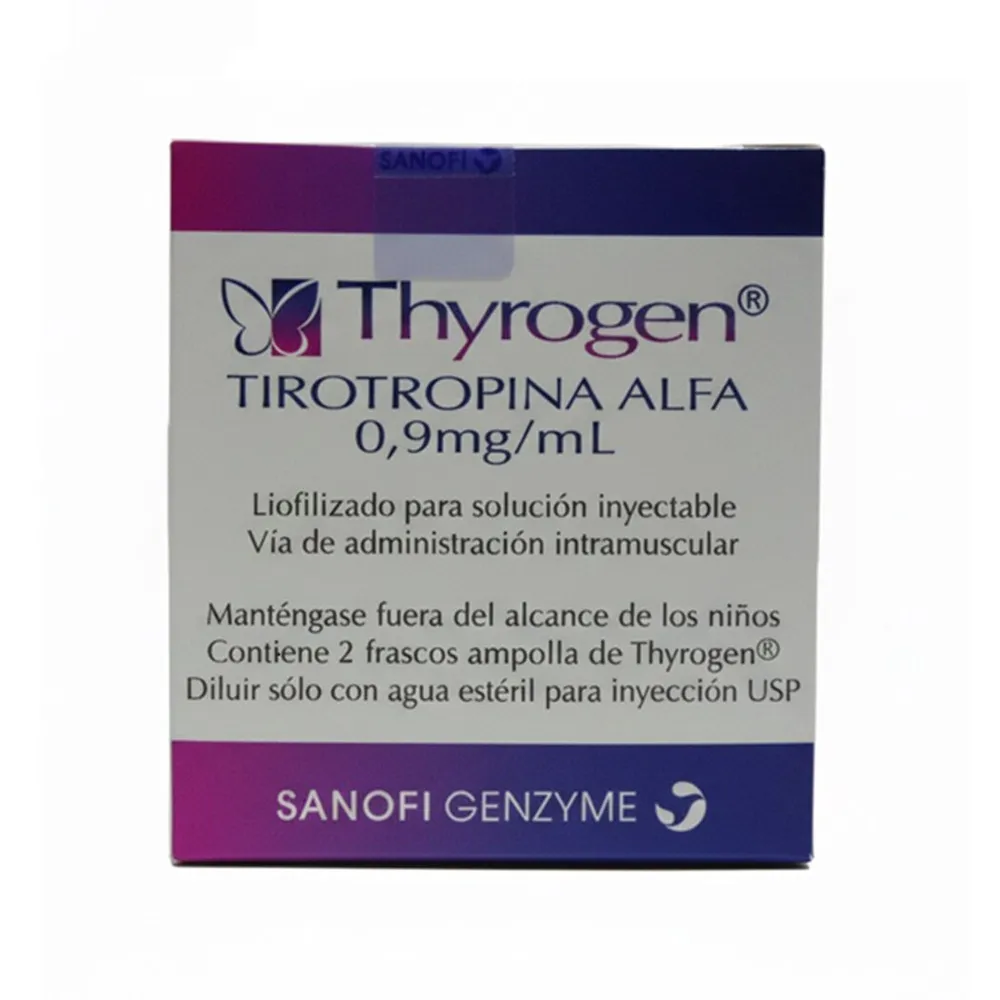
Table of Contents
Package leaflet: Information for the user
Introduction
Package leaflet: information for the user
Thyrogen 0.9 mg powder for solution for injection
Thyrotropin alfa
Read the entire leaflet carefully before you start using this medicine, because it contains important information for you.
- Keep this leaflet, as you may need to read it again.
- If you have any questions, ask your doctor or pharmacist.
- If you experience any adverse reactions, consult your doctor or pharmacist, even if they are adverse reactions not listed in this leaflet. See section 4.
Leaflet contents
- What Thyrogen is and what it is used for
- What you need to know before using Thyrogen
- How to use Thyrogen
- Possible side effects
- How to store Thyrogen
- Contents of the pack and other information
1. What Thyrogen is and what it is used for
Thyrogen contains the active substance thyrotropin alfa. Thyrogen is a human thyroid-stimulating hormone (TSH) produced by biotechnology processes.
Thyrogen is used for the detection of certain types of thyroid cancer in patients who have had their thyroid gland removed and who are receiving thyroid hormone therapy. One of its effects is to stimulate any remaining thyroid tissue to take up iodine, which is important for imaging with radioactive iodine. It also stimulates the production of thyroglobulin and thyroid hormones if any residual thyroid tissue is present. These hormones can be measured in the blood.
Thyrogen is also used in combination with radioactive iodine treatment to destroy (ablate) residual thyroid tissue after surgical removal of the thyroid gland (remnants) in patients who do not have secondary growths (metastases) and who are receiving thyroid hormone therapy.
2. What you need to know before using Thyrogen
Do not use Thyrogen:
- if you are allergic to bovine or human thyroid-stimulating hormone (TSH) or to any of the other components of this medicine (listed in section 6).
- if you are pregnant.
Warnings and precautions
Consult your doctor or pharmacist before using Thyrogen:
- if you have kidney disease requiring dialysis; your doctor will decide the dose of Thyrogen you should receive, as you may be more likely to experience headache and nausea.
- if you have reduced kidney function; your doctor will determine the amount of radioactive iodine to be administered.
- if you have reduced liver function; you may still receive Thyrogen.
Effect on tumor growth
In patients with thyroid cancer, cases of tumor growth have been reported during withdrawal of thyroid hormones for diagnostic procedures. This was thought to be related to elevated levels of thyroid-stimulating hormone (TSH) over a prolonged period. Thyrogen might also cause tumor growth. This was not observed in clinical trials.
Due to the increase in TSH levels following administration of Thyrogen, patients with secondary tumor growth (metastases) may experience local swelling or bleeding at the site of such metastases, which may increase in size. If metastases are present in confined spaces, e.g., intracerebral (in the brain) or in the spinal cord, patients may develop symptoms rapidly, such as partial paralysis affecting one side of the body (hemiparesis), breathing difficulties, or vision loss.
Your doctor will decide whether you belong to specific patient groups for whom pretreatment with corticosteroids should be considered (e.g., if you have tumor metastases in the brain or spinal cord). If you have any doubts, consult your doctor.
Children
Due to lack of data on the use of Thyrogen in children, Thyrogen should only be given to children under exceptional circumstances.
Elderly patients
No special precautions are required for elderly patients. However, if your thyroid gland has not been completely removed and you also have heart disease, your doctor will help determine whether you should receive Thyrogen.
Other medicines and Thyrogen
Inform your doctor or pharmacist if you are taking, have recently taken, or might need to take any other medicines.
No drug interactions between Thyrogen and thyroid hormones you may be taking are known.
Your doctor will determine the exact activity of radioactive iodine to be used for imaging, taking into account that you are continuing to take thyroid hormones.
Pregnancy and breastfeeding
Do not take Thyrogen if you are pregnant. If you are pregnant or breastfeeding, think you may be pregnant, or are planning to become pregnant, consult your doctor or pharmacist before using this medicine.
Thyrogen must not be administered to women who are breastfeeding. Breastfeeding must not be resumed until your doctor advises it is safe to do so.
Driving and using machines
Some patients may experience dizziness or headache after administration of Thyrogen, which may affect their ability to drive or operate machinery.
Thyrogen contains sodium
This medicine contains less than 23 mg of sodium (1 mmol) per vial; therefore, essentially “sodium-free”.
3. How to use Thyrogen
A doctor or nurse will inject your medication.
Your treatment must be supervised by a physician experienced in thyroid cancer. The Thyrogen powder must be dissolved in water for injectable preparations. Only one vial of Thyrogen is required per injection. Thyrogen should only be administered into the buttocks. This solution must never be injected into a vein. Thyrogen must not be mixed with other medicines in the same injection.
The recommended dose of Thyrogen consists of two doses given 24 hours apart. Your doctor or nurse will inject 1.0 ml of the Thyrogen solution.
For radioactive iodine ablation or imaging, your doctor will administer radioactive iodine 24 hours after the last injection of Thyrogen.
Diagnostic scanning should be performed 48 to 72 hours after administration of radioactive iodine (72 to 96 hours after the last injection of Thyrogen).
Post-treatment scanning may be delayed by a few days to allow overall radioactivity to decrease.
For thyroglobulin (Tg) testing, your doctor or nurse will take a serum sample 72 hours after the last injection of Thyrogen.
Use in children
Your child's doctor will help determine whether Thyrogen should be given to your child.
If you use more Thyrogen than you should
Patients who have accidentally received too much Thyrogen have reported nausea, weakness, dizziness, headache, vomiting, and flushing.
In case of overdose, treatment aimed at restoring fluid balance, as well as administration of an antiemetic, is recommended.
If you have any further questions about the use of this medicine, ask your doctor.
4. Possible adverse effects
Like all medicines, this medicine can cause adverse effects, although not everyone experiences them.
The following effects have been reported with Thyrogen:
Very common (may affect more than 1 in 10 people):
- nausea
Common (may affect up to 1 in 10 people):
- vomiting
- fatigue
- dizziness
- headache
- weakness
Uncommon (may affect up to 1 in 100 people):
- feeling of warmth
- hives (urticaria)
- skin rash
- flu-like symptoms
- fever
- chills
- back pain
- diarrhea
- sensation of itching or tingling (paresthesia)
- neck pain
- loss of taste (ageusia)
- altered sense of taste (dysgeusia)
- flu
Not known (frequency cannot be estimated from the available data):
- tumor swelling
- pain (including pain at sites of metastases (growth of secondary tumors))
- tremor
- stroke
- palpitations
- flushing
- shortness of breath
- itching (pruritus)
- excessive sweating
- muscle or joint pain
- injection site reactions (including: local redness, discomfort, itching, pain or burning sensation, and itchy skin rash)
- low TSH
- hypersensitivity (allergic reactions), these reactions include hives (urticaria), itching, flushing, breathing difficulty, and skin rash.
Very rarely, cases of hyperthyroidism (increased thyroid gland activity) or atrial fibrillation have been reported when Thyrogen has been administered to patients who have not undergone total or partial removal of the thyroid gland.
Reporting of adverse effects
If you experience any adverse effect, talk to your doctor or pharmacist, even if it is a possible adverse effect not listed in this leaflet. You can also report them directly through the national reporting system included in Appendix V. By reporting adverse effects, you can help provide more information on the safety of this medicine.
5. Storage of Thyrogen
Keep out of the sight and reach of children.
Do not use this medicine after the expiry date stated on the label after “EXP”. The expiry date refers to the last day of the month indicated.
Store in a refrigerator (between 2°C and 8°C).
Keep the vial in the outer packaging to protect it from light.
It is recommended that Thyrogen be administered within 3 hours after reconstitution.
The reconstituted solution may be stored for up to 24 hours at a temperature between 2°C and 8°C, protected from light and avoiding bacterial contamination.
Do not use this medicine if you notice foreign particles, cloudiness, or any change in colour.
Medicines must not be disposed of via wastewater or household waste. Ask your pharmacist how to dispose of medicines and containers you no longer need. This will help protect the environment.
6. Contents of the pack and other information
Composition of Thyrogen
- The active substance is thyrotropin alfa.
Each vial contains 0.9 mg of thyrotropin alfa when reconstituted with 1.2 ml of water for injectable preparations.
Only 1 ml should be withdrawn, equivalent to 0.9 mg of thyrotropin alfa.
- The other components are:
Mannitol
Monobasic sodium phosphate monohydrate
Dibasic sodium phosphate heptahydrate
Sodium chloride
Thyrogen contains sodium; see section 2.
Appearance of the product and contents of the pack
Powder for injectable solution. White to off-white lyophilized powder.
Pack sizes: Packs containing one or two vials of Thyrogen.
Only certain pack sizes may be marketed.
Marketing Authorization Holder and Manufacturer
Marketing Authorization Holder:
Sanofi Winthrop Industrie
82 Avenue Raspail
94250 Gentilly
France
Manufacturer:
Genzyme Ireland Limited
IDA Industrial Park
Old Kilmeaden Road
Waterford
Ireland
Further information on this medicinal product is available upon request from the local representative of the Marketing Authorization Holder:
Belgium/Belgium/Belgium/Luxembourg/Luxembourg Sanofi Belgium Tel/Tel: + 32 (0)2 710 54 00 | Hungary SANOFI-AVENTIS Zrt. Tel: +36 1 505 0050 |
| Malta Sanofi S.r.l. Tel: +39 02 39394275 |
Czech Republic Sanofi s.r.o. Tel: +420 233 086 111 | Netherlands Sanofi B.V. Tel: +31 20 245 4000 |
Denmark Sanofi A/S Tlf: +45 45 16 70 00 | Norway sanofi-aventis Norge AS Tlf: + 47 67 10 71 00 |
Germany Sanofi-Aventis Deutschland GmbH Tel.: 0800 52 52 010 Tel: from abroad: +49 69 305 21 131 | Austria sanofi-aventis GmbH Tel: + 43 1 80 185 - 0 |
Estonia Swixx Biopharma OÜ Tel: +372 640 10 30 | Poland Sanofi Sp. z o.o. Tel.: +48 22 280 00 00 |
Greece Sanofi-Aventis Μονοπρόσωπη AEBE Tel: +30 210 900 16 00 | Portugal Sanofi – Produtos Farmacêuticos, Lda. Tel: +351 21 35 89 400 |
Spain sanofi-aventis, S.A. Tel: +34 93 485 94 00 | Romania Sanofi Romania SRL Tel: +40 (0) 21 317 31 36 |
France Sanofi Winthrop Industrie Tél: 0 800 222 555 Call from abroad: +33 1 57 63 23 23 | Slovenia Swixx Biopharma d.o.o. Tel: +386 1 235 51 00 |
Croatia Swixx Biopharma d.o.o. Tel: +385 1 2078 500 | Slovakia Swixx Biopharma s.r.o. Tel: +421 2 208 33 600 |
Ireland sanofi-aventis Ireland Ltd. T/A SANOFI Tel: +353 (0) 1 403 56 00 Iceland Vistor hf. Sími: +354 535 7000 | Finland Sanofi Oy Puh/Tel: + 358 (0) 201 200 300 |
Italy Sanofi S.r.l. Tel: 800536389 Cyprus C.A. Papaellinas Ltd. Tel: +357 22 741741 | Sweden Sanofi AB Tel: +46 (0)8 634 50 00 |
Latvia Swixx Biopharma SIA Tel: +371 6 616 47 50 | United Kingdom (Northern Ireland) sanofi-aventis Ireland Ltd. T/A SANOFI Tel: +44 (0) 800 035 2525 |
Lithuania Swixx Biopharma UAB Tel: +370 5 236 91 40 |
Date of the most recent revision of this summary:
Detailed information on this medicine is available on the European Medicines Agency website: http://www.ema.europa.eu.
This information is intended for healthcare professionals only:
The recommended dose of Thyrogen is two intramuscular injections of 0.9 mg of thyrotropin alfa administered 24 hours apart.
Traceability
In order to improve the traceability of biological medicinal products, the name and batch number of the administered medicine should be clearly documented.
Use of an aseptic technique.
Add 1.2 ml of water for injections to the vial containing the Thyrogen powder. Gently rotate the vial until the contents are completely dissolved. Do not shake the solution. When the powder is fully dissolved, the total volume in the vial will be 1.2 ml. The pH of the Thyrogen solution is approximately 7.0.
Visually inspect the Thyrogen solution in each vial for the presence of foreign particles and discoloration. The Thyrogen solution should be clear and colourless. Do not use vials containing foreign particles, or showing cloudiness or discoloration.
Withdraw 1.0 ml of the Thyrogen solution from the vial. This corresponds to 0.9 mg of thyrotropin alfa.
Thyrogen does not contain preservatives. Immediately discard any unused solution. No special requirements for its disposal.
The solution should be injected within three hours after reconstitution. The reconstituted solution may be stored for up to 24 hours at a temperature between 2°C and 8°C, protected from light and avoiding bacterial contamination. It is important to note that microbiological safety will depend on the aseptic conditions maintained during solution preparation.