Terbinafine Normon 250 mg tablets EFG
Spain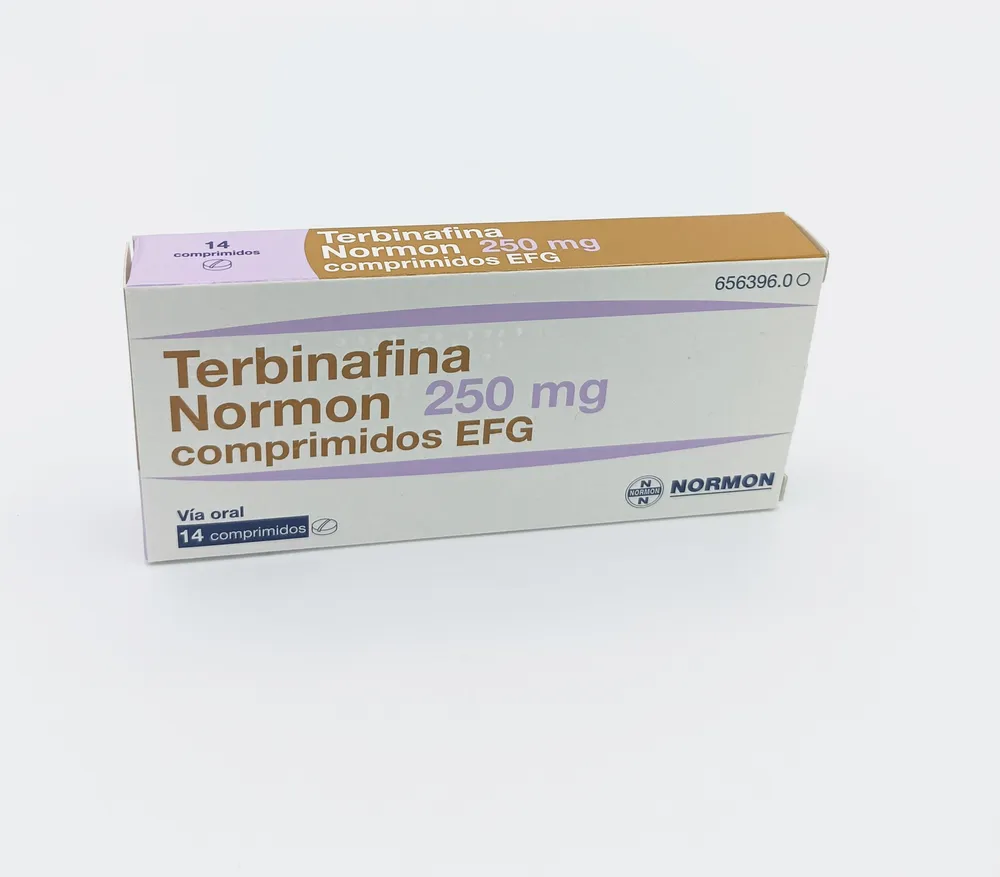
Table of Contents
- Package leaflet: Information for the user
- Introduction
- 1. What Terbinafina Normon is and what it is used for
- 2. What you need to know before taking Terbinafine Normon
- 3. How to take Terbinafine Normon
- 4. Possible adverse effects
- 5. Storage of Terbinafine Normon
- 6. Contents of the pack and other information
Package leaflet: Information for the user
Introduction
Package leaflet: Information for the user
Terbinafine Normon 250 mg tablets EFG
Read the entire patient information leaflet carefully before starting to take this medicine, as it contains important information for you.
|
Package leaflet contents
- What Terbinafine Normon is and what it is used for
- What you need to know before taking Terbinafine Normon
- How to take Terbinafine Normon
- Possible side effects
- Storage of Terbinafine Normon
- Contents of the pack and other information
1. What Terbinafina Normon is and what it is used for
Terbinafine belongs to a group of medicines called antifungals and works by preventing the growth of fungi.
Terbinafina Normon is used to treat the following fungal infections of the skin, scalp, and nails:
- Tinea corporis (ringworm of the body).
- Tinea cruris (jock itch or groin ringworm).
- Tinea pedis (athlete's foot).
- Tinea capitis (scalp ringworm).
- Onychomycosis (fungal nail infection).
2. What you need to know before taking Terbinafine Normon
Read the following information before taking Terbinafine Normon.
Do not take Terbinafine Normon
- If you are allergic to terbinafine or to any of the other ingredients of this medicine (listed in section 6).
- If you have or have had liver problems.
- If you have kidney problems.
Warnings and precautions
Talk to your doctor or pharmacist before taking Terbinafine Normon:
If any of the following apply to you, inform your doctor before taking Terbinafine Normon.
-
If you have kidney problems, consult your doctor before taking this medicine.
-
If you experience symptoms such as persistent and unexplained nausea, vomiting, stomach pain, loss of appetite, unusual tiredness, yellowing of the skin or whites of the eyes, unusually dark urine, or unusually pale stools (signs of liver problems).
-
If you develop any skin problems such as rash, red skin, blisters on the lips, eyes or mouth, or skin peeling (signs of serious skin reactions).
-
If you experience weakness, unusual bleeding, bruising, or frequent infections (signs of blood disorders).
-
If you suffer from psoriasis or systemic lupus erythematosus.
Use in children
Experience with Terbinafine Normon in children is limited; therefore, its use is not recommended in this patient group.
Use in elderly patients
Terbinafine Normon may be administered to patients over 65 years of age. If there is a pre-existing kidney problem, a lower than usual dose may be prescribed. Terbinafine Normon is not recommended for patients who have or have previously had liver problems.
Other medicines and Terbinafine Normon
Inform your doctor or pharmacist if you are using, have recently used, or might need to use any other medicines, including oral contraceptives, herbal remedies, and medicines obtained without a prescription.
There are other medicines that may alter the effect of Terbinafine Normon, for example:
- Some antibiotics (e.g. rifampicin).
- Caffeine.
- Some antidepressants (e.g. desipramine).
- Some medicines used to treat heart problems (e.g. propafenone, amiodarone).
- Some medicines used to treat high blood pressure (e.g. metoprolol).
- Some medicines used to treat stomach ulcers (e.g. cimetidine).
- Some medicines used to treat fungal infections (e.g. fluconazole, ketoconazole).
- Some medicines used to treat cough (e.g. dextromethorphan).
- Some medicines used to prevent organ rejection in transplant patients (e.g. ciclosporin).
Pregnancy and breastfeeding
If you are pregnant or breastfeeding, think you might be pregnant, or plan to become pregnant, consult your doctor or pharmacist before using this medicine.
Pregnancy
Terbinafine Normon must not be used during pregnancy unless your doctor considers it strictly necessary. In such a case, your doctor will inform you of the possible risks of taking Terbinafine Normon during pregnancy.
Breastfeeding
Terbinafine passes into breast milk; therefore, mothers receiving treatment with Terbinafine Normon must not breastfeed.
Driving and using machines
If you feel dizzy while taking Terbinafine Normon, do not drive or operate machinery.
Terbinafine Normon 250 mg tablets contain sodium
Terbinafine Normon contains less than 23 mg of sodium (1 mmol) per tablet; this is essentially "sodium-free".
3. How to take Terbinafine Normon
Follow exactly the instructions for use of this medicine as given by your doctor or pharmacist. If in doubt, consult your doctor or pharmacist again.
Remember to take your medicine.
How much to take
Take Terbinafine Normon exactly as prescribed by your doctor. Your doctor will determine the dose you need.
The recommended dose in adults is one tablet (250 mg) once daily.
How to take Terbinafine Normon
Terbinafine Normon tablets are for oral administration. Swallow the tablets whole, without chewing, with a glass of water.
How long to take Terbinafine Normon
The duration of treatment will be determined by your doctor. Do not stop treatment early, as this could worsen your condition.
Complete resolution of infection symptoms may not occur until several weeks (skin and scalp) or months (nails) after the causative fungus has disappeared.
If you take more Terbinafine Normon than you should
In case of overdose or accidental ingestion, contact your doctor or pharmacist immediately or call the Toxicology Information Service at telephone: 91 562 04 20, indicating the medicine and the amount ingested. Your doctor will establish the most appropriate treatment for the overdose.
The main symptoms of acute intoxication may be gastrointestinal, e.g. nausea, abdominal pain, or vomiting, but headache or dizziness (sensation of instability) may also occur. If you experience any of these effects or any other unusual effect, consult your doctor.
If you forget to take Terbinafine Normon
Do not take a double dose to make up for missed doses.
Take the missed dose as soon as you remember, unless it is less than 6 hours until your next scheduled dose.
4. Possible adverse effects
Like all medicines, this medicine can cause adverse effects, although not everyone will experience them.
Some adverse effects may be serious:
Rarely, Terbinafina Normon may cause liver problems, and in very rare cases these problems may be severe. Other serious adverse reactions include a decrease in certain blood cells, lupus (an autoimmune disease), severe skin reactions, severe allergic reactions, inflammation of blood vessels, inflammation of the pancreas, or muscle necrosis.
Contact your doctor immediately:
- If you experience symptoms such as persistent and unexplained nausea, stomach problems, loss of appetite, or unusual tiredness or weakness, or
- If you notice that your skin or the whites of your eyes turn yellow, your urine becomes unusually dark, or you have pale stools (possible signs of liver problems).
- If you have fever, chills, sore throat or mouth ulcers due to infections, weakness, or if you get infections more often, or if you experience unusual bleeding or bruising (possible signs of diseases affecting the levels of certain blood cells).
- If you experience difficulty breathing, dizziness, swelling mainly of the face and throat, redness, colicky abdominal pain, or loss of consciousness, or if you experience symptoms such as joint pain, stiffness, skin rash, fever, or swelling/thickening of the lymph nodes (possible signs of severe allergic reactions).
- If you experience symptoms such as skin rash, fever, itching, tiredness, or notice the appearance of red-purple spots under the skin surface (possible signs of inflammation of blood vessels).
- If you develop any skin problems such as skin rash, redness of the skin, blistering of the lips, eyes or mouth, skin peeling, or fever.
- If you experience severe pain in the upper abdomen radiating to the back (possible signs of pancreatitis).
- If you experience unexplained muscle pain and weakness or dark-colored (brown-red) urine (possible signs of muscle necrosis).
Other adverse effects:
Very common (affect more than 1 in 10 patients): Headache, nausea, mild abdominal pain, gastric discomfort after meals (heartburn), diarrhea, bloating or abdominal distension (feeling of fullness in the stomach), loss of appetite, skin rash (with itching), urticaria, joint or muscle pain.
Common (affect between 1 and 10 in 100 patients): Mood disturbance (depression), disturbance or loss of taste sensation, dizziness, visual disturbances.
Uncommon (affect between 1 and 10 in 1,000 patients):
If you notice pale skin, mucous membranes, or nail beds, unusual tiredness or weakness, or difficulty breathing during exercise (possible signs of a disease affecting red blood cell levels), anxiety, tingling or numbness sensations, decreased skin sensitivity, increased skin sensitivity to sunlight, noises (e.g., ringing) in the ears, fever, and weight loss.
Rare (affect between 1 and 10 in 10,000 patients):
Yellowing of the eyes or skin (liver problems) and abnormal results in liver function tests.
Very rare (affect fewer than 1 in 10,000 patients):
Decrease in certain blood cells (mainly white blood cells and platelets), lupus (an autoimmune disease characterized by general and/or skin disorders), severe skin reactions, allergic reactions, psoriasis-like skin eruptions (skin rash with silvery appearance), worsening of psoriasis, skin rash with peeling, hair loss.
The following adverse effects have also been reported:
Severe allergic reactions or infections, inflammation of blood vessels, disturbances of smell including permanent loss of smell, decreased ability to smell, blurred vision, decreased visual acuity, inflammation of the pancreas, skin rash caused by elevated levels of a specific type of white blood cells, muscle necrosis, pseudo-flu-like symptoms (e.g., tiredness, chills, sore throat, muscle or joint pain), and increased blood levels of a muscle enzyme (creatine phosphokinase).
Reporting of adverse effects
If you experience any type of adverse effect, talk to your doctor or pharmacist, even if it is a possible adverse effect not listed in this leaflet. You can also report them directly through the Spanish Pharmacovigilance System for Human Medicines: https://www.notificaRAM.es. By reporting adverse effects, you can help provide more information on the safety of this medicine.
5. Storage of Terbinafine Normon
Keep this medicine out of the sight and reach of children.
Store in the original packaging to protect from light.
Do not use this medicine after the expiry date stated on the packaging after "EXP". The expiry date refers to the last day of the month indicated.
Medicines must not be disposed of via wastewater or household waste. Dispose of unused medicines and their containers at the SIGRE collection point at your pharmacy. If you are unsure, ask your pharmacist how to properly dispose of unused medicines and their containers. This will help protect the environment.
6. Contents of the pack and other information
Composition of Terbinafina Normon
The active substance is terbinafine. Each tablet contains 250 mg of terbinafine (as hydrochloride).
The other components (excipients) are: microcrystalline cellulose, sodium carboxymethyl potato starch (potato starch), hypromellose, magnesium stearate and anhydrous colloidal silica.
Appearance of the product and contents of the pack:
Terbinafina Normon 250 mg are tablets. The tablets are white or almost white, round, flat and scored. The tablets can be divided into equal doses.
Available in packs of 14 and 28 tablets.
Marketing Authorization Holder and Manufacturer:
Laboratorios Normon, S.A.
Ronda de Valdecarrizo, 6 – 28760 Tres Cantos – Madrid (SPAIN)
Date of the most recent review of the leaflet: November 2022.
Detailed and up-to-date information on this medicinal product is available on the website of the Spanish Agency of Medicines and Medical Devices (AEMPS) http://www.aemps.gob.es/