Tepmetko 225 mg film-coated tablets
Spain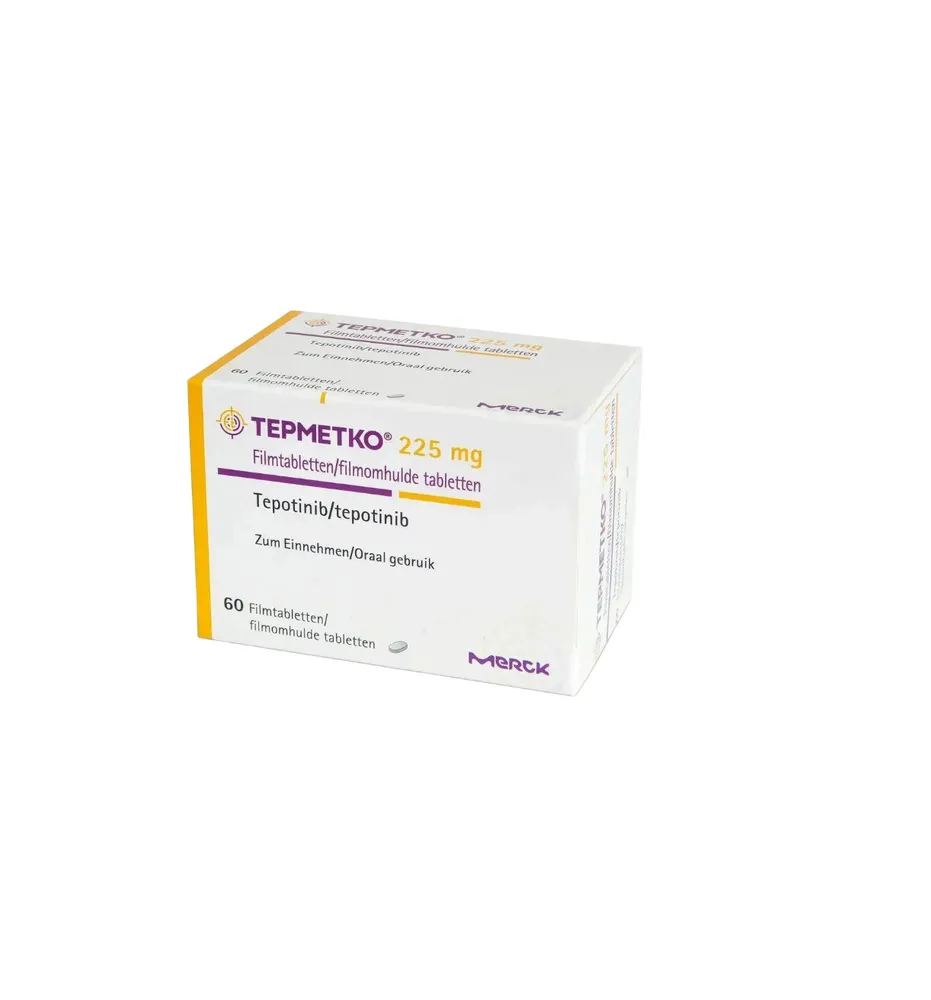
Table of Contents
Package leaflet: Information for the user
Introduction
Package leaflet: information for the patient
TEPMETKO 225 mg film-coated tablets
tepotinib
This medicinal product is subject to additional monitoring, which will allow for faster identification of new safety information. You can help by reporting any side effects you may experience. Section 4 at the end of this leaflet includes information on how to report side effects.
Read the entire leaflet carefully before you start taking this medicine, because it contains important information for you.
- Keep this leaflet, as you may need to refer to it again.
- If you have any questions, consult your doctor or pharmacist.
- This medicine has been prescribed for you only; do not give it to other people, even if they have the same symptoms as you, because it could harm them.
- If you experience any side effects, consult your doctor or pharmacist, even if they are side effects not listed in this leaflet. See section 4.
Leaflet contents
- What TEPMETKO is and what it is used for
- What you need to know before taking TEPMETKO
- How to take TEPMETKO
- Possible side effects
- How to store TEPMETKO
- Contents of the pack and other information
1. What TEPMETKO is and what it is used for
TEPMETKO contains the active substance tepotinib, which belongs to a group of medicines called "protein kinase inhibitors" used to treat cancer.
TEPMETKO is used to treat adults with lung cancer that has spread to other parts of the body or cannot be removed by surgery. The medicine is given when the cancer cells have an alteration in the MET gene (mesenchymal-epithelial transition factor), and previous treatment has not helped to stop the progression of the disease.
An alteration in the MET gene may lead to the production of an abnormal protein, which in turn can cause uncontrolled cell growth and cancer. By blocking the action of this abnormal protein, TEPMETKO can slow down or stop the growth of cancer. It may also help reduce the size of the tumour.
2. What you need to know before starting TEPMETKO
Do not take TEPMETKO
- if you are allergic to tepotinib or to any of the other ingredients of this medicine (listed in section 6).
Warnings and precautions
Consult your doctor before starting to take this medicine if you have any doubts.
Lung or breathing problems
TEPMETKO may sometimes cause sudden breathing difficulties, which may be associated with fever and cough. Inform your doctor immediately if you experience new symptoms or if your symptoms worsen (see section 4), as this could be a sign of a serious lung disorder (interstitial lung disease) requiring immediate medical attention. Your doctor may need to treat you with other medications and discontinue your treatment with TEPMETKO.
Liver function monitoring
Your doctor will perform blood tests to check how well your liver is functioning before starting treatment with TEPMETKO and whenever necessary during treatment.
Cardiac function monitoring
Your doctor will perform electrocardiograms (ECG) when needed during treatment to monitor whether TEPMETKO affects your heart rhythm.
Contraception
This medicine must not be used during pregnancy, as it may harm the unborn child. Men and women must use effective contraceptive methods during treatment with TEPMETKO and for at least 1 week after the last dose. Your doctor will advise you on appropriate contraceptive methods. See "Pregnancy" below.
Children and adolescents
This medicine has not been studied in patients under 18 years of age.
Other medicines and TEPMETKO
Inform your doctor if you are taking, have recently taken, or might need to take any other medicines.
TEPMETKO may affect the way the following medicines work and/or increase the adverse effects of these medicines:
- dabigatran, used to prevent stroke or venous thrombosis/pulmonary embolism
- digoxin, used to treat irregular heartbeat or other heart problems
- aliskiren, used to treat high blood pressure
- everolimus, used to treat cancer
- sirolimus, used to prevent rejection of transplanted organs
- rosuvastatin, used to treat high levels of fats in the blood
- methotrexate, used to treat inflammatory diseases or cancer
- topotecan, used to treat cancer
- metformin, used to treat diabetes
Pregnancy and breastfeeding
Pregnancy
Do not take TEPMETKO if you are pregnant or suspect you may be pregnant, unless instructed by your doctor. This medicine may harm the unborn child. A pregnancy test is recommended before starting treatment with TEPMETKO.
Contraception in men and women
If you are a woman of childbearing potential, you must use an effective method of contraception to prevent pregnancy during treatment with TEPMETKO and for at least 1 week after the last dose. Inform your doctor if you are taking hormonal contraceptives (e.g., "the pill"), as you will need to use a second method of contraception during this period.
If you are a man, you must use a barrier method of contraception to prevent your partner from becoming pregnant during your treatment with TEPMETKO and for at least 1 week after the last dose.
Your doctor will advise you on appropriate contraceptive methods.
Breastfeeding
It is unknown whether TEPMETKO passes into breast milk. Discontinue breastfeeding during treatment with this medicine and for at least 1 week after the last dose.
Driving and use of machines
TEPMETKO has no influence on the ability to drive and use machines.
3. How to take TEPMETKO
Follow exactly the instructions given by your doctor for taking this medicine. If you are unsure, consult your doctor again.
The recommended dose is 2 TEPMETKO tablets taken orally once daily. You may continue taking this medicine daily for as long as it is beneficial to you and you do not experience intolerable adverse effects. If you experience intolerable adverse effects, your doctor may advise you to reduce the dose to 1 tablet daily or to interrupt treatment for several days.
Take the tablets with food or shortly after a meal. Swallow the tablets whole and do not chew them. This will ensure you receive the full dose.
If you have difficulty swallowing the tablets, you may mix them with water:
- Place the tablets in a glass without crushing them.
- Add 30 ml (equivalent to two tablespoons) of non-carbonated water: do not use any other liquid.
- Stir the water until the tablets disintegrate into very small fragments, which may take a few minutes: the tablets will not dissolve completely.
- Drink the liquid within one hour.
- To ensure you have taken the entire dose, rinse the glass thoroughly with another 30 ml of water and drink the rinse immediately.
If you have an 8 French or larger nasogastric (NG) tube:
- Follow the same instructions for mixing the tablets in 30 ml of non-carbonated water as described above.
- Administer the liquid within one hour, following the manufacturer's instructions for the NG tube.
- To ensure you have taken the entire dose, rinse the glass and syringe twice with an additional 30 ml of water each time to ensure no medication residue remains in the glass or syringe and that the full dose is administered.
If you take more TEPMETKO than you should
Experience with overdose of TEPMETKO is limited. Symptoms of overdose are likely to be similar to those listed under "Possible side effects" (see section 4). If you have taken more TEPMETKO than you should, inform your doctor.
If you forget to take TEPMETKO
If you forget to take a dose of TEPMETKO, take it as soon as you remember. If less than 8 hours remain before your next scheduled dose, skip the missed dose and take the next dose at the usual time. Do not take a double dose to make up for a missed dose.
If you have any further questions about the use of this medicine, ask your doctor or pharmacist.
4. Possible adverse effects
Like all medicines, this medicine can cause adverse effects, although not everyone will experience them.
Serious adverse effects
Lung or breathing problems
Inform your doctor immediately if you develop new symptoms or if your symptoms worsen, for example sudden difficulty breathing, cough or fever, as this could be a sign of a serious lung disorder (interstitial lung disease) requiring immediate medical attention. This adverse effect is common (may affect up to 1 in 10 people).
Other adverse effects
Inform your doctor if you experience any other adverse effects. These may include:
Very common adverse effects (may affect more than 1 in 10 people)
- Swelling caused by fluid accumulation in the body (edema)
- Feeling sick (nausea) or vomiting
- Diarrhea
- Increased levels of creatinine in blood (a sign of possible kidney problems)
- Increased levels of alanine-aminotransferase, aspartate-aminotransferase or alkaline phosphatase in blood (a sign of possible liver problems)
- Increased levels of amylase or lipase in blood (a sign of possible digestive problems)
- Reduced levels of the protein albumin in blood
Common adverse effects (may affect up to 1 in 10 people)
- Changes in the electrical activity of the heart seen on an ECG (prolongation of the QT interval)
Reporting of adverse effects
If you experience any type of adverse effect, consult your doctor or pharmacist, even if it is a possible adverse effect not listed in this leaflet. You can also report them directly through the national reporting system included in Appendix V. By reporting adverse effects, you can help provide more information on the safety of this medicine.
5. Storage of TEPMETKO
Keep this medicine out of the sight and reach of children.
Do not use this medicine after the expiry date stated on the carton and blister after EXP/CAD. The expiry date refers to the last day of the month indicated.
This medicine does not require any special storage conditions.
Medicines must not be disposed of via wastewater or household waste. Ask your pharmacist how to dispose of medicines and packaging you no longer need. This will help protect the environment.
6. Contents of the pack and other information
Composition of TEPMETKO
- The active substance is tepotinib. Each film-coated tablet contains 225 mg of tepotinib (as tepotinib hydrochloride hydrate).
- The other components are in the tablet core: mannitol, colloidal anhydrous silica, crospovidone, magnesium stearate, and microcrystalline cellulose; and in the film coating: polyvinyl alcohol (E1203), titanium dioxide (E171), macrogol (polyethylene glycol), talc (E553b), and iron oxide red (E172).
Appearance of the product and contents of the pack
TEPMETKO film-coated tablets are white-pink in colour, oval and biconvex, approximately 18 x 9 mm in size, with the inscription «M» on one side and no inscription on the other side. Each pack contains 60 tablets in a clear blister, consisting of a multilayer composite foil and an aluminium cover foil.
Marketing Authorisation Holder
Merck Europe B.V.
Gustav Mahlerplein 102
1082 MA Amsterdam
The Netherlands
Manufacturer
Merck Healthcare KGaA
Frankfurter Strasse 250
64293 Darmstadt
Germany
Date of the most recent revision of this leaflet:
Other sources of information
Detailed information on this medicine is available on the European Medicines Agency website: https://www.ema.europa.eu.