Tenkasi 400 mg powder for concentrate for infusion solution
Spain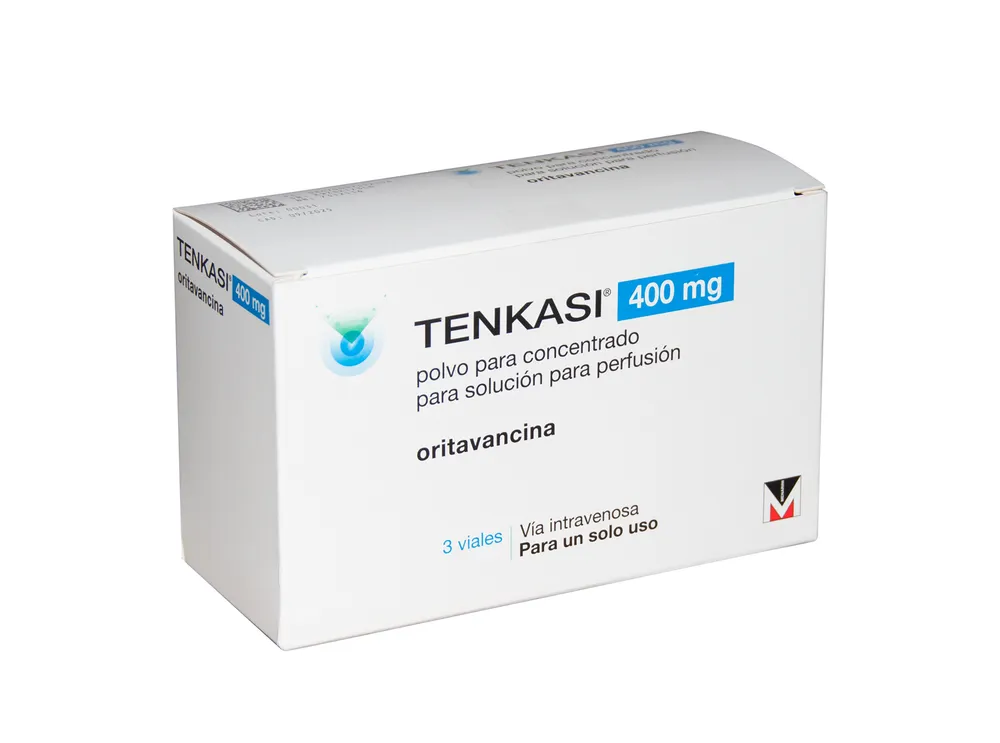
Table of Contents
Package leaflet: Information for the user
Introduction
Package leaflet: information for the patient
Tenkasi 400 mg powder for concentrate for solution for infusion
oritavancin
Read the entire leaflet carefully before you are given this medicine, because it contains important information for you.
- Keep this leaflet, as you may need to read it again.
- If you have any questions, consult your doctor or nurse.
- If you experience any adverse reactions, consult your doctor or nurse, even if they are adverse reactions not listed in this leaflet. See section 4.
Contents of the leaflet
- What Tenkasi is and what it is used for
- What you need to know before you are given Tenkasi
- How Tenkasi will be administered to you
- Possible side effects
- How to store Tenkasi
- Contents of the pack and other information
1. What Tenkasi is and what it is used for
Tenkasi is an antibiotic that contains the active substance oritavancin. Oritavancin is a type of antibiotic (a lipoglycopeptide antibiotic) that can kill or stop the growth of certain bacteria.
Tenkasi is used to treat skin and soft tissue infections of the skin.
It is used to treat adult patients and pediatric patients from 3 months of age.
Tenkasi may be used alone to treat infections caused by bacteria known as gram-positive bacteria. In cases of mixed infections where other types of bacteria are suspected, your doctor will provide other appropriate antibiotics in addition to Tenkasi.
2. What you need to know before Tenkasi is administered to you
Do not receive Tenkasi:
- if you are allergic to oritavancin or to any of the other ingredients of this medicine (listed in section 6).
- if it is expected that you may need to be given a medicine used to make the blood less thick (unfractionated sodium heparin) within 5 days (120 hours) after receiving your dose of Tenkasi.
Warnings and precautions
Talk to your doctor or nurse before receiving Tenkasi if:
- you have ever had an allergic reaction to another glycopeptide antibiotic (such as vancomycin and telavancin)
- you have previously experienced severe diarrhoea during or after antibiotic treatment.
- you have or are suspected of having a bone infection caused by bacteria (osteomyelitis). Your doctor will treat you as appropriate.
- you have or are suspected of having a painful collection of pus in the skin (abscess). Your doctor will treat you as appropriate.
Intravenous infusions of Tenkasi may cause redness of the upper body, hives, itching and/or rashes. Infusion-related reactions such as chest pain, chest discomfort, chills, shivering, back pain, neck pain, shortness of breath, abdominal pain, fever and headache, fatigue, drowsiness may also occur, which could be symptoms of hypoxia. If you experience reactions like these, your doctor may decide to stop or slow down the infusion.
Tenkasi may interfere with laboratory tests measuring blood coagulation and may produce a false reading.
Although antibiotics, including Tenkasi, fight certain bacteria, they may not be active against other bacteria or fungi, which may therefore continue to grow. This is known as overgrowth. Your doctor will monitor you for this and treat you if necessary.
After receiving Tenkasi, you may develop a new infection in another area of the skin. Your doctor should monitor you for this and treat you as appropriate.
Children and adolescents
Tenkasi must not be used in children under 3 months of age. The use of Tenkasi has not yet been studied in this age group.
Use of Tenkasi with other medicines
Tell your doctor if you are taking, have recently taken, or might need to take any other medicines.
If you are to be given a medicine to make the blood less thick called unfractionated heparin, tell your doctor if you have received Tenkasi within the last 5 days (120 hours).
It is especially important that you tell your doctor if you are taking medicines that prevent blood from clotting (oral anticoagulants, e.g., coumarin anticoagulants). Tenkasi may interfere with laboratory or self-testing that measures blood coagulation (INR), and may cause a false reading for up to 12 hours after the infusion.
Pregnancy and breastfeeding
If you are pregnant or breastfeeding, think you may be pregnant or plan to become pregnant, consult your doctor before using this medicine.
You must not receive this medicine during pregnancy unless it is considered that the benefit outweighs the risk to the baby.
Driving and using machines
Tenkasi may make you feel dizzy, which could affect your ability to drive or use machines.
3. How Tenkasi will be administered to you
Your doctor or nurse will administer Tenkasi to you by intravenous infusion (drip) into a vein.
In adults, the recommended dose of Tenkasi is a single 1,200 mg infusion given into a vein over 3 hours.
For pediatric patients from 3 months of age, the recommended dose of Tenkasi will be calculated based on body weight and age: a single intravenous infusion of 15 mg per kg of body weight administered over 3 hours (maximum 1,200 mg). See section 6 for further details.
If you are given more Tenkasi than you should
Your doctor will decide how to manage your treatment, as well as when to discontinue treatment and monitor for signs of adverse effects.
4. Possible adverse effects
Like all medicines, this medicine can cause adverse effects, although not everyone will experience them.
Tell your doctor or nurse immediately if you experience an infusion reaction, including any of the following symptoms:
- flushing of the face and upper body, hives, itching and/or rashes;
- wheezing (a high-pitched whistling sound when breathing);
- shortness of breath;
- swelling around the throat or under the skin that develops rapidly;
- chills or tremors;
- rapid or weak pulse;
- chest pain or tightness;
- Decreased blood pressure (may make you feel weak or dizzy).
These reactions may be life-threatening.
Other adverse effects occur with the following frequencies:
Frequent adverse effects (may affect up to 1 in 10 patients):
- lower than normal red blood cells or hemoglobin;
- dizziness;
- headache;
- nausea or vomiting;
- diarrhea;
- constipation;
- pain or irritation at the injection site;
- itching, skin rash;
- muscle pain;
- increased levels of liver enzymes (as shown by blood test results);
- rapid heartbeat;
- worsening of an infection or new infection at another site on the skin;
- swollen, red area of skin or beneath the skin with a sensation of warmth and pain on palpation;
- accumulation of pus under the skin.
Uncommon adverse effects (may affect up to 1 in 100 patients):
- higher than normal levels of eosinophils, a type of white blood cell (eosinophilia);
- low blood sugar levels;
- high levels of uric acid in the blood;
- increased levels of bilirubin in the blood;
- severe skin rash;
- hot flushes;
- inflammation around a tendon (known as tenosynovitis);
- bone infection caused by bacteria (known as osteomyelitis);
- reduced platelet count in the blood below the lower limit of normal (known as thrombocytopenia);
- Abdominal pain
- Chest pain
- Fever
- Shortness of breath
Rare adverse effects (may affect up to 1 in 1000 patients):
- Headache, fatigue, somnolence, which may be symptoms of hypoxia;
- Back pain
- Neck pain
- Chills
- Tremors
Additional side effects in children and adolescents
Side effects in pediatric patients are similar to those observed in adults. Side effects observed exclusively in pediatric patients are: irritability, changes in ECG cardiac tracing (transient, asymptomatic, and not associated with other changes in cardiac tracing), intestinal infection (colitis due to Clostridioides difficile).
Reporting of adverse effects
If you experience any type of adverse effect, consult your doctor or nurse, even if it is a possible adverse effect not listed in this leaflet. You may also report them directly through the national reporting system included in Appendix V. By reporting adverse effects, you can help provide more information on the safety of this medicine.
5. Storage of Tenkasi
Keep this medicine out of the sight and reach of children.
Do not use this medicine after the expiry date stated on the label. The expiry date refers to the last day of the month indicated.
Do not store above 25 °C.
Medicines should not be disposed of via wastewater drains. Ask your pharmacist how to properly dispose of unused medicines and their packaging. This will help protect the environment.
6. Contents of the pack and other information
Composition of Tenkasi
- The active substance is oritavancin. Each vial contains oritavancin difosphate equivalent to 400 mg of oritavancin.
- The other components are mannitol and phosphoric acid.
Nature of the product and contents of the container
- Tenkasi is a powder for concentrate for solution for infusion.
- Tenkasi is a white to off-white powder, supplied in a 50 ml glass vial.
- Tenkasi is available in packs of 3 vials.
Marketing Authorization Holder
Menarini International Operations Luxembourg S.A.
1, Avenue de la Gare
L-1611, Luxembourg
Luxembourg
Manufacturer responsible for batch release
Biologici Italia Laboratories S.r.l
Via Filippo Serpero 2
20060 Masate (MI)
Italy
For further information about this medicinal product, please contact the local representative of the marketing authorization holder:
Belgium/Belgium/Belgium Menarini Benelux NV/SA Tel/Tel: + 32 (0)2 721 4545 | Lithuania UAB “BERLIN-CHEMIE MENARINI BALTIC” Tel: +370 52 691 947 |
Bulgaria Berlin-Chemie/Menarini Bulgaria EAD Tel: +359 24540950 | Luxembourg/Luxembourg Menarini Benelux NV/SA Tel/Tel: + 32 (0)2 721 4545 |
Czech Republic Berlin-Chemie/A.Menarini Czech Republic s.r.o. Tel: +420 267 199 333 | Hungary Berlin-Chemie/A. Menarini Kft. Tel.: +36 1799 7320 |
Denmark Menarini International Operations Luxembourg S.A. Tlf: +352 264976 | Malta Menarini International Operations Luxembourg S.A. Tel: +352 264976 |
Germany Berlin-Chemie AG Tel: +49 (0) 30 67070 | Netherlands Menarini Benelux NV/SA Tel: +32 (0)2 721 4545 |
Estonia OÜ Berlin-Chemie Menarini Estonia Tel: +372 667 5001 | Norway Menarini International Operations Luxembourg S.A. Tlf: +352 264976 |
Greece MENARINI HELLAS AE Tel: +30 210 8316111-13 | Austria
Tel: +43 1 879 95 85-0 |
Spain Laboratorios Menarini S.A. Tel: +34-93 462 88 00 | Poland Berlin-Chemie/Menarini Poland Sp. z o.o. Tel.: +48 22 566 21 00 |
France MENARINI France Tél: +33 (0)1 45 60 77 20 | Portugal
Tel: +351 210 935 500 |
Croatia Berlin-Chemie Menarini Croatia d.o.o. Tel: + 385 1 4821 361 | Romania Berlin-Chemie A.Menarini S.R.L. Tel: +40 21 232 34 32 |
Ireland
Tel: +353 1 284 6744 | Slovenia Berlin-Chemie / A. Menarini Distribution Ljubljana d.o.o. Tel: +386 01 300 2160 |
Iceland Menarini International Operations Luxembourg S.A. Sími: +352 264976 | Slovakia Berlin-Chemie / A. Menarini Distribution Slovakia s.r.o Tel: +421 2 544 30 730 |
Italy
| Finland/Suomi Berlin-Chemie/A.Menarini Finland OY Puh/Tel: +358 403 000 760 |
Cyprus MENARINI HELLAS AE Tel: +30 210 8316111-13 | Sweden Menarini International Operations Luxembourg S.A. Tel: +352 264976 |
Latvia SIA Berlin-Chemie/Menarini Baltic Tel: +371 67103210 | United Kingdom (Northern Ireland)
Tel: +44 (0)1628 856400 |
Date of the most recent review of this summary: 07/2021
Other sources of information
Detailed information on this medicine is available on the European Medicines Agency website: http://www.ema.europa.eu.
This information is intended for healthcare professionals only:
Tenkasi is intended for intravenous (IV) administration only, following reconstitution and dilution.
Tenkasi must be prepared using aseptic techniques in a pharmacy.
The powder must be reconstituted with water for injections, and the resulting concentrate must be diluted in an intravenous infusion bag containing 5% glucose prior to use. Both the reconstituted solution and the diluted infusion solution should be clear and colourless or pale yellow. Parenteral medicines should be inspected visually for particulate matter after reconstitution. Aseptic techniques must be used when preparing Tenkasi.
Adults
Three vials of Tenkasi 400 mg must be reconstituted and diluted to prepare a single 1,200 mg IV dose for single use.
Reconstitution: Aseptic technique must be used to reconstitute three 400 mg vials of Tenkasi.
- Add 40 ml of water for injections using a sterile syringe to reconstitute each vial, providing a 10 mg/ml solution per vial.
- To avoid excessive foaming, it is recommended to add the water for injections carefully, along the walls of the vials.
- Gently swirl each vial to avoid foaming and ensure complete reconstitution of all Tenkasi powder into solution.
The reconstituted solution must be immediately further diluted in an intravenous infusion bag containing 5% glucose.
Dilution: Three reconstituted vials are required for dilution to administer a single IV infusion of 1,200 mg. Only a 5% glucose intravenous bag (D5W) must be used for dilution.
To dilute:
- Remove and discard 120 ml from a 1,000 ml 5% glucose intravenous bag.
- Withdraw 40 ml from each of the three reconstituted vials and add to the 5% glucose intravenous bag to bring the total volume to 1,000 ml. This results in an oritavancin concentration of 1.2 mg/ml. Polypropylene (PP) or polyvinyl chloride (PVC) infusion bags must be used for preparation and administration.
Use in the paediatric population (3 months to < 18 years of age)
Calculate the required oritavancin dose based on the patient's body weight (a single 15 mg/kg infusion administered intravenously over 3 hours).
Determine the number of oritavancin vials required for the patient (each vial contains 400 mg).
Reconstitution:
-
Add 40 ml of water for injections using a sterile syringe to reconstitute each vial, yielding a 10 mg/ml solution per vial.
- To avoid excessive foaming, it is recommended to add the water for injections carefully along the walls of the vials.
-
Gently swirl each vial to avoid foaming and ensure complete reconstitution of all powder into solution.
Dilution: Only a 5% glucose intravenous bag (D5W) must be used for dilution (see section 6.2). Sodium chloride solution must not be used for dilution.
Dilution:
Withdraw the required volume of oritavancin using a sterile syringe and add it to the intravenous bag containing sterile 5% glucose (D5W) (see the corresponding example in Table 1). The size of the intravenous bag will depend on the total volume to be administered. For small volumes, an infusion pump may be used.
Table 1: 15 mg/kg Oritavancin: 3-hour Infusion (Concentration of 1.2 mg/ml)
Patient Weight (kg) | Calculated Oritavancin Dose (mg) | Total Infusion Volume (ml) | Volume of Reconstituted Oritavancin (ml) | Volume of D5W to Add to IV Bag (ml) |
5 | 75 | 62.5 | 7.5 | 55 |
10 | 150 | 125 | 15 | 110 |
15 | 225 | 187.5 | 22.5 | 165 |
20 | 300 | 250 | 30 | 220 |
25 | 375 | 312.5 | 37.5 | 275 |
30 | 450 | 375 | 45 | 330 |
35 | 525 | 437.5 | 52.5 | 385 |
40 | 600 | 500 | 60 | 440 |
Calculations
- Use the patient's actual weight – ROUND ONLY TO THE NEAREST WHOLE NUMBER
- Dose: Weight (kg) x 15 mg/kg = ______ mg (Maximum dose 1200 mg)
- Total infusion volume: Dose (mg) ÷ 1.2 mg/ml = _______ ml
- Volume of Reconstituted Oritavancin: Dose (mg) ÷ 10 = ______ ml
- Volume of D5W to add to the IV bag: Total infusion volume (C) - Volume of Reconstituted Oritavancin (D) = _______ ml
The diluted solution should be used immediately.
From a microbiological standpoint, the medicinal product should be used immediately. If not used immediately, the storage times and conditions prior to use are the responsibility of the user and normally should not exceed 12 hours at 25 °C and 24 hours at a temperature between 2 °C and 8 °C for diluted Tenkasi in an intravenous infusion bag with 5% dextrose, unless reconstitution and dilution have taken place under controlled and validated aseptic conditions.