Tegsedi 284 mg solution for injection in pre-filled syringe
Spain
Table of Contents
Package leaflet: Information for the user
Introduction
Package leaflet: information for the user
Tegsedi 284 mg solution for injection in pre-filled syringe
Inotersen
This medicine is subject to additional monitoring, which will allow for rapid identification of new safety information. You can help by reporting any side effects you may experience. Section 4 at the end of this leaflet includes information on how to report side effects.
Read this entire leaflet carefully before you start using this medicine, as it contains important information for you.
- Keep this leaflet, as you may need to read it again.
- If you have any questions, consult your doctor, pharmacist, or nurse.
- This medicine has been prescribed for you only and must not be given to other people, even if they have the same symptoms as you, since it could harm them.
- If you experience any side effects, consult your doctor, pharmacist, or nurse, even if they are side effects not listed in this leaflet. See section 4.
Contents of this leaflet
- What Tegsedi is and what it is used for
- What you need to know before using Tegsedi
- How to use Tegsedi
- Possible side effects
- How to store Tegsedi
- Contents of the pack and other information
1. What Tegsedi is and what it is used for
Tegsedi contains the active substance inotersen. Inotersen is used to treat adults with hereditary transthyretin amyloidosis. Hereditary transthyretin amyloidosis is a genetic disease that causes the accumulation of small fibers of a protein called transthyretin in the organs of the body, preventing them from functioning properly. Tegsedi is used when the disease causes symptoms of polyneuropathy (nerve damage).
The active substance in Tegsedi, inotersen, is a type of medicine called an antisense oligonucleotide inhibitor. It works by reducing the production of transthyretin by the liver, thereby decreasing the risk of transthyretin fibers depositing in organs and causing symptoms.
2. What you need to know before using Tegsedi
Do not use Tegsedi:
- if you are allergic to inotersen or any of the other ingredients of this medicine (listed in section 6).
- if blood tests indicate that you have an excessively low platelet count (the blood cells that clump together to help with clotting).
- if kidney function tests or urine protein tests show signs of severe kidney problems.
- if you have severely reduced liver function (hepatic failure).
Warnings and precautions
Before starting treatment with Tegsedi, your doctor will evaluate your blood cell counts, liver function, kidney function, vitamin A levels, and protein levels in your urine. You may also be tested to ensure you have a negative pregnancy test result. Unless your doctor specifically advises otherwise, you will only be treated with Tegsedi if all these test results are within acceptable ranges and your pregnancy test is negative. Your doctor will repeat these checks regularly during treatment. It is important that you have these blood and urine tests performed regularly while you are receiving Tegsedi.
Thrombocytopenia
Tegsedi can reduce the blood cells responsible for clotting (platelets), which may lead to a condition called thrombocytopenia at any time during treatment with Tegsedi (see section 4). When platelet levels are too low, as in thrombocytopenia, your blood may not clot quickly enough to stop bleeding. This can result in bruising and more serious complications such as excessive bleeding or internal hemorrhage. Your doctor will perform blood tests to monitor your platelet levels before and regularly throughout treatment with Tegsedi. It is important that these blood tests are performed regularly during treatment due to the risk of severe bleeding caused by low platelet counts. If you stop using Tegsedi, your blood values should be monitored for 8 weeks after discontinuation of the medicine.
Contact your doctor immediately if you experience unexplained bruising or a rash of small red spots on the skin (called petechiae), prolonged or oozing bleeding from skin cuts, nosebleeds or gum bleeding, blood in the urine or stool, or bleeding in the white part of the eyes. Seek immediate medical help if you develop neck stiffness or an unusual and severe headache, as these symptoms may be caused by cerebral hemorrhage.
Glomerulonephritis/kidney problems
Glomerulonephritis is a kidney condition in which the kidneys do not function properly due to inflammation and kidney damage. Some patients treated with inotersen have developed this condition. Symptoms of glomerulonephritis include foamy urine, pink or brown-colored urine, blood in the urine, and reduced urine output.
Some patients treated with inotersen have also developed worsening kidney function without having glomerulonephritis.
Your doctor will monitor your kidney function before treatment and regularly during treatment with Tegsedi. It is important that these blood tests are performed regularly while you are receiving Tegsedi due to the risk of severe bleeding caused by low platelet counts. If you stop using Tegsedi, your kidney function should be monitored for 8 weeks after stopping the medicine. If you develop glomerulonephritis, your doctor will treat you for this condition.
Vitamin A deficiency
Tegsedi may decrease vitamin A (also known as retinol) levels in your body. Your doctor will measure these levels, and if they are already low, they must be corrected and all symptoms resolved before starting treatment with Tegsedi. Symptoms of low vitamin A include:
- Dry eyes, poor vision, reduced night vision, blurred or cloudy vision
If you experience vision problems or any other eye issues while using Tegsedi, inform your doctor. Your doctor may refer you to an eye specialist for evaluation if necessary.
Your doctor will instruct you to take a daily vitamin A supplement during treatment with Tegsedi.
Both excess and deficient levels of vitamin A can harm fetal development. Therefore, women of childbearing potential must have pregnancy ruled out before starting treatment with Tegsedi and must use effective contraceptive methods (see section "Pregnancy and breastfeeding" below).
If you plan to become pregnant, you will stop taking inotersen, including vitamin A supplements, and confirm that your vitamin A levels have returned to normal before attempting conception.
If you have an unplanned pregnancy, you will stop taking inotersen. However, due to the prolonged activity of Tegsedi, reduced vitamin A levels may persist. It is unknown whether continuing supplementation with 3000 IU of vitamin A per day would be harmful to your unborn child during the first trimester of pregnancy, but this dose should not be exceeded. You will resume vitamin A supplementation during the second and third trimesters of pregnancy if your vitamin A levels have not yet returned to normal, due to the increased risk of vitamin A deficiency in the third trimester.
Liver injury and liver monitoring
Tegsedi can cause serious liver problems. Before starting inotersen, you will need a blood test to check that your liver is functioning properly. You will also need to have these blood tests regularly while taking this medicine. It is important that you have these blood tests performed regularly while taking Tegsedi.
Liver transplant rejection
Talk to your doctor before using Tegsedi if you have received a liver transplant. Cases of liver transplant rejection have been reported in patients treated with Tegsedi. Your doctor will monitor this regularly during treatment with Tegsedi.
Children and adolescents
Tegsedi must not be used in children and adolescents under 18 years of age.
Other medicines and Tegsedi
Tell your doctor or pharmacist if you are taking, have recently taken, or might need to take any other medicines. It is important that you inform your doctor if you are already taking any of the following:
- Medicines that prevent blood clots or reduce platelet counts, such as acetylsalicylic acid, heparin, warfarin, clopidogrel, rivaroxaban, and dabigatran.
- Any medicine that may affect kidney function or could damage the kidneys, such as sulfonamides (used as antibiotics), anilides (used to treat fever and pain), aldosterone antagonists (used as diuretics), and natural opiate alkaloids and other opioids (used for pain treatment).
Pregnancy and breastfeeding
If you are pregnant or breastfeeding, think you may be pregnant, or plan to become pregnant, consult your doctor before using this medicine.
Women of childbearing potential
Tegsedi reduces vitamin A levels in your body, which is important for normal fetal development during pregnancy. It is unknown whether vitamin A supplementation can fully compensate for the risk of vitamin A deficiency that could affect your unborn child (see "Warnings and precautions" above). If you are a woman of childbearing potential, you must use effective contraceptive methods, and pregnancy must be ruled out before starting treatment with Tegsedi.
Pregnancy
You must not use Tegsedi if you are pregnant unless your doctor explicitly advises you to do so.
Breastfeeding
Inotersen may pass into breast milk. The risk to the infant cannot be excluded. Consult your doctor to decide whether to discontinue breastfeeding or discontinue treatment with Tegsedi.
Driving and using machines
Tegsedi has not been shown to affect the ability to drive or operate machinery.
Tegsedi contains sodium
This medicine contains less than 1 mmol of sodium (23 mg) per 1.5 ml, and is therefore essentially "sodium-free".
3. How to use Tegsedi
Follow exactly the administration instructions for this medicine given by your doctor. If in doubt, consult your doctor or pharmacist again.
The recommended dose of Tegsedi is one dose of 284 mg of inotersen.
Doses should be administered once weekly. All subsequent doses should be injected once weekly, on the same day each week.
Route and method of administration
Tegsedi is for subcutaneous injection only (injected under the skin).
Instructions for use
Before using the pre-filled syringe, your doctor will show you or your caregiver how to use it correctly. If you or your caregiver have any questions, ask your doctor.
Read the instructions for use before starting to use the pre-filled syringe and each time the prescription is renewed, as there may be new information.
Parts guide
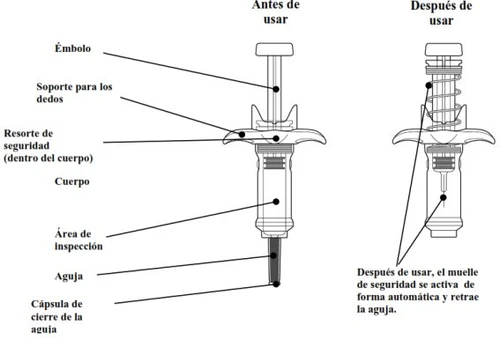
Each pre-filled syringe contains one dose and is for single use only.
WARNINGS | |
Do not remove the needle cap until you have reached Step 6 of these instructions and are ready to inject Tegsedi. Do not share the syringe with another person or reuse the syringe. Do not use the prefilled syringe if it has fallen on a hard surface or is damaged. Do not freeze the prefilled syringe. If any of the above occurs, discard the prefilled syringe into a sharps container and use a new prefilled syringe. | |
PREPARATION | |
| |
Do not inject the medication until you have gathered all the items listed above. | |
| |
Do not move the plunger. | |
| |
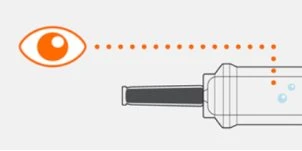
| Look at the inspection window to ensure the solution is clear and colorless or pale yellow. It is normal to see bubbles in the solution. No action is needed. Do not use if the solution appears cloudy, discolored, or contains particles. If the solution appears cloudy, discolored, or contains particles, discard the prefilled syringe into a sharps container and use a new prefilled syringe. |
| |
| Select the injection site on the abdomen (stomach) or the front of the thigh. The injection site may also be the outer area of the upper arm, if Tegsedi is administered by a caregiver. Do not inject within 3 cm around the navel. Do not inject in the same site each time. Do not inject if the skin is bruised, tender, red, or hard. Do not inject into tattoos, scars, or damaged skin. Do not inject through clothing. |
| |
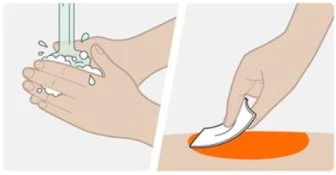
| Wash your hands with soap and water. Clean the injection site with an alcohol wipe using a circular motion. Allow the skin to air dry. Do not touch the area again before injecting. |
INJECTION | |
| |
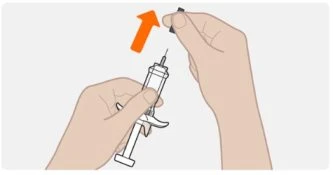
| Hold the prefilled syringe by the body with the needle pointing outward. Remove the needle cap by pulling it straight off. Do not twist. You may see a drop of liquid at the tip of the needle. This is normal. Keep your hands away from the plunger to avoid pushing it before you are ready to inject. Do not remove the needle cap until just before injecting. Do not pull off the needle cap while holding the prefilled syringe by the plunger. Always hold the body of the syringe. Do not let the needle touch any surface. Do not remove any bubbles from the prefilled syringe. Do not recap the needle onto the prefilled syringe. |
| |
Hold the prefilled syringe in one hand. Hold the skin around the injection site as instructed by your healthcare provider. Gently pinch the skin at the injection site, or inject without pinching, as directed. Slowly insert the needle at a 90° angle into the selected injection site until fully inserted. Do not hold the prefilled syringe by the plunger or push against the plunger to insert the needle. | |
| |
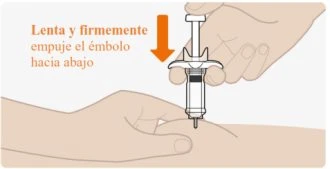
| Slowly and firmly push the plunger all the way down until the medication is fully injected. Ensure the needle remains fully inserted during the injection. It is important to push the plunger completely down. The prefilled syringe may make a "click" sound as you push the plunger down. This is normal. It does not mean the injection is complete. The plunger may feel stiff toward the end of the injection. You may need to press a little harder to ensure it is fully depressed. Do not release the plunger. |
| |
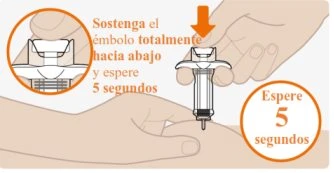
| Firmly press on the plunger at the end of the injection. Hold the plunger fully down and wait 5 seconds. Releasing the plunger too quickly may result in loss of medication. The plunger will begin to rise automatically, indicating it has been fully depressed. Press again if the plunger does not begin to rise automatically. |
| |
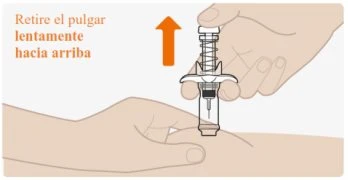
| Slowly release the plunger and allow the safety spring to automatically retract it upward. The needle should now safely retract into the prefilled syringe, and the safety mechanism spring will be visible on the outer part of the plunger. When the plunger stops moving, the injection is complete. If the plunger does not rise automatically when pressure is released, the safety spring was not activated and you must press the plunger again with more force. Do not lift the plunger with your hand. Lift the entire prefilled syringe straight up. Do not attempt to recap the retracted needle. Do not rub the injection site. |
DISPOSAL AND CARE | |
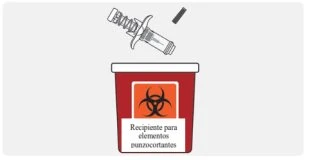
Disposal of the used prefilled syringe | |
| Immediately after use, place the used prefilled syringe into a sharps container. Do not throw the prefilled syringe into your household trash. |

If you use more Tegsedi than you should
Contact your doctor or pharmacist immediately, or go to the nearest hospital emergency department, even if you do not have any symptoms.
If you forget to use Tegsedi
If you miss a dose of Tegsedi, the next dose should be administered as soon as possible, unless the next scheduled dose is within two days, in which case the missed dose should be skipped and the next dose should be administered according to the scheduled plan.
Do not take a double dose to make up for missed doses.
If you stop using Tegsedi
Do not stop treatment with Tegsedi unless your doctor tells you to do so.
If you have any further questions about the use of this medicine, ask your doctor, pharmacist, or nurse.
4. Possible adverse effects
Like all medicines, this medicine can cause adverse effects, although not everyone will experience them.
Serious adverse effects
If you experience any of the following adverse effects, stop using Tegsedi and contact your doctor immediately:
- Symptoms that could indicate glomerulonephritis (where your kidneys do not function properly), such as foamy urine, pink or brown-colored urine, blood in the urine, or urinating less than usual. Glomerulonephritis is a common adverse effect of inotersen (it may affect up to 1 in 10 people).
- Symptoms that could indicate thrombocytopenia (impaired blood clotting due to low platelet levels in the blood), such as unexplained bruising or a rash of small red spots on the skin (called petechiae), bleeding from cuts that does not stop or oozes, nosebleeds or bleeding gums, blood in the urine or stools, or bleeding in the white part of the eyes. Low platelet count is a very common adverse effect of inotersen (it may affect up to 1 in 10 people).
- Symptoms that could indicate liver injury, such as yellowing of the eyes or skin, or dark urine, possibly accompanied by itching of the skin, pain in the upper right part of the abdomen, loss of appetite, bleeding or bruising more easily than normal, or feeling tired.
Seek immediate medical help if you experience neck stiffness or an unusual and severe headache, as these symptoms may be caused by cerebral hemorrhage.
Other adverse effects
Very common (may affect more than 1 in 10 people)
- Decrease in red blood cells that may cause paleness of the skin and lead to weakness or difficulty breathing (anemia)
- Headache
- Vomiting or nausea (feeling sick)
- Increase in body temperature
- Feeling cold or chills
- Pain, redness, itching, or bruising at the injection site
- Swelling in the ankles, feet, or fingers (peripheral edema)
Common (may affect up to 1 in 10 people)
- Increase in white blood cells called eosinophils (eosinophilia)
- Decreased appetite
- Feeling dizzy or faint, especially when standing (low blood pressure, hypotension)
- Bruising
- Blood accumulation in tissues, visible as significant bruising (hematomas)
- Itching
- Rash
- Kidney damage that may lead to impaired kidney function or kidney failure
- Changes in blood and urine test results (this may indicate liver or kidney damage)
- Flu-like symptoms, such as high temperature, aches, and chills
- Swelling or discoloration of the skin at the injection site
Uncommon (may affect up to 1 in 100 people)
- Allergic reaction
Reporting of adverse effects
If you experience any type of adverse effect, consult your doctor or pharmacist, even if it is an adverse effect not listed in this leaflet. You may also report them directly through the national reporting system included in Appendix V. By reporting adverse effects, you can help provide more information on the safety of this medicine.
5. Storage of Tegsedi
Keep this medicine out of the sight and reach of children.
Do not use this medicine after the expiry date stated on the carton, tray, and pre-filled syringe after CAD/EXP. The expiry date refers to the last day of the month indicated.
Store in a refrigerator (between 2°C and 8°C).
Do not freeze.
Tegsedi may be stored unrefrigerated for up to 6 weeks at a temperature below 30°C. If not refrigerated and not used within 6 weeks, the medicine must be discarded.
Keep in the original packaging to protect from light.
Do not use this medicine if you notice that the solution is cloudy or contains particles.
Medicines must not be disposed of via wastewater or household waste. Ask your pharmacist how to dispose of medicines and packaging no longer required. This helps protect the environment.
6. Contents of the container and additional information
Composition of Tegsedi
- The active substance is inotersen.
Each ml contains 189 mg of inotersen (as inotersen sodium). Each pre-filled syringe contains 284 mg of inotersen (as inotersen sodium) in 1.5 ml of solution.
- The other components are water for injections, sodium hydroxide, and hydrochloric acid (see “Tegsedi contains sodium” in section 2).
Appearance of the product and contents of the container
Tegsedi is an injectable solution, clear, colourless to pale yellow (pH 7.5 – 8.8), in a pre-filled syringe.
Tegsedi is available in pack sizes of 1 or 4 pre-filled syringes.
Only certain pack sizes may be marketed.
Marketing Authorization Holder
Akcea Therapeutics Ireland Ltd
St. James House,
72 Adelaide Road, Dublin 2
D02 Y017, Ireland
Manufacturer
ABF Pharmaceutical Services GmbH
Brunnerstraße 63/18-191230 Vienna
Austria
Date of the most recent revision of this leaflet: 11/2023
Detailed information on this medicine is available on the European Medicines Agency website: http://www.ema.europa.eu.