Teglutik 5 mg/ml oral suspension
Spain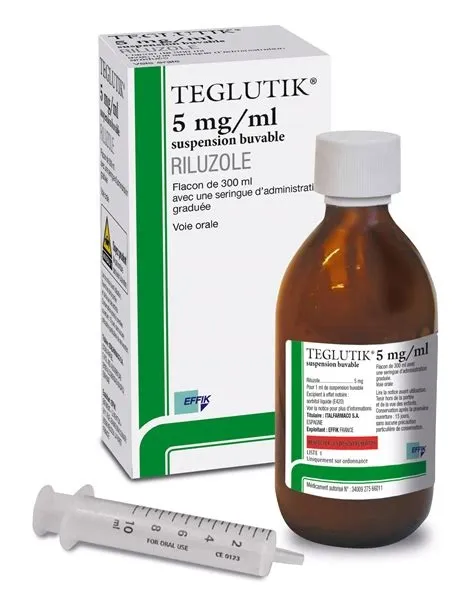
Instructions for Use
Table of Contents
- Introduction
- 1. What Teglutik is and what it is used for
- 2. What you need to know before starting to take Teglutik
- **Children and adolescents:**
- If you are under 18 years of age, the use of Teglutik is not recommended since there is no available information in this population.
- 3. How to take Teglutik
- 4. Possible adverse effects
- 5. Storage of Teglutik
- 6. Package contents and other information
Package leaflet: Information for the user
Introduction
Package leaflet: Information for the user TEGLUTIK 5 mg/ml oral suspension
riluzole
Read the entire leaflet carefully before you start taking this medicine because it contains important information for you.
- Keep this leaflet as you may need to read it again.
- If you have any questions, ask your doctor, pharmacist or nurse.
- This medicine has been prescribed for you only and must not be given to other people, even if they have the same symptoms as you. It may harm them.
- If you experience any adverse effects, consult your doctor, pharmacist or nurse, even if they are effects not listed in this leaflet. See section 4.
Leaflet contents:
- What Teglutik is and what it is used for
- What you need to know before taking Teglutik
- How to take Teglutik
- Possible side effects
- How to store Teglutik
- Contents of the pack and other information
1. What Teglutik is and what it is used for
What Teglutik is
The active substance of Teglutik is riluzole, which acts on the nervous system.
What Teglutik is used for
Teglutik is used in patients with amyotrophic lateral sclerosis (ALS).
ALS is a type of motor neuron disease that affects nerve cells responsible for sending signals to the muscles, leading to weakness, loss of muscle mass, and paralysis. The destruction of nerve cells in motor neuron diseases may be caused by excess glutamate (a chemical messenger) in the brain and spinal cord. Teglutik inhibits the release of glutamate, which may help prevent damage to nerve cells. For further information, please consult your doctor about ALS and the reason why this medicine has been prescribed to you.
2. What you need to know before starting to take Teglutik
Do not take Teglutik
- if you are allergic (hypersensitive) to riluzole or to any of the other ingredients of this medicine (listed in section 6).
- if you have any liver disease or elevated blood levels of certain liver enzymes (transaminases).
- if you are pregnant or breastfeeding.
Warnings and precautions. Consult your doctor or pharmacist before starting to take Teglutik:
- if you have liver problems: yellowing of the skin or whites of the eyes (jaundice), widespread itching, dizziness, nausea
- if your kidneys are not functioning properly
- if you have fever: this may be due to a reduced number of white blood cells, which can increase the risk of infections
If any of the above conditions apply to you, or if you are unsure, inform your doctor so that he/she can advise you on what to do.
Children and adolescents:
If you are under 18 years of age, the use of Teglutik is not recommended since there is no available information in this population.
Use of Teglutik with other medicines
Inform your doctor or pharmacist if you are taking, have recently taken, or might need to take any other medicines.
Pregnancy, breastfeeding, and fertility
You must not take Teglutik if you are pregnant or suspect you may be pregnant, or if you are breastfeeding.
If you are pregnant or breastfeeding, think you might be pregnant, or plan to become pregnant, consult your doctor before using this medicine.
Driving and using machines
You may drive or operate tools or machinery unless you feel dizzy or confused after taking this medicine.
Teglutik contains sorbitol liquid (E420) and sodium
This medicine contains 4,000 mg of sorbitol (E420) in each 10 ml of oral suspension.
Sorbitol is a source of fructose. If your doctor has diagnosed you with intolerance to certain sugars, or if you have been diagnosed with hereditary fructose intolerance (HFI), a rare genetic disorder in which patients cannot break down fructose, consult your doctor before taking this medicine.
This medicine contains less than 23 mg of sodium (1 mmol) per 10 ml of oral suspension; hence, it is essentially “sodium-free”.
3. How to take Teglutik
The suspension can be administered orally and, alternatively, is also suitable for administration via enteral feeding tube.
Always follow exactly the dosing instructions provided by your doctor. If you are unsure, consult your doctor or pharmacist again.
The recommended dose is 100 mg per day (50 mg every 12 hours) administered orally. Therefore, 10 ml of suspension containing 50 mg of riluzole should be taken every 12 hours at the same time each day (e.g., morning and night). The oral suspension is administered using a graduated dosing syringe.
The oral suspension should be gently shaken manually for at least 30 seconds, continuously turning the bottle upside down and right side up, until the TEGLUTIK suspension is well mixed, no clear liquid is visible at the top of the suspension, and no particles remain at the bottom of the bottle.
Method of administration:
Instructions for oral use:
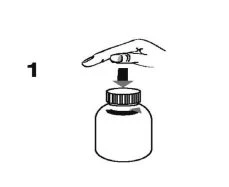
Open the bottle: press down on the cap and turn counterclockwise (Figure 1).
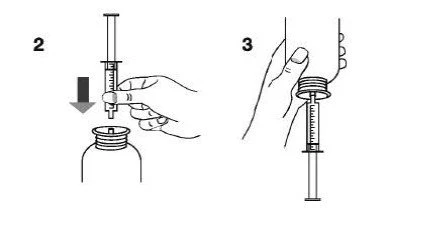
Take the syringe, remove the cap, and insert the syringe into the opening of the adapter (Figure 2). Invert the bottle (Figure 3).
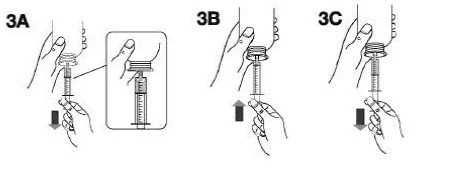
Fill the syringe with a small amount of suspension by pulling the plunger down (Figure 3A), then push the plunger up to remove any possible air bubble (Figure 3B). Pull the plunger down again to the graduation mark corresponding to the amount in millilitres (ml) prescribed by your doctor (Figure 3C).
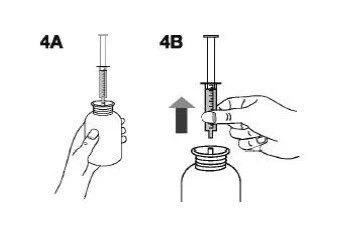
Turn the bottle upright (Figure 4A). Remove the syringe from the adapter (Figure 4B).
- Take the entire contents of the syringe orally.
- Close the bottle with the plastic cap.
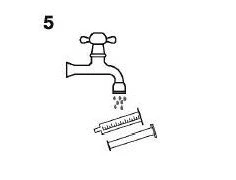
- Rinse the syringe with tap water and only replace the cap once the syringe is completely dry (Figure 5).
Instructions for use with enteral feeding tube:
Ensure the enteral feeding tube is unobstructed before administration.
- Flush the enteral tube with 30 ml of water.
- Administer the required dose of Teglutik oral suspension using the graduated dosing syringe.
- Flush the enteral tube with 30 ml of water.
If you take more Teglutik than you should
Contact your doctor or pharmacist immediately if you take more of this medicine than prescribed. You may also contact the Toxicology Information Service at telephone number 91 562 04 20, indicating the name of the medicine and the amount taken.
If you forget to take Teglutik
If you miss a dose, skip it and take the next dose at your regular scheduled time.
Do not take a double dose to make up for a missed dose.
If you have any further questions about the use of this product, ask your doctor or pharmacist.
4. Possible adverse effects
Like all medicines, Teglutik may cause adverse effects, although not everyone experiences them.
IMPORTANT
Contact your doctor immediately
- if you have fever (raised temperature), because Teglutik may cause a decrease in the number of white blood cells. Your doctor may ask you to have blood tests to monitor your white blood cell count, which are important in fighting infections.
- if you experience any of the following symptoms: yellowing of the skin or whites of the eyes (jaundice), widespread itching, feeling faint or nauseous, as these may be signs of liver disease (hepatitis). Your doctor will recommend periodic blood tests while you are taking Teglutik to ensure this does not occur.
- if you experience cough or difficulty breathing, as this could be a sign of a lung disease called interstitial lung disease.
Other adverse effects
Very common adverse effects (may affect more than 1 in 10 people)
- fatigue
- dizziness
- elevated blood levels of certain liver enzymes (transaminases)
Common adverse effects (may affect up to 1 in 10 people)
- vertigo
- numbness or tingling of the mouth
- vomiting
- somnolence
- tachycardia
- diarrhea
- headache
- abdominal pain
- pain
Uncommon adverse effects (may affect up to 1 in 100 people)
- anemia
- allergic reactions
- inflammation of the pancreas (pancreatitis)
Adverse effects with unknown frequency (frequency cannot be estimated from available data)
- skin rash
Since the oral suspension of riluzole is absorbed more rapidly than tablets, a slight increase in fatigue, dizziness, diarrhea, and transaminases cannot be ruled out.
Reporting of adverse effects:
If you experience any adverse effect, consult your doctor or pharmacist, even if it is a possible adverse effect not listed in this leaflet. You may also report them directly via the Spanish Pharmacovigilance System for Human Medicinal Products: https://www.notificaram.es. By reporting adverse effects, you can help provide more information on the safety of this medicine.
5. Storage of Teglutik
- Keep this medicine out of the sight and reach of children.
- Keep the container tightly closed. Do not use Teglutik after the expiry date stated on the packaging, after EXP. The expiry date refers to the last day of the month indicated.
- This medicine does not require any special storage conditions.
- After first opening, use within 15 days. Do not use this medicine if you notice any visible signs of deterioration.
Medicines must not be disposed of via wastewater or household waste. Dispose of unused medicines and their containers at the SIGRE collection point at your pharmacy. If you have any doubts, ask your pharmacist how to properly dispose of unused medicines and their packaging. This will help protect the environment.
6. Package contents and other information
What Teglutik contains
- The active substance is riluzole. 1 ml of oral suspension contains 5 mg of riluzole.
- The other components are: liquid sorbitol (E420), magnesium aluminium silicate, xanthan gum (E415), sodium saccharin (E954), 30% simethicone emulsion, sodium lauryl sulfate, cetostearyl alcohol macrogol ether, water.
What Teglutik looks like and contents of the pack
This medicine is presented as an oral suspension which, after being gently shaken by hand, becomes a slightly brown, opaque and homogeneous mixture.
Teglutik is supplied in 250 ml and 300 ml bottles with a graduated plastic dosing syringe.
Pack sizes are:
- Box containing one or two 250 ml bottles of riluzole 5 mg/ml oral suspension
- Box containing one 300 ml bottle of riluzole 5 mg/ml oral suspension
The syringe is graduated in millilitres up to a maximum of 10 ml.
Only certain pack sizes may be commercially available.
Marketing Authorisation Holder and Manufacturer
Marketing Authorisation Holder:
ITALFARMACO, S.A. San Rafael, 3 – 28108 Alcobendas (Madrid), SPAIN
Tel.: 916572323
Manufacturer:
ITALFARMACO, S.A. San Rafael, 3 – 28108 Alcobendas (Madrid), SPAIN
Tel.: 916572323
This medicinal product is authorised in the European Economic Area (EEA) Member States and in the United Kingdom (Northern Ireland) under the following names:
Spain: Teglutik 5 mg/ml oral suspension
France: Teglutik 5 mg/ml suspension buvable
Italy: Teglutik 5 mg/ml sospensione orale
Greece: Teglutik 5 mg/ml π?σιμο εναι?ρημα
Portugal: Teglutik 5 mg/ml
Austria: Teglutik 5 mg/ml suspension zum Einnehmen
Belgium: Teglutik 5 mg/ml suspension buvable
Germany: Teglutik 5 mg/ml suspension zum Einnehmen
Poland: Teglutik 5 mg/ml Zawiesina doustna
United Kingdom: Teglutik 5 mg/ml oral suspension
Cyprus: Teglutik 5 mg/ml π?σιμο εναι?ρημα
Finland: Teglutik 5 mg/ml oraalisuspensio
Luxembourg: Teglutik 5 mg/ml suspension buvable
Netherlands: Teglutik 5 mg/ml, suspensie voor oraal gebruik
Norway: Teglutik 5 mg/ml mikstur, suspensjon
Sweden: Teglutik 5 mg/ml oral suspension
Date of most recent review of this leaflet: March 2023
Detailed information on this medicine is available on the website of the Spanish Agency of Medicines and Health Products (AEMPS) http://www.aemps.gob.es/
This page has been machine-translated and may contain inaccuracies. The original data is available in the manufacturing country's language.
Last data check: May 18, 2026 · Data source: CIMA — AEMPS