Tecvayli 90 mg/ml solution for injection
Spain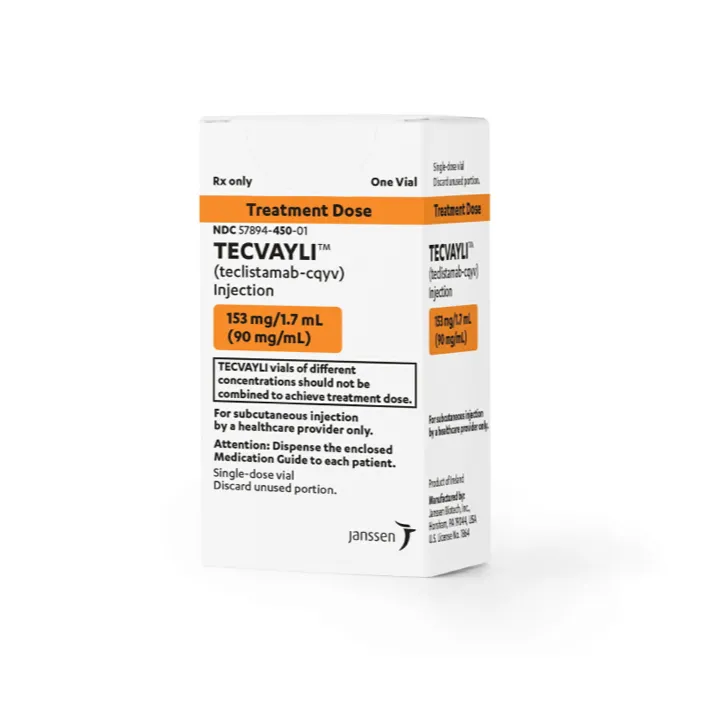
Table of Contents
Package leaflet: Information for the user
Introduction
Package leaflet: information for the patient
TECVAYLI 10 mg/ml solution for injection
TECVAYLI 90 mg/ml solution for injection
teclistamab
This medicine is subject to additional monitoring, which will allow for quicker detection of new safety information. You can help by reporting any side effects you may experience. Information on how to report side effects is included at the end of section 4.
Read this entire leaflet carefully before you start receiving this medicine, because it contains important information for you.
- Keep this leaflet, as you may need to read it again.
- If you have any questions, ask your doctor or nurse.
- If you experience any side effects, talk to your doctor or nurse, even if they are side effects not listed in this leaflet. See section 4.
Leaflet contents
- What TECVAYLI is and what it is used for
- What you need to know before receiving TECVAYLI
- How to use TECVAYLI
- Possible side effects
- How to store TECVAYLI
- Contents of the pack and other information
1. What TECVAYLI is and what it is used for
TECVAYLI is an anticancer medicine that contains the active substance "teclistamab" and is used to treat adult patients with a type of bone marrow cancer called multiple myeloma.
It is used in patients who have received at least three prior lines of therapy that either did not work or are no longer effective.
How TECVAYLI works
TECVAYLI is an antibody, a type of protein designed to recognize specific targets in your body and bind to them. TECVAYLI targets B-cell maturation antigen (BCMA), which is found on the cancer cells in multiple myeloma, and cluster of differentiation 3 (CD3), which is found on the so-called T cells of your immune system. This medicine works by binding to these cells and bringing them together, enabling your immune system to destroy the multiple myeloma cancer cells.
2. What you need to know before using TECVAYLI
Do not use TECVAYLI if you are allergic to teclistamab or to any of the other ingredients of this medicine (listed in section 6).
If you are unsure whether you are allergic, speak with your doctor or nurse before using TECVAYLI.
Warnings and precautions
Talk to your doctor or nurse before starting TECVAYLI if you have had a stroke or seizures within the past 6 months.
TECVAYLI and vaccines
If you have recently been vaccinated or are planning to be vaccinated, consult your doctor or nurse before using TECVAYLI.
You must not receive vaccines made with live organisms starting four weeks before treatment with TECVAYLI and until four weeks after treatment with TECVAYLI.
Tests and check-ups
Before starting TECVAYLI, your doctor will check your blood counts for signs of infection. If you have any infection, it will be treated before starting TECVAYLI. Your doctor will also check whether you are pregnant or breastfeeding.
During treatment with TECVAYLI, your doctor will monitor you for adverse effects. Your doctor will periodically check your blood counts, as the number of blood cells and other blood components may decrease.
Be alert for possible serious side effects.
Immediately inform your doctor or nurse if you experience any of the following:
- Signs of a condition known as "cytokine release syndrome" (CRS). Cytokine release syndrome is a serious immune reaction with symptoms such as fever, chills, nausea, headache, rapid heartbeat, dizziness, and difficulty breathing.
- Effects on the nervous system. Symptoms include confusion, feeling less alert, drowsiness, or difficulty writing and/or speaking. Some of these may be signs of a serious immune reaction called "immune effector cell-associated neurotoxicity syndrome" (ICANS).
- Signs and symptoms of an infection.
If you notice any of the above signs, inform your doctor or nurse immediately.
Children and adolescents
Do not administer TECVAYLI to children or adolescents under 18 years of age, as it is unknown how this medicine may affect them.
Other medicines and TECVAYLI
Inform your doctor or nurse if you are taking, have recently taken, or might need to take any other medicines. This includes medicines you can obtain without a prescription and herbal medicines.
Pregnancy and breastfeeding
It is unknown whether TECVAYLI affects the unborn baby or passes into breast milk.
Pregnancy – information for women
If you are pregnant, think you may be pregnant, or plan to become pregnant, consult your doctor or nurse before using TECVAYLI.
If you become pregnant while being treated with this medicine, inform your doctor or nurse immediately.
Pregnancy – information for men
If your partner becomes pregnant while you are being treated with this medicine, inform your doctor immediately.
Contraception
If you or your partner can become pregnant, you must use an effective method of contraception during treatment and for 3 months after stopping treatment with TECVAYLI.
Breastfeeding
You and your doctor will decide whether the benefit of breastfeeding outweighs the risk to your baby. If you and your doctor decide to stop using this medicine, you must not breastfeed for 3 months after stopping treatment.
Driving and using machines
Some people may feel tired, dizzy, or confused when using TECVAYLI. Do not drive, use tools, operate heavy machinery, or perform any activity that could be dangerous for you for at least 48 hours after receiving your third dose of TECVAYLI, or as directed by your doctor.
TECVAYLI contains sodium
TECVAYLI contains less than 1 mmol of sodium (23 mg) per dose; this is essentially "sodium-free".
3. How to use TECVAYLI
Dose administered
Your doctor will determine your dose of TECVAYLI. The dose will depend on your body weight. The first two doses will be lower.
TECVAYLI is administered as follows:
- You will receive 0.06 mg per kilogram of body weight for your first dose.
- You will receive 0.3 mg per kilogram of body weight as your second dose 2-7 days later.
- Then, you will receive a "maintenance dose" of 1.5 mg per kilogram of body weight 2-7 days after the second dose.
- Afterwards, you will continue to receive the "maintenance dose" once weekly for as long as you benefit from using TECVAYLI.
Your doctor will monitor you for adverse effects after each of the first three doses. This monitoring will last for 2 days after each dose.
You must remain close to a healthcare facility after each of the first three doses in case you experience adverse effects.
How the medicine is administered
TECVAYLI will be administered by a doctor or nurse as an injection under your skin (a "subcutaneous" injection). It is given in the stomach area (abdomen) or in the thigh.
Other medicines administered during treatment with TECVAYLI
You will be given medications 1-3 hours before each of the first three doses of TECVAYLI to help reduce the likelihood of adverse effects, such as cytokine release syndrome. These may include:
- Medicines to reduce the risk of an allergic reaction (antihistamines)
- Medicines to reduce the risk of inflammation (corticosteroids)
- Medicines to reduce the risk of fever (such as paracetamol)
You may also be given these medications before later doses of TECVAYLI, depending on the symptoms you experience.
You may also be given additional medications depending on your symptoms or medical history.
If you are given more TECVAYLI than you should
This medicine will be administered by your doctor or nurse, and it is unlikely that you will receive an excessive amount. In the event that an excessive amount (an overdose) is administered, your doctor will examine you for any adverse effects.
If you miss your appointment for TECVAYLI administration
It is very important to attend all your appointments. If you miss an appointment, schedule another one as soon as possible.
If you have any further questions about the use of this medicine, ask your doctor or nurse.
4. Possible adverse effects
Like all medicines, this medicine can cause adverse effects, although not everyone will experience them.
Serious adverse effects
Seek immediate medical attention if you experience any of the following serious adverse effects, which could be severe and even fatal.
Very common (may affect more than 1 in 10 people):
- severe immune reaction ("cytokine release syndrome") that may cause fever, chills, nausea, headache, rapid heartbeat, dizziness, and difficulty breathing
- low levels of antibodies called "immunoglobulins" in the blood (hypogammaglobulinemia), which may increase the likelihood of infections
- low levels of a type of white blood cells (neutropenia)
- infection, which may include fever, chills, rigors, cough, difficulty breathing, rapid breathing, and rapid pulse
Common (may affect up to 1 in 10 people):
-
Effects on the nervous system. These may be signs of a serious immune reaction called "immune effector cell-associated neurotoxicity syndrome" (ICANS). Some of the symptoms are:
-
feeling confused
-
feeling less alert
-
difficulty writing
-
difficulty speaking
-
drowsiness
-
loss of ability to perform coordinated movements and gestures (despite having the physical ability and desire to do so)
Immediately inform your doctor if you experience any of the serious adverse effects listed above.
Other adverse effects
The following is a list of other adverse effects. If you experience any of these adverse effects, inform your doctor or nurse.
Very common (may affect more than 1 in 10 people):
- lung infection (pneumonia)
- infection with COVID-19 caused by a virus called coronavirus (SARS-CoV-2)
- infection of the nose, sinuses, or throat (upper respiratory tract infection)
- low levels of red blood cells in the blood (anemia)
- low levels of "platelets" in the blood (cells that help blood to clot; thrombocytopenia)
- low number of white blood cells in the blood (leukopenia)
- low levels of a type of white blood cells in the blood (lymphopenia)
- low levels of "phosphate", "magnesium", or "potassium" in the blood (hypophosphatemia, hypomagnesemia, hypokalemia)
- increased level of "calcium" (hypercalcemia)
- increased "alkaline phosphatase" level in the blood
- loss of appetite
- feeling unwell (nausea), diarrhea, constipation, vomiting
- headache
- nerve damage that may cause tingling, numbness, pain, or loss of pain sensation
- high blood pressure (hypertension)
- bleeding that may be severe (hemorrhage)
- cough
- shortness of breath (dyspnea)
- fever
- feeling of intense fatigue
- muscle pain or discomfort
- swelling of hands, ankles, or feet (edema)
- skin reactions at or near the injection site, including redness, itching, swelling, pain, bruising, rash, bleeding
Common (may affect up to 1 in 10 people):
- severe infection throughout the body (sepsis)
- skin infection causing redness (cellulitis)
- low count of a type of white blood cells in the blood with fever (febrile neutropenia)
- low levels of "fibrinogen", a type of protein in the blood, making blood clotting more difficult
- impairment of brain function (encephalopathy)
- low level of "calcium" or "sodium" in the blood (hypocalcemia or hyponatremia)
- high level of "potassium" in the blood (hyperkalemia)
- low level of "albumin" in the blood (hypoalbuminemia)
- low level of oxygen in the blood (hypoxia)
- high level of "gamma-glutamyl transferase" in the blood
- high levels of liver enzymes "transaminases" in the blood
- high level of "creatinine" in the blood
- high level of "amylase" in the blood (hyperamylasemia)
- high level of "lipase" in the blood (hyperlipasemia)
- blood tests may show that blood takes longer to clot (increased INR and prolonged aPTT)
Reporting of adverse effects
If you experience any adverse effect, consult your doctor or nurse, even if it is a possible adverse effect not listed in this leaflet. You may also report them directly through the national reporting system included in Appendix V. By reporting adverse effects, you can help provide more information on the safety of this medicine.
5. Storage of TECVAYLI
TECVAYLI will be stored by your doctor at the hospital or medical center.
Keep this medicine out of the sight and reach of children.
Do not use this medicine after the expiry date stated on the carton and label of the vial after "EXP". The expiry date refers to the last day of the month indicated.
Store in a refrigerator (between 2 °C and 8 °C). Do not freeze.
Keep in the original packaging to protect from light.
Medicines should not be disposed of via wastewater or household waste. Your healthcare professional will dispose of any unused medicines for you. This helps protect the environment.
6. Contents of the pack and other information
Composition of TECVAYLI
-
The active substance is teclistamab. TECVAYLI is available in two different concentrations:
-
10 mg/ml – a 3 ml vial contains 30 mg of teclistamab
-
90 mg/ml – a 1.7 ml vial contains 153 mg of teclistamab
-
The other components are disodium edetate dihydrate, glacial acetic acid, polysorbate 20, sodium acetate trihydrate, sucrose, and water for injections (see "TECVAYLI contains sodium" in section 2).
Appearance of TECVAYLI and contents of the pack
TECVAYLI is an injectable liquid solution, colourless to pale yellow.
TECVAYLI is supplied in a cardboard pack containing 1 glass vial.
Marketing Authorisation Holder
Janssen-Cilag International NV
Turnhoutseweg 30
B-2340 Beerse
Belgium
Manufacturer
Janssen Biologics B.V.
Einsteinweg 101
2333 CB Leiden
The Netherlands
For further information about this medicine, please contact the local representative of the Marketing Authorisation Holder:
Belgium/Belgium/Belgium Janssen-Cilag NV Tel/Tel: +32 14 64 94 11 | Lithuania UAB "JOHNSON & JOHNSON" Tel: +370 5 278 68 88 |
| Luxembourg/Luxembourg Janssen-Cilag NV Tél/Tel: +32 14 64 94 11 |
Czech Republic Janssen-Cilag s.r.o. Tel: +420 227 012 227 | Hungary Janssen-Cilag Kft. Tel.: +36 1 884 2858 |
Denmark Janssen-Cilag A/S Tlf: +45 4594 8282 | Malta AM MANGION LTD Tel: +356 2397 6000 |
Germany Janssen-Cilag GmbH Tel: +49 2137 955 955 | Netherlands Janssen-Cilag B.V. Tel: +31 76 711 1111 |
Estonia UAB "JOHNSON & JOHNSON" Estonian Branch Tel: +372 617 7410 | Norway Janssen-Cilag AS Tlf: +47 24 12 65 00 |
Greece Janssen-Cilag Φαρμακευτική Α.Ε.Β.Ε. Tel: +30 210 80 90 000 | Austria Janssen-Cilag Pharma GmbH Tel: +43 1 610 300 |
Spain Janssen-Cilag, S.A. Tel: +34 91 722 81 00 | Poland Janssen-Cilag Polska Sp. z o.o. Tel.: +48 22 237 60 00 |
France Janssen-Cilag Tél: 0 800 25 50 75 / +33 1 55 00 40 03 | Portugal Janssen-Cilag Farmacêutica, Lda. Tel: +351 214 368 600 |
Croatia Johnson & Johnson S.E. d.o.o. Tel: +385 1 6610 700 | Romania Johnson & Johnson România SRL Tel: +40 21 207 1800 |
Ireland Janssen Sciences Ireland UC Tel: +353 1 800 709 122 | Slovenia Johnson & Johnson d.o.o. Tel: +386 1 401 18 00 |
Iceland Janssen-Cilag AB c/o Vistor hf. Tel: +354 535 7000 | Slovakia Johnson & Johnson, s.r.o. Tel: +421 232 408 400 |
Italy Janssen-Cilag SpA Tel: 800.688.777 / +39 02 2510 1 | Finland Janssen-Cilag Oy Tel: +358 207 531 300 |
| Sweden Janssen-Cilag AB Tel: +46 8 626 50 00 |
Latvia UAB "JOHNSON & JOHNSON" Latvian Branch Tel: +371 678 93561 | United Kingdom (Northern Ireland) Janssen Sciences Ireland UC Tel: +44 1 494 567 444 |

Date of the most recent review of this leaflet:
This medicinal product has been authorised under a "conditional approval". This type of approval means that further information on this medicinal product is expected.
The European Medicines Agency will review new information on this medicinal product at least once a year, and this leaflet will be updated as necessary.
Other sources of information
Detailed information on this medicinal product is available on the website of the European Medicines Agency: http://www.ema.europa.eu.
This leaflet can be found on the website of the European Medicines Agency in all languages of the European Union/European Economic Area.
This information is intended for healthcare professionals only:
It is very important to strictly follow the preparation and administration instructions provided in this section to minimise potential dosing errors with TECVAYLI 10 mg/ml and TECVAYLI 90 mg/ml vials.
TECVAYLI must only be administered by subcutaneous injection. Do not administer TECVAYLI intravenously.
TECVAYLI must be administered by a healthcare professional with appropriately trained medical personnel and appropriate medical equipment available to manage serious reactions, including cytokine release syndrome.
TECVAYLI 10 mg/ml and TECVAYLI 90 mg/ml vials are for single use only.
Do not combine TECVAYLI vials of different concentrations to achieve the maintenance dose.
An aseptic technique must be used when preparing and administering TECVAYLI.
Disposal of unused medicinal product and all materials that have come into contact with it must be carried out in accordance with local regulations.
Preparation of TECVAYLI
-
Verify the prescribed dose for each TECVAYLI injection. To minimise errors, use the following tables to prepare the TECVAYLI injection.
-
Use Table 1 to determine the total dose, injection volume, and number of vials required based on the patient's current body weight for step-up dose 1 using the TECVAYLI 10 mg/ml vial.
Table 1: Injection volumes of TECVAYLI (10 mg/ml) for step-up dose 1 (0.06 mg/kg)
Dose Escalation 1 (0.06 mg/kg) | Body Weight (kg) | Total Dose (mg) | Injection Volume (mL) | Number of Vials (1 vial = 3 mL) |
35–39 | 2.2 | 0.22 | 1 | |
40–44 | 2.5 | 0.25 | 1 | |
45–49 | 2.8 | 0.28 | 1 | |
50–59 | 3.3 | 0.33 | 1 | |
60–69 | 3.9 | 0.39 | 1 | |
70–79 | 4.5 | 0.45 | 1 | |
80–89 | 5.1 | 0.51 | 1 | |
90–99 | 5.7 | 0.57 | 1 | |
100–109 | 6.3 | 0.63 | 1 | |
110–119 | 6.9 | 0.69 | 1 | |
120–129 | 7.5 | 0.75 | 1 | |
130–139 | 8.1 | 0.81 | 1 | |
140–149 | 8.7 | 0.87 | 1 | |
150–160 | 9.3 | 0.93 | 1 |
- Use Table 2 to determine the total dose, injection volume, and number of vials required based on the patient's current body weight for dose escalation 2 using the TECVAYLI 10 mg/ml vial.
Table 2: TECVAYLI (10 mg/ml) Injection Volumes for Dose Escalation 2 (0.3 mg/kg)
Dose Escalation 2 (0.3 mg/kg) | Body weight (kg) | Total dose (mg) | Injection volume (ml) | Number of vials (1 vial = 3 ml) |
35–39 | 11 | 1.1 | 1 | |
40–44 | 13 | 1.3 | 1 | |
45–49 | 14 | 1.4 | 1 | |
50–59 | 16 | 1.6 | 1 | |
60–69 | 19 | 1.9 | 1 | |
70–79 | 22 | 2.2 | 1 | |
80–89 | 25 | 2.5 | 1 | |
90–99 | 28 | 2.8 | 1 | |
100–109 | 31 | 3.1 | 2 | |
110–119 | 34 | 3.4 | 2 | |
120–129 | 37 | 3.7 | 2 | |
130–139 | 40 | 4.0 | 2 | |
140–149 | 43 | 4.3 | 2 | |
150–160 | 47 | 4.7 | 2 |
- Use Table 3 to determine the total dose, injection volume, and number of vials required based on the patient's current body weight for the maintenance dose using the TECVAYLI 90 mg/ml vial.
Table 3: TECVAYLI (90 mg/mL) Injection Volumes for Maintenance Dose (1.5 mg/kg)
|
Maintenance dose (1.5 mg/kg) |
Body weight (kg) |
Total dose (mg) |
Injection volume (ml) |
Number of vials (1 vial = 7 ml) |
|
35–39 |
56 |
0.62 |
1 |
1 |
|
40–44 |
63 |
0.70 |
1 |
1 |
|
45–49 |
70 |
0.78 |
1 |
1 |
|
50–59 |
82 |
0.91 |
1 |
1 |
|
60–69 |
99 |
1.1 |
1 |
1 |
|
70–79 |
108 |
1.2 |
1 |
1 |
|
80–89 |
126 |
1.4 |
1 |
1 |
|
90–99 |
144 |
1.6 |
1 |
1 |
|
100–109 |
153 |
1.7 |
1 |
1 |
|
110–119 |
171 |
1.9 |
1 |
2 |
|
120–129 |
189 |
2.1 |
1 |
2 |
|
130–139 |
198 |
2.2 |
1 |
2 |
|
140–149 |
216 |
2.4 |
1 |
2 |
|
150–160 |
234 |
2.6 |
1 |
2 |
-
Remove the TECVAYLI vial of the appropriate concentration from refrigerated storage (2 °C - 8 °C) and allow it to reach room temperature (15 °C - 30 °C), if necessary, for at least 15 minutes. Do not heat TECVAYLI by any other method.
-
Once equilibrated, gently invert the vial for approximately 10 seconds to mix. Do not shake.
-
Using a transfer needle, withdraw the required injection volume of TECVAYLI from the vial(s) into a syringe of suitable size.
-
Each injection volume must not exceed 2.0 ml. Divide doses requiring more than 2.0 ml equally into multiple syringes.
-
TECVAYLI is compatible with stainless steel needles and syringe materials made of polypropylene and polycarbonate.
-
Replace the transfer needle with an appropriate needle for injection.
-
Visually inspect TECVAYLI for particles and discoloration prior to administration. Do not use if the solution is discolored, cloudy, or contains foreign particles.
-
The TECVAYLI injectable solution is colorless to pale yellow.
Administration of TECVAYLI
- Inject the required volume of TECVAYLI into the subcutaneous tissue of the abdomen (preferred injection site). Alternatively, TECVAYLI may be injected into the subcutaneous tissue of the thigh. If multiple injections are required, TECVAYLI injection sites must be separated by at least 2 cm.
- Do not inject into tattoos or scars, or into areas where the skin is red, bruised, tender, hard, or not intact.
Traceability
In order to improve the traceability of biological medicinal products, the name and batch number of the administered medicinal product should be clearly recorded.