Tecfidera 120 mg gastro-resistant hard capsules
Spain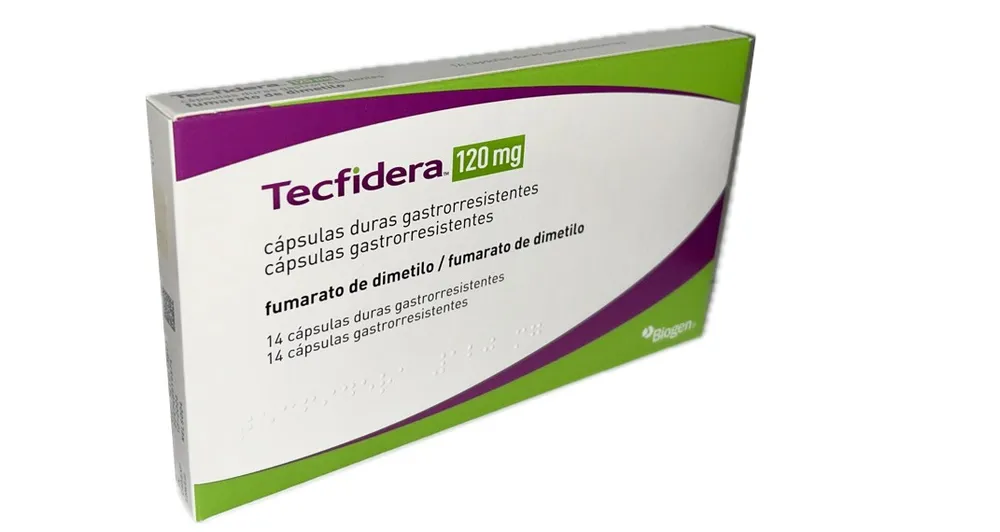
Table of Contents
Package leaflet: Information for the user
Introduction
Package leaflet: information for the patient
Tecfidera 120 mg gastro-resistant hard capsules
Tecfidera 240 mg gastro-resistant hard capsules
dimethyl fumarate
Read the entire leaflet carefully before you start taking this medicine, because it contains important information for you.
- Keep this leaflet as you may need to read it again.
- If you have any questions, ask your doctor or pharmacist.
- This medicine has been prescribed for you only, and you should not give it to others, even if they have the same symptoms as you, because it could harm them.
- If you experience any adverse effects, consult your doctor or pharmacist, even if they are effects not listed in this leaflet. See section 4.
Leaflet contents
- What Tecfidera is and what it is used for
- What you need to know before taking Tecfidera
- How to take Tecfidera
- Possible side effects
- How to store Tecfidera
- Contents of the pack and other information
1. What Tecfidera is and what it is used for
What Tecfidera is
Tecfidera is a medicine that contains dimethyl fumarate as the active substance.
What Tecfidera is used for
Tecfidera is used to treat relapsing-remitting multiple sclerosis (MS) in patients 13 years of age and older.
MS is a long-term disease that affects the central nervous system (CNS), which includes the brain and spinal cord. Relapsing-remitting MS is characterized by repeated attacks (relapses) of neurological symptoms. Symptoms vary from patient to patient but usually include: difficulty walking, balance problems, and vision problems (e.g., blurred or double vision). These symptoms may completely disappear when a relapse ends, but some problems may persist.
How Tecfidera works
Tecfidera appears to work by preventing the body's immune system from damaging the brain and spinal cord. This may also help delay future worsening of your MS.
2. What you need to know before taking Tecfidera
Do not take Tecfidera
- If you are allergic to dimethyl fumarate or any of the other ingredients of this medicine (listed in section 6).
- If you are suspected of having a rare brain infection called progressive multifocal leukoencephalopathy (PML) or if PML has been confirmed.
Warnings and precautions
Tecfidera may affect your white blood cell count, kidneys, and liver. Before starting Tecfidera, your doctor will perform a blood test to determine your white blood cell count and to check that your kidneys and liver are functioning properly. Your doctor will carry out regular blood tests during treatment. If you experience a decrease in white blood cells during treatment, your doctor may consider additional testing or interrupt your treatment.
Consult your doctor before starting Tecfidera if you have:
- severe kidney disease
- severe liver disease
- a stomach or intestinal disorder
- a serious infection (e.g., pneumonia)
Herpes zoster (shingles) may occur during treatment with Tecfidera. In some cases, serious complications have occurred. You must inform your doctor immediately if you suspect you have any symptoms of shingles.
If you think your MS is worsening (e.g., weakness or visual changes) or you notice new symptoms, speak to your doctor immediately, as these could be symptoms of a rare brain infection called PML. PML is a serious condition that can lead to death or severe disability.
A rare but serious kidney disorder called Fanconi syndrome has been reported with a medicine containing dimethyl fumarate in combination with other fumaric acid esters, used to treat psoriasis (a skin condition). If you notice that you are urinating more, feel more thirsty and drink more than usual, your muscles seem weaker, you suffer a bone fracture, or simply have aches and pains, inform your doctor as soon as possible so that this can be further investigated.
Children and adolescents
Do not give this medicine to children under 10 years of age, as there is no available data in this age group.
Other medicines and Tecfidera
Tell your doctor or pharmacist if you are taking, have recently taken, or might need to take any other medicines, especially:
- medicines containing fumaric acid esters (fumarates) used to treat psoriasis
- medicines that affect the body's immune system, including chemotherapy, immunosuppressants, or other medicines used to treat MS
- medicines that affect the kidneys, including certain antibiotics (used to treat infections), "diuretics" (tablets that increase urine output), certain types of painkillers (such as ibuprofen or other similar anti-inflammatory drugs, and over-the-counter medications), and medicines containing lithium
- using Tecfidera together with certain types of vaccines (attenuated vaccines) could cause you to develop an infection and should therefore be avoided. Your doctor will advise you whether you should receive other types of vaccines (inactivated vaccines).
Taking Tecfidera with alcohol
After taking Tecfidera, you should avoid consuming more than a small amount (more than 50 ml) of strong alcoholic drinks (with an alcohol volume of more than 30%, such as spirits) for the first hour, as alcohol may interact with this medicine. This may cause inflammation of the stomach (gastritis), especially in people who are prone to this condition.
Pregnancy and breastfeeding
If you are pregnant or breastfeeding, think you may be pregnant, or are planning to become pregnant, consult your doctor or pharmacist before using this medicine.
Pregnancy
Information on the effects of this medicine on the fetus if used during pregnancy is limited. Do not use Tecfidera during pregnancy unless you have discussed it with your doctor and this medicine is clearly necessary in your case.
Breastfeeding
It is unknown whether the active ingredient of Tecfidera passes into breast milk. Your doctor will advise you whether you should stop breastfeeding or stop taking Tecfidera. This decision involves weighing the benefits of breastfeeding for your child against the benefits of treatment for you.
Driving and using machines
Tecfidera is not expected to affect your ability to drive or use machines.
Tecfidera contains sodium
This medicine contains less than 23 mg of sodium (1 mmol) per capsule; this is essentially “sodium-free”.
3. How to take Tecfidera
Follow exactly your doctor's instructions for taking this medicine. If in doubt, consult your doctor again.
Starting dose: 120 mg twice daily.
Take this starting dose for the first 7 days, then take the maintenance dose.
Maintenance dose: 240 mg twice daily.
Tecfidera is taken orally.
The capsules must be swallowed whole, with some water. Do not split, crush, dissolve, suck, or chew the capsules, as this could increase certain adverse effects.
Take Tecfidera with food – this helps reduce some of the very common adverse effects (listed in section 4).
If you take more Tecfidera than you should
If you take too many capsules, contact your doctor immediately. You may experience adverse effects similar to those described below in section 4.
In case of overdose or accidental ingestion, contact your doctor or pharmacist immediately, or call the Toxicology Information Service at 91 562 04 20, indicating the medication and the amount ingested.
If you forget to take Tecfidera
Do not take a double dose to make up for a missed dose.
You may take the missed dose if at least 4 hours remain before the next scheduled dose. Otherwise, wait until the time for your next dose.
If you have any further questions about the use of this medicine, ask your doctor or pharmacist.
4. Possible adverse effects
Like all medicines, this medicine can cause adverse effects, although not everyone will experience them.
Serious adverse effects
Tecfidera may reduce your lymphocyte count (a type of white blood cell in the blood). A low white blood cell count can increase the risk of infection, including a rare brain infection called progressive multifocal leukoencephalopathy (PML). PML can lead to death or cause severe disability. PML has occurred after 1 to 5 years of treatment, so your doctor must continue to monitor your white blood cells throughout treatment, and you should remain alert to any possible symptoms of PML, as described below. The risk of PML may be higher if you have previously taken a medicine that impaired the function of your immune system.
The symptoms of PML may be similar to those of an MS relapse. Symptoms may include new weakness or worsening of weakness on one side of the body; clumsiness; changes in vision, thinking, or memory; or confusion or personality changes, or difficulty speaking and communicating that may persist for more than several days. Therefore, it is very important that you speak to your doctor as soon as possible if you think your MS is worsening or if you notice any new symptoms while being treated with Tecfidera. In addition, inform your partner or caregivers about your treatment. Symptoms may arise that you do not notice yourself.
Call your doctor immediately if you experience any of these symptoms
Serious allergic reactions
The frequency of serious allergic reactions cannot be estimated from the available data (frequency not known).
Flushing of the face or body (rubefaction) is a very common adverse effect. However, if flushing is accompanied by a red rash or skin rash and you have any of the following symptoms:
- swelling of the face, lips, mouth, or tongue (angioedema)
- wheezing, difficulty breathing, or shortness of breath (dyspnea, hypoxia)
- dizziness or loss of consciousness (hypotension)
this could then constitute a serious allergic reaction (anaphylaxis).
Stop taking Tecfidera and call your doctor immediately
Other adverse effects
Very common (may affect more than 1 in 10 people)
- flushing of the face or body, feeling of warmth, heat, burning sensation, or itching (rubefaction)
- loose stools (diarrhea)
- nausea or vomiting
- stomach pain or cramps
Taking the medicine with food may help reduce the above adverse effects.
While being treated with Tecfidera, urine tests commonly show the presence of ketones, substances that are naturally produced in the body.
Consult your doctor about how to manage these adverse effects. Your doctor may reduce your dose. Do not reduce your dose unless instructed by your doctor.
Common (may affect up to 1 in 10 people)
- inflammation of the intestinal mucosa (gastroenteritis)
- vomiting
- indigestion (dyspepsia)
- inflammation of the stomach lining (gastritis)
- gastrointestinal disorders
- burning sensation
- hot flushes, feeling of warmth
- skin itching (pruritus)
- rash
- red or rosy spots accompanied by itching on the skin (erythema)
- hair loss (alopecia)
Adverse effects that may appear in blood or urine tests
- low levels of white blood cells (lymphopenia, leucopenia) in blood. A decrease in white blood cells may reduce the body's ability to fight infections. If you have a serious infection (such as pneumonia), inform your doctor immediately
- proteins (albumin) in urine
- increased liver enzymes (ALT, AST) in blood
Uncommon (may affect up to 1 in 100 people)
- allergic reactions (hypersensitivity)
- reduction in blood platelets
Rare (may affect up to 1 in 1,000 people)
- inflammation of the liver and increased levels of liver enzymes (ALT or AST simultaneously with bilirubin)
Frequency not known (cannot be estimated from the available data)
- herpes zoster (shingles) with symptoms such as blisters, burning, itching, or skin pain, usually on one side of the upper body or face, and other symptoms such as fever and weakness in the early stages of infection, followed by numbness, itching, or red spots with severe pain.
- nasal discharge (rhinorrhea)
Children (aged 13 years and older) and adolescents
The adverse effects described above also apply to children and adolescents.
Some adverse effects were reported more frequently in children and adolescents than in adults, e.g., headache, stomach pain or cramps, vomiting, sore throat, cough, and painful menstruation.
Reporting of adverse effects
If you experience any adverse effect, talk to your doctor or pharmacist, even if it is a possible adverse effect not listed in this leaflet. You can also report them directly through the national reporting system included in Appendix V. By reporting adverse effects, you can help provide more information on the safety of this medicine.
5. Storage of Tecfidera
Keep this medicine out of the sight and reach of children.
Do not use this medicine after the expiry date stated on the blister and outer carton following EXP.
The expiry date is the last day of the month indicated.
Do not store above 30 °C.
Keep blisters in the outer packaging to protect from light.
Medicines should not be disposed of via wastewater or household waste. Ask your pharmacist how to dispose of medicines and packaging you no longer need. This will help protect the environment.
6. Contents of the pack and other information
Composition of Tecfidera
The active substance is dimethyl fumarate.
Tecfidera 120 mg: each capsule contains 120 mg of dimethyl fumarate.
Tecfidera 240 mg: each capsule contains 240 mg of dimethyl fumarate.
The other components are microcrystalline cellulose, sodium croscarmellose, talc, anhydrous colloidal silica, magnesium stearate, triethyl citrate, methacrylic acid-methyl methacrylate copolymer (1:1), methacrylic acid-ethyl acrylate copolymer (1:1) 30% dispersion, simethicone, sodium lauryl sulfate, polysorbate 80, gelatin, titanium dioxide (E171), brilliant blue FCF (E133), iron oxide yellow (E172), shellac, potassium hydroxide and iron oxide black (E172).
Appearance of the product and contents of the pack
Tecfidera 120 mg gastro-resistant hard capsules are green and white with the imprint ‘BG-12 120 mg’ and are available in packs containing 14 capsules.
Tecfidera 240 mg gastro-resistant hard capsules are green with the imprint ‘BG-12 240 mg’ and are available in packs containing 56 or 168 capsules.
Only certain pack sizes may be marketed.
Marketing Authorization Holder and Manufacturer
Biogen Netherlands B.V.
Prins Mauritslaan 13
1171 LP Badhoevedorp
The Netherlands
More information about this medicinal product is available upon request by contacting the local representative of the Marketing Authorization Holder:
Belgium/Belgium/Belgium Biogen Belgium NV/SA Tel/Tel: +32 2 2191218 | Lithuania Biogen Lithuania UAB Tel: +370 5 259 6176 |
| Luxembourg/Luxembourg Biogen Belgium NV/SA Tél/Tel: +32 2 2191218 |
Czech Republic Biogen (Czech Republic) s.r.o. Tel: +420 255 706 200 | Hungary Biogen Hungary Kft. Tel: + 36 1 899 9883 |
Denmark Biogen (Denmark) A/S Tlf.: +45 77 41 57 57 | Malta Pharma. MT Ltd. Tel: +356 21337008 |
Germany Biogen GmbH Tel: +49 (0) 89 99 6170 | Netherlands Biogen Netherlands B.V. Tel: +31 20 542 2000 |
Estonia Biogen Estonia OÜ Tel: +372 618 9551 | Norway Biogen Norway AS Tlf: +47 23 40 01 00 |
Greece Genesis Pharma SA Tel: +30 210 8771500 | Austria Biogen Austria GmbH Tel: +43 1 484 46 13 |
Spain Biogen Spain, S.L. Tel: +34 91 310 7110 | Poland Biogen Poland Sp. z o.o. Tel: +48 22 351 51 00 |
France Biogen France SAS Tél: +33 (0)1 41 37 95 95 | Portugal Biogen Portugal Sociedade Farmacêutica, Unipessoal, Lda. Tel: +351 21 318 8450 |
Croatia Biogen Pharma d.o.o. Tel: +385 (0) 1 775 73 22 | Romania Johnson & Johnson Romania S.R.L. Tel: +40 21 207 18 00 |
Ireland Biogen Idec (Ireland) Ltd. Tel: +353 (0)1 463 7799 | Slovenia Biogen Pharma d.o.o. Tel: +386 1 511 02 90 |
Iceland Icepharma hf Sími: +354 540 8000 | Slovakia Biogen Slovakia s.r.o. Tel: +421 2 323 340 08 |
Italy Biogen Italia s.r.l. Tel: +39 02 5849901 | Finland Biogen Finland Oy Puh/Tel: +358 207 401 200 |
Cyprus Genesis Pharma Cyprus Ltd Tel: +3572 2 765715 | Sweden Biogen Sweden AB Tel: +46 8 594 113 60 |
Latvia Biogen Latvia SIA Tel: +371 68 688 158 |
Date of the most recent review of this leaflet: 12/2024
Detailed information on this medicine is available on the website of the European Medicines Agency: https://www.ema.europa.eu/