Taucor 20 mg
Spain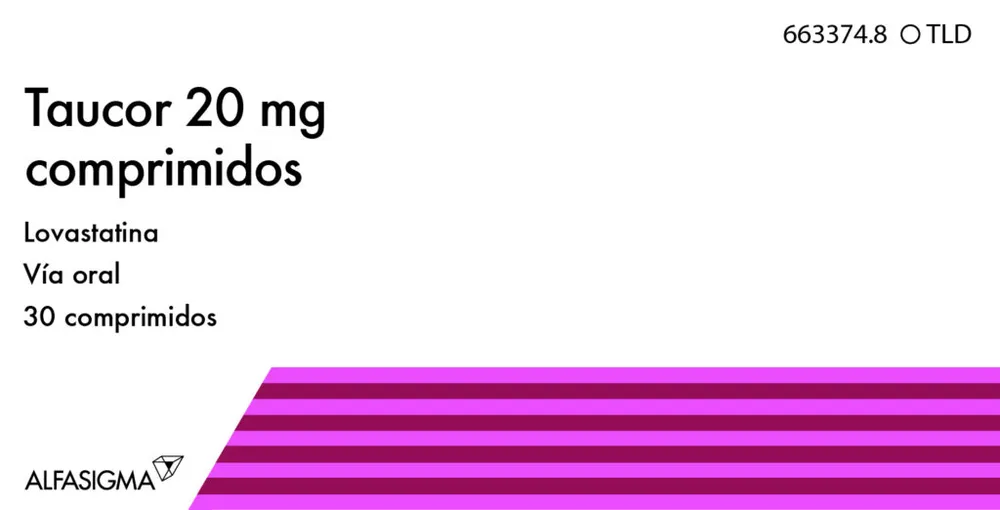
Table of Contents
- Package leaflet: Information for the user
- Introduction
- 1. What Taucor 20 mg tablets are and what they are used for
- 2. What you need to know before taking Taucor 20 mg tablets
- 3. How to take Taucor 20 mg tablets
- 4. Possible adverse effects
- 5. Storage of Taucor 20 mg tablets
- 6. Contents of the pack and other information
Package leaflet: Information for the user
Introduction
Package leaflet: information for the user
Taucor 20 mg tablets
(Lovastatin)
Read the entire leaflet carefully before you start taking this medicine, because it contains important information for you.
- Keep this leaflet, as you may need to read it again.
- If you have any questions, ask your doctor or pharmacist.
- This medicine has been prescribed for you only and must not be given to other people, even if they have the same symptoms as you, because it may harm them.
- If you experience any adverse effects, consult your doctor or pharmacist, even if such effects are not listed in this leaflet. See section 4.
Leaflet contents
- What Taucor 20 mg tablets are and what they are used for.
- What you need to know before taking Taucor 20 mg tablets.
- How to take Taucor 20 mg tablets.
- Possible side effects.
- How to store Taucor 20 mg tablets.
- Contents of the pack and other information.
1. What Taucor 20 mg tablets are and what they are used for
Taucor (lovastatin) lowers cholesterol levels in your blood. It belongs to a class of medicines called hydroxymethylglutaryl-coenzyme A (HMG-CoA) reductase inhibitors.
This medicine reduces cholesterol production in the liver (the body's main source of cholesterol) and increases the removal of cholesterol from the bloodstream. Regarding LDL and HDL cholesterol, Taucor significantly reduces LDL cholesterol (bad cholesterol) and, in most patients, increases HDL cholesterol (good cholesterol). By combining Taucor with diet, you control both the amount of cholesterol you consume and the amount your body produces.
Taucor reduces elevated cholesterol levels in patients with high blood cholesterol (hypercholesterolemic) when response to diet and other measures alone has been inadequate.
Treatment with this medicine, together with an appropriate diet, helps delay the progression of atherosclerosis (hardening of the arteries) in patients with hypercholesterolemia and coronary heart disease (blockage or hardening of blood vessels carrying oxygen and nutrients to the heart).
2. What you need to know before taking Taucor 20 mg tablets
Do not take Taucor
-
if you are allergic to lovastatin or any of the other ingredients of this medicine (listed in section 6).
-
if you have diagnosed active liver disease.
-
if you are pregnant or breastfeeding.
-
if you are taking any of the following medicines:
-
Antifungal medicines (medicines to treat fungal infections) such as itraconazole or ketoconazole.
-
The antibiotics erythromycin, clarithromycin, or telithromycin.
-
HIV protease inhibitors (medicines used to treat HIV virus infections that cause AIDS) such as indinavir, nelfinavir, ritonavir, and saquinavir.
-
The antidepressant nefazodone.
Warnings and precautions
Talk to your doctor or pharmacist before starting to take Taucor:
- If you have or have had myasthenia (a disease characterized by generalized muscle weakness that, in some cases, affects the muscles used for breathing) or ocular myasthenia (a disease causing weakness of the eye muscles), as statins may sometimes worsen the condition or trigger the onset of myasthenia (see section 4).
- If you experience muscle pain, tenderness, or weakness.
- If you have severe respiratory failure.
- If you are taking or have taken within the last 7 days an oral or injectable medicine containing fusidic acid (used to treat bacterial infection). The combination of fusidic acid and Taucor may cause serious muscle problems (rhabdomyolysis).
Also inform your doctor or pharmacist if you have persistent muscle weakness. Additional tests and treatments may be needed to diagnose and manage this condition.
Rarely, Taucor may cause serious muscle problems that can lead to kidney damage. This risk is higher in patients taking high doses of this medicine or who are also taking other medicines that increase the levels of lovastatin (the active ingredient in Taucor) in the blood, thereby increasing the risk of muscle disorders, such as:
- Fibrates and niacin (medicines that lower cholesterol levels).
- Amiodarone and verapamil (medicines used to treat heart problems).
- Cyclosporine (a medicine used to prevent transplant rejection).
While you are taking this medicine, your doctor will monitor whether you have diabetes or are at risk of developing diabetes. This risk increases if you have high blood sugar and fat levels, are overweight, or have high blood pressure.
Inform your doctor about any current or past medical conditions and any allergies you may have. Let your doctor know if you consume large amounts of alcohol or have a history of liver disease.
Children
The use of Taucor is not recommended in children.
Other medicines and Taucor
Tell your doctor or pharmacist if you are using, have recently used, or might need to use any other medicines.
Because taking Taucor with any of the following medicines may increase the risk of muscle problems (see section 4. Possible Side Effects), it is especially important that you inform your doctor if you are taking:
- Cyclosporine (a medicine used to prevent transplant rejection).
- Danazol (a medicine used to treat endometriosis).
- Antifungal medicines (medicines to treat fungal infections) such as itraconazole or ketoconazole.
- Fibr acid derivatives (medicines that reduce cholesterol levels) such as gemfibrozil, bezafibrate, or fenofibrate.
- The antibiotics erythromycin, clarithromycin, telithromycin, and fusidic acid.
- HIV protease inhibitors (medicines used to treat HIV infections that cause AIDS) such as indinavir, nelfinavir, ritonavir, and saquinavir.
- The antidepressant nefazodone.
- Amiodarone (a medicine used to treat irregular heartbeat).
- Verapamil (a medicine used to treat high blood pressure or angina pectoris).
- High doses (more than 1 g per day) of niacin or nicotinic acid.
It is also very important to inform your doctor if you are taking anticoagulants (medicines to prevent blood clots such as warfarin, phenprocoumon, or acenocoumarol).
If you need to take oral fusidic acid to treat a bacterial infection, you must stop using this medicine. Your doctor will advise you when you can restart treatment with Taucor. Using Taucor with fusidic acid may cause muscle weakness, tenderness, or pain (rhabdomyolysis). For more information about rhabdomyolysis, see section 4.
Taking Taucor with food and drink
Grapefruit juice increases the effect of this medicine; therefore, grapefruit juice should be avoided during treatment with Taucor.
Pregnancy, breastfeeding, and fertility
If you are pregnant or breastfeeding, think you might be pregnant, or plan to become pregnant, consult your doctor before using this medicine.
Pregnancy
Taucor is contraindicated during pregnancy. Women who are pregnant, planning to become pregnant, or suspect they are pregnant should not take Taucor. If you become pregnant while taking Taucor, stop treatment immediately and contact your doctor without delay.
Breastfeeding
Women taking Taucor must not breastfeed their babies.
Driving and using machines
Taucor, at the recommended therapeutic doses, does not affect the ability to drive or operate machinery. However, if you experience dizziness, do not drive or operate machinery until you know how you react to the medicine.
Taucor contains lactose
This medicine contains lactose. If your doctor has informed you of an intolerance to certain sugars, consult with him before taking this medicine.
3. How to take Taucor 20 mg tablets
Follow exactly the instructions given by your doctor for taking this medicine. If in doubt, consult your doctor or pharmacist again.
Remember to take your medicine.
Your doctor has prescribed your dose of Taucor.
The usual starting dose is 20 mg once daily, taken as a single dose with the evening meal. Some patients with mild to moderate hypercholesterolemia may be treated with an initial dose of 10 mg. Your doctor may adjust your dose up to a maximum of 80 mg/day, administered as a single dose with the evening meal or in divided doses with lunch and evening meal. Your doctor may prescribe lower doses, especially if you are taking certain medications mentioned above or have certain renal disorders.
Try to take Taucor exactly as directed by your doctor.
Most patients take Taucor with a glass of water.
Break the tablet along the score line if you need a 10 mg dose.
If you think that the effect of Taucor is too strong or too weak, tell your doctor or pharmacist.
If you take more Taucor than you should
In case of overdose or accidental ingestion, contact your doctor, pharmacist, or call the Toxicology Information Service immediately at telephone number 91 562 04 20, indicating the medicine and the amount ingested.
If you forget to take Taucor
Do not take a double dose to make up for missed doses. Simply continue with your usual dosing schedule.
If you stop taking Taucor
Keep taking Taucor unless your doctor tells you to stop. If you stop taking Taucor, your cholesterol levels may rise again.
If you have any further questions about the use of this medicine, ask your doctor or pharmacist.
4. Possible adverse effects
Like all medicines, this medicine may cause adverse effects, although not everyone will experience them.
In general, Taucor is adequately tolerated. In most cases, adverse reactions have been mild and short-lived.
Contact your doctor immediately if you experience pain, tenderness to pressure, or muscle weakness. This is because, on rare occasions, muscle problems can be serious, including muscle breakdown which may lead to kidney damage.
The risk of muscle breakdown is higher in patients taking high doses of Taucor and in patients with abnormal kidney function.
Adverse effect frequencies are listed as follows:
Frequent (may affect up to 1 in 10 people):
- Constipation
- Indigestion
Uncommon (may affect up to 1 in 100 people):
- Itching
- Increased transaminases
Rare (may affect up to 1 in 1,000 people):
- Loss of appetite
- Sleep disturbances, including insomnia and nightmares
- Psychiatric disturbances, including anxiety
- Dizziness, loss of taste sensation, headache, tingling sensation, tingling and numbness of feet or legs
- Blurred vision
- Abdominal pain, diarrhea, dry mouth, flatulence, nausea, vomiting
- Yellowing of the skin and eyes (cholestatic jaundice), hepatitis
- Hair loss, red patchy or widespread skin rash including Stevens-Johnson syndrome, skin redness and swelling, skin peeling
- Muscle weakness (myopathy), fatigue and muscle pain, muscle cramps
- Weakness
- Other abnormalities in liver function tests, including increased alkaline phosphatase and bilirubin; increases in serum CK levels
Frequency not known: (cannot be estimated from available data):
- Myasthenia gravis (a disease causing generalized muscle weakness which, in some cases, affects the muscles used for breathing)
- Ocular myasthenia (a disease causing weakness of the eye muscles)
- Consult your doctor if you experience arm or leg weakness that worsens after periods of activity, double vision or drooping eyelids, difficulty swallowing, or difficulty breathing
- Persistent muscle weakness
Rarely, a hypersensitivity syndrome has been reported, which may include some of the following features: anaphylaxis, angioedema, pseudolupus syndrome, polymyalgia rheumatica, dermatomyositis, vasculitis, thrombocytopenia, leukopenia, eosinophilia, hemolytic anemia, positive antinuclear antibodies (ANA), increased erythrocyte sedimentation rate, arthritis, arthralgia, urticaria, asthenia, photosensitivity, fever, flushing, chills, dyspnea, and malaise.
Other possible adverse effects:
- Memory loss
- Sexual dysfunction
- Respiratory problems including persistent cough and/or difficulty breathing or fever
Diabetes. This is more likely if you have high levels of sugar and fats in the blood, are overweight, and have high blood pressure. Your doctor will monitor you while you are taking this medicine.
Other adverse effects may also occur rarely, and as with any prescribed medicine, some may be serious. Ask your doctor or pharmacist for more information. Both have access to a more complete list of adverse effects.
Inform your doctor or pharmacist if you experience any unusual symptoms or if any known symptoms persist.
Reporting of adverse effects
If you experience any type of adverse effect, talk to your doctor, pharmacist, or nurse, even if it is a possible adverse effect not listed in this leaflet. You can also report them directly via the Spanish Pharmacovigilance System for Human Medicinal Products: www.notificaram.es. By reporting adverse effects, you can help provide more information on the safety of this medicine.
5. Storage of Taucor 20 mg tablets
Keep this medicine out of the sight and reach of children.
This medicine does not require any special storage conditions.
Do not use this medicine after the expiry date stated on the packaging after EXP. The expiry date refers to the last day of the month indicated.
Medicines should not be disposed of via wastewater or household waste. Return any unused medicines and their containers to your pharmacy's designated collection point (Punto SIGRE). If you are unsure, ask your pharmacist how to dispose of medicines and containers you no longer need. This will help protect the environment.
6. Contents of the pack and other information
Composition of Taucor 20 mg tablets
- The active substance is: Lovastatin. Each tablet contains 20 mg of Lovastatin.
- The other components (excipients) are: butylated hydroxyanisole (E-320), lactose, pregelatinized corn starch, microcrystalline cellulose, magnesium stearate and indigo carmine (E-132).
Appearance of the product and contents of the pack
Taucor 20 mg is available in packs of 30 and 500 tablets, each containing 20 mg of lovastatin. The tablets are round, blue, scored on one side and bear the sigma symbol on the other.
Marketing Authorisation Holder and Manufacturer
Marketing Authorisation Holder
Alfasigma España, S.L
C/ Aribau 195, 4º
08021 Barcelona, Spain
Manufacturer
Pharmaloop S.L
C/Bolivia, 15
Polígono Industrial Azque
28806 Alcalá de Henares (Madrid), Spain
Date of the most recent revision of this leaflet: April 2023
Other sources of information
Detailed and up-to-date information on this medicinal product is available on the website of the Spanish Agency of Medicines and Health Products (AEMPS) http://www.aemps.gob.es.