Tasmar 100 mg film-coated tablets
Spain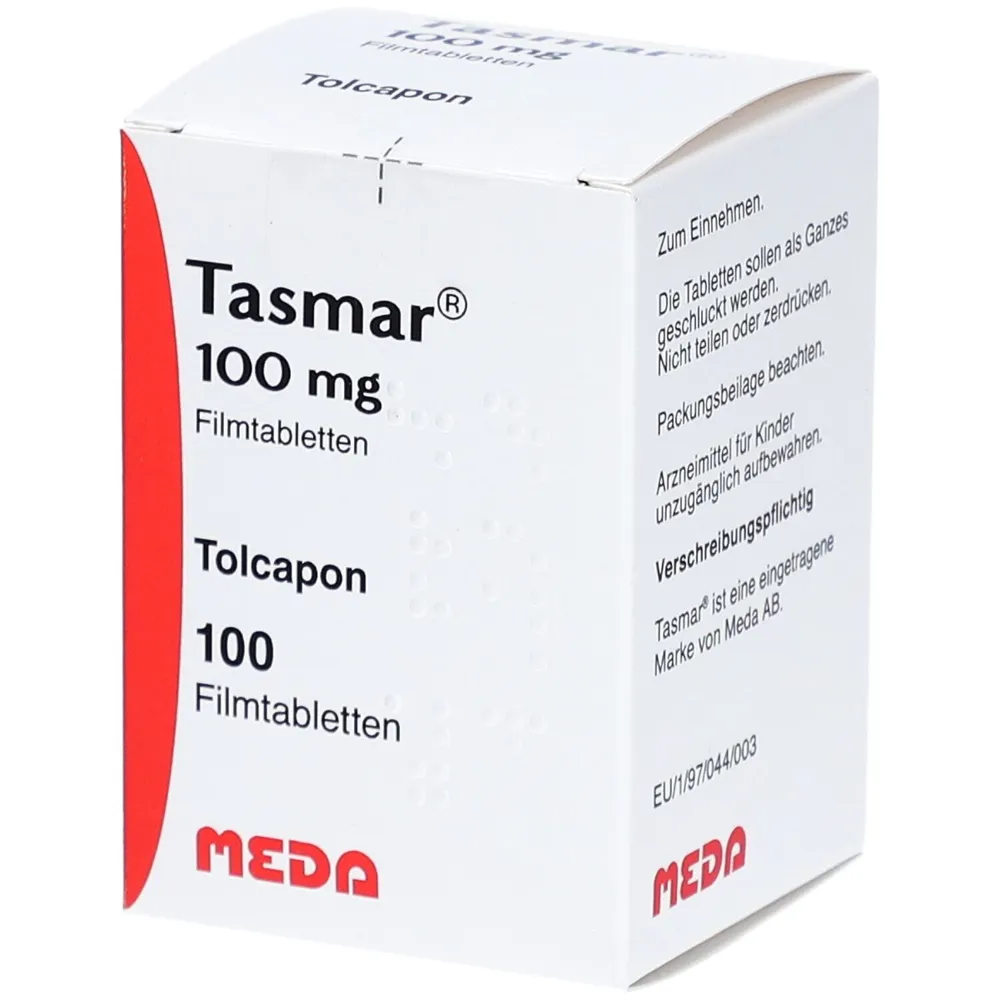
Table of Contents
Package leaflet: Information for the user
Introduction
Package leaflet: information for the user
Tasmar 100 mg film-coated tablets
tolcapone
Read the entire leaflet carefully before you start taking this medicine, because it contains important information for you.
- Keep this leaflet; you may need to read it again.
- If you have any questions, ask your doctor or pharmacist.
- This medicine has been prescribed for you only, and you should not give it to others, even if they have the same symptoms as you, because it may harm them.
- If you experience any adverse effects, consult your doctor or pharmacist, even if they are adverse effects not listed in this leaflet. See section 4.
Leaflet contents:
- What Tasmar is and what it is used for
- What you need to know before taking Tasmar
- How to take Tasmar
- Possible adverse effects
- How to store Tasmar
- Contents of the pack and other information
1. What Tasmar is and what it is used for
For the treatment of Parkinson's disease, Tasmar is taken together with the medication levodopa (such as levodopa/benserazide or levodopa/carbidopa).
Tasmar is used when other alternative medications are unable to stabilize your Parkinson's disease.
For the treatment of your Parkinson's disease, you are already taking levodopa.
A protein (enzyme) in the human body, catechol-O-methyltransferase (COMT), breaks down levodopa. Tasmar inhibits this enzyme and thus delays the breakdown of levodopa. As a result, when taken together with levodopa (such as levodopa/benserazide or levodopa/carbidopa), you will notice an improvement in the symptoms of your Parkinson's disease.
2. What you need to know before taking Tasmar
Do not take Tasmar
- if you have liver disease or elevated liver enzymes
- if you have severe involuntary movements (dyskinesia)
- if you have previously experienced severe symptoms of muscle stiffness, fever, or mental confusion (Neuroleptic Malignant Syndrome-like symptoms (NMS)) and/or have had tissue damage to the musculoskeletal system (non-traumatic rhabdomyolysis) or fever (hyperthermia)
- if you are allergic (hypersensitive) to the active substance tolcapone or to any of the other ingredients of Tasmar
- if you have a special type of tumor in the adrenal medulla (pheochromocytoma)
- if you are taking certain medicines for depression and anxiety called non-selective monoamine oxidase inhibitors (MAO)
Warnings and precautions
Talk to your doctor or pharmacist before starting to take Tasmar.
You should not start taking Tasmar until your doctor:
- has explained to you the risks of treatment with Tasmar
- has explained the measures necessary to minimize these risks
- has answered any questions you may have
- if you are pregnant or planning to become pregnant. Your doctor will explain the risks and benefits of taking Tasmar during pregnancy. The effects of Tasmar in children have not been studied. You must stop breastfeeding while being treated with Tasmar.
Tell your doctor if you or your family/carer notice that you are developing impulses or urges to behave in an unusual way, or if you cannot resist the impulse or temptation to carry out certain activities that could be harmful to you or others. These behaviors are known as impulse control disorders and may include gambling addiction, excessive eating or spending, abnormally increased sex drive, or increased sexual thoughts and sensations. Your doctor may need to review your treatment.
Tasmar should only be used if your Parkinson’s disease is not adequately controlled with other treatments.
In addition, your doctor will stop treatment with Tasmar if, after 3 weeks, there is not sufficient improvement to justify continuing treatment.
Liver injury
Tasmar may rarely cause liver injury, which can potentially be fatal. Liver injury most commonly occurs after 1 month and before 6 months of treatment. It should be noted that women may have a higher risk of liver damage. Therefore, the following preventive measures should be taken.
Before starting treatment:
To reduce the risk of liver injury, Tasmar must not be taken if
- you have liver disease.
- liver function tests are elevated in the blood test performed before starting treatment (alanine aminotransferase (ALT) and aspartate aminotransferase (AST) tests).
While receiving treatment:
During treatment, blood tests will be performed at the following intervals:
- every 2 weeks during the first 12 months of treatment,
- every 4 weeks during the next 6 months of treatment,
- every 8 weeks during continued treatment.
Treatment will be stopped if blood test results are not normal.
Tasmar may sometimes cause problems with liver function. Therefore, inform your doctor immediately if you experience symptoms such as nausea, vomiting, stomach pain (particularly in the upper right side where the liver is located), loss of appetite, weakness, fever, dark-colored urine, jaundice (yellowing of the skin or eyes), or if you become easily tired.
If you have previously taken Tasmar and developed acute liver injury during treatment, Tasmar treatment must not be restarted.
NMS (Neuroleptic Malignant Syndrome):
Symptoms of Neuroleptic Malignant Syndrome (NMS) may occur during treatment with Tasmar.
NMS consists of one or all of the following symptoms:
- severe muscle rigidity, muscle twitching, stiff arms or legs, and sore muscles. Muscle damage sometimes causes dark-colored urine.
- other important symptoms are high fever and mental confusion.
Rarely, when stopping or suddenly reducing Tasmar or other anti-Parkinson medications, you may experience severe symptoms of muscle rigidity, fever, or mental confusion. If this happens, inform your doctor immediately.
The following preventive measures should be considered.
Before starting treatment:
To reduce the risk of NMS, you must not take Tasmar if your doctor says you have severe involuntary movements (dyskinesia) or have previously had an illness that may have been NMS.
Tell your doctor about all medicines you are taking, with or without a prescription, as your risk of developing NMS may increase if you are taking certain specific medicines.
While receiving treatment:
If you develop any symptoms similar to those described above that make you suspect NMS, you must inform your doctor immediately.
Do not stop taking Tasmar or any other Parkinson’s medication without telling your doctor, as this may increase the risk of NMS.
Also inform your doctor:
- if you have any other illness besides Parkinson’s disease
- if you are allergic to other medicines, foods, or dyes
- if symptoms that may be caused by levodopa, such as involuntary movements (dyskinesia) and nausea, appear after starting or during treatment with Tasmar.
If you do not feel well, you should tell your doctor, as you may need a reduction in your levodopa dose.
Children and adolescents
Tasmar is not recommended for use in children under 18 years of age due to insufficient data on safety and efficacy. There is no relevant information on use in children and adolescents.
Other medicines and Tasmar
Tell your doctor or pharmacist if you are taking, have recently taken, or might need to take any other medicines, including those obtained without a prescription (over-the-counter medicines and herbal remedies).
Tell your doctor about all the medicines you are taking, especially:
- antidepressants
- alpha-methyldopa (used to treat high blood pressure)
- apomorphine (used for Parkinson’s disease)
- dobutamine (used for chronic heart failure)
- adrenaline and isoprenaline (both used for heart attacks)
- anticoagulants such as warfarin (which prevent blood clots). In this case, your doctor will regularly perform blood tests to monitor your blood’s clotting ability.
If you go to the hospital or are prescribed a new medicine, tell your doctor that you are taking Tasmar.
Taking Tasmar with food, drinks, and alcohol
Tasmar can be taken with or without food.
Tasmar should be taken with one glass of water.
Pregnancy, breastfeeding, and fertility
Inform your doctor if you are pregnant or planning to become pregnant. Your doctor will explain the risks and benefits of treatment with Tasmar during pregnancy.
The effects of Tasmar in children have not been studied. You must stop breastfeeding while being treated with Tasmar.
Driving and using machines
Since the ability to drive or operate machinery may be impaired by Parkinson’s disease, you should consult your doctor about this.
Tasmar affects the symptoms of Parkinson’s disease.
When Tasmar is combined with other Parkinson’s medications, it may cause excessive sleepiness (somnolence) and sudden episodes of falling asleep (you may suddenly fall asleep). Therefore, you must refrain from driving or operating machinery until these periodic episodes and excessive sleepiness have disappeared.
Tasmar contains lactose and sodium
If your doctor has told you that you have an intolerance to certain sugars, consult with him before taking this medicine.
This medicine contains less than 1 mmol of sodium (23 mg) per tablet; this is essentially “sodium-free”.
3. How to take Tasmar
Follow exactly the administration instructions for Tasmar provided by your doctor. If in doubt, consult your doctor or pharmacist again.
Dosage and frequency of administration
Your doctor will always start your treatment with the standard dose of 1 tablet (100 mg) 3 times a day.
If no benefits are observed within 3 weeks of starting treatment, treatment with Tasmar should be discontinued.
To improve efficacy, your doctor should only increase the dose to 2 tablets (200 mg) 3 times a day if the improvement in control of Parkinson's disease symptoms outweighs the increase in adverse effects. At the higher dose, adverse effects may often be serious and affect the liver. If there is no improvement with the higher dose after a total of 3 weeks, your doctor will stop your treatment with Tasmar.
At the start and during treatment with Tasmar, a change in your levodopa dose may be necessary. Your doctor will give you instructions.
How to take the medication:
Swallow Tasmar with a glass of water.
Do not break or crush the tablets.
The first Tasmar tablet should be taken in the morning together with your other Parkinson's medication, "levodopa".
The subsequent doses of Tasmar should be taken 6 and 12 hours later.
Time of day | Dosage | Notes |
Morning | 1 film-coated tablet of Tasmar | Together with the first daily dose of “levodopa” |
Midday | 1 film-coated tablet of Tasmar | |
Evening | 1 film-coated tablet of Tasmar |
If you take more Tasmar than you should
Contact your doctor, pharmacist, or hospital immediately, as you may require urgent medical attention. If someone else accidentally takes your medication, contact your doctor or hospital immediately, as they may require urgent medical attention.
Symptoms of overdose may include nausea, vomiting, dizziness, and difficulty breathing.
If you forget to take Tasmar
Take it as soon as you remember, and then continue at your regular times. However, if your next dose is due soon, do not take the missed dose and take the next dose at the usual time. Do not take a double dose to make up for forgotten doses. If you have missed several doses, inform your doctor and follow their advice.
If you stop taking Tasmar
Do not reduce the dose or stop taking the medicine unless your doctor tells you to. Always follow your doctor's instructions regarding the duration of treatment with Tasmar.
4. Possible adverse effects
Like all medicines, Tasmar can cause adverse effects, although not everyone will experience them.
The frequency of the possible adverse effects listed below is defined as follows:
Very common: | may affect more than 1 in 10 people |
Common: | may affect up to 1 in 10 people |
Uncommon: | may affect up to 1 in 100 people |
Rare: | may affect up to 1 in 1,000 people |
Very rare: | may affect up to 1 in 10,000 people |
Not known: | frequency cannot be estimated from the available data. |
Inform your doctor or pharmacist as soon as possible:
- If you do not feel well while taking Tasmar.
- If you experience symptoms such as nausea, vomiting, abdominal pain, loss of appetite, weakness, fever, dark-coloured urine, or jaundice, since liver function disorders have been observed infrequently, sometimes including severe hepatitis.
- If you notice dark-coloured urine, as this could be a sign of muscle or liver injury. Any other yellow discoloration of the urine is usually harmless.
- If you develop persistent or severe diarrhoea.
After starting treatment with Tasmar and during treatment, symptoms caused by levodopa such as involuntary movements and nausea may occur. Therefore, if you do not feel well, you should inform your doctor, as you may require an adjustment in your levodopa dose.
Other possible adverse effects:
Very common:
- Involuntary movements (dyskinesia),
- Nausea, decreased appetite, diarrhoea,
- Headache, dizziness,
- Difficulty sleeping, drowsiness,
- Dizziness upon standing (orthostatic problems),
- Mental confusion and hallucinations,
- Movement disorders with involuntary muscle spasms or abnormal posture (dystonia),
- Excessive sleepiness.
Common:
- Chest pain,
- Constipation, indigestion, stomach pain, vomiting, dry mouth,
- Fainting,
- Increased sweating,
- Flu and flu-like symptoms,
- Reduced voluntary and involuntary movements (hypokinesia),
- Upper respiratory tract infection,
- Increased specific liver enzymes,
- Discoloration of urine.
Uncommon:
- Liver injury, in rare cases with fatal outcome.
Rare:
- Severe symptoms of muscle rigidity, fever, or mental confusion (Neuroleptic Malignant Syndrome) when anti-Parkinson treatments are abruptly reduced or discontinued.
- Impulse control disorders (inability to resist the impulse to carry out an action that may be harmful). This may include:
- An intense urge to gamble excessively, despite serious personal or family consequences;
- Altered or increased sexual interest and behaviour significantly affecting you or others, for example, increased sex drive;
- Uncontrollable compulsive buying or spending;
- Binge eating (consuming large amounts of food in a short period of time) or compulsive eating (consuming an amount of food larger than usual and more than necessary to satisfy hunger).
Inform your doctor if you experience any of these behaviours; they will help you develop strategies to manage or reduce the symptoms.
Reporting of adverse effects
If you experience any type of adverse effect, consult your doctor or pharmacist, even if it is a possible adverse effect not listed in this leaflet. You can also report them directly through the national reporting system listed in Annex V. By reporting adverse effects, you can help provide more information on the safety of this medicine.
5. Storage of Tasmar
Keep this medicine out of sight and reach of children.
Do not use Tasmar after the expiry date stated on the packaging.
This medicine does not require any special storage conditions.
Do not use Tasmar if you notice that the tablets are damaged.
6. Contents of the pack and other information
Composition of Tasmar
- The active substance is tolcapone (100 mg in each film-coated tablet).
- The other components are:
Tablet core: calcium hydrogen phosphate, microcrystalline cellulose, povidone K30, sodium starch glycolate, lactose monohydrate (see Section 2 “Tasmar contains lactose”), talc, magnesium stearate.
Coating: hydroxypropylmethylcellulose, talc, yellow iron oxide, ethylcellulose, titanium dioxide (E171), triacetin, sodium lauryl sulfate.
Appearance of the product and contents of the pack
Tasmar is a film-coated tablet, pale to light yellow, oval in shape. One side is marked with the inscriptions “TASMAR” and “100”. Tasmar is supplied as 100 mg film-coated tablets. It is available in blisters containing 30 or 60 tablets, and in glass bottles containing 30, 60, 100 or 200 film-coated tablets.
Not all pack sizes may be marketed.
Marketing Authorization Holder:
Viatris Healthcare Limited
Damastown Industrial Park
Mulhuddart
Dublin 15
DUBLIN
Ireland
Manufacturer:
ICN Polfa Rzeszów S.A.
ul. Przemyslowa 2
35-959 Rzeszów
Poland
Further information on this medicinal product is available from the local representative of the Marketing Authorization Holder:
Belgium/Belgium/Belgium Viatris Tel/Tel: +32 (0) 26586100 | Lithuania Viatris UAB Tel: + 370 52051288 |
| Luxembourg/Luxembourg Viatris Tél/Tel: +32 (0) 26586100 Belgium/Belgium |
Czech Republic Viatris CZ s.r.o Tel: +420 222 004 400 | Hungary Viatris Healthcare Kft. H-1138 Budapest, Váci út 150. Tel.: +36 1 465 2100 |
Denmark Viatris ApS Tlf: +45 28 11 69 32 | Malta V.J. Salomone Pharma Limited Tel: +356 21220174 |
Germany Viatris Healthcare GmbH Tel: + 49 8000700800 | Netherlands Mylan Healthcare B.V. Krijgsman 20 NL-1186 DM Amstelveen Tel: +31 20 426 33 00 |
Estonia Viatris OÜ Tel: +372 6363 052 | Norway Viatris AS Tlf: +47 66 75 33 00 |
Greece Viatris Hellas Ltd Tel: +210 010 0002 | Austria Viatris Austria GmbH Guglgasse 15 A-1110 Vienna Tel: + 43 1 86 390 |
Spain Viatris Pharmaceuticals S.L. Tel: +34 900 102 712 | Poland Viatris Healthcare Sp.z.o.o. ul. Postepu 21 B 02-676 Warsaw Tel.: +48 22 5466400 |
France Viatris Santé 1 bis place de la Défense Tour Trinity 92400 Courbevoie Tél: +33 1 40 80 15 55 | Portugal Viatris Healthcare, Lda Av. D. João II, Edifício Atlantis, nº 44C – 7.3 e 7.4 1990-095 Lisbon Tel:+351 214 127 200 |
Croatia Viatris Hrvatska d.o.o. Tel: +385 1 23 50 599 | Romania BGP PRODUCTS SRL Tel: +40372 579 000 |
Ireland Viatris Limited Tel: +353 18711600 | Slovenia Viatris d.o.o. Tel: +386 1 23 63 180 |
Iceland Icepharma hf. Sími: + 354 540 8000 | Slovakia Viatris Slovakia s.r.o. Tel: +421 2 32 199 100 |
Italy Viatris Italia Via Vittor Pisani, 20 20124 Milan Tel: +39 0261246921 | Finland/Sweden Viatris Oy Puh/Tel: +358 20 720 9555 |
Cyprus GPA Pharmaceuticals Ltd Tel: +357 22863100 | Sweden Viatris AB Tel: +46 (0) 8 630 19 00 |
Latvia Viatris SIA Tel: +371 67616137 | United Kingdom (Northern Ireland) Mylan IRE Healthcare Limited Tel: +353 18711600 |

Date of the most recent review of this leaflet:
Detailed information on this medicine is available on the European Medicines Agency website: http://www.ema.europa.eu/