Tamsulosin Sandoz 0.4 mg prolonged-release tablets EFG
Spain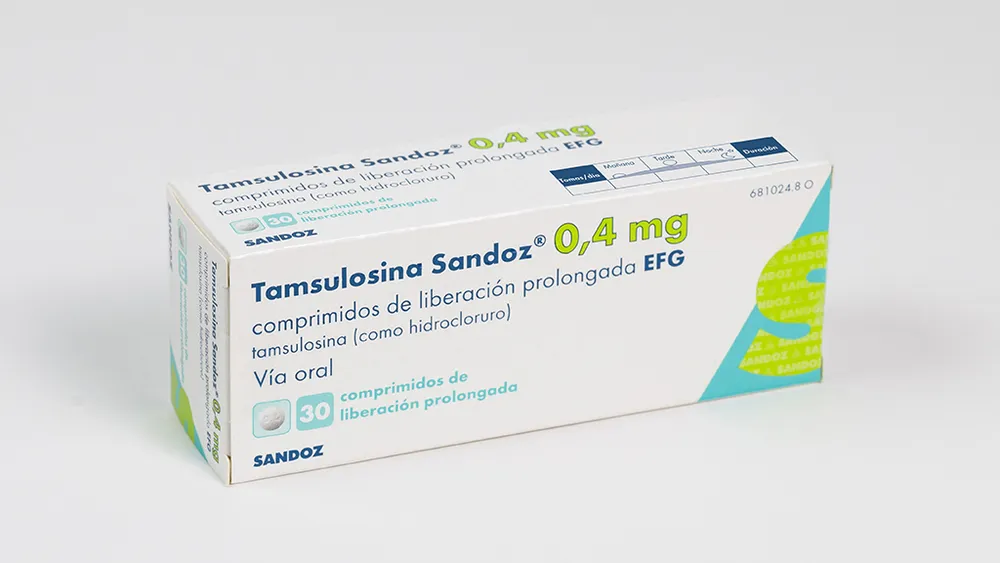
Table of Contents
- Package leaflet: Information for the user
- Introduction
- 1. What Tamsulosin Sandoz is and what it is used for
- 2. What you need to know before starting to take Tamsulosin Sandoz
- 3. How to take Tamsulosin Sandoz
- 4. Possible adverse effects
- 5. Storage of Tamsulosin Sandoz
- 6. Contents of the pack and other information
Package leaflet: Information for the user
Introduction
Package leaflet: information for the user
Tamsulosina Sandoz 0.4 mg prolonged-release tablets EFG
Tamsulosin hydrochloride
Read all of this leaflet carefully before you start taking this medicine, because it contains important information for you.
- Keep this leaflet, as you may need to read it again.
- If you have any questions, ask your doctor or pharmacist.
- This medicine has been prescribed for you only and must not be given to other people, even if they have the same symptoms as you, because it could harm them.
- If you experience any adverse effects, talk to your doctor or pharmacist, even if the adverse effects are not listed in this leaflet. See section 4.
Contents of the leaflet:
- What Tamsulosina Sandoz is and what it is used for
- What you need to know before taking Tamsulosina Sandoz
- How to take Tamsulosina Sandoz
- Possible side effects
- How to store Tamsulosina Sandoz
- Contents of the pack and other information
1. What Tamsulosin Sandoz is and what it is used for
Tamsulosin relaxes the muscles in the prostate and urinary tract. By relaxing these muscles, tamsulosin allows urine to pass more easily and facilitates urination. It also reduces the sensation of urgency.
Tamsulosin is used in men to relieve urinary symptoms caused by an enlarged prostate (benign prostatic hyperplasia). These symptoms may include difficulty urinating (weak stream), dribbling, urgency, and the need to urinate frequently both during the night and during the day.
2. What you need to know before starting to take Tamsulosin Sandoz
Do not take Tamsulosin Sandoz:
- if you are allergic to tamsulosin or to any of the other ingredients of this medicine (listed in section 6). Hypersensitivity may present as sudden localized swelling of soft tissues of the body (e.g. throat or tongue), breathing difficulties and/or itching and skin rash (angioedema),
- if you have a history of a drop in blood pressure upon standing, causing dizziness or fainting,
- if you have severe liver problems.
Warnings and precautions
Talk to your doctor or pharmacist before starting to take Tamsulosin Sandoz
- if you experience dizziness or fainting, especially after standing up. Tamsulosin may lower your blood pressure and cause these symptoms. You should lie down or sit until symptoms have passed,
- if you have severe kidney problems, consult your doctor,
- if you are scheduled for eye surgery due to cataracts (lens opacity) or increased intraocular pressure (glaucoma). A condition called Intraoperative Floppy Iris Syndrome (IFIS) may occur (see section 4). Please inform your ophthalmologist if you are currently taking or have previously taken tamsulosin. The specialist can then take appropriate precautions regarding medication and surgical techniques. Consult your doctor on whether you should delay or temporarily discontinue this medicine prior to undergoing eye surgery due to cataracts or increased intraocular pressure (glaucoma).
Regular medical examinations are necessary to monitor the progression of the condition for which you are being treated.
You may notice tablet remnants in your stools. Since the active ingredient has already been released from the tablet, there is no risk that the tablet will be less effective.
Children and adolescents
Do not give this medicine to children or adolescents under 18 years of age, as it is not effective in this population.
Taking Tamsulosin Sandoz with other medicines
Inform your doctor or pharmacist if you are taking, have recently taken, or might need to take any other medicines.
Taking tamsulosin together with other medicines of the same class (α1-adrenergic receptor antagonists) may cause an undesirable decrease in blood pressure.
It is especially important to inform your doctor if you are also being treated with medicines that may reduce the elimination of tamsulosin from the body (e.g. ketoconazole, erythromycin).
Diclofenac (an anti-inflammatory painkiller) and warfarin (used to prevent platelet aggregation) may influence the rate at which tamsulosin is eliminated from the body.
Taking Tamsulosin Sandoz with food and drink
Tamsulosin Sandoz may be taken regardless of meals.
Pregnancy, breastfeeding and fertility
Tamsulosin is not indicated for use in women.
Fertility
In men, abnormal ejaculation (ejaculation disorders) has been reported. This means that semen does not exit the body through the urethra but instead enters the bladder (retrograde ejaculation), or the volume of ejaculate is reduced or absent (ejaculation failure).
Driving and using machines
There is no evidence that tamsulosin affects the ability to drive or operate machinery. However, you should bear in mind that tamsulosin may cause dizziness. Only drive or operate machinery if you feel well.
3. How to take Tamsulosin Sandoz
Follow exactly the instructions given by your doctor for taking this medicine. If in doubt, consult your doctor or pharmacist again.
The recommended dose is 1 tablet per day. You may take tamsulosin with or without food, preferably at the same time each day.
The tablet should be swallowed whole. It is important not to break or chew the tablet, as this may affect the proper functioning of Tamsulosin Sandoz.
Tamsulosin is not indicated for use in children.
If you take more Tamsulosin Sandoz than you should
If you have taken more Tamsulosin Sandoz than you should, contact your doctor or pharmacist immediately or call the Toxicology Information Service at telephone number 91 562 04 20, indicating the medication and the amount taken.
If you take more tamsulosin than prescribed, your blood pressure may suddenly decrease. You may experience dizziness, weakness, vomiting, diarrhea, and fainting. Lie down to minimize the effects of low blood pressure and consult your doctor.
If you forget to take Tamsulosin Sandoz
If you have forgotten to take Tamsulosin Sandoz as recommended, you may take your dose later on the same day. If you have missed the dose for an entire day, take the next dose at the usual time. Do not take a double dose to make up for forgotten doses.
If you stop taking Tamsulosin Sandoz
When treatment with tamsulosin is stopped prematurely, your original symptoms may return. Therefore, take Tamsulosin Sandoz for as long as your doctor prescribes, even if your symptoms have disappeared. Always consult your doctor if you decide to discontinue treatment.
If you have any further questions about the use of this medicine, ask your doctor or pharmacist.
4. Possible adverse effects
Like all medicines, this medicine can cause adverse effects, although not everyone will experience them.
Serious adverse reactions are rare. Contact your doctor immediately if you experience a severe allergic reaction causing swelling of the face or throat (angioedema).
Frequent (may affect up to 1 in 10 people)
- Dizziness.
- Abnormal ejaculation (ejaculation disorder). This means that semen does not exit through the urethra but goes into the bladder (retrograde ejaculation), or that the ejaculated volume is reduced or absent (failure to ejaculate). This phenomenon is harmless.
Uncommon (may affect up to 1 in 100 people)
- Headache.
- Noticeable heartbeat (palpitations).
- Drop in blood pressure when standing up, causing dizziness or fainting (orthostatic hypotension).
- Swelling and irritation of the nose (rhinitis).
- Constipation.
- Diarrhea.
- Feeling sick (nausea).
- Vomiting.
- Rash.
- Itching.
- Hives (urticaria).
- Feeling of weakness (asthenia).
Rare (may affect up to 1 in 1,000 people)
- Fainting and local swelling of soft body tissues (e.g., throat or tongue).
- Breathing difficulty and/or itching and rash, sometimes as an allergic reaction (angioedema).
Very rare (may affect up to 1 in 10,000 people)
- Painful erection (priapism).
- Serious illness with blisters on the skin, mouth, eyes, and genitals (Stevens-Johnson syndrome).
Frequency not known (cannot be estimated from available data)
- Altered heart rhythm.
- Irregular heartbeat.
- Faster heartbeat.
- Breathing difficulty.
- Blurred vision.
- Vision problems.
- Nosebleed.
- Rash.
- Skin swelling and blistering (erythema multiforme, exfoliative dermatitis).
- Dry mouth.
During eye surgery, a condition called Intraoperative Floppy Iris Syndrome (IFIS) may occur: The pupil may dilate poorly and the iris (the circular colored part of the eye) may become floppy during surgery. For further information, see section 2.
Reporting of adverse effects
If you experience any type of adverse effect, consult your doctor or pharmacist, even if it is a possible adverse effect not listed in this leaflet. You can also report them directly via the Spanish Pharmacovigilance System for Human Medicinal Products: https://www.notificaram.es.
By reporting adverse effects, you can help provide more information on the safety of this medicine.
5. Storage of Tamsulosin Sandoz
Keep this medicine out of the sight and reach of children.
Store in the original packaging to protect from light.
Do not use this medicine after the expiry date stated on the container after “EXP”. The expiry date refers to the last day of the month indicated.
Medicines must not be disposed of via wastewater or household waste. Dispose of unused medicines and their containers at the SIGRE collection point at your pharmacy. If you are unsure, please ask your pharmacist how to properly dispose of unused medicines and their packaging. This will help protect the environment.
6. Contents of the pack and other information
Composition of Tamsulosin Sandoz 0.4 mg
- The active substance is 0.400 mg of tamsulosin hydrochloride, equivalent to 0.367 mg of tamsulosin.
- The other components are:
Internal tablet: microcrystalline cellulose, hypromellose, carbomer, anhydrous colloidal silica, red iron oxide (E172), magnesium stearate.
External tablet: microcrystalline cellulose, hypromellose, carbomer, anhydrous colloidal silica, magnesium stearate.
- The other components are:
Appearance of the product and contents of the pack
Tamsulosin Sandoz is presented as round, white tablets, with the imprint “T9SL” on one side and “0.4” on the other.
Available in packs containing 10, 18, 20, 28, 30, 50, 60, 90, 98 and 100 tablets.
Only certain pack sizes may be commercially available.
Marketing Authorization Holder and Manufacturer
Marketing Authorization Holder
Sandoz Farmacéutica, S.A.
Parque Norte Business Park
Roble Building
C/ Serrano Galvache, 56
28033 Madrid
Spain
Manufacturer
Synthon Hispania, S.L.
Castello, 1
Poligono Las Salinas
08830 Sant Boi de Llobregat
Spain
SYNTHON BV
Microweg, 22, P.O. Box 7071 (Nijmegen)
NL-6545 - The Netherlands
This medicinal product is authorized in the European Economic Area member states under the following names:
The Netherlands: Tamsulosine HCL Sandoz Retard 0.4 mg, tabletten met verlengde afgifte
Spain: Tamsulosin Sandoz 0.4 mg prolonged-release tablets EFG
Date of the most recent review of this leaflet: June 2015
Detailed and up-to-date information on this medicinal product is available on the website of the Spanish Agency of Medicines and Health Products (AEMPS): http://www.aemps.gob.es/