Tamsulosin Combix 0.4 mg prolonged-release hard capsules EFG
Spain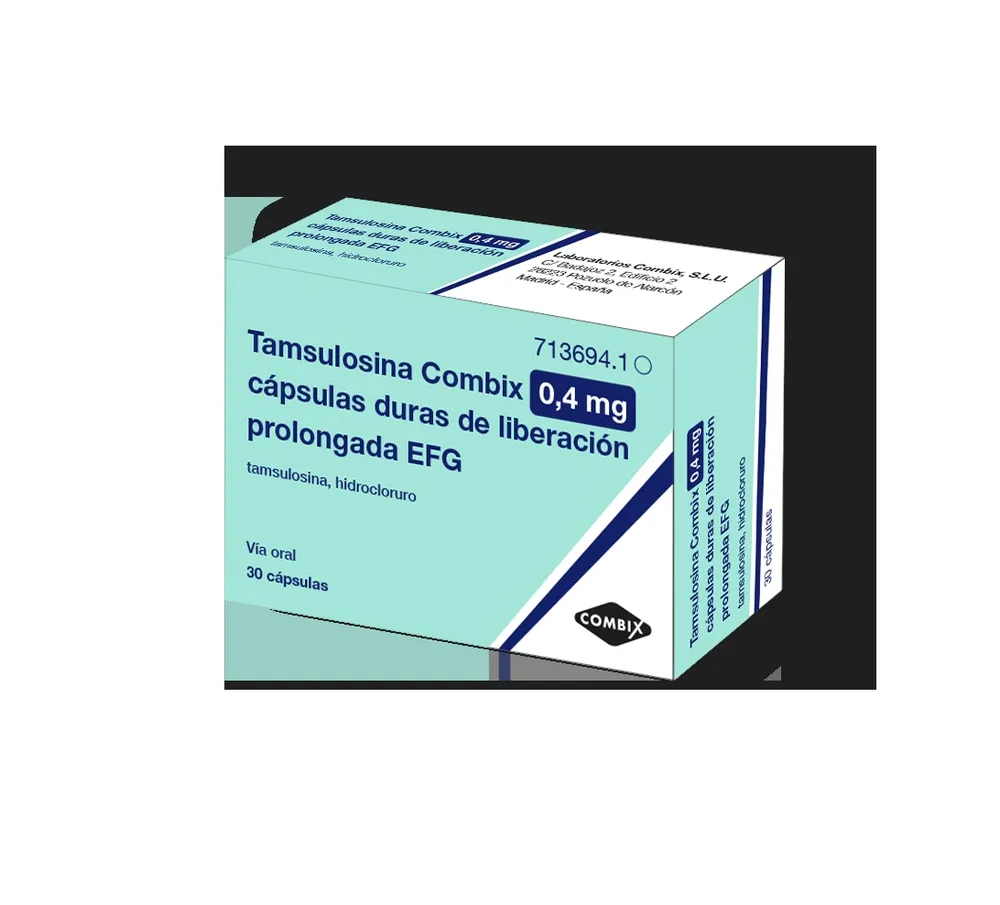
Table of Contents
- Package leaflet: Information for the user
- Introduction
- 1. What Tamsulosina Combix is and what it is used for
- 2. What you need to know before taking Tamsulosina Combix
- 3. How to take Tamsulosina Combix
- 4. Possible adverse effects
- 5. Storage of Tamsulosin Combix
- 6. Contents of the pack and other information
Package leaflet: Information for the user
Introduction
Package leaflet: information for the user
Tamsulosina Combix 0.4 mg prolonged-release hard capsules EFG
tamsulosin, hydrochloride
Read the entire leaflet carefully before you start taking this medicine, because it contains important information for you.
- Keep this leaflet, as you may need to read it again.
- If you have any questions, ask your doctor or pharmacist.
- This medicine has been prescribed for you only, and you must not give it to other people, even if they have the same symptoms as you, because it could harm them.
- If you experience any adverse reactions, consult your doctor or pharmacist, even if they are adverse reactions not listed in this leaflet. See section 4.
Contents of the leaflet
- What Tamsulosina Combix is and what it is used for
- What you need to know before taking Tamsulosina Combix
- How to take Tamsulosina Combix
- Possible side effects
- How to store Tamsulosina Combix
- Contents of the pack and other information
1. What Tamsulosina Combix is and what it is used for
The active substance in Tamsulosina Combix is tamsulosin hydrochloride. It works by relaxing the muscles in the prostate and the urethra (the tube that carries urine out of the body), allowing urine to pass more easily through the urethra and making urination easier.
In the prostate gland, bladder, and urethra, there are specialized cells containing alpha1A receptors that cause tightening of the urethral muscles. Tamsulosina Combix is an antagonist of alpha1A-adrenergic receptors, which reduces the activity of these specialized cells and relaxes the muscles, thereby facilitating the passage of urine.
Tamsulosina Combix is used in men for the treatment of lower urinary tract symptoms associated with an enlarged prostate gland (benign prostatic hyperplasia). These symptoms include difficulty starting urination, frequent need to urinate, a sensation of incomplete bladder emptying, and having to get up several times during the night to urinate.
2. What you need to know before taking Tamsulosina Combix
Do not take Tamsulosina Combix
- If you are allergic (hypersensitive) to tamsulosin or to any of the other ingredients of this medicine (listed in section 6).
- If you have severe liver problems
- If you have ever fainted or felt dizzy when sitting down or standing up suddenly. Dizziness may sometimes occur when taking tamsulosin, especially if you are also taking other alpha-1 blockers. If you feel weak or dizzy, make sure to sit or lie down immediately until symptoms have passed.
Warnings and precautions
Talk to your doctor or pharmacist before starting to take Tamsulosina Combix.
Be especially careful with Tamsulosina Combix (and inform your doctor)
- If you have kidney problems
- If you are scheduled for or undergoing eye surgery due to clouding of the lens (cataracts) or increased pressure in the eye (glaucoma).
Please inform your ophthalmologist that you have previously taken, are currently taking, or are planning to take tamsulosin. The specialist may take appropriate precautions regarding medication and surgical techniques to be used. Consult your doctor about whether you should delay or temporarily discontinue taking this medicine if you are undergoing eye surgery for cataracts or glaucoma.
Children and adolescents
Do not give this medicine to children or adolescents under 18 years of age, as it has no effect in this population.
Taking Tamsulosina Combix with other medicines
- Taking Tamsulosina Combix together with other medicines belonging to the same class (α1-adrenergic receptor antagonists) may cause an undesirable drop in blood pressure.
- It is especially important that you inform your doctor if you are being treated simultaneously with medicines that may reduce the elimination of Tamsulosina Combix from the body (e.g., ketoconazole, erythromycin).
Tell your doctor or pharmacist if you are using, have recently used, or might need to use any other medicines.
Taking Tamsulosina Combix with food, drinks, and alcohol
Tamsulosina Combix should be taken after breakfast or the first meal of the day.
Pregnancy, breast-feeding, and fertility
Tamsulosina Combix is not indicated for use in women.
In men, abnormal ejaculation (ejaculation disorder) has been observed. This means that semen does not exit the body through the urethra but enters the bladder instead (retrograde ejaculation), or the volume of ejaculate is reduced or absent (ejaculatory insufficiency). This phenomenon is harmless.
Driving and using machines
There is no evidence that Tamsulosina Combix affects the ability to drive or operate machinery or equipment. However, you should bear in mind that dizziness may occur; in such a case, you should not perform activities requiring attention.
This medicine contains less than 1 mmol of sodium (23 mg) per tablet; essentially "sodium-free".
3. How to take Tamsulosina Combix
Follow exactly the instructions for use of this medicine as given by your doctor. If you have any doubts, consult your doctor or pharmacist.
The recommended dose is 1 capsule per day, taken after breakfast or the first meal of the day. The capsule must be swallowed whole and should not be broken or chewed. Tamsulosina Combix is usually prescribed for long periods of time. The effects on the bladder and urination are maintained during long-term treatment with Tamsulosina Combix.
If you take more Tamsulosina Combix than you should
Taking too much tamsulosin may cause an unwanted decrease in blood pressure and an increased heart rate, accompanied by a feeling of faintness. Contact your doctor immediately if you have taken too much Tamsulosina Combix.
In case of overdose or accidental ingestion, contact your doctor or pharmacist immediately or call the Toxicology Information Service at telephone number 91 562 04 20, indicating the medicine and the amount ingested.
If you forget to take Tamsulosina Combix
If you forget to take Tamsulosina Combix as instructed, you may take your daily dose later on the same day. If you have missed a day's dose, simply continue taking your daily capsule as prescribed. Do not take a double dose to make up for forgotten doses.
If you stop taking Tamsulosina Combix
If treatment with Tamsulosina Combix is stopped prematurely, your original symptoms may return. Therefore, take Tamsulosina Combix for as long as your doctor prescribes, even if your symptoms have already disappeared. Always consult your doctor if you decide to discontinue treatment.
If you have any further questions about the use of this medicine, ask your doctor or pharmacist.
4. Possible adverse effects
Like all medicines, this medicine can cause adverse effects, although not everyone experiences them.
Frequent (may affect up to 1 in 10 people):
- Dizziness, especially when sitting down or standing up.
- Abnormal ejaculation (ejaculation disorder). This means that semen does not exit the body through the urethra, but instead enters the bladder (retrograde ejaculation), or that the volume of ejaculate is reduced or absent (ejaculatory insufficiency). This phenomenon is harmless.
Uncommon (may affect up to 1 in 100 people):
- Headache.
- Palpitations (heart beats faster than normal and is noticeable).
- Drop in blood pressure, e.g. when standing up quickly from a sitting or lying position, sometimes accompanied by dizziness.
- Runny nose or nasal congestion (rhinitis).
- Diarrhea.
- Feeling nauseous and vomiting.
- Constipation.
- Weakness (asthenia).
- Skin rashes, itching, and hives (urticaria).
Rare (may affect up to 1 in 1,000 people):
- Fainting and sudden swelling of the soft tissues of the body (e.g. throat or tongue), difficulty breathing and/or itching and skin rash, often as an allergic reaction (angioedema).
Very rare (may affect up to 1 in 10,000 people):
- Priapism (prolonged, painful, unwanted erection requiring immediate medical treatment).
- Skin rash, inflammation, blisters on the skin and/or mucous membranes of the lips, eyes, mouth, nostrils, or genitals (Stevens-Johnson syndrome).
Frequency not known (cannot be estimated from available data):
- Blurred vision or visual disturbances.
- Nosebleeds.
- Dry mouth.
- Severe skin rashes (erythema multiforme, exfoliative dermatitis).
- Abnormal irregular heart rhythm (atrial fibrillation, arrhythmia, tachycardia).
- Difficulty breathing (dyspnea).
- If you are undergoing eye surgery due to lens opacity (cataracts) or increased eye pressure (glaucoma) and you are taking or have recently taken Tamsulosina Combix, the pupil may show poor dilation and the iris (the colored circular part of the eye) may become floppy during the procedure.
Reporting of adverse effects
If you experience any type of adverse effect, consult your doctor, pharmacist, or nurse, even if it is a possible adverse effect not listed in this leaflet. You may also report them directly via the Spanish Pharmacovigilance System for Human Medicinal Products: https://www.notificaram.es. By reporting adverse effects, you can help provide more information on the safety of this medicine.
5. Storage of Tamsulosin Combix
Keep this medicine out of sight and reach of children.
This medicine does not require any special storage conditions.
Do not use this medicine after the expiry date stated on the blister and on the packaging after "EXP:". The expiry date refers to the last day of the month indicated.
Medicines should not be disposed of via wastewater or household waste. Dispose of unused medicines and their containers at the SIGRE collection point at your pharmacy. If you have any doubts, ask your pharmacist how to dispose of medicines and containers you no longer need. This will help protect the environment.
6. Contents of the pack and other information
Composition of Tamsulosin Combix
- The active substance is tamsulosin hydrochloride.
- The other components are polysorbate 80, methacrylic acid copolymer dispersion, triacetin, sodium lauryl sulfate, purified water, microcrystalline cellulose, and calcium stearate. These are used in the manufacture of the granules contained within the capsule.
- The capsule shell contains FD & C Blue 2 (E 132), black iron oxide (E 172), red iron oxide (E 172), yellow iron oxide (E 172), titanium dioxide (E 171), gelatin, purified water, and sodium lauryl sulfate; the printing ink consists of Shellac (E904), dehydrated alcohol, isopropyl alcohol, butyl alcohol, propylene glycol, strong ammonia solution, black iron oxide (E172), potassium hydroxide, and purified water.
Appearance of the product and pack contents
Tamsulosin Combix consists of opaque olive green/opaque orange, size “2”, hard gelatin capsules containing white to off-white granules, with the imprint “CL 23” on the cap and “0.4” on the body of the capsule printed in black ink.
The capsules are packed in transparent PVC/PE/PVdC / aluminium blisters.
The capsules are available in blister packs containing 14, 20, 28, 30, 50, 56, 90, 98 and 100 capsules.
Only certain pack sizes may be commercially available.
Marketing Authorization Holder and Manufacturer
Marketing Authorization Holder:
Laboratorios Combix, S.L.U.
C/ Badajoz 2, Edificio 2
28223 Pozuelo de Alarcón (Madrid)
Spain
Manufacturer:
Macleods Pharma UK Limited
Wynyard Park House,
Wynyard Avenue,
Wynyard, Billingham,
TS22 5TB, United Kingdom
Synoptis Industrial Sp. z o.o
ul. Rabowicka 15, Swarzedz,
62-020,
Poland
Heumann Pharma GmbH & Co. Generica KG
Südwestpark 50,
90449 Nürnberg,
Germany
Laboratori FUNDACIO DAU,
C/ De la letra C, 12-14,
Poligono Industrial de la Zona Franca,
08040 Barcelona,
Spain
Date of the latest revision of this leaflet: February 2021
Detailed and up-to-date information on this medicinal product is available on the website of the Spanish Agency of Medicines and Health Products (AEMPS): http://www.aemps.gob.es/