Takipril Hiperbarica 20 mg/ml injectable solution
Spain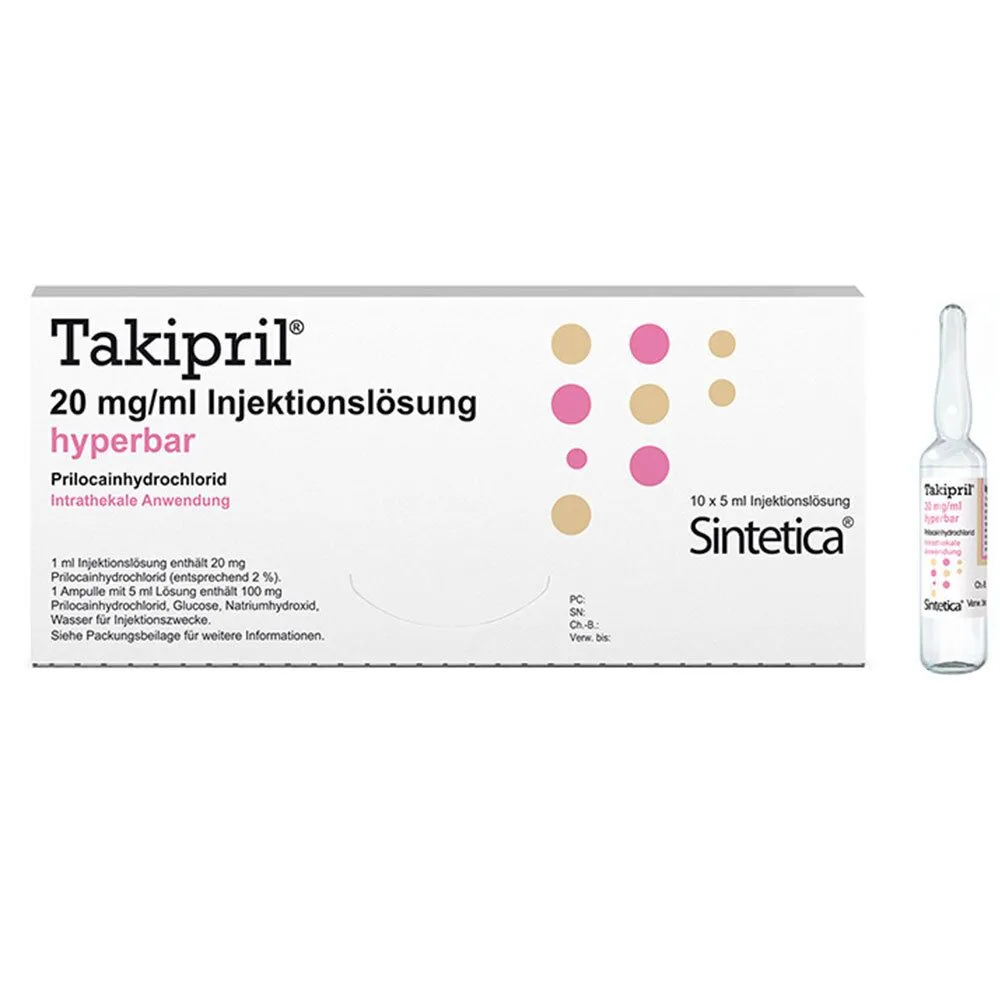
Table of Contents
- Package leaflet: Information for the user
- Introduction
- 1. What Takipril hiperbárica is and what it is used for
- 2. What you need to know before using Takipril hiperbárica
- 3. How to use Takipril hyperbaric
- 4. Possible adverse effects
- 5. Storage of Takipril hyperbaric
- 6. Contents of the pack and other information
Package leaflet: Information for the user
Introduction
Package leaflet: information for the user
Takipril hiperbárica 20 mg/ml injectable solution
Prilocaine hydrochloride
Read all of this leaflet carefully before you start using this medicine because it contains important information for you.
- Keep this leaflet. You may need to read it again.
- If you have any questions, ask your doctor or pharmacist.
- If you get any side effects, talk to your doctor or pharmacist. This includes any possible side effects not listed in this leaflet. See section 4.
Leaflet contents
- What Takipril is and what it is used for
- What you need to know before you use Takipril
- How to use Takipril
- Possible side effects
- How to store Takipril
- Contents of the pack and other information
1. What Takipril hiperbárica is and what it is used for
Takipril hiperbárica 20 mg/ml is a type of medicine called a local anaesthetic, belonging to the amide class. Takipril hiperbárica is an injectable solution used to numb (anaesthetise) specific parts of the body and prevent pain during surgery in adults.
Takipril hiperbárica is injected into the lower part of your spine. This rapidly blocks pain from the waist downwards for a limited period of time (short-duration surgeries).
2. What you need to know before using Takipril hiperbárica
Do not use Takipril hiperbárica
- if you are allergic (hypersensitive) to prilocaine hydrochloride, to other amide-type local anesthetics, or to any of the other ingredients of this medicine (listed in section 6)
- if you have serious cardiac conduction disorders
- if you suffer from severe anemia
- if you have decompensated heart failure
- if you have cardiogenic or hypovolemic shock
- if you suffer from congenital or acquired methemoglobinemia
- if you have specific or general contraindications to subarachnoid anesthesia technique
Takipril hiperbárica must not be administered intravascularly.
Takipril hiperbárica must not be used in children under 6 months of age.
Warnings and precautions
If any of the following situations apply to you, you must discuss them with your doctor before receiving this medicine.
- if you have ever experienced an adverse reaction to an anesthetic in the past
- if you have a skin infection at or near the proposed injection site
- if you suffer from any of the following disorders:
- central nervous system diseases such as meningitis, poliomyelitis, or spinal cord problems due to anemia
- severe headache
- brain, spinal, or other tumors
- spinal tuberculosis
- recent spinal trauma
- very low blood pressure or low blood volume
- blood coagulation disorders
- acute porphyria
- fluid in the lungs
- septicemia (blood poisoning)
- if you have heart disease (e.g. complete or partial heart block, cardiac decompensation, or arrhythmia)
- if you have liver or kidney problems
- if you suffer from neurological disorders such as multiple sclerosis, hemiplegia, paraplegia, or muscular disorders
- if you are in a generally poor state of health
Spinal anesthesia should only be administered by a physician with the necessary knowledge and experience. The physician is responsible for taking the necessary measures to prevent intravascular injection and for recognizing and managing adverse effects.
Children and adolescents
Takipril hiperbárica is not recommended for use in children and adolescents. The efficacy and safety of Takipril hiperbárica in the pediatric population have not been established. No data are available.
The use of Takipril in children under 6 months of age is contraindicated due to the higher risk of developing methemoglobinemia.
Other medicines and Takipril
Tell your doctor if you are taking, have recently taken, or might need to take any other medicines, including those obtained without a prescription. Especially if you are taking any medicines for irregular heartbeat (class III antiarrhythmics) or for pain relief.
Pregnancy and breastfeeding
If you are pregnant or breastfeeding, think you may be pregnant, or plan to become pregnant, your doctor will decide whether to administer Takipril hiperbárica injection. Prilocaine must not be used as local or regional anesthesia during labor.
It is not known whether prilocaine is excreted in breast milk. If administration is necessary during breastfeeding, breastfeeding may be resumed approximately 24 hours after treatment.
Driving and using machines
Do not drive or operate tools or machinery, as Takipril hiperbárica may temporarily interfere with your muscle coordination and reactions.
Takipril hiperbárica contains sodium
This medicine contains less than 1 mmol of sodium (23 mg) per dose (maximum dose equal to 4 ml of Takipril hiperbárica), and is therefore considered essentially “sodium-free”.
3. How to use Takipril hyperbaric
This medicine will be administered by your doctor, who will decide the correct dose for you. The usual dose in adults is 40 – 60 mg of prilocaine hydrochloride (2-3 ml of Takipril hyperbaric); the maximum dose is 80 mg of prilocaine hydrochloride (4 ml of Takipril hyperbaric).
Your doctor will administer Takipril hyperbaric into the lower part of your spine while you are sitting or lying down.
Use in children and adolescents
Takipril hyperbaric is not recommended for use in children and adolescents. The safety and efficacy of Takipril hyperbaric in the pediatric population have not been established. The use of Takipril hyperbaric in children under 6 months of age is contraindicated due to the higher risk of developing methemoglobinemia.
A reduced dose is indicated in patients with impaired general condition and with established concomitant diseases (e.g., vascular occlusion, arteriosclerosis, diabetic polyneuropathy).
In patients with impaired liver or kidney function, a lower dosage range is recommended.
Takipril hyperbaric is administered by intrathecal injection.
Immediately available equipment, medications, and qualified personnel must be on hand to manage an emergency. Serious reactions following the use of local anesthetics have been reported rarely, even in the absence of individual hypersensitivity in the patient's medical history.
If you are given more Takipril hyperbaric than you should
The doctor administering Takipril hyperbaric has experience in the use of local anesthetics via intrathecal route, so it is unlikely that you will receive an overdose. However, if the dose is accidentally injected into the bloodstream, you may experience short-term problems with vision or hearing, muscle twitching, tremors, seizures, and loss of consciousness. When Takipril hyperbaric is administered, and in the event of an overdose, a medical team will be available to assist you.
If you have any further questions about the use of this medicine, ask your doctor or pharmacist.
4. Possible adverse effects
Like all medicines, Takipril hyperbaric may cause adverse effects, although not everyone experiences them.
As with all local anaesthetics, a drop in blood pressure and a slowing of heart rate may occur.
You may feel nauseous and experience low blood pressure or a slow heart rate. Other possible effects include headache after surgery, vomiting, and difficulty urinating.
These are the possible adverse effects:
Very common: may affect more than 1 in 10 people
Decreased blood pressure, nausea
Common: may affect up to 1 in 10 people
Paresthesia, dizziness, vomiting
Uncommon: may affect up to 1 in 100 people
Seizures, circumoral paresthesia, loss of consciousness, tremor, numbness affecting the tongue, speech disorders, ear disorders, tinnitus, visual disturbances, back pain, temporary muscle weakness, slow heartbeat. High blood pressure.
Rare: may affect up to 1 in 1,000 people
Methemoglobinemia, cyanosis. Anaphylactic shock, anaphylactic reaction, itching. Arachnoiditis, neuropathy, peripheral nerve injury.
Diplopia. Cardiac arrest, irregular heartbeat. Respiratory depression.
It is unlikely that Takipril hyperbaric injectable solution will cause serious adverse effects unless accidentally administered incorrectly or used concomitantly with other local anaesthetics. If this occurs, numbness of the tongue, feeling faint, dizziness, tremor, and convulsive seizures may arise. In extremely rare cases, prilocaine has been associated with heart attack, breathing difficulties, loss of sensation in the lower part of the body, and allergic reactions, which may cause skin rashes, swelling, or very low blood pressure readings.
A rare but serious adverse reaction associated with intrathecal anaesthesia is high or complete spinal block, resulting in cardiovascular and respiratory depression.
If you experience any adverse effects, consult your doctor, pharmacist, or nurse, even if they are adverse effects not listed in this leaflet.
Reporting of adverse effects
If you experience any adverse event, talk to your doctor, pharmacist, or nurse, even if they are adverse effects not listed in this leaflet. You can also report them directly via the Spanish Pharmacovigilance System for Human Medicines: www.notificaRAM.es. By reporting adverse effects, you can help provide more information on the safety of this medicine.
5. Storage of Takipril hyperbaric
Keep this medicine out of the reach and sight of children.
Do not use Takipril hyperbaric after the expiry date stated on the blister pack and the outer carton. The expiry date refers to the last day of the month indicated.
Do not store Takipril hyperbaric at temperatures above 25°C. Do not refrigerate or freeze. Store in the original packaging to protect from light.
The medicine should be used immediately after first opening.
Do not use Takipril hyperbaric if you notice that the solution is not clear or contains particles.
Any unused product must be discarded. Since its use is restricted to hospitals, disposal of medicinal waste is carried out directly by the hospital. This will help protect the environment.
6. Contents of the pack and other information
Composition of Takipril hyperbaric
- The active substance is Prilocaine hydrochloride.
1 ml of injectable solution contains 20 mg of Prilocaine hydrochloride (equivalent to 2%).
1 vial containing 5 ml of solution contains 100 mg of prilocaine hydrochloride.
- The other components are: anhydrous glucose or monohydrate glucose, sodium hydroxide 1N (for pH adjustment) and water for injectable preparations.
Appearance of the product and contents of the pack
Injectable solution. Clear, colourless solution.
Takipril hyperbaric is presented in clear, colourless glass type I vials.
Box of 10 vials, each containing 5 ml of injectable solution.
Marketing Authorisation Holder and Manufacturer
Marketing Authorisation Holder
- Braun Medical, S.A.
Carretera de Terrassa, 121
08191 Rubí (Barcelona)
Spain
Telephone: +34 93 582 95 80
Fax: +34 93 588 10 96
e-mail: [email protected]
Manufacturer
Sirton Pharmaceuticals S.P.A.
Piazza XX Settembre 2
22079 Villa Guardia
Italy
Sintetica GmbH
Albersloher Weg 11
48155 - Münster
Germany
This medicinal product is authorised in the EEA Member States under the following names:
Member State | Product Name |
Austria | Takipril hyperbar 2% Injektionslösung |
Germany | Takipril 20 mg/ml Injektionslösung |
Italy | Prilotekal |
Spain | Takipril hiperbárica 20mg/ml solución inyectable |
United Kingdom | Prilotekal 20mg/ml solution for injection |
Belgium | Tachipri Hyperbar 20 mg/ml Oplossing voor injectie Tachipri Hyperbar 20 mg/ml Solution injectable Tachipri Hyperbar 20mg/ml Injektionslösung |
Bulgaria | Takipril 20mg/ml ??????????? ??????? |
Czech Republic | Takiprin |
Denmark | Takipril 20mg/ml Injektionsvæske, opløsning |
Finland | Takipril 20mg/ml Injektioneste, liuos |
France | Baritekal 20mg/ml Solution injectable |
Hungary | Prilotekal 20mg/ml oldatos injekció |
Luxembourg | Baritekal 20 mg/ml Solution injectable |
Netherlands | Prilotekal 20mg/ml Oplossing voor injectie |
Norway | Takipril20 mg/ml injeksjonsvæske, oppløsning |
Poland | Prilotekal |
Romania | Prilotekal 20mg/ml Solutie injectabila |
Slovakia | Prilotekal 20mg/ml Injekcný roztok |
Sweden | Takipril 20mg/ml Injektionsvätska, lösning |
Date of the most recent review of this leaflet: February 2020
Detailed and up-to-date information about this medicine is available on the website of the Spanish Agency for Medicines and Health Products (AEMPS) http://www.aemps.gob.es/
This information is intended solely for doctors or healthcare professionals:
The Summary of Product Characteristics (SmPC) is attached at the end of the printed leaflet as a separable section.