Syntocinon 10 IU/mL solution for injection and infusion
Spain
Table of Contents
Package Leaflet: Information for the User
Introduction
Package Leaflet: Information for the Patient
Syntocinon 10 IU/ml injection and infusion solution
oxytocin
Read the entire leaflet carefully before you start using this medicine, because it contains important information for you.
- Keep this leaflet, as you may need to read it again.
- If you have any questions, consult your doctor or nurse.
- If you experience any adverse effects, consult your doctor or pharmacist, even if they are adverse effects not listed in this leaflet. See section 4.
Leaflet Contents:
- What Syntocinon is and what it is used for
- What you need to know before using Syntocinon
- How to use Syntocinon
- Possible adverse effects
- How to store Syntocinon
- Contents of the pack and other information
1. What Syntocinon is and what it is used for
Syntocinon is available as an injectable solution for infusion.
Syntocinon belongs to a group of medicines called oxytocics (medicines that promote labour by stimulating contractions of the uterus). The action produced is identical to that of oxytocin, a natural hormone released by the pituitary glands.
Syntocinon is indicated in the following cases:
- Induction of term labour.
- Stimulation of uterine contractility in cases of uterine inertia.
- Prevention and treatment of postpartum haemorrhage.
2. What you need to know before using Syntocinon
Do not use Syntocinon:
-
if you are allergic to oxytocin or any of the other ingredients of this medicine (listed in section 6).
-
if the fetus presents cephalopelvic disproportion or abnormal presentation.
-
if there is a predisposition to amniotic fluid embolism (e.g., intrauterine fetal death, premature placental abruption).
-
if you have a history of cesarean section or any surgical procedure involving the uterus, placenta previa, vasa previa, or hypertonic contractions.
-
if fetal distress is present and delivery is not imminent.
-
if you are concurrently receiving prostaglandins or other uterine contraction stimulants; in any case, at least six hours must have passed since the administration of those agents.
-
In cases of multiple pregnancy.
Warnings and precautions
Consult your doctor or nurse before starting to use Syntocinon.
The use of oxytocin for labor induction must be strictly for medical reasons, not for convenience.
Syntocinon should not be used for prolonged periods in patients with oxytocin-resistant uterine inertia, severe pre-eclamptic toxemia, or severe cardiovascular disorders.
Special caution is required in the presence of borderline cephalopelvic disproportion, secondary uterine inertia, mild to moderate pregnancy-induced hypertension, or heart disease, and in patients over 35 years of age or with a history of lower uterine segment cesarean section.
Cardiovascular disorders
To avoid significant changes in blood pressure and heart rate, Syntocinon should be used with caution in patients with pre-existing cardiovascular diseases (such as hypertrophic cardiomyopathy, valvular heart disease and/or ischemic heart disease, including coronary artery vasospasm). Inform your doctor if you have any of these conditions.
QT syndrome
Syntocinon should be administered with caution to patients with long QT syndrome or related symptoms, and to patients receiving medications known to prolong the QT interval (see “Use of Syntocinon with other medicines”).
Fetal distress and fetal death
Excessive doses of oxytocin may cause uterine overstimulation, which can lead to fetal distress, asphyxia, and death, or may result in hypertonicity, tetanic contractions, or uterine rupture. Your doctor will monitor fetal heart rate and uterine activity.
Disseminated intravascular coagulation (DIC):
Rarely, pharmacological induction of labor with uterotonic agents, including oxytocin, may increase the risk of postpartum DIC. This risk is particularly increased in women with additional risk factors for DIC, such as being 35 years or older, pregnancy complications, or gestational age beyond 40 weeks.
Water intoxication
Because oxytocin has mild antidiuretic activity, prolonged intravenous administration at high doses together with large volumes of fluids—such as in the management of inevitable or delayed abortion, or in the treatment of postpartum hemorrhage—may cause water intoxication associated with hyponatremia. Particular caution should be exercised in patients with severe renal impairment due to the potential for water retention and oxytocin accumulation.
Renal impairment
Particular caution should be exercised in patients with severe renal impairment due to the potential for water retention and oxytocin accumulation.
Latex allergy
The active substance in Syntocinon may cause a severe allergic reaction (anaphylactic reaction) in patients allergic to latex. Inform your doctor if you are allergic to latex.
Children and adolescents
The safety and efficacy of Syntocinon in children and adolescents (under 18 years of age) have not been established. No data are available.
Use of Syntocinon with other medicines:
Inform your doctor if you are taking, have recently taken, or might need to take any other medicines. Certain medicines may interact with Syntocinon; in such cases, your doctor may adjust the dose or discontinue treatment with one of the medicines. In particular:
- Inhalational anesthetics with strong utero-relaxant effects (e.g., halothane, chloroform, etc.), as they may reduce the effect of Syntocinon.
- Vasopressor agents (medications that cause vasoconstriction), as Syntocinon may enhance their effect and cause severe arterial hypertension in the postpartum period.
- Prostaglandins or other uterine contraction stimulants, as Syntocinon may enhance their effect (see section 2).
- Medications that prolong the QT interval (causing irregular heartbeats), as Syntocinon may enhance this effect.
- Caudal anesthesia: when administered during or after caudal block, Syntocinon may enhance the pressor effect of sympathomimetic vasoconstrictor agents.
Pregnancy, breastfeeding, and fertility
Limited pregnancy data suggest that oxytocin does not cause adverse reactions during pregnancy when administered according to therapeutic indications.
Oxytocin may be excreted in small amounts in breast milk. However, it is unlikely to cause harmful effects in the newborn, as oxytocin is rapidly inactivated in the infant’s gastrointestinal tract.
Driving and use of machines
No data are available regarding the effects on the ability to drive or operate machinery.
Syntocinon contains ethanol (alcohol) and sodium
This medicine contains 0.6% ethanol (alcohol), corresponding to 4.8 mg per ml, which is equivalent to less than one ml of beer or wine. The small amount of alcohol in this medicine has no perceptible effect.
This medicine contains less than 23 mg of sodium (1 mmol) per ml; this is essentially “sodium-free”.
3. How to use Syntocinon
Oxytocin will always be administered in a hospital setting and under medical supervision.
Labour induction or stimulation of uterine contractility
For labour induction, administration is always performed intravenously.
The healthcare professional will control the infusion rate, using an infusion pump or similar device (see section “Instructions for correct use of Syntocinon” at the end of this leaflet).
The initial infusion rate is usually set between 1-4 milliunits/minute (2-8 drops/minute). This may be gradually increased at intervals of not less than 20 minutes until a contraction pattern resembling normal labour is established, with a maximum recommended rate of 20 milliunits/minute (40 drops/minute).
In women with term pregnancy in whom regular contractions have not started after administering a dose of oxytocin of 5 IU (equivalent to 500 ml of the prepared solution as described in the section “Instructions for correct use of Syntocinon”), it is recommended to discontinue the induction and repeat the procedure the following day, starting again with a dose of 1-4 milliunits/minute.
The dose must always be adjusted according to individual response. For this reason, careful monitoring (fetal heart rate, blood pressure, etc.) will be performed. In case of uterine hyperactivity or fetal distress, the infusion will be stopped immediately.
Prevention of postpartum haemorrhage
The usual dose is 5 IU administered by intravenous infusion (5 IU diluted in physiological saline solution) or 5 to 10 IU by intramuscular injection after delivery of the placenta.
Treatment of postpartum haemorrhage
The usual dose is 5 IU by intravenous infusion (5 IU diluted in physiological saline solution) or 5 to 10 IU by intramuscular injection in severe cases, followed by another intravenous infusion of a solution containing 5-20 IU of oxytocin.
If you use more Syntocinon than you should
In case of overdose or accidental ingestion, consult your doctor or pharmacist, or call the Toxicology Information Service at telephone number 915 620 420, indicating the medication and the amount used.
If signs or symptoms of overdose occur during continuous intravenous administration of Syntocinon, your doctor will immediately stop the infusion and administer oxygen to the mother.
In cases of water intoxication, it is essential to restrict fluid intake, promote diuresis, correct electrolyte imbalances, and manage any seizures that may occur.
4. Possible adverse effects
Like all medicines, this medicine can cause adverse effects, although not everyone will experience them.
The following adverse effects have been reported. Adverse effects are classified under frequency headings, with the most frequent listed first, using the following convention: Very common (≥ 1/10); common (≥ 1/100, < 1/10); uncommon (≥ 1/1,000, < 1/100); rare (≥ 1/10,000, < 1/1,000); very rare (< 1/10,000); and frequency not known (cannot be estimated from the available data).
Adverse effects derived from post-marketing experience with Syntocinon have been obtained from spontaneous case reports and cases described in the literature. Since these adverse effects are reported voluntarily from a population of unknown size, it is not possible to reliably estimate their frequency; therefore, they are classified as not known.
Table 1: Adverse effects in the mother
Organ system classification | Adverse effect |
Blood and lymphatic system disorders Frequency not known: | Disseminated intravascular coagulation |
Immune system disorders Rare: | Anaphylactic/anaphylactoid reactions associated with dyspnea and hypotension; Anaphylactic/anaphylactoid shock |
Metabolism and nutrition disorders Frequency not known: | Water intoxication, hyponatremia |
Nervous system disorders Frequent: | Headache |
Cardiac disorders Frequent: Uncommon: Frequency not known: | Tachycardia, bradycardia Arrhythmia Myocardial ischemia, QT interval prolongation on electrocardiogram |
Vascular disorders Frequency not known: | Hypotension |
Respiratory, thoracic and mediastinal disorders Frequency not known: | Acute pulmonary edema |
Gastrointestinal disorders Frequent: | Nausea, vomiting |
Skin and subcutaneous tissue disorders Rare: Frequency not known: | Rash Angioedema |
Pregnancy, puerperium and perinatal conditions Frequency not known: | Uterine hypertonia, tetanic uterine contractions, uterine rupture |
General disorders and administration site conditions Frequency not known: | Flushing |
Table 2: Adverse effects in the fetus/newborn
Organ system classification | Adverse effect |
Metabolism and nutrition disorders Frequency not known: | Neonatal hyponatremia |
Pregnancy, puerperium and perinatal conditions Frequency not known: | Fetal distress syndrome, asphyxia and death |
Reporting of adverse reactions
If you experience any type of adverse reaction, consult your doctor, pharmacist, or nurse, even if it is a possible adverse reaction not listed in this leaflet. You may also report them directly through the Spanish Pharmacovigilance System for Human Medicinal Products: www.notificaRAM.es. By reporting adverse reactions, you can help provide more information on the safety of this medicine.
5. Storage of Syntocinon
-
Keep this medicine out of the sight and reach of children.
-
Store in the original container in the refrigerator (between 2 and 8 °C). Do not freeze.
-
Store in the original container to protect from light.
-
Do not use this medicine after the expiry date stated on the container. The expiry date is the last day of the month indicated.
Medicines must not be disposed of via wastewater or household waste. Return unused medicines and their containers to the SIGRE collection point at your pharmacy. If you are unsure, ask your pharmacist how to dispose of unused medicines and their containers. This helps protect the environment.
6. Contents of the pack and other information
Composition of Syntocinon
- The active substance is oxytocin. Each ml of solution contains 10 IU of oxytocin.
- The other components (excipients) are ethanol, sodium acetate trihydrate, chlorobutanol, sodium chloride, glacial acetic acid, water for injections.
Appearance of the product and contents of the container
Clear, sterile, colorless solution in transparent glass ampoules containing 1 ml.
Packaging containing 10 ampoules.
Marketing Authorization Holder
Alfasigma S.p.A.
Via Ragazzi del '99, n.5
40133 Bologna, ITALY
Manufacturer:
Alfasigma S.p.A.
Via Pontina Km 30.400
00071 Pomezia (Rome), ITALY
Local representative:
Alfasigma España, S.L
C/ Aribau 195, 4º
08021 Barcelona, Spain
Date of the most recent revision of this leaflet: February 2021
This information is intended for healthcare professionals only.
Instructions for the correct use of Syntocinon
Prepare the oxytocin solution by aseptically dissolving one 10 IU ampoule in 1,000 ml of physiological saline or 5% glucose solution. Ensure, by gentle agitation or rotation of the flask, that the mixture is homogeneous (the solution contains 10 milliIU/ml of oxytocin).
Instructions for correct opening of the ampoule
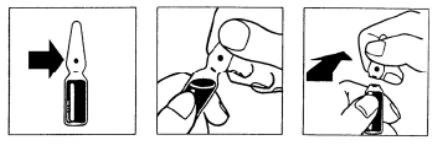
Breakable ampoule. The break line is located below the colored dot. Place the
thumb above the colored dot and break the ampoule by bending backwards.
“Detailed and up-to-date information on this medicinal product is available on the website of the Spanish Agency for Medicines and Health Products (AEMPS) http://www.aemps.es/”