Supofen 10 mg/ml solution for infusion EFG
Spain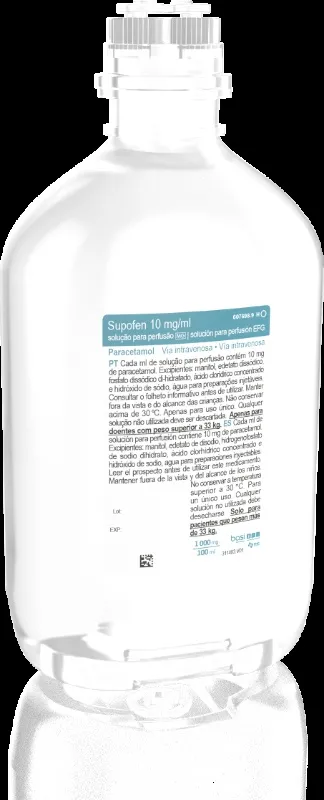
Table of Contents
Package leaflet: Information for the user
Introduction
Package leaflet: Information for the user
Supofen 10 mg/ml solution for infusion EFG
paracetamol
Read the entire leaflet carefully before you start using this medicine, as it contains important information for you.
-
Keep this leaflet, as you may need to read it again.
-
If you have any questions, ask your doctor or pharmacist.
-
This medicine has been prescribed for you only, and you should not give it to others, even if they have the same symptoms as you, because it may harm them.
-
If you experience any adverse effects, consult your doctor or pharmacist, even if they are effects not listed in this leaflet. See section 4.
Contents of the leaflet
- What Supofen is and what it is used for
- What you need to know before using Supofen
- How to use Supofen
- Possible adverse effects
- How to store Supofen
- Contents of the pack and other information
1. What Supofen is and what it is used for
This medicine contains the active substance paracetamol and is an analgesic (relieves pain) and antipyretic (reduces fever).
It is indicated for the short-term treatment of moderate pain, particularly after surgery, and for the short-term treatment of fever.
Supofen is restricted to adults, adolescents, and children weighing more than 33 kg.
2. What you need to know before using Supofen
Do not use Supofen
- If you are allergic to paracetamol or to any of the other ingredients of this medicine (listed in section 6)
- If you are allergic to propacetamol (another analgesic which is converted to paracetamol in your body)
- If you have severe liver disease.
Warnings and precautions
Talk to your doctor or pharmacist before using Supofen if any of the following apply to you:
- if you could take analgesics by mouth (orally), as this is the recommended route of administration;
- if you have reduced liver or kidney function, or if you consume excessive amounts of alcohol;
- if you are taking other medicines containing paracetamol;
- in cases of malnutrition or dehydration;
- in case of glucose-6-phosphate dehydrogenase deficiency (which may cause haemolytic anaemia), a blood disorder.
During treatment with Supofen, inform your doctor immediately if:
You have serious illnesses such as severe renal failure or sepsis (when bacteria and their toxins circulate in the blood, causing organ damage), or if you suffer from malnutrition, chronic alcoholism, or are also taking flucloxacillin (an antibiotic). A serious condition called metabolic acidosis (an abnormality in blood and body fluids) has been reported in patients in these situations when paracetamol is used at regular doses over a prolonged period or when paracetamol is taken together with flucloxacillin. Symptoms of metabolic acidosis may include: severe difficulty breathing with deep and rapid breathing, drowsiness, feeling unwell (nausea), and vomiting.
As soon as oral administration becomes possible, appropriate analgesic treatment by this route is recommended.
Other medicines and Supofen
Tell your doctor or pharmacist if you are taking, have recently taken, or might need to take any other medicines.
Supofen may be affected by, or may affect, other medicines:
- other medicines containing paracetamol or propacetamol, so that you do not exceed the recommended daily dose (see section 3 “How to use Supofen”).
- probenecid: a lower dose of paracetamol may be required;
- salicylamide, an anti-inflammatory drug;
- oral anticoagulants: monitoring of the anticoagulant effect may be necessary;
- medicines that induce liver enzymes: in such cases, the paracetamol dose must be closely monitored to avoid liver damage;
- flucloxacillin (an antibiotic), due to a serious risk of blood and fluid abnormalities (called metabolic acidosis) which requires urgent treatment (see section 2).
Use of Supofen with alcohol
Limit alcohol consumption during treatment with this medicine.
Pregnancy and breastfeeding
If you are pregnant or breastfeeding, think you may be pregnant, or are planning to become pregnant, consult your doctor or pharmacist before using this medicine.
Pregnancy
Supofen may be used during pregnancy. However, in such cases, your doctor must evaluate whether treatment is advisable.
Breastfeeding
Supofen may be used during breastfeeding.
Driving and using machines
The influence of Supofen on the ability to drive and use machines is none or negligible.
Supofen contains sodium
This medicine contains less than 1 mmol of sodium (23 mg) per 100 ml vial; essentially “sodium-free”.
3. How to use Supofen
This medicine will be administered by a healthcare professional through intravenous infusion into one of your veins, over approximately 15 minutes.
Your doctor will adjust the dose individually according to your body weight and general condition.
Supofen is restricted to adults, adolescents, and children weighing more than 33 kg.
If you feel that the effect of the medicine is too strong or too weak, inform your doctor.
If you receive more Supofen than you should
An overdose is unlikely since the medicine will be administered by a healthcare professional. Your doctor will ensure that you do not receive a dose higher than recommended.
However, in cases of overdose, symptoms generally appear within the first 24 hours and may include: nausea, vomiting, anorexia, pallor, abdominal pain, and risk of liver damage. If you receive more Supofen than intended, inform your doctor immediately.
In case of overdose or accidental ingestion, contact your doctor or pharmacist immediately or call the Toxicology Information Service at telephone number 91 562 04 20, indicating the medicine and the amount ingested.
If you have any further questions about the use of this medicine, ask your doctor or pharmacist.
4. Possible adverse effects
Like all medicines, this medicine may cause adverse effects, although not everyone experiences them.
Frequent (may affect up to 1 in 10 people)
The following may occur:
- pain and burning sensation at the injection site.
Rare (may affect up to 1 in 1,000 people)
The following may occur:
- malaise
- decreased blood pressure
- changes in laboratory test results: abnormally high levels of liver enzymes in blood tests. If this occurs, consult your doctor, as regular monitoring of blood parameters may be necessary.
Very rare (may affect up to 1 in 10,000 people)
The following may occur:
- Severe skin rash or allergic reaction (such as anaphylactic shock, urticaria, erythema). Discontinue treatment immediately and inform your doctor.
- Other changes in laboratory test results have been observed that required regular blood monitoring: abnormally low levels of certain types of blood cells (platelets, white blood cells), possibly resulting in nosebleeds or bleeding gums. If this occurs, inform your doctor.
- Very rare cases of blood and fluid disturbances (metabolic acidosis with elevated anion gap) occurring when paracetamol is used concomitantly with flucloxacillin, usually in the presence of risk factors (see section 2).
Frequency not known (cannot be estimated from available data)
- Cases of skin redness, flushing, itching, and abnormally rapid heartbeats have been reported.
- A serious condition that may cause the blood to become more acidic (called metabolic acidosis) has been reported in seriously ill patients receiving paracetamol (see section 2).
Reporting of adverse effects
If you experience any type of adverse effect, consult your doctor, even if it is a possible adverse effect not listed in this leaflet. You may also report them directly via the Spanish Pharmacovigilance System for Human Medicines: https://www.notificaram.es. By reporting adverse effects, you can help provide more information on the safety of this medicine.
5. Storage of Supofen
Keep this medicine out of the sight and reach of children.
Do not use this medicine after the expiry date stated on the vial after EXP. The expiry date refers to the last day of the month indicated.
Do not store above 30 °C.
Store in the original packaging to protect from light.
For single use only. After opening, the medicine should be used immediately. Any unused solution must be discarded.
Before administration, the solution should be inspected visually. Do not use the medicine if you observe any particles or changes in colour.
Medicines should not be disposed of via wastewater or household waste. Ask your pharmacist how to dispose of unused medicines and their containers. This will help protect the environment.
6. Contents of the container and other information
Composition of Supofen
- The active substance is paracetamol. 1 ml contains 10 mg of paracetamol.
Each vial (100 ml) contains 1,000 mg of paracetamol.
- The other components are disodium edetate, disodium hydrogen phosphate dihydrate, concentrated hydrochloric acid, mannitol, sodium hydroxide and water for injections.
Appearance of Supofen and contents of the container
Vials containing 100 ml of solution for infusion.
Clear solution, free from visible particles, packaged in a polypropylene vial with polypropylene twin head or pull-off caps and a closure made of polyisoprene rubber.
Available in pack sizes containing 1 or 50 vials (clinical pack).
Only certain pack sizes may be marketed.
Marketing Authorization Holder
Laboratórios Basi - Indústria Farmacêutica, S.A.
Parque Industrial Manuel Lourenço Ferreira, Lote 15
3450-232 Mortágua
Portugal
Tel: + 351 231 920 250 | Fax: + 351 231 921 055
E-mail: [email protected]
Manufacturer
Laboratórios Basi - Indústria Farmacêutica, S.A.
Parque Industrial Manuel Lourenço Ferreira, Lotes 8, 15, 16
3450-232 Mortágua
Portugal
Local representative
Laphysan, S.A.U
Calle Anabel Segura 11,
Complejo Empresarial Albatros, Edificio A, Planta 4, puerta D
28108 Alcobendas (Madrid)
This medicinal product is authorized in the Member States of the European Economic Area under the following names:
Portugal Supofen
Spain Supofen 10 mg/ml solution for infusion EFG
Latvia Paracetamol Basi 10 mg/ml škidums infuzijam
Lithuania Paracetamol Basi 10 mg/ml infuzinis tirpalas
Estonia Paracetamol Basi
France Paracetamol Basi 10 mg/mL, solution pour perfusion
Date of the most recent review of this leaflet: November 2025
Detailed and up-to-date information on this medicinal product is available on the website of the Spanish Agency of Medicines and Health Products (AEMPS) (http://www.aemps.gob.es/)
This information is intended for healthcare professionals only:
Intravenous route.
Supofen is restricted to adults, adolescents and children weighing more than 33 kg.
Close monitoring is required before completion of the infusion.
Dosage
Information prior to dose preparation:
- The minimum interval between each administration must be at least 4 hours.
- The minimum interval between each administration in patients with severe renal impairment must be at least 6 hours.
- No more than 4 doses should be administered in 24 hours.
Risk of medication errors
Take care to avoid administration errors due to possible confusion between milligrams (mg) and millilitres (ml), which could lead to accidental overdose and death.
Dose based on patient weight (please refer to the dosing table included below):
Patient weight | Dose per administration | Volume per administration | Maximum volume of Supofen (10 mg/ml) per administration, based on the upper weight limits of the group (ml)* | Maximum daily dose** |
> 33 kg up to ≤ 50 kg | 15 mg/kg | 1.5 ml/kg | 75 ml | 60 mg/kg not exceeding 3 g |
> 50 kg with additional risk factors for hepatotoxicity | 1 g | 100 ml | 100 ml | 3 g |
> 50 kg and without additional risk factors for hepatotoxicity | 1 g | 100 ml | 100 ml | 4 g |
- Patients with lower body weight will require smaller volumes.
**Maximum daily dose: The maximum daily dose indicated in the table above refers to patients who are not receiving other medications containing paracetamol and should be adjusted accordingly, taking into account these other medications.
Method of administration
Paracetamol solution must be administered as a 15-minute intravenous infusion.
The medicine should be used immediately after opening the vial.
Before administration, the solution should be visually inspected for particulate matter and discoloration. For single use only.
Any unused medicine and all materials that have come into contact with it must be disposed of in accordance with local regulations.