Sunosi 75 mg film-coated tablets
Spain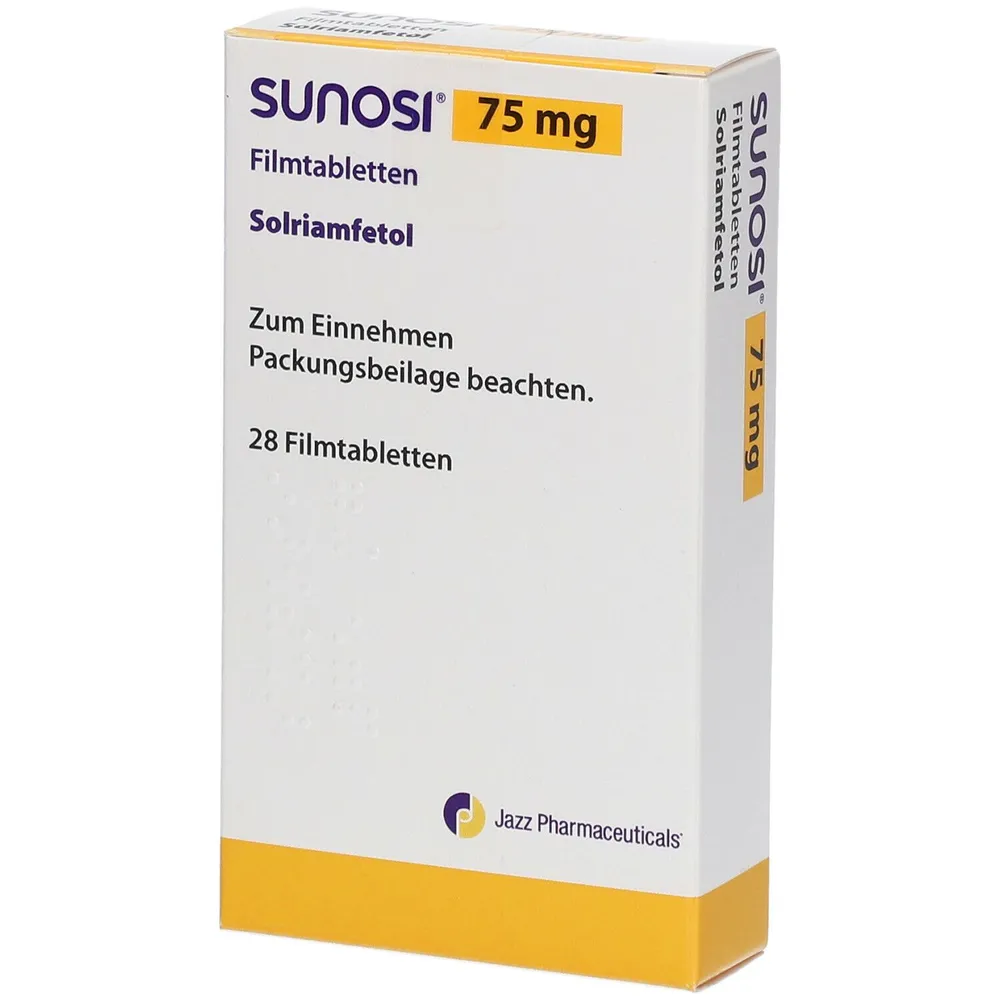
Table of Contents
Patient Information Leaflet
Introduction
Package Leaflet: Information for the Patient
Sunosi 75 mg film-coated tablets
Sunosi 150 mg film-coated tablets
Solriamfetol
This medicinal product is subject to additional monitoring, which will allow for faster identification of new safety information. You can help by reporting any side effects you may experience. Information on how to report side effects is provided at the end of section 4.
Read this entire leaflet carefully before you start taking this medicine, as it contains important information for you.
- Keep this leaflet, as you may need to read it again.
- If you have any questions, ask your doctor or pharmacist.
- This medicine has been prescribed for you only and must not be given to other people, even if they have the same symptoms as you, as it may harm them.
- If you experience any side effects, consult your doctor or pharmacist, even if they are side effects not listed in this leaflet. See section 4.
Contents of the leaflet
- What Sunosi is and what it is used for
- What you need to know before taking Sunosi
- How to take Sunosi
- Possible side effects
- How to store Sunosi
- Contents of the pack and other information
1. What Sunosi is and what it is used for
Sunosi contains the active substance solriamfetol. Solriamfetol increases the levels of the natural substances dopamine and norepinephrine (noradrenaline) in the brain. Sunosi helps you stay awake and feel less sleepy.
It is used in
-
adults with narcolepsy, a condition that causes sudden and unexpected episodes of strong sleepiness at any time. Some patients with narcolepsy also have cataplexy symptoms (when muscles become weak in response to emotions such as anger, fear, laughter, or surprise, sometimes causing collapse);
-
adults with obstructive sleep apnoea (OSA), a condition caused by repeated interruptions in breathing during sleep, which may cause excessive sleepiness during the day. Sunosi is used in patients who are using or have tried using an OSA treatment such as continuous positive airway pressure (CPAP).
2. What you need to know before taking Sunosi
Do not take Sunosi
- if you are allergic to solriamfetol or to any of the other ingredients of this medicine (listed in section 6);
- if you have had a heart attack within the last year;
- if you have serious heart problems such as newly occurring chest pain, or chest pain that lasts longer or is more severe than usual, uncontrolled high blood pressure, serious irregular heartbeat, or other serious heart conditions;
- if you are taking a type of medicine called a “monoamine oxidase inhibitor” (MAOI) for depression or Parkinson’s disease, or have taken an MAOI within the last 14 days.
Warnings and precautions
Talk to your doctor or pharmacist before starting Sunosi if you have or have had:
- mental health problems, including psychosis (altered sense of reality) and extreme changes in mood (bipolar disorder);
- heart problems, heart attack, or stroke;
- high blood pressure;
- alcoholism or any substance abuse or dependence;
- an eye condition called closed-angle glaucoma.
Before starting treatment, inform your doctor or pharmacist if any of the above apply to you. This is because Sunosi may worsen some of these conditions. Your doctor will want to monitor how the medicine affects you.
Sunosi does not replace your main treatment for OSA such as CPAP. You must continue using your primary treatment in addition to Sunosi.
Children and adolescents
Sunosi is not recommended for use in children or adolescents under 18 years of age. Safety and efficacy have not yet been established in this age group.
Other medicines and Sunosi
Tell your doctor or pharmacist if you are taking, have recently taken, or might need to take any other medicines.
Do not take Sunosi if:
- you are taking a medicine called a “monoamine oxidase inhibitor” (MAOI) for depression or Parkinson’s disease, or have taken an MAOI within the last 14 days, as taking an MAOI with Sunosi may increase blood pressure.
Consult your doctor or pharmacist if you are taking medicines that may increase blood pressure or heart rate, or if you are taking dopaminergic agonists (e.g., pramipexole, levodopa, methylphenidate) used to treat Parkinson’s disease, depression, restless legs syndrome, or ADHD.
Pregnancy and breastfeeding
If you are pregnant or breastfeeding, think you may be pregnant, or are planning to become pregnant, consult your doctor or pharmacist before using this medicine.
Sunosi must not be used during pregnancy or in women of childbearing potential who are not using effective contraception.
Do not use Sunosi while breastfeeding. You and your doctor must decide whether to discontinue breastfeeding or to stop or avoid treatment with Sunosi, taking into account the benefits of breastfeeding for you and your child, and the benefit of treatment for you.
Driving and using machines
You may feel dizzy or your ability to concentrate may be affected; therefore, be especially careful when driving or operating machinery.
Consult your doctor or pharmacist if you are unsure about how your underlying condition or this medicine may affect your ability to perform activities requiring attention, such as driving or operating machinery:
- at the beginning of treatment;
- if your dose is changed.
3. How to take Sunosi
Follow exactly the instructions for using this medicine as given by your doctor or pharmacist. If in doubt, consult your doctor or pharmacist again.
How much Sunosi should you take
Your doctor will determine the dose of Sunosi you should take.
-
For narcolepsy, treatment usually starts with a dose of 75 mg once daily in the morning upon waking. Some patients may require an initial dose of 150 mg. Your doctor will tell you if this applies to you. Your doctor may prescribe a lower dose of 37.5 mg. This dose can be achieved by taking half of a 75 mg tablet. The tablet should be split using the score line.
-
For OSA, treatment usually starts with a dose of 37.5 mg once daily in the morning upon waking. This dose can be achieved by taking half of a 75 mg tablet. The tablet should be split using the score line.
-
After at least 3 days of treatment, your doctor may increase your daily dose to reach the most appropriate dose.
The maximum recommended dose of Sunosi is 150 mg per day.
Elderly people (over 65 years of age)
Take the usual daily dose unless you have kidney problems (see “Patients with kidney problems” below).
Patients with kidney problems
If you have kidney problems, your doctor may need to adjust your dose.
How to take Sunosi
- Sunosi is administered orally.
- Take Sunosi orally (by mouth) in the morning upon waking.
- You may take Sunosi with food or between meals.
How long you should take Sunosi
You should continue taking Sunosi for as long as your doctor recommends.
If you take more Sunosi than you should
The following symptoms have been observed in patients treated with 900 mg (6 times the maximum daily dose) of Sunosi: uncontrollable movements (tardive dyskinesia) and a feeling of restlessness and inability to remain still (akathisia). These symptoms disappeared after stopping Sunosi.
Contact your doctor or nearest emergency service immediately for advice. Take this leaflet and any remaining tablets with you.
If you forget to take Sunosi
If you forget to take your dose at the usual time, you may take it if there are more than 9 hours remaining before bedtime. Do not take a double dose to make up for forgotten doses.
If you stop taking Sunosi
Consult your doctor before stopping treatment with Sunosi.
If you have any further questions about the use of this medicine, ask your doctor or pharmacist.
4. Possible adverse effects
Like all medicines, this medicine can cause adverse effects, although not everyone will experience them.
Very common adverse effects (may affect more than 1 in 10 people)
- Headache.
Common adverse effects (may affect up to 1 in 10 people)
- Anxiety, difficulty sleeping, irritability, dizziness, feeling of restlessness, excessive sweating.
- Fast or irregular heartbeat, also called palpitations, chest discomfort.
- Increase in blood pressure.
- Nausea, diarrhoea, stomach pain, constipation, vomiting.
- Cough, teeth grinding or clenching, dry mouth.
- Loss of appetite.
Uncommon adverse effects (may affect up to 1 in 100 people)
- Agitation, restlessness, inability to concentrate, tremor.
- Increase in heart rate to a much faster than normal rate.
- Shortness of breath.
- Chest pain.
- Thirst.
- Weight loss.
Skin rash, urticaria, and itching have also been reported.
Reporting of adverse effects
If you experience any type of adverse effect, consult your doctor or pharmacist, even if it is a possible adverse effect not listed in this leaflet. You can also report them directly through the national reporting system included in Appendix V. By reporting adverse effects, you can help provide more information on the safety of this medicine.
5. Storage of Sunosi
Keep this medicine out of the sight and reach of children.
Do not use this medicine after the expiry date stated on the carton and bottle/blister after EXP. The expiry date refers to the last day of the month indicated.
Blister packs: This medicine requires no special storage conditions.
Bottles: After opening, use within 4 months. Keep the container tightly closed to protect from moisture.
Medicines should not be disposed of via wastewater or household waste. Ask your pharmacist how to dispose of medicines and packaging that you no longer need. This will help protect the environment.
6. Contents of the pack and other information
Composition of Sunosi
The active substance is solriamfetol.
Sunosi 75 mg film-coated tablets
Each tablet contains solriamfetol hydrochloride, equivalent to 75 mg of solriamfetol.
Sunosi 150 mg film-coated tablets
Each tablet contains solriamfetol hydrochloride, equivalent to 150 mg of solriamfetol.
The other components are:
Tablet core: hydroxypropyl cellulose, magnesium stearate.
Film coating: polyvinyl alcohol, macrogol, talc, titanium dioxide (E171), yellow iron oxide (E172).
Appearance of the product and contents of the pack
Film-coated tablet
Sunosi 75 mg film-coated tablets
Oblong, yellow to dark yellow/orange film-coated tablet, with "75" engraved on one side and a score line on the other. The tablet can be divided into equal doses.
Sunosi 150 mg film-coated tablets
Oblong, yellow film-coated tablet with "150" engraved on one side.
Sunosi is available in blister packs of 7 x 1 film-coated tablets in perforated PVC/PCTFE/aluminum unit-dose blisters, packs of 28 and 56 film-coated tablets, and bottles containing 30 and 100 film-coated tablets.
Only certain pack sizes may be marketed.
Marketing Authorisation Holder and Manufacturer
Marketing Authorisation Holder
TMC Pharma (EU) Limited
7a Durands Court
45 Parnell Street
Waterford
Co. Waterford
X91 P381
Ireland
Telephone: 900 876 202
E-Mail: [email protected]
Manufacturer
Cilatus Manufacturing Services Limited
Pembroke House
28-32 Pembroke Street Upper
Dublin 2
Co. Dublin
D02 EK84
Ireland
Date of the most recent revision of this leaflet: MM/YYYY.
Other sources of information
Detailed information on this medicine is available on the website of the European Medicines Agency: http://www.ema.europa.eu.