Suniderma 1.27 mg/g cream
Spain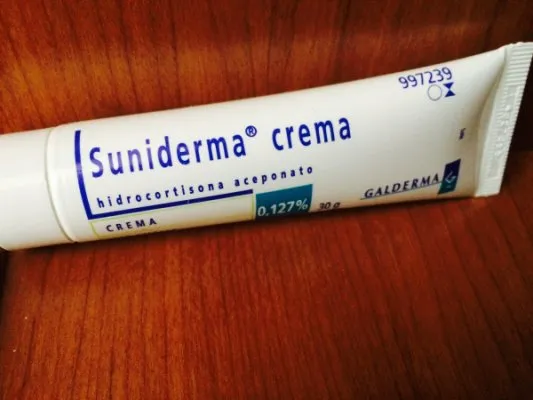
Table of Contents
- Patient Information Leaflet
- Introduction
- **Suniderma 1.27 mg/g cream**
- 1. What Suniderma cream is and what it is used for
- 2. What you need to know before using Suniderma cream
- 3. How to use Suniderma cream
- 4. Possible adverse effects
- 5. Storage of Suniderma cream
- 6. Contents of the pack and other information
Patient Information Leaflet
Introduction
Patient Information Leaflet
Suniderma 1.27 mg/g cream
Hydrocortisone aceponate
Read the entire leaflet carefully before you start using this medicine, because it contains important information for you.
- Keep this leaflet, as you may need to read it again.
- If you have any questions, ask your doctor or pharmacist.
- This medicine has been prescribed for you only, and you should not give it to others, even if they have the same symptoms as you, because it may harm them.
- If you experience any adverse effects, consult your doctor or pharmacist, even if they are effects not listed in this leaflet. See section 4.
Contents of the leaflet
- What Suniderma cream is and what it is used for
- What you need to know before using Suniderma cream
- How to use Suniderma cream
- Possible adverse effects
- How to store Suniderma cream
- Contents of the pack and other information
1. What Suniderma cream is and what it is used for
It contains the active substance hydrocortisone aceponate, which is a corticosteroid (anti-inflammatory) that, when applied to the skin, reduces redness, inflammation, and itching caused by certain skin conditions.
Suniderma cream is indicated for skin disorders (dermatoses) that respond to treatment with corticosteroids, such as various types of eczema: skin rash due to allergy or to substances that irritate the skin (allergic and irritant contact dermatitis), endogenous rash related to patient factors (atopic dermatitis), rash with inflammation and scaling (seborrheic dermatitis), itchy plaques on the skin caused by scratching (neurodermatitis), scaly reddish lesions often covered with silvery scales (psoriasis).
Suniderma, in this pharmaceutical form as a cream, is particularly suitable for acute and exudative (weeping) conditions.
2. What you need to know before using Suniderma cream
Do not use Suniderma cream
- If you are allergic to hydrocortisone aceponate or to any of the other ingredients of this medicine (listed in section 6).
- if you have a viral infection (e.g., herpes or chickenpox), bacterial or fungal infection (see section "Warnings and precautions")
- if you have symptoms of tuberculosis or syphilis on the skin
- if you have had a reaction at the application site after receiving any vaccine
- in ulcers
- if you have acne, rosacea (a red/rosy skin condition affecting the face), or perioral dermatitis (certain red pimples around the mouth).
Warnings and precautions
Talk to your doctor or pharmacist before using Suniderma cream.
- Anti-inflammatory drugs (corticosteroids), such as the active substance in this medicine, have significant effects on the body. Application over large areas of the body or for prolonged periods, especially under occlusive materials, significantly increases the risk of adverse effects.
- If hypersensitivity or intolerance to treatment occurs, you must stop using it and consult your doctor.
- Due to the possibility of corticosteroid absorption, treatment over extensive areas or under occlusion may lead to effects reported with oral corticosteroid use, for example, affecting glands located near the kidneys, resulting in symptoms such as obesity, growth retardation in children, etc. (Cushing's syndrome).
- If you develop an infection during treatment, such as fungal or bacterial infection, consult your doctor about your treatment; if the infection spreads, treatment must be stopped and appropriate therapy initiated.
- Do not apply in ocular therapy or in areas near the eyes. If treatment is on the face, take care to avoid contact of Suniderma with the eyes, and treatment should be as short as possible.
- Do not apply on open wounds.
- Do not apply on mucous membranes (e.g., nose or mouth).
- Occlusive treatment (e.g., with bandages) should not be performed unless directed and supervised by your doctor. Note that diapers as well as skin folds such as in the groin or armpits may create occlusive conditions.
- If you are being treated for psoriasis, strict medical supervision of your condition is recommended to monitor for possible worsening.
- Contact your doctor if you experience blurred vision or other visual disturbances.
- If you notice worsening of your condition while using this medicine, consult your doctor; you may be experiencing an allergic reaction, have an infection, or your condition may require different treatment. If your condition recurs shortly after stopping treatment, within the following 2 weeks, do not reuse the cream without consulting your doctor, unless your doctor has previously instructed you otherwise. If your condition has resolved and, in case of recurrence, redness spreads beyond the initial treatment area and you experience a burning sensation, consult a doctor before restarting treatment.
Children and adolescents
In children, corticosteroids are more likely to pass through the skin into the body and cause adverse effects in other parts of the body than in adult patients.
The use of corticosteroids in children should preferably be avoided, and special attention should be paid to occlusive conditions such as those caused by diapers.
Using Suniderma cream with other medicines
Tell your doctor or pharmacist if you are using, have recently used, or might need to use any other medicines.
Pregnancy, breastfeeding and fertility
If you are pregnant or breastfeeding, think you might be pregnant, or are planning to become pregnant, consult your doctor before using this medicine.
This medicine should not be used during pregnancy unless the benefit to the mother outweighs the potential risk to the fetus.
As a general rule, Suniderma cream should not be applied during the first trimester of pregnancy.
Pregnant women or women planning to become pregnant should avoid applying the cream over large areas of skin, for prolonged periods, or using occlusive dressings.
If you are breastfeeding, inform your doctor before using Suniderma cream. If you use it during breastfeeding, do not apply the cream on the breast area.
Driving and using machines
Treatment with Suniderma does not affect the ability to drive or operate machinery.
Suniderma cream contains cetyl alcohol
This medicine may cause local skin reactions (such as contact dermatitis) because it contains cetyl alcohol.
Suniderma cream contains 22 mg of benzyl alcohol per gram of cream.
Benzyl alcohol may cause allergic reactions and moderate local irritation.
3. How to use Suniderma cream
Follow exactly the instructions for use of this medicine as given by your doctor. If in doubt, consult your doctor or pharmacist again.
- Adults: Apply once or twice daily. Apply a thin layer of cream directly to the affected area, gently massaging until completely absorbed.
Do not exceed application more than twice a day. Increasing the number of daily applications may worsen adverse effects without improving the therapeutic efficacy of the medicine.
When improvement occurs, the frequency of application may be reduced.
If your doctor considers it necessary for chronic conditions to continue treatment beyond 2 weeks, treatment should be intermittent (e.g., once daily, twice weekly), under medical supervision.
Use in children
The recommended dosage is one application per day.
Prolonged continuous use in children should not exceed 1 week, and the smallest effective amount of the product should be used.
If the doctor considers prolonged use necessary, treatment-free intervals without steroid therapy should be introduced.
Occlusive dressings (such as diapers) must be avoided in young children when using this medicine.
For external use only.
Gently squeeze the tube and place a small sufficient amount onto the hands for the area to be treated. Apply the cream in a thin layer with gentle massage.
Wash hands thoroughly and tightly close the tube after use.
If you use more Suniderma cream than you should
If excessive amounts of Suniderma cream are applied (repeated overdose), adverse effects may occur (see section 4).
If the cream is used more frequently than recommended or over large areas of skin, it may be absorbed into the body and cause various disorders.
In cases of chronic toxicity, corticosteroids should be gradually withdrawn. Treatment of overdose is symptomatic. Acute symptoms due to excessive use of corticosteroids are generally reversible.
In case of overdose or accidental ingestion, contact your doctor or pharmacist immediately, go to a medical center, or call the Toxicology Information Service at: 91 562 04 20, indicating the medicine and the amount ingested.
If you forget to use Suniderma cream
Do not apply a double dose to make up for missed doses.
If you forget to apply the cream, apply the missed dose as soon as you remember, and then continue treatment as usual.
If you stop using Suniderma cream
If you have any further questions about the use of this medicine, ask your doctor or pharmacist.
4. Possible adverse effects
Like all medicines, this medicine may cause adverse effects, although not everybody experiences them.
The use of corticosteroids for prolonged periods and/or over large areas or under occlusive dressings or materials may cause adverse effects not only at the site of application but also in other parts of the body.
Possible adverse effects:
- Cutaneous atrophy (thinning of the skin)
- Skin striae (stretch marks)
- Skin fragility
- Acne
- Dilation of small superficial blood vessels beneath the skin (telangiectasias)
- Inflammation of hair follicles (folliculitis)
- Increased hair growth (hypertrichosis)
- Change in skin color
- Hypersensitivity reactions such as allergic contact dermatitis
- Easy bruising
- Redness/irritation
- Secondary infections, including fungal infections
- Development of certain red bumps around the mouth (perioral dermatitis) or elsewhere on the face (rosacea)
- Blurred vision (frequency “not known”)
Adverse effects affecting other parts of the body may include:
A condition characterized by a rounded face, obesity, fat accumulation in the neck area (Cushing's syndrome), delayed wound healing (such as sores and leg ulcers), glaucoma, cataracts, etc.
Steroid withdrawal reaction:
If you use this medicine continuously for prolonged periods, a steroid withdrawal reaction may occur when treatment is stopped, with some of the following symptoms: skin redness that may spread beyond the originally treated area, burning or stinging sensation, intense itching, skin peeling, open sores that ooze.
Reporting of adverse effects
If you experience any type of adverse effect, consult your doctor or pharmacist, even if it is a possible adverse effect not listed in this leaflet. You can also report them directly via the Spanish Pharmacovigilance System for Human Medicinal Products: https://www.notificaRAM.es. By reporting adverse effects, you can help provide more information on the safety of this medicine.
5. Storage of Suniderma cream
Do not store above 25°C.
Keep this medicine out of the sight and reach of children.
Do not use this medicine after the expiry date stated on the packaging after EXP. The expiry date refers to the last day of the month indicated.
Medicines should not be disposed of via wastewater or household waste. Dispose of unused containers and medicines at the SIGRE collection point at your pharmacy. If you are unsure, ask your pharmacist how to properly dispose of containers and unused medicines. This will help protect the environment.
6. Contents of the pack and other information
Composition of Suniderma cream
- The active substance is hydrocortisone acetonide. Each g of cream contains 1.27 mg of hydrocortisone acetonide (0.127%).
- The other components are: emulsifying wax, soft white paraffin, stearyl alcohol, benzyl alcohol, and purified water.
Appearance of the product and contents of the pack
Suniderma is a white cream.
It is available in tubes containing 30 g and 60 g.
Marketing Authorization Holder and Manufacturer
Marketing Authorization Holder:
Laboratoires Bailleul, S.A.
14-16 Avenue Pasteur
L-2310 Luxembourg
LUXEMBURG
Manufacturer:
Lichtenheldt GmbH Pharmazeutische Fabrik
Lichtenheldt GmbH – Werk I
Industriestrasse 7 – 11
23812 Wahlstedt
(Germany)
Date of latest review of this package leaflet: August 2023
Detailed and up-to-date information on this medicinal product is available on the website of the Spanish Agency of Medicines and Medical Devices (AEMPS) http://www.aemps.es